Choosing the right way to get paid comes down to a fundamental choice: do you stick with familiar fiat systems like Stripe, or do you embrace the control and lower costs of non-custodial Bitcoin solutions? The answer really hinges on what you value more—the established, traditional infrastructure or the sheer efficiency of direct, peer-to-peer payments.
Choosing Your Payment Processor: A Critical Business Decision
Picking a payment processor is one of the most important calls a modern business can make. It directly hits your cash flow, your operational costs, and how far your business can reach. For years, traditional fiat processors were the only game in town, but a new wave of decentralized Bitcoin payment solutions is seriously challenging that norm.
This guide is a deep-dive payment processor comparison. We're going to push past the surface-level fee charts and really dissect the core differences in transaction speed, security, and who actually controls your money.
Before we get into the weeds, it helps to have a solid grasp of the fundamentals of payment processing. Understanding these core concepts is the foundation for making a smart choice. By the end of this, you'll have a clear framework to decide if the familiarity of fiat or the efficiency of a non-custodial Bitcoin setup is the right fit for your business goals.
Why This Comparison Matters Now
The world of finance is at a crossroads. Traditional systems work, sure, but they come with built-in costs and headaches that merchants have just learned to live with. We're talking about multi-day settlement times, confusing fee structures, and the constant threat of chargebacks, which can yank a sale back up to 120 days after the fact.
Bitcoin, on the other hand, offers a completely different way of doing things. By letting customers pay you directly from their wallet to yours, it cuts out many of the middlemen who jack up costs and slow down your access to your own money.
The core distinction is one of custody and control. Fiat processors hold your money as an intermediary, whereas a non-custodial Bitcoin solution ensures funds move directly from your customer to your wallet, which you alone control.
Setting the Stage for Our Analysis
To do a real, meaningful comparison, we have to look past the brand names and get into the mechanics of how each system actually works. This guide will give you a side-by-side analysis based on the criteria that actually impact your bottom line.
Here’s what we'll cover:
- Core Operational Models: We'll break down how traditional fiat systems and non-custodial Bitcoin processors function on a technical level.
- A Detailed Comparison Framework: This is where we’ll stack them up on costs, settlement speed, custody, global reach, and the effort to get them integrated.
- Real-World Business Scenarios: We'll apply our findings to specific use cases—from eCommerce stores to subscription services—to give you clear, practical recommendations.
- Actionable Takeaways: We’ll wrap up with the key insights you need to make a confident, strategic decision.
Our goal here is to give you a balanced and practical analysis, so you can choose the payment infrastructure that not only serves your business today but also sets you up for the future.
To really compare payment processors, you first have to grasp that traditional fiat and non-custodial Bitcoin systems are built on completely different foundations. We’re not talking about two slightly different flavors of the same ice cream. This is a fundamental architectural split in how money gets from your customer to you.
Traditional processors like Stripe or PayPal are trusted middlemen. Think of them as the digital gatekeepers of a sprawling banking network. They manage a complex relay race of data and funds between your customer's bank, the big card networks like Visa or Mastercard, and, finally, your business bank account.
This whole setup is designed to give customers a familiar and seemingly secure checkout using their credit or debit cards. The processor takes on the messy parts: handling sensitive data, dealing with compliance like Know Your Customer (KYC), and absorbing the risk of fraud for the merchant.
The Role of the Intermediary
In the old-school model, the processor is smack in the middle of every single transaction. When a customer pays you, the money doesn't actually come directly to you. It first lands in the processor's system, where it’s held for verification, clearing, and eventual settlement. Their entire business model is built on being a custodian.
Now, this offers some conveniences, like built-in fraud detection and having one company to call when things go wrong. But it also adds layers of complexity and cost. Everyone in the chain—the issuing bank, the card network, the acquiring bank, and the processor—takes their slice. Those little slices add up to the final fee you pay.
The key takeaway with fiat processing is that you are trusting a third party with your revenue. This middleman controls the flow of your money, sets the settlement times, and has the power to hold, freeze, or even reverse your payments based on its own risk rules.
The Direct Path of Bitcoin Payments
In complete contrast, non-custodial Bitcoin processors like Flash run on a peer-to-peer model. They aren’t financial middlemen; they're more like a software tool that builds a direct bridge between your customer’s Bitcoin wallet and your own.
When a customer pays with Bitcoin using a non-custodial solution, the money is sent straight to a wallet that only you control. The processor's software is just there to create the payment request and confirm the transaction hit the Bitcoin network. It never, ever touches your money.
This approach completely cuts out the chain of financial intermediaries.
- No Custodial Risk: Since the payment processor never holds your money, you don't have to lose sleep over them freezing your account or holding up your payouts.
- Direct Settlement: Funds move directly from the customer's wallet to your wallet on the Bitcoin blockchain. There’s no third-party ledger in between.
- Simplified Compliance: Because the processor isn't a money handler, the heavy KYC and AML requirements tied to traditional financial services often don't apply for merchant onboarding.
This direct, non-custodial model completely changes the game. It shifts the power dynamic from relying on a trusted bank to using a secure software tool that gives you total control over your revenue from the second a sale is made. Understanding this architectural gulf is the first step in making a real payment processor comparison.
A Practical Comparison: Fiat vs. Bitcoin Payment Processors

To really figure out which payment processor is right for you, we have to look past the marketing fluff. It’s about understanding the core mechanics of how each model actually affects your business day-to-day. This framework is a straight-up, side-by-side look at the old guard—traditional fiat processors—versus new-school, non-custodial Bitcoin solutions.
The payment processing market is already massive and it’s not slowing down. Valued at $173.38 billion in 2025, it's expected to rocket to $914.91 billion by 2034. A big reason for this is that over 70% of consumers globally now prefer digital payments. This shift makes your choice of payment infrastructure more critical than ever.
Let's break down what truly matters for your bottom line.
Transaction Fees And Cost Structure
For almost any business, the first question is always about cost. Traditional processors, like Stripe or PayPal, typically take a slice of every sale—often around 2.9% + $0.30. This model means your costs go up right alongside your revenue. The more successful you are, the more you pay in fees.
Non-custodial Bitcoin processors work differently. They facilitate payments directly on the Bitcoin network, so your main cost is the network fee paid to miners. This fee depends on how busy the network is, not how much money you’re moving. This makes costs predictable and often much lower, especially if you have a high average order value.
The biggest difference is the pricing model. Fiat processors charge you a percentage of your own success. Bitcoin network fees are tied to network usage, which creates a more predictable and often cheaper structure for merchants.
Settlement Speed And Access to Funds
How fast do you get your money? This is a huge deal for cash flow. With traditional processors, settlement is a waiting game. Your funds are held for 2-3 business days (sometimes longer) for clearing before they land in your bank account.
That delay is just part of how the legacy banking system works. Bitcoin transactions, on the other hand, settle directly on the blockchain. Once a transaction gets a few confirmations, which usually takes minutes, the funds are yours. Final.
This near-instant settlement is a game-changer for cash flow. It gives you immediate control over your revenue without waiting for a middleman to release it.
Feature Comparison Traditional Fiat vs Bitcoin Processors
To make the differences crystal clear, let's put the core features side-by-side. This table breaks down the practical distinctions between relying on a traditional payment gateway versus a non-custodial Bitcoin solution.
| Feature | Traditional Fiat Processors (e.g., Stripe, PayPal) | Non-Custodial Bitcoin Processors (e.g., Flash) |
|---|---|---|
| Fees | Percentage-based (2.9% + $0.30 typical) | Based on network activity, not transaction value |
| Settlement Speed | 2-3 business days or more | Minutes |
| Custody | Custodial (they hold your money first) | Non-custodial (funds go directly to your wallet) |
| Chargebacks | Yes, a significant risk and cost for merchants | No, transactions are final and irreversible |
| KYC/Onboarding | Extensive KYC required, can be slow | Minimal to no KYC for merchants, fast setup |
| Global Reach | Limited by banking infrastructure and regional restrictions | Borderless, permissionless access to anyone with an internet connection |
| Control | Third-party can freeze or reverse funds | You have sole, immediate, and final control over your funds |
| Integration | Can be complex, often requiring developer resources | Often simple with low-code widgets, payment links, or POS apps |
As you can see, the choice isn't just about accepting a different currency; it's about adopting a fundamentally different approach to handling revenue, risk, and cash flow.
Custody And Control Over Your Revenue
This is where the two models really diverge. Traditional fiat processors are custodial by design. They hold your money in their accounts before sending it to you, giving them the power to freeze, hold, or even reverse payments if their risk algorithms get spooked.
A non-custodial Bitcoin processor like Flash, in contrast, never touches your money. It's simply a software layer that connects your customer's wallet directly to your own.
Here’s the breakdown:
- Traditional Processors: Your money is held by an intermediary. You’re trusting them to manage and release your revenue based on their rules.
- Non-Custodial Bitcoin Processors: Funds move straight from the buyer's wallet to yours. You have immediate, complete, and sole control over your money.
This is a critical distinction for any business owner who values financial sovereignty and wants to cut out counterparty risk. When making your choice, it’s also vital to ensure any processor follows robust website security best practices to protect financial data.
Global Reach and Market Access
Traditional payment processors are stuck within the confines of the global banking system. Trying to accept payments from customers in countries with less-developed financial infrastructure can be a nightmare, if not impossible. This creates "banking deserts" where you can't reach willing customers.
Bitcoin is different. It’s a borderless, permissionless network that operates outside of any single country's banking system. This means you can accept payments from anyone, anywhere in the world, as long as they have an internet connection. It unlocks entire markets that were previously off-limits.
Integration Effort and Onboarding
Getting started can be either a breeze or a slog. Traditional processors often demand a mountain of paperwork—business licenses, bank statements—as part of their mandatory KYC/AML compliance. A full integration might mean tying up your developers with complex APIs.
Non-custodial Bitcoin solutions are usually built for simplicity. Because they don't hold funds, the heavy KYC requirements for merchants often disappear. Integration can be as easy as embedding a low-code widget, generating a payment link, or using a POS app. This lets you start accepting Bitcoin in minutes, not weeks, dramatically lowering the barrier for entry.
Real-World Scenarios: Which Processor Wins for Your Business?
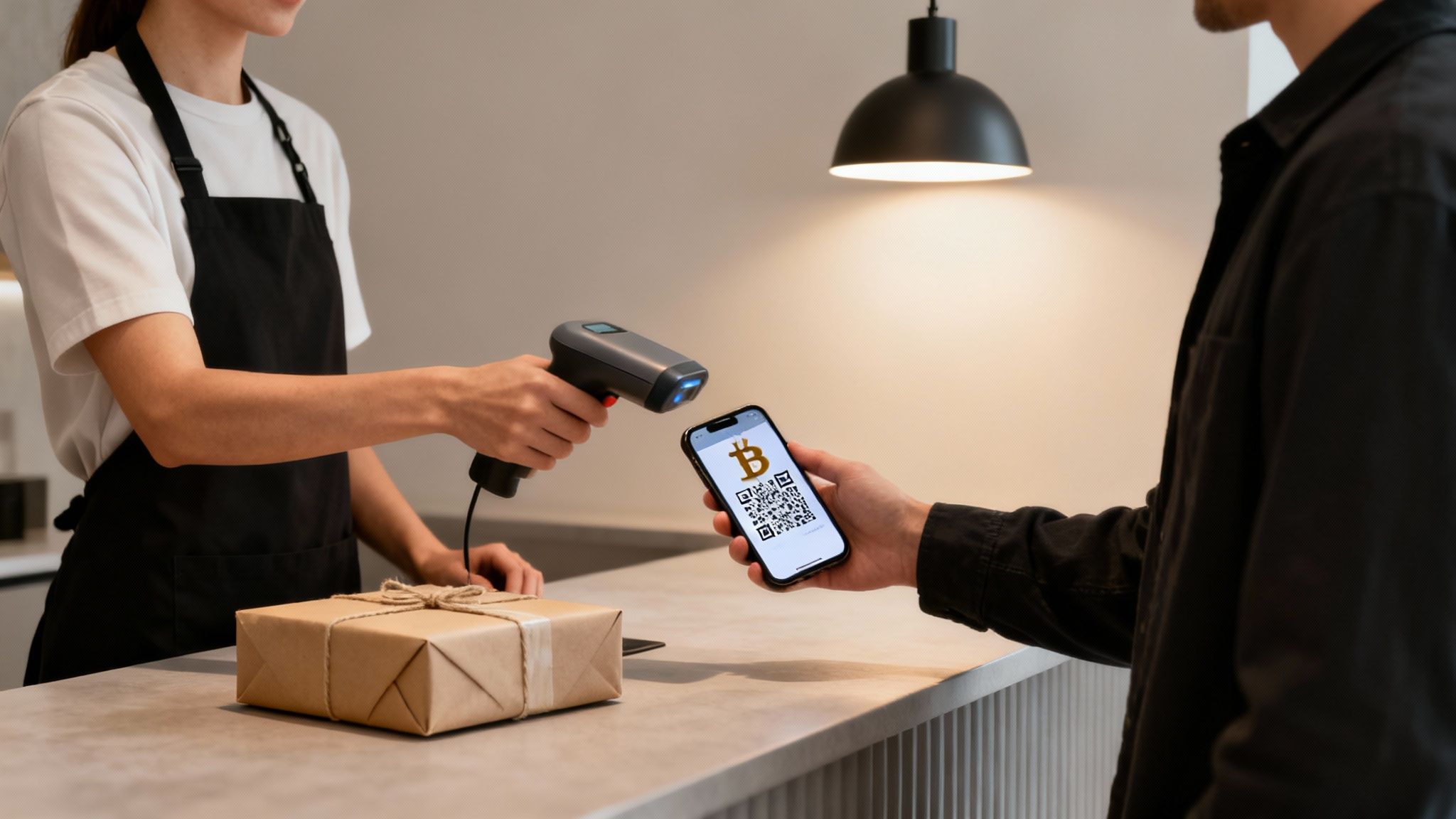
Moving past the technical specs is where a payment processor comparison really comes to life. There's rarely a single "best" solution. Instead, the right choice is a strategic one that hinges on your business model, who your customers are, and what you prioritize operationally.
By digging into a few real-world examples, we can see exactly where traditional processors still make sense and where non-custodial Bitcoin solutions offer a killer advantage. This is about finding the right fit for your specific needs, not just picking the most popular name.
The Global eCommerce Store
Picture a digital shop selling handmade goods to a worldwide audience. The biggest headaches are managing cross-border payments, seeing thin margins get eaten by high fees, and dealing with the constant threat of fraudulent chargebacks from customers you’ve never met.
For this kind of merchant, a non-custodial Bitcoin processor like Flash can be a game-changer. Bitcoin transactions are borderless. A customer in Japan can pay just as easily as someone in Texas, with zero currency conversion drama or international banking headaches.
More importantly, Bitcoin payments are final. Once they're sent, they can't be reversed, which completely wipes out the risk of chargebacks. This is a massive win for any business selling high-value or digital items globally, protecting revenue that could otherwise be clawed back weeks or even months later.
SaaS and Subscription Businesses
Subscription-based companies—think SaaS platforms or monthly membership sites—live and die by predictable, recurring revenue. Their biggest payment problems are involuntary churn from expired credit cards and the slow, steady bleed from percentage-based fees on every single renewal.
Traditional fiat processors have owned this space for years with their automated recurring billing systems. But they still take their cut, often 2.9% + $0.30, from every single payment. Across thousands of users, that adds up fast.
This is where a hybrid approach shines. While fiat serves the mainstream user, offering automated Bitcoin payments via a tool like Flash gives you a powerful alternative. It lets customers who prefer self-sovereign money pay directly from their wallets, often with lower, more predictable fees for your business. You diversify your options and cut your overall processing costs.
For subscription models, the key is balancing user convenience with long-term cost efficiency. While fiat's auto-billing is established, Bitcoin offers a lower-cost, no-churn alternative for a growing segment of tech-savvy customers.
Digital Content Creators and Micropayments
Imagine a blogger, podcaster, or streamer who wants to accept small, one-time tips or sell individual articles for a buck or two. For these creators, traditional payment processors are often a complete non-starter.
That fixed $0.30 fee from most fiat processors can demolish a small transaction. A $1.00 payment could lose 33% to fees before the percentage cut is even taken. It makes micropayments totally unworkable and forces creators into clunky models like ads or platform subscriptions.
Bitcoin completely flips this script. Because network fees aren't tied to the transaction amount, it becomes practical to accept tiny payments from anyone in the world. A non-custodial solution enables a direct value-for-value exchange, allowing fans to support creators instantly with any amount and minimal cost. It unlocks a revenue stream that was previously impossible.
International Non-Profits and Charities
Non-profits that work globally face huge hurdles with traditional banking. Donations get stuck in intermediary banks, get hit with high currency conversion fees, and face delays that can stop aid from reaching people who desperately need it. Donors also worry about transparency, wanting to know their money is being used effectively.
Accepting donations directly via a non-custodial Bitcoin wallet solves these issues head-on.
- Borderless Donations: Anyone, anywhere can donate without needing permission from a bank or government.
- Lower Overhead: More of every dollar goes to the actual cause instead of getting lost in banking and processing fees.
- Enhanced Transparency: The public nature of the Bitcoin ledger can give donors a clear view of how funds are being moved, building trust.
This model gives non-profits a resilient and efficient way to receive support from a global base, bypassing the friction and cost baked into the legacy financial system.
While the convenience of established platforms is undeniable, their market dominance often comes with entrenched fee structures. For instance, in January 2025, PayPal commanded a massive 45% of the online payment processing market globally, more than Stripe and Shopify combined. You can find more details about these market dynamics in the full analysis from Statista's global payment platform research. This highlights the trade-off businesses make between accessing a huge user base and optimizing for lower costs and greater control.
Making an Informed Decision: Key Takeaways for Merchants

After breaking down all the details, the choice in payment processors comes down to a simple reality: there's no single "best" option. It's a strategic decision that pivots entirely on your business model, your customers, and what you value most. The real verdict is a balancing act between operational control and customer familiarity, between cost savings and leaning on established infrastructure.
If your priority is a conventional checkout experience for a mainstream audience, traditional fiat processors are still a solid, reliable choice. Their systems are familiar, deeply embedded in the global financial world, and carry a level of trust that many customers simply expect.
Of course, that convenience comes with trade-offs. You're signing up for percentage-based fees that grow right alongside your revenue, settlement delays that can tie up your cash for days, and the constant threat of chargebacks that can claw back sales weeks or even months down the line.
Sovereignty and Efficiency Through Bitcoin
For merchants who want to maximize every dollar and maintain absolute control over their revenue, a non-custodial Bitcoin solution like Flash is more than just an alternative—it's a forward-thinking move. By enabling direct wallet-to-wallet transactions, it completely rewrites the rules of the game for merchants.
The advantages are hard to ignore:
- Drastically Lower Costs: Fees are tied to network activity, not a percentage slice of your revenue. This can mean massive savings, especially on larger ticket items.
- Zero Chargebacks: Bitcoin transactions are final. This completely removes the financial risk and administrative nightmare of chargeback fraud.
- Instant Settlement: Money hits your wallet in minutes, not days. Your cash flow is immediate and accessible.
- Total Control: Because the processor never touches your money, you eliminate the risk of frozen accounts or withheld funds. You're always in control of what you've earned.
The global payments market is exploding. Projections show it rocketing to $122.08 billion by 2031, with 75% of adults expected to use digital payments. This isn't just growth; it's a fundamental shift that demands merchants find solutions that are both cost-effective and resilient. You can dig deeper into the future of the payment processor market to see where things are headed.
A Hybrid Strategy for Maximum Reach
Perhaps the smartest strategy for many businesses isn't picking one side. It's adopting a "both/and" approach. Offering both traditional fiat and non-custodial Bitcoin payments creates a powerful hybrid model that expands your market reach and strengthens your operations.
By accommodating both payment types, you cater to the established habits of mainstream customers while also capturing the growing global market of Bitcoin users who prioritize privacy, speed, and financial self-sovereignty.
This dual approach lets you leverage the best of both worlds. Use the familiar fiat options for those who prefer them, but tap into the superior efficiency of Bitcoin to slash costs, open up new international markets, and bulletproof your revenue against fraud. Ultimately, this kind of flexibility positions your business to thrive by meeting customers exactly where they are, on their own terms.
Your Top Questions, Answered
When you're comparing old-school payment systems with new Bitcoin solutions, a few key questions always come up. Let's tackle the most common concerns merchants have so you can make a decision with real confidence. Getting clear on these points is essential for any serious payment processor comparison.
Is It a Headache to Integrate Bitcoin Payments?
There's a persistent myth that adding Bitcoin payments is some complex, developer-only task. The reality is that modern, non-custodial solutions are built from the ground up to be simple. Many offer low-code widgets, ready-to-use payment links, and intuitive point-of-sale (POS) apps that you can get running in minutes, not weeks.
Honestly, it's often faster and involves less technical hassle than the clunky API integrations required by many traditional processors. Plus, because there's no mandatory Know Your Customer (KYC) process for merchants, you can skip the lengthy onboarding and start accepting payments almost immediately.
What Are the Real Security Differences?
The security models for fiat and Bitcoin processors are worlds apart, and this is a crucial distinction. Traditional processors are centralized gatekeepers. They hold your money, making them a giant, tempting target for hackers and data breaches.
Worse, they expose you to the constant threat of chargeback fraud, where a customer can reverse a payment long after you've delivered the goods or services. This is a massive headache for merchants, leading to unpredictable cash flow and endless administrative work.
On the other hand, non-custodial Bitcoin processors like Flash simply facilitate a direct wallet-to-wallet payment. We never hold your funds. This model completely sidesteps custodial risk and makes chargeback fraud impossible, since Bitcoin transactions are final.
This does shift the responsibility to you—the merchant—to secure your own Bitcoin wallet. But the payoff is huge: you gain full, sovereign control over your money without needing a third party to protect you from fraudulent reversals.
Can My Business Take Bitcoin Without Worrying About Price Swings?
Yes, absolutely. This is a valid concern, but it's one with a straightforward solution. Just because a non-custodial solution means you receive Bitcoin doesn't mean you have to hold it and ride the market waves.
Many merchants use third-party services that automatically and instantly convert incoming Bitcoin payments into a stable currency like the US Dollar. The whole process runs quietly in the background, locking in the value at the exact moment of the transaction.
This gives you the best of both worlds. You get all the benefits of accepting Bitcoin—like tiny transaction fees, zero chargebacks, and a global customer base—without exposing your business to price volatility. Your accounting stays clean, your revenue is stable, and you get to use a far more efficient payment rail. It's a practical strategy that makes Bitcoin a viable option for any business.
Ready to eliminate chargebacks, slash fees, and take full control of your revenue? Flash provides simple, non-custodial Bitcoin payment tools that let you start accepting payments in minutes. Explore our solutions and see how easy it is to upgrade your business.