Peer-to-peer payment platforms are exactly what they sound like: digital services that let you send money directly to someone else through an app or website. They neatly sidestep the traditional banking system, offering a modern, much-needed alternative to cash, checks, and those painfully slow bank transfers.
This shift has completely changed how we think about exchanging money.
The Evolution of Peer to Peer Payment Platforms

Remember the jump from sending physical mail to sending an email? One involved stamps, post offices, and days of waiting. The other arrives instantly, right in the recipient's inbox. The move from old-school banking to peer-to-peer payment platforms is a similar leap forward in speed and simplicity.
Instead of wrestling with the clunky, multi-day process of a conventional bank wire, these platforms let you send funds almost instantaneously. At its heart, a P2P payment is a simple idea: moving value directly from one person to another without a bank getting in the way at every turn.
Let's quickly compare the old and new worlds to see just how different they are.
Traditional vs. Peer to Peer Payments at a Glance
| Feature | Traditional Bank Transfers | Peer to Peer Platforms |
|---|---|---|
| Speed | 1-5 business days | Instant or near-instant |
| Accessibility | Bank hours, online portal | 24/7 via smartphone app |
| Intermediaries | Multiple banks, clearinghouses | Platform operator or none (decentralized) |
| Cost | Often includes fixed fees | Free or low percentage-based fees |
| Use Case | Formal payments, large sums | Splitting bills, paying friends, small business |
This table makes it clear why P2P has caught on so quickly. The convenience is just on another level.
A New Standard for Transactions
This model has rocketed from a niche tech curiosity to a mainstream financial tool. The simple act of splitting a dinner bill, paying a vendor at a farmer's market, or sending a few bucks to family has fueled its explosive growth. This isn't just a fad; it's a fundamental change in what we expect from our financial services.
The market’s incredible growth tells the whole story. The global P2P payments market was valued at around $2,244.95 billion in 2021 and is on track to nearly double to $4,300.9 billion by 2025. This massive expansion shows just how essential these platforms have become in our day-to-day lives. You can find more details on P2P payments market growth in recent industry reports.
A P2P transaction is the digital equivalent of handing cash to a friend. It removes unnecessary steps, delays, and fees, making the exchange of value as simple and direct as it should be.
Centralized vs Decentralized Models
As P2P platforms grew, two different flavors emerged.
First, you have the centralized model. This is where a company like Venmo or Cash App runs the service, connects to user bank accounts, and acts as the facilitator for the transfer. While they're super convenient, they still put an intermediary back into the picture.
The second, and far more disruptive, model is decentralized. Built on technology like Bitcoin, these platforms allow transactions to happen directly between users' digital wallets on a public ledger. This approach kicks the company out of the middle entirely, creating a true peer-to-peer exchange with no central point of control or failure.
Understanding this difference is key as we dive deeper into how these platforms are reshaping personal finance and giving people more control over their money.
How P2P Payment Platforms Actually Work
At their core, peer-to-peer payment platforms act like digital go-betweens, but the way they shuffle your money around behind the scenes is what really matters. For you, the process always kicks off the same way: you link a funding source, like your bank account or debit card, to an app on your phone.
From that point on, your money can take one of two very different routes. Grasping the difference between these models is the key to picking the right tool for the job.
The Centralized Custodial Model
Most of the big-name payment apps you know run on a centralized, or custodial, model. Picture the platform as a digital bank teller. When you "send" money to your friend, you're not actually handing it over to them directly.
Instead, you’re really just telling the company to move the funds for you. They pull the money from your account, hold it for a moment in their own system, and then credit your friend’s account within that same walled garden. It's usually quick and feels seamless, but there's a big trade-off: you're placing all your trust in a third party to manage the entire show. They hold the keys to the kingdom and have the final say on whether your money moves.
The Decentralized Non-Custodial Model
The other path is a decentralized and non-custodial one, powered by technology like Bitcoin. This approach boots the middleman out of the picture entirely. A transaction here isn't an instruction to a company; it's more like a direct digital handshake between you and the other person.
This system is built on a few simple but powerful components:
- Public Ledger: Think of it as a massive, transparent notebook shared across a global network of computers. Every single Bitcoin transaction is carved into this ledger for anyone to see, which keeps things honest and foils attempts at fraud.
- Private Keys: This is your secret password to your personal digital vault. Only you have it, and it's what you use to give the green light for sending Bitcoin from your wallet. It puts you in the driver's seat.
- Bitcoin Wallet: Your wallet is simply the software that stores your private keys and lets you talk to the Bitcoin network. It's your personal gateway for sending and receiving money without asking for permission.
When you send Bitcoin, you use your private key to "sign" the transaction, which then gets broadcast to that public ledger. The funds zip directly from your wallet to the recipient's, never once touching a company's bank account.
With a decentralized system like Bitcoin, you are your own bank. You have full sovereignty over your money, and no central authority can freeze your account or block a transaction. This is the essence of true peer-to-peer exchange.
This is the model that platforms like Flash are built on. It flips the script, shifting control from a central company right back to the individual user. It’s a fundamentally different—and for many, a more empowering—way to think about money.
Exploring Centralized vs Decentralized P2P Systems
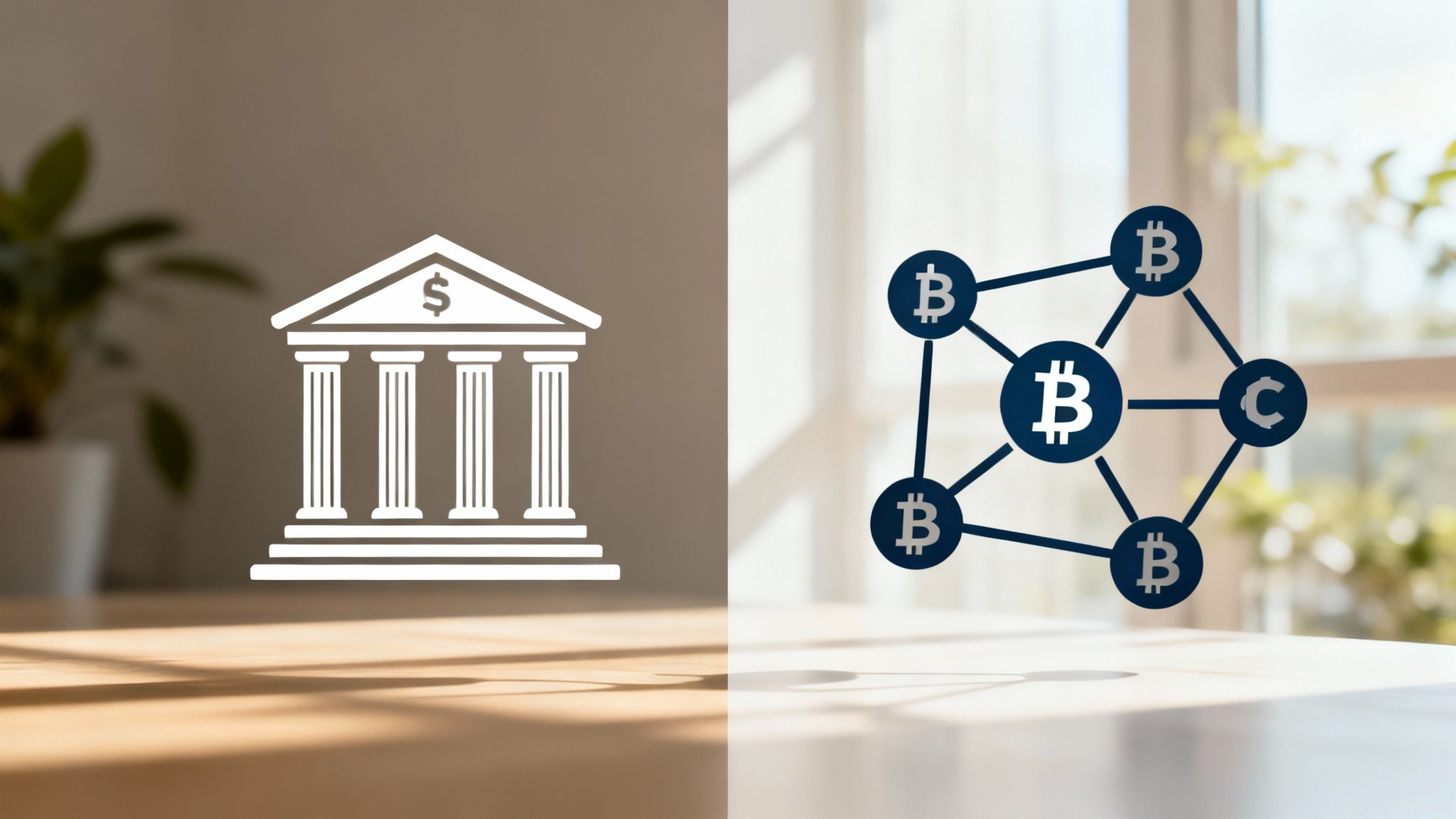
When you're picking a peer to peer payment platform, you’re really making a choice between two completely different philosophies: centralized and decentralized. One is basically a slick, modern version of a traditional bank, while the other is a whole new way to think about and control your money. Getting a handle on what each one offers—and what it costs you—is key to finding the right fit for your needs.
The Familiar World of Centralized Platforms
Centralized platforms are the ones you already know and probably use. Think of the big names that make it dead simple to split a dinner bill or pay your friend back for concert tickets. They’re popular for a reason: they are incredibly easy to use and have built a lot of trust through their recognizable brands.
But that convenience has strings attached.
These services all rely on a company acting as the middleman, processing every single transaction you make. This means your money and your personal data flow through their servers. Because of this, they hold all the cards—they can freeze your account, reverse a payment, or hand over your financial history if asked. Your money isn't truly yours to control, and your privacy is never guaranteed.
The Freedom of Decentralized Alternatives
This is where decentralized P2P systems, built on networks like Bitcoin, flip the script entirely. They get rid of the middleman. Instead of a corporation controlling everything, payments happen directly between two people, recorded on a public ledger that nobody owns. This structure puts you back in the driver's seat.
This approach comes with some game-changing benefits:
- Censorship Resistance: There is no central authority that can block or freeze your transactions. If you hold the keys to your wallet, you—and only you—have the final say.
- User Sovereignty: You are your own bank. Your funds are secured in your personal wallet, not sitting in a company's bank account waiting for their permission to be used.
- Enhanced Privacy: Transactions are pseudonymous. While they’re visible on a public ledger, they aren’t tied to your real-world identity unless you decide to link them.
- Cheaper Cross-Border Payments: Sending money across the globe with Bitcoin can be dramatically cheaper than old-school wire transfers because it sidesteps the messy web of intermediary banks.
The core difference is simple: centralized systems ask you to trust a company, while decentralized systems like Bitcoin ask you to trust open-source code and mathematics. This shift from trusting people to trusting protocols is what empowers users with true financial sovereignty.
Feature Comparison Centralized vs. Decentralized P2P
To really see the difference, it helps to put the two models head-to-head. The table below breaks down the key trade-offs you make when choosing between a traditional app and a decentralized one.
| Feature | Centralized Platforms | Decentralized Platforms (e.g., Bitcoin-based) |
|---|---|---|
| Control Over Funds | Company holds custody of funds in transit or on platform balance. | User maintains 100% self-custody of funds in a personal wallet. |
| Censorship | Transactions can be blocked, frozen, or reversed by the platform. | Transactions are immutable and cannot be censored or reversed. |
| Privacy | User data is collected, stored, and may be shared with third parties. | No personal data is required; transactions are pseudonymous. |
| Global Access | Often restricted by country and local banking regulations. | Borderless network accessible to anyone with an internet connection. |
| Intermediary | The platform acts as a trusted third party for all transactions. | No intermediary; transactions are validated by a distributed network. |
Ultimately, centralized platforms offer convenience managed by a third party, while decentralized systems provide true peer-to-peer freedom. For anyone who puts a premium on control, privacy, and borderless finance, decentralized peer to peer payment platforms are the clear way forward, sketching out the blueprint for a more open and equitable financial future.
The Key Benefits of Using Bitcoin for P2P Payments
While a lot of peer-to-peer payment apps are convenient, one built on Bitcoin brings a whole different set of advantages to the table. These benefits aren't just about sending money—they fundamentally change your relationship with your finances. We're talking true global access, lower costs, and a level of user control that traditional systems just can't match.
Anyone who's ever had to send money across a border feels the difference immediately. Traditional wire transfers are painfully slow and expensive, getting bogged down as multiple banks each take their cut along the way. Bitcoin transactions, on the other hand, live on a global, borderless network. This means you can send value from one country to another with way lower fees, completely sidestepping the old, clunky financial system.
True Financial Autonomy
The single biggest advantage of using Bitcoin for P2P payments is user autonomy. With the apps you're used to, the company always has the final say. In a decentralized system, you are your own bank. Your funds sit in a personal wallet that only you can access with your private keys.
This setup delivers a few game-changing perks:
- Final Settlement: Once a Bitcoin transaction is confirmed on the network, it’s done. It can't be reversed or charged back, which gets rid of a huge risk for merchants and freelancers who take digital payments.
- Permissionless Access: Anyone with an internet connection can use the Bitcoin network. There are no gatekeepers, no applications to fill out, and nobody to ask for permission. This opens up financial access to people all over the world.
Bitcoin gives you a system where your right to send and receive money is guaranteed by math, not by some corporation's terms of service. It's a powerful shift toward real financial sovereignty for the individual.
This new way of exchanging value directly and without permission is turning a lot of heads. The global P2P payment market was valued at USD 3.07 trillion in 2024 and is expected to rocket to USD 16.21 trillion by 2034. That kind of growth shows a massive consumer appetite for better financial tools. You can discover more insights about this explosive market growth and what's driving it.
This rapid expansion points to one clear trend: people are actively looking for better ways to manage and move their money. Bitcoin-native peer to peer payment platforms are in the perfect spot to meet this demand, offering a stronger, more secure, and more empowering option for everyone, everywhere.
Real-World Use Cases for P2P Bitcoin Payments
The theory behind decentralized peer to peer payment platforms is great, but where the rubber really meets the road is in everyday life. These tools are solving real problems that go way beyond just splitting a dinner bill. For people all over the world, they’re creating brand new economic opportunities.
Let's dive into a few mini-stories to see how Bitcoin-based payments are making a tangible difference.
Empowering the Global Freelancer
Picture a graphic designer in Southeast Asia who just wrapped up a big project for a client in Europe. In the old system, getting paid was a slow-motion nightmare. We're talking wire transfers, painful conversion fees, and week-long delays. The freelancer could easily lose 5-10% of their hard-earned cash just to middlemen.
With a Bitcoin P2P platform, the client sends the payment directly, wallet to wallet. The funds land in minutes, not days, and the transaction fee is a tiny fraction of what a bank would skim off the top. This isn't just a minor convenience—it's a lifeline that makes it viable for talent everywhere to compete in the global economy.
Connecting Families Across Borders
Now think about a family with a parent working abroad to support relatives back home. Every month, they send a chunk of their earnings—a remittance—to cover essentials like school fees and groceries. Traditional remittance services are notorious for charging outrageous fees that eat into the money the family desperately needs.
By using a Bitcoin P2P app, they can send funds directly and almost instantly. This ensures that virtually every dollar arrives where it's supposed to, maximizing the impact of their hard work. It’s a far more efficient and compassionate way to support loved ones, no matter the distance.
This is all part of a much bigger shift toward direct, peer-to-peer finance. The global P2P lending market, for instance, hit a value of USD 139.8 billion in 2024 and is projected to explode to USD 1,380.8 billion by 2034. This kind of growth signals a clear demand for financial tools that cut out the gatekeepers and serve people directly. You can learn more about this shift toward financial inclusion and what's driving it.
In a decentralized P2P system, your economic relationships are no longer defined by geography or access to traditional banking. They are defined only by your connection to the internet.
These examples show that Bitcoin P2P platforms aren't just some technical curiosity. They are practical, powerful tools for financial inclusion and empowerment, available today.
The Future Is Decentralized: Your Gateway to Financial Sovereignty
As we've journeyed through the world of peer-to-peer payment platforms, a clear pattern emerges. The centralized apps we use every day offer a certain level of convenience, sure, but they all operate within the same old financial sandbox. They’re just middlemen with a modern interface, still holding the ultimate control over your funds and your data.
Think of it this way: they’ve put a fresh coat of paint on a very old house, but the foundation hasn't changed.
The real leap forward isn't a better-looking app; it's getting rid of the middleman altogether. Systems built on Bitcoin do exactly that. They create a direct, unshakeable financial link between two people, no trusted third party required. This isn't just a nerdy technical detail—it’s a fundamental shift toward an economy that's more open, fair, and accessible to everyone, where your postcode and the whims of a gatekeeper don't decide if you can participate.
Embracing True P2P with Flash
This is the very idea that fuels Flash. We’re built on the core principle that a genuine peer-to-peer exchange shouldn't need anyone standing in between. By tapping into the raw power and security of the Bitcoin network, Flash gives you the tools to send and receive value directly, wallet-to-wallet, without ever handing over control of your money.
With Flash, you get to experience payments as they were always meant to be:
- Direct: Your money moves straight from your wallet to theirs. Period.
- Global: A transaction can cross the globe as easily as you send an email.
- Low-Cost: Fees are just a tiny fraction of what old-school systems skim off the top.
- Sovereign: It’s your money. You, and only you, are in control.
Moving to a decentralized P2P platform is more than just downloading a new app. It's a conscious choice to take back your financial autonomy and join a network built from the ground up on transparency and individual empowerment.
This is your invitation to financial sovereignty. When you explore tools like Flash, you aren't just trying out new tech. You're becoming part of a movement to build a more direct and equitable financial future for everyone, one transaction at a time.
Got Questions About P2P Payments?
Moving from the payment apps you know to something decentralized like Bitcoin naturally brings up a few questions. That's totally normal. Getting comfortable with how it all works is the first step to taking real control over your money.
Let's walk through some of the most common things people ask.
Are Bitcoin P2P Payments Actually Secure?
Yes, and in a way that’s fundamentally different from traditional apps. The cryptography behind the Bitcoin network itself is incredibly robust. But the real game-changer is that when you use a non-custodial wallet, you are the only one with the keys to your funds.
This means you’re the only person who can approve a transaction. There's no central company that can get hacked, freeze your account, or lose your money.
The core idea behind decentralized security is simple: your keys, your Bitcoin. You are in complete control, and the safety of your funds is in your hands, not some third party's.
It's a big shift in thinking, putting you back in the driver's seat.
How Long Does It Take to Send a Bitcoin P2P Payment?
While a standard Bitcoin transaction can be sent instantly, getting it confirmed on the main network can take a bit of time. But that’s not the whole story.
This is where clever solutions built on top of Bitcoin, like the Lightning Network, come into play. Lightning is designed for one thing: speed. It allows for instant, nearly free transactions, making it perfect for the kind of everyday P2P payments you’d make for buying a coffee or splitting a dinner bill with a friend.
Is It Hard to Get Started with Bitcoin for P2P Payments?
Not anymore. The days of needing a computer science degree to use Bitcoin are long gone. Modern Bitcoin wallets and platforms have come a massive way, with many designed to feel as clean and simple as any mainstream payment app you've used.
Getting up and running is pretty straightforward:
- Download a Wallet: Grab a user-friendly, non-custodial wallet for your phone.
- Get Some Bitcoin: You can acquire a small amount from a reputable exchange or service.
- Send and Receive: To pay someone, you just scan their QR code or paste their address. It's that simple.
The learning curve is surprisingly gentle. It's easier than ever to dive in and start exploring what a truly decentralized peer to peer payment platform can do for you.
Ready to experience direct, wallet-to-wallet payments without the middlemen? Flash gives you the tools to send and receive Bitcoin instantly. Discover what financial sovereignty feels like today at .