Bitcoin fraud is on the rise, with billions lost to theft and scams annually. Traditional fraud detection methods are too slow to keep up with the rapid pace of blockchain transactions. Real-time analytics offers a faster, smarter solution by analyzing transactions as they happen, identifying suspicious patterns in milliseconds, and preventing funds from being stolen.
Key takeaways from this article:
- Major Bitcoin fraud types: Private key theft, money laundering, phishing, ransomware, and flash loan attacks.
- Real-time analytics benefits: Detects fraud in under 100 milliseconds, ensuring faster responses compared to outdated methods.
- How it works: Machine learning and graph-based models monitor transaction patterns, flagging risks before funds are lost.
- Advanced tools: Behavioral biometrics, graph neural networks, and risk scoring help uncover complex schemes like multi-hop laundering.
- Business integration: Fraud detection APIs connect directly to payment systems, enabling instant decisions to block or flag risky transactions.
With Bitcoin fraud projected to grow, real-time analytics is becoming essential for securing transactions and meeting regulatory requirements.
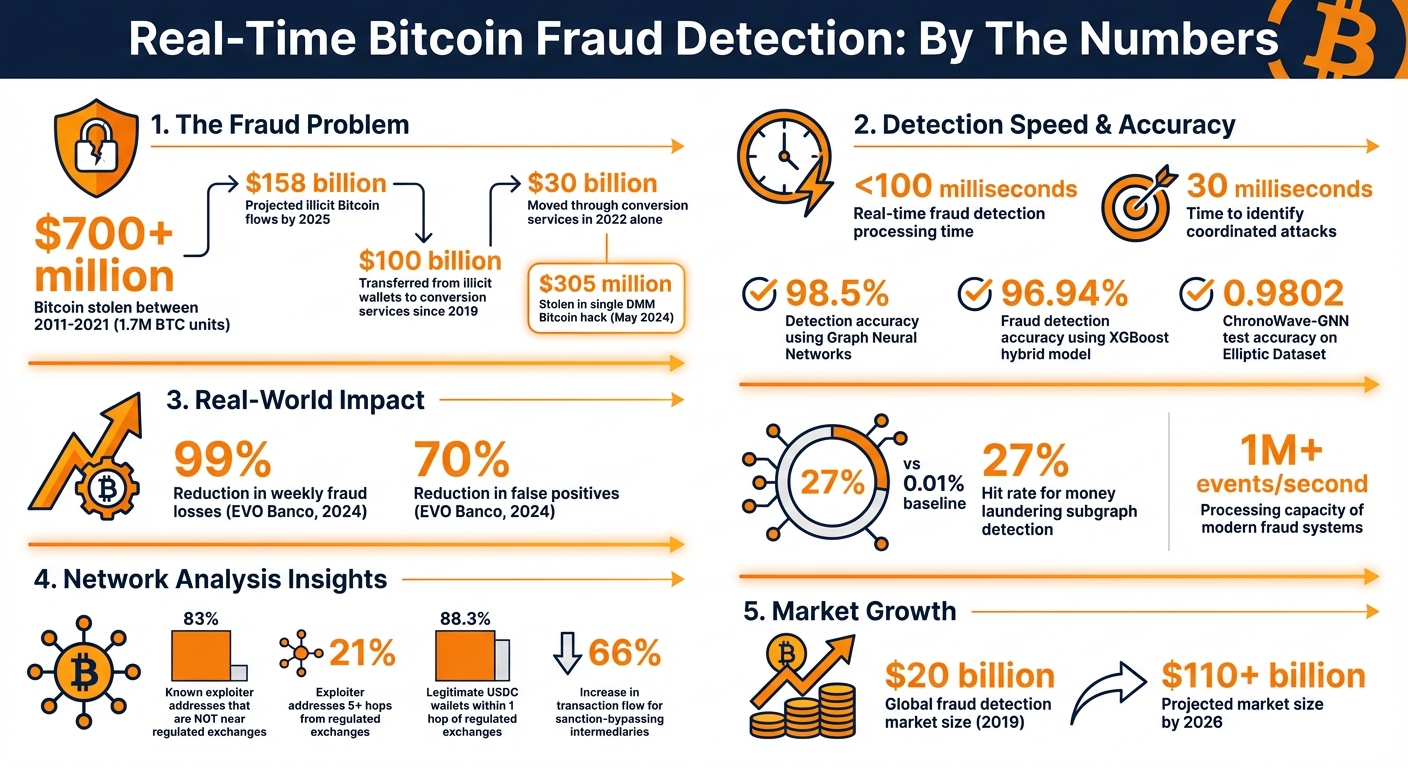
Real-Time Bitcoin Fraud Detection: Key Statistics and Performance Metrics
Scaling Blockchain ML With Databricks: From Graph Analytics to Graph Machine Learning

How Real-Time Analytics Detect Bitcoin Fraud
Real-time fraud detection leverages machine learning and graph analytics to spot suspicious Bitcoin transactions as they happen. By processing data instantly, these systems can block fraudulent activity before funds leave a wallet. This approach analyzes patterns across millions of transactions, enabling the detection of threats with remarkable speed and precision.
The technology models Bitcoin transactions as nodes in a graph, with edges representing the flow of funds between wallets. Tools like Graph Neural Networks (GNNs) and Graph Convolutional Networks (GCNs) excel at uncovering coordinated fraud schemes by analyzing these relationships. These methods have achieved detection accuracy rates as high as 98.5%.
Frameworks like ChronoWave-GNN take this a step further by using wavelet transforms to analyze transaction patterns across different time scales. This technique helps differentiate between rapid bursts of activity - common in mixing services - and slower, methodical strategies like money laundering. This time-frequency analysis sharpens the detection of illicit behaviors, as highlighted in Nature:
"Money laundering activities often appear as rapid bursts of mixer operations intertwined with slow, low-frequency layering strategies, spanning multiple temporal scales."
ChronoWave-GNN demonstrated its effectiveness with a test accuracy of 0.9802 and an F1-score of 0.9799 on the Elliptic Bitcoin Dataset. By focusing on these nuanced patterns, it identifies nonstationary illicit behavior that traditional methods might miss.
Machine Learning and Anomaly Detection
Machine learning is the backbone of real-time fraud detection, building on insights from graph analytics. Supervised models like XGBoost, Random Forest, and Support Vector Machines classify transactions as legitimate or fraudulent based on historical data and known fraud patterns. For instance, a hybrid deep learning framework using XGBoost achieved a fraud detection accuracy of 96.94%.
Unsupervised techniques, on the other hand, are vital for spotting new fraud tactics without relying on predefined labels. As Joshua Uzezi Umavezi explains in the All Finance Journal:
"Traditional rule-based fraud detection systems... are increasingly insufficient in environments where adversaries continuously adapt techniques to bypass established controls."
Real-time systems also monitor key indicators of suspicious activity. Machine learning models adapt through continuous retraining, ensuring they stay effective even as fraud tactics evolve. Adaptive feedback loops address "concept drift", while ensemble methods like Random Forest and Gradient Boosting excel in high-volume networks where only a small fraction of transactions are fraudulent.
Behavioral Biometrics for Fraud Detection
In addition to transaction analytics, behavioral biometrics enhance fraud detection by analyzing user interactions in real time. These systems track device fingerprints - such as browser settings, operating system details, and GPU data - alongside IP addresses, geolocation, and user behaviors like mouse movements and keystrokes. Together, these factors create a unique profile for each user, making it easier to detect account takeovers or automated fraud.
Device fingerprinting is particularly effective at linking multiple accounts to a single device or identifying known fraudulent devices. Meanwhile, IP tracking can reveal the use of VPNs, proxies, or Tor networks, which fraudsters often use to hide their location. When combined with geolocation data, these methods can trigger "impossible travel" alerts if transactions occur from geographically implausible locations.
Behavioral biometrics also help prevent account takeover attacks by monitoring patterns like login times, transaction amounts, and navigation habits. This technique, referred to as "seamless authentication" by FraudNet, identifies unusual activity without inconveniencing legitimate users.
When integrated with machine learning, behavioral biometrics create a robust defense. Modern platforms combine telemetry, behavioral data, and analytical insights into a single dashboard that provides real-time recommendations - Trust, Allow, Challenge, or Deny. This unified approach addresses threats ranging from stolen credentials to insider risks, giving organizations a comprehensive view of potential vulnerabilities.
Detecting Complex Fraud Schemes
As fraud tactics grow more sophisticated, enterprises face challenges in identifying schemes that rely on complex methods like multi-hop transactions and layering. These techniques are designed to obscure money trails, making conventional tracking methods less effective. However, real-time analytics offers a solution by examining entire transaction chains instead of focusing on individual wallets, enabling a deeper understanding of fraudulent activity.
One common tactic is the "peel chain", where fraudsters repeatedly send small amounts to new addresses while transferring the bulk of funds to a fresh change address. This creates intricate branching patterns that can confuse traditional tracking systems. To counter this, analytics models transactions as directed graphs, revealing the underlying structure of these schemes.
In May 2024, Elliptic and the MIT-IBM Watson AI Lab tested a deep learning model on 200 million transactions to identify money laundering subgraphs - entire transaction chains representing laundering activities. When deployed on a real cryptocurrency exchange, the model identified 52 subgraphs ending in deposits. The exchange later confirmed that 14 of these (roughly 27%) corresponded to users flagged for money laundering through off-chain intelligence. This hit rate, far exceeding the random baseline of 1 in 10,000, highlights the effectiveness of this approach.
Tracing Multi-Hop Transactions
Tracking funds across multiple hops requires bidirectional analysis, as traditional systems often miss critical links by tracing transactions in only one direction. For instance, deposits into mixing services may go unnoticed without this broader perspective. Advanced platforms now use bidirectional exploration to map the complete flow of funds.
Graph Neural Networks (GNNs) aid this process by treating the blockchain as a network, where nodes represent addresses and edges denote fund flows. These systems calculate the distance between a wallet and regulated exchanges, referred to as "Easily Attainable Identities" (EAIs). Interestingly, 83% of known exploiter addresses are not EAIs, and 21% are more than five hops away from any regulated exchange. In contrast, 88.3% of legitimate large USDC wallets (with balances over $10,000) are within just one hop of a regulated exchange.
Fraudsters also exploit cross-chain bridges and nested services to add complexity. For example, in May 2024, hackers stole 4,502.9 BTC (valued at $305 million) from the Japanese exchange DMM Bitcoin. The stolen funds were laundered through intermediary addresses, a Bitcoin CoinJoin mixing service, bridging platforms, and eventually routed to Huione Guarantee, a marketplace linked to the Cambodian Huione Group.
Risk Propagation and Layering Detection
In addition to mapping transactions, advanced systems track how risk evolves across networks. Fraudsters often combine rapid bursts of activity with slower, deliberate transfers to obscure their actions. Frameworks like ChronoWave-GNN use wavelet transforms to break down transaction data, distinguishing between high-frequency mixer operations and slower layering schemes. Tests on the Elliptic Bitcoin Dataset showed this method achieved a test accuracy of 0.9802.
Risk scores, which measure exposure to high-risk sources, are updated in real time as transactions occur. This allows analytics tools to flag wallets accumulating risk over multiple connections. Since 2019, nearly $100 billion has been transferred from known illicit wallets to conversion services like exchanges, mixers, and bridges, with $30 billion moved in 2022 alone.
Rather than tracking individual addresses, which fraudsters can easily abandon, real-time systems now focus on identifying subgraph patterns that indicate layering processes. As Elliptic Research explains:
"By identifying these subgraphs rather than illicit wallets, this approach allows us to focus on the 'multi-hop' laundering process more generally rather than the on-chain behavior of specific illicit actors."
This shift from monitoring individual wallets to analyzing broader transaction processes marks a significant change in combating fraud. By examining the structure and timing of transaction chains, real-time analytics can expose laundering schemes, even as fraudsters rotate through new addresses. This process-level focus underscores the importance of real-time analytics in strengthening Bitcoin fraud prevention efforts.
sbb-itb-f81ab9b
Real-Time Monitoring and Enterprise Fraud Management
Once sophisticated fraud patterns are identified using advanced analytics, businesses need to act fast. Real-time monitoring tools and automated alerts bridge the gap between detection and response, empowering enterprises to stop fraud before any funds are lost. These systems rely on instant action to be effective, ensuring fraud is addressed in real time. By leveraging earlier detection methods, these tools enable immediate responses to threats.
The evolution from reactive investigations to proactive prevention hinges on centralized oversight of all payment activities. Today’s high-performance fraud detection systems can process over a million events per second while retaining full transactional context. This capability allows businesses to identify and respond to coordinated attacks - like rapid mixer operations or front-running schemes - within just 30 milliseconds.
Customizable Dashboards for Transaction Monitoring
Centralized dashboards bring together data on transactions, users, devices, and behaviors into one comprehensive view. Instead of analyzing individual transactions in isolation, these dashboards allow analysts to track entire transaction flows, filtering by destination or risk level to detect sophisticated schemes like layering.
These platforms also let businesses set custom compliance rules and thresholds to automatically flag unusual activity. These rules take into account factors like transaction size, frequency, and geographic location. For example, a wallet receiving 50 small transfers in five minutes followed by one large consolidation might be flagged for "smurfing" - a tactic used to evade detection thresholds.
Advanced dashboards go further by calculating the proximity of wallets to regulated exchanges and instantly assessing counterparty risk. They use graph-based analytics to map payment networks, connecting cards, devices, merchants, and IP addresses to uncover coordinated fraud rings. This dynamic approach replaces outdated blacklists, identifying new threats through relational patterns.
A standout feature is explainable AI, which helps analysts understand why a transaction was flagged. Tools like GNNExplainer create visual representations of transaction chains, offering clarity for audits and regulatory compliance. This transparency speeds up decision-making and ensures compliance teams can document their reasoning for regulators.
Automated Alerts for High-Risk Activity
Dashboards provide continuous visibility, but automated alerts ensure swift responses to emerging threats. These alerts give businesses the critical lead time needed to address risks before they escalate. For example, in Bitcoin payments - where settlements happen quickly - alerts can prompt action while funds are still in transit or before a withdrawal is completed.
Alerts are triggered by specific high-risk behaviors, such as rapid mixer operations, clusters of small-value transactions, or interactions with flagged entities like high-risk exchanges. For instance, if a wallet suddenly interacts with an address known to be five steps removed from a regulated exchange - a pattern often linked to exploiters - the system will issue an alert.
These alerts are calibrated against historical transaction data, flagging deviations from expected patterns. For example, in network analysis tests, intermediaries bypassing international sanctions showed a 66% increase in transaction flow compared to normal averages. Such anomalies trigger alerts, prompting further investigation.
To ensure alerts are actionable, enterprises often use window-horizon modeling. This setup typically includes a 30-minute observation window and a five-minute lead time, giving compliance teams enough time to review and intervene before funds are moved. This balance of speed and oversight ensures ambiguous cases still receive human attention.
As Swathi Kashettar from Analytics Insight explains:
"Real-time monitoring of Bitcoin transactions is instrumental in detecting and preventing illicit activities such as money laundering, terrorist financing, and other financial crimes."
Integrating Fraud Prevention with Bitcoin Payment Systems
Stopping fraud in its tracks requires fraud detection systems to work smoothly within payment processes. By linking analytics tools directly with Bitcoin gateways, businesses can evaluate every transaction before the funds are transferred. This transforms fraud prevention from a slow, after-the-fact audit into a lightning-fast defense system that operates in milliseconds.
APIs play a key role in this process, allowing payment systems to communicate instantly with fraud detection engines. When someone initiates a Bitcoin payment, the gateway sends critical data - like wallet addresses, device details, IP locations, and behavioral signals - to the fraud detection system. The system then assigns a risk score, guiding the decision to approve, block, or flag the transaction for further review. These API-driven workflows enable real-time risk assessments that don’t disrupt the payment experience.
Fraud Detection APIs in Payment Gateways
Modern fraud detection APIs are built for speed, processing transactions in under 100 milliseconds to ensure security checks don’t slow down the checkout process. These systems analyze multiple data points at once, including Bitcoin address histories, device characteristics (like browser and operating system), and geolocation signals. Some even use behavioral biometrics, like typing patterns, to gauge risk. Aerospike highlights this capability:
Real-time fraud detection means analyzing transactions and user activity on the fly, within milliseconds, to spot red flags and intervene immediately.
Even during sudden traffic spikes, today’s fraud detection APIs maintain sub-10-millisecond processing times. These tools enable automated responses, such as instantly blocking risky transactions, requiring multi-factor authentication for borderline cases, or flagging payments for further scrutiny.
How Flash Prevents Bitcoin Payment Fraud
Flash builds on this integration model with its specialized Bitcoin payment solution. By embedding real-time analytics into its gateway, Flash evaluates every transaction as it happens. Using techniques like device fingerprinting and IP analysis, it identifies threats such as synthetic identities, bot attacks, and account takeovers before payments are finalized. During checkout, Flash captures browser details, operating system data, and location signals to detect suspicious behavior.
As a non-custodial platform, Flash facilitates wallet-to-wallet payments without holding customer funds, minimizing systemic risks while still performing real-time fraud checks. It also supports Lightning Network transactions, enabling near-instant settlements with minimal fees. Flash’s analytics dashboard lets businesses customize risk thresholds and set up automated alerts for high-risk activities. Enterprises can tailor rules based on transaction size, frequency, geographic location, and wallet reputation, ensuring legitimate payments go through while suspicious ones are flagged for review.
The need for integrated fraud prevention is growing rapidly. The global fraud detection market is expected to surge from $20 billion in 2019 to over $110 billion by 2026. For Bitcoin payments, where over 1.7 million Bitcoin units were stolen between 2011 and 2021 - leading to losses of more than $700 million - real-time fraud screening is no longer optional; it’s essential.
Conclusion
Real-time analytics have reshaped the way Bitcoin fraud prevention works by enabling transaction analysis in milliseconds. This rapid response blocks fraudulent transfers before they are finalized - a critical capability since Bitcoin transactions are irreversible and settle almost instantly. Traditional batch processing, which can take hours or even days, simply can't keep up.
Take EVO Banco in 2024, for example. By implementing real-time detection, they slashed weekly fraud losses by 99% and reduced false positives by 70%. This approach not only ensures smoother transactions but also isolates suspicious activity with precision.
With illicit Bitcoin flows projected to hit $158 billion by 2025, financial institutions face escalating risks. Outdated fraud prevention methods are no longer an option. Real-time analytics offer a robust solution, enabling businesses to monitor wallet-to-wallet payments, trace complex multi-hop transactions, and meet global AML/KYC compliance standards - all without disrupting the user experience.
Platforms like Flash take these capabilities further by integrating real-time analytics directly into payment gateways. Combining tools such as device fingerprinting, behavioral biometrics, and Lightning Network support with adjustable risk thresholds, these platforms empower businesses to secure transactions while preserving the speed and low costs that make Bitcoin payments appealing. This dual focus on security and convenience strengthens trust in digital asset transactions.
FAQs
How does real-time analytics help prevent Bitcoin payment fraud?
Real-time analytics is a game-changer for fraud prevention, especially when it comes to Bitcoin transactions. Traditional methods often rely on batch processing, which can delay the detection of suspicious activities. In contrast, real-time tools deliver instant insights, making it possible to identify unusual patterns or anomalies as they happen.
With advanced anomaly detection, businesses can protect their Bitcoin payment systems more effectively. These tools help ensure transactions are secure and efficient while minimizing the risk of fraud.
How do machine learning and graph analytics help detect complex Bitcoin fraud schemes?
Machine learning and graph analytics are game-changers when it comes to exposing complex Bitcoin fraud schemes. By digging deep into transaction networks, these tools can pinpoint hidden patterns and unusual behaviors that might otherwise go unnoticed.
Machine learning models excel at analyzing transaction data to flag anomalies. Think of things like suspicious payment patterns or signs of money laundering. What’s even more impressive? These models don’t stay static - they keep learning and adjusting, which means they get better and faster at identifying fraud in real time.
On the other hand, graph analytics focuses on mapping out the connections between wallets, transactions, and users within a payment network. Using advanced techniques like graph neural networks (GNNs), it can uncover intricate fraud setups. For example, it might detect collusion between accounts or identify clusters of suspicious activity that would be tough to spot with traditional methods.
When combined, these technologies give businesses a serious edge, offering powerful, real-time tools to tackle even the most sophisticated Bitcoin fraud schemes that might slip through older detection systems.
How can businesses use real-time analytics to prevent Bitcoin payment fraud?
Businesses can tackle Bitcoin payment fraud head-on by leveraging real-time analytics to monitor transactions as they occur. These advanced systems rely on anomaly detection algorithms to flag unusual activity - like rapid transaction bursts, suspicious login attempts, or unexpected geographic patterns - that might signal fraudulent behavior.
To stay ahead of evolving fraud tactics, businesses can integrate machine learning models such as random forests or gradient boosting. These models analyze transaction data in real time, offering instant alerts for any suspicious activity. Importantly, privacy-preserving methods ensure that these systems maintain user confidentiality while boosting detection precision.
Platforms like Flash simplify the process by embedding real-time analytics directly into Bitcoin payment workflows. This ensures secure, non-custodial transactions with instant processing and low fees. By adopting this proactive strategy, businesses can safeguard their revenue while fostering customer trust.