When it comes to your Bitcoin, the private key is everything. It's the one piece of secret information that gives you absolute control and ownership over your funds.
Think of it as the master key to your digital vault. Without it, your Bitcoin is locked away forever. And if someone else gets their hands on it? They can spend your funds as if they were their own.
Your Digital Key to Controlling Bitcoin
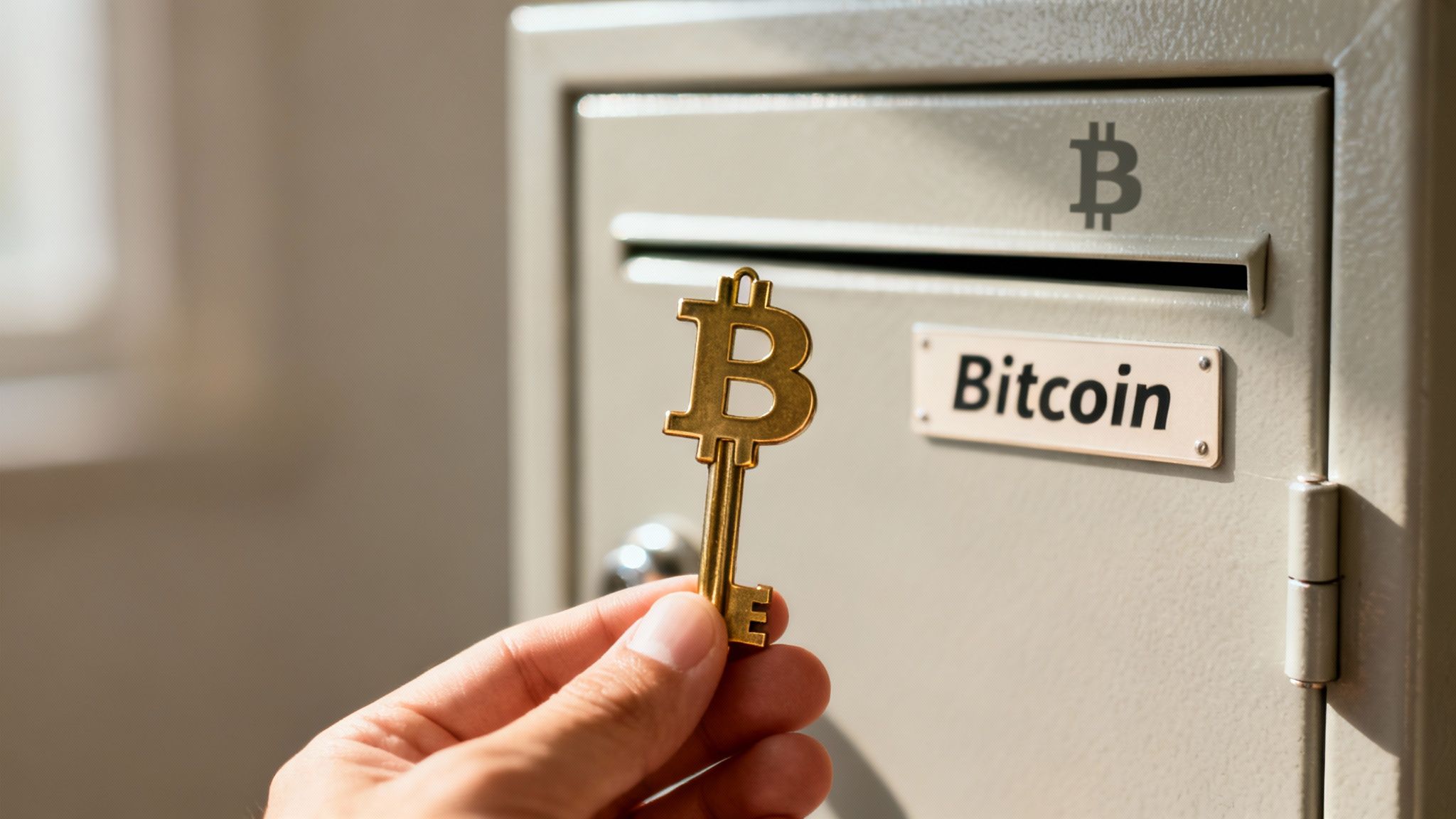
To really get your head around the power of a private key, let's use an analogy. Picture your Bitcoin wallet as a super-secure, see-through mailbox. Anyone can look up its location (your public address) and drop mail (Bitcoin) inside. But only the person with the one-of-a-kind physical key can unlock it and take out what's inside.
Your private key is that physical key. It's a long, complex string of characters that's mathematically tied to your public address. This link only works one way—you can figure out a public key from a private key, but it's impossible to do the reverse.
The Foundation of Self-Sovereignty
This cryptographic marriage between your private and public key is the bedrock of Bitcoin's security. It completely flips the script on how we think about ownership compared to traditional banking. With a bank, your identity is what grants you access to your money. In Bitcoin, simply possessing the private key is ownership.
There's a simple, powerful phrase in the Bitcoin community that sums this up perfectly: "Not your keys, not your coins." It's a constant reminder that if you let a third party hold your private keys, you're also handing them ownership of your money.
For any merchant, this is the first and most critical concept to grasp for accepting Bitcoin securely. When you're in control of your own keys, you effectively become your own bank. This cuts out the middleman and eliminates the risk of a third-party service freezing your account, reversing transactions, or getting hacked.
How Keys and Addresses Work Together
The way these pieces fit together is what makes the whole system both secure and usable. Here’s a quick breakdown of how they play off each other:
- Private Key: This is your secret. You use it to create a digital signature that proves you're authorizing a transaction to send Bitcoin out of your wallet—all without ever revealing the key itself.
- Public Key: This is generated from your private key and is designed to be shared. Its main job is to verify the digital signature your private key made, confirming that a transaction is legit.
- Bitcoin Address: Think of this as a shorter, more user-friendly version of your public key. It's what you share with others to get paid, like an email address or an IBAN. These typically start with a '1', '3', or 'bc1'.
As a merchant, generating a fresh address for every single payment you receive is a simple way to seriously boost customer privacy and the security of your operations. This entire system, all powered by that one secret private key, lets businesses tap directly into the Bitcoin network and enjoy all the perks of a truly decentralized payment system.
How Private Keys Secure Bitcoin Transactions
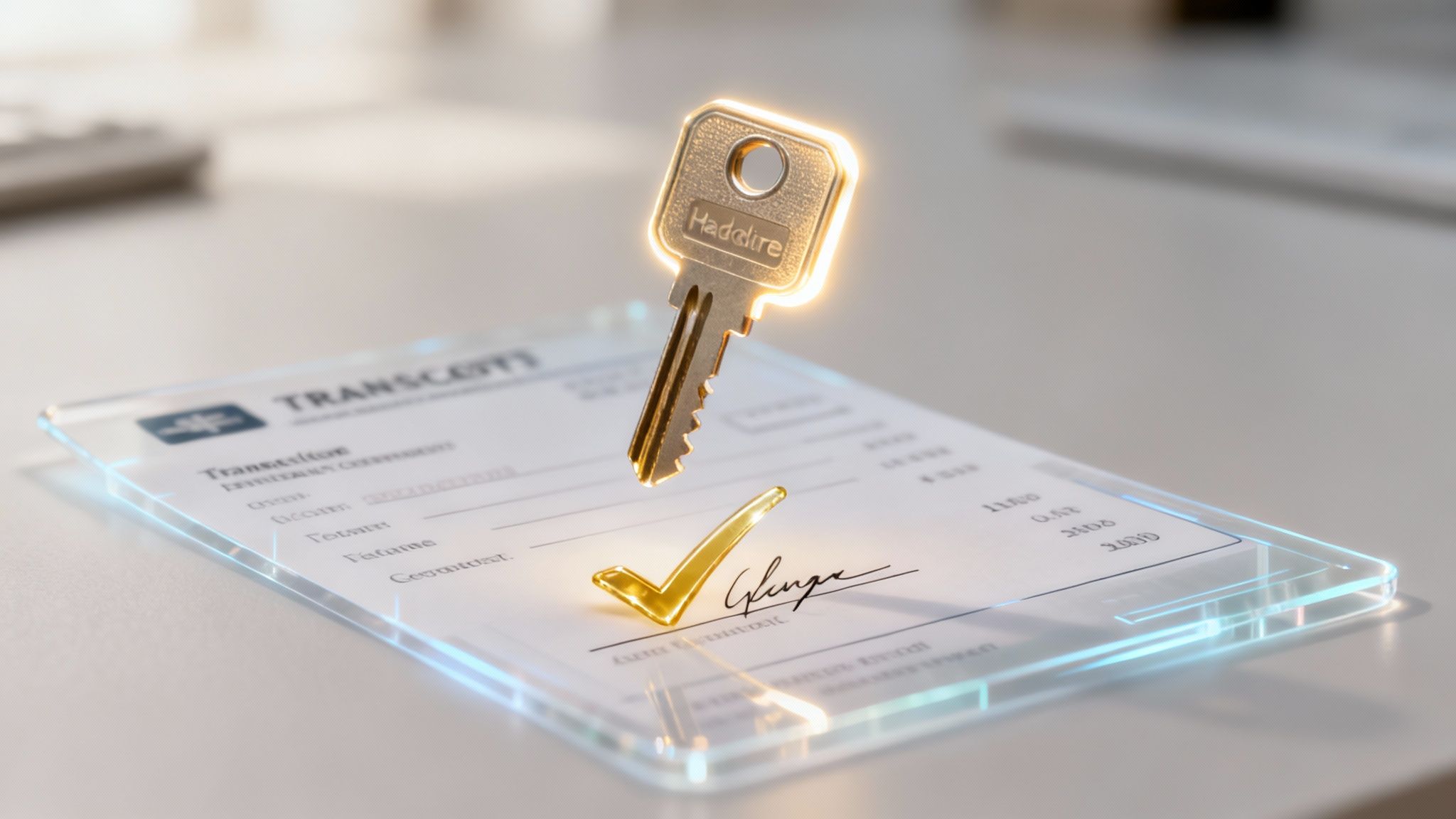
Here's something most people miss: when you "send" Bitcoin, you're not actually moving digital coins from one computer to another. What you're really doing is broadcasting a signed message to the whole world, telling the network you authorize a change in ownership. Your private key crypto is what makes this possible—it's your unforgeable digital signature, the mathematical proof that you, and only you, own those funds.
Think about writing a check to a supplier. You can fill out the amount and the recipient, but it’s just a piece of paper until you put your personal signature on it. A Bitcoin transaction follows the same logic. Your wallet software bundles up the details—how much you're sending and to what address—and then uses your private key to "sign" it.
This digital signature is where the magic happens. It's a cryptographic masterpiece created using your private key and the specific data from that one transaction. The most crucial part? This all happens locally on your device without ever showing your private key to the network. It stays a complete secret, always.
The Lifecycle of a Signed Transaction
Once your wallet applies that signature, the transaction gets fired off to the Bitcoin network. This is where the public key jumps into the ring. While your private key creates the signature, your public key lets everyone else on the network verify it.
It’s a beautifully simple, yet powerful, process:
- Creation: Your wallet software builds the transaction, specifying the amount and the recipient's address.
- Signing: Your private key is used to generate a unique cryptographic signature for this exact transaction.
- Broadcasting: The signed transaction is sent out to nodes all over the Bitcoin network.
- Verification: Every node uses your public key to check the signature. If it matches, they know you're the real owner and pass the transaction on.
- Confirmation: Once enough nodes agree the transaction is legit, it's bundled into a new block on the blockchain, making the transfer permanent.
This system is what allows for secure, irreversible transactions without needing a bank or any other middleman to give the thumbs up. The math behind the private key signature is the only authority that matters.
The Golden Rule of Bitcoin Security
This entire process brings us to the most fundamental principle of Bitcoin ownership: "not your keys, not your coins." When you hold the private key, you have absolute and final say over how your Bitcoin is spent. Nobody can touch your funds without it, and nobody can fake your signature.
Holding the private key means having complete authority over your Bitcoin. It is the digital equivalent of holding physical gold in your own vault—you are the sole gatekeeper.
This idea of self-sovereignty is what truly sets Bitcoin apart from traditional finance. When Bitcoin first appeared in 2009, its market cap was basically zero, with just a few thousand hobbyists managing their own keys. Fast forward fifteen years, and the digital asset market has exploded into a multi-trillion dollar industry, all of it ultimately secured by private keys, not usernames and passwords. You can dive deeper into this incredible growth in this Grayscale research report on the institutional dawn of digital assets.
For a merchant, this isn't just an interesting detail; it's a non-negotiable part of the business. By controlling your own private keys, you completely sidestep the risk of a third-party custodian getting hacked, going bankrupt, or freezing your funds. The power and the responsibility are in your hands, giving you the freedom to operate with total confidence in a genuinely peer-to-peer economy.
Choosing the Right Way to Manage Your Keys
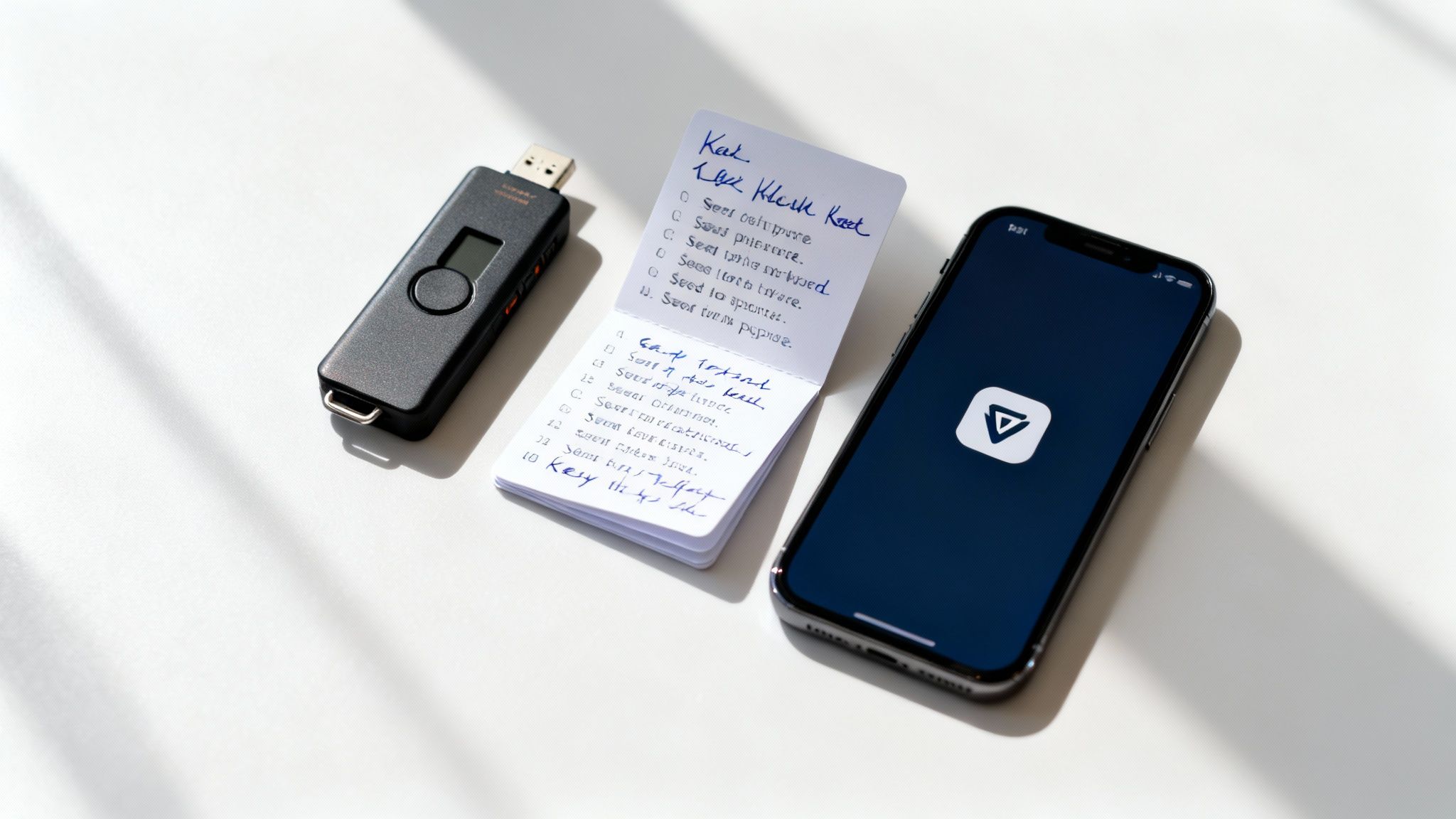
Knowing that a private key controls your Bitcoin is the first crucial step. The next, far more practical question is: how do you actually manage that key? For merchants, this isn't just a technical detail—it's a core business decision that requires balancing daily operational speed with the ironclad security needed to protect your revenue.
The earliest Bitcoin wallets were brutally simple, often managing just one private key at a time. While straightforward, this single-key model is completely impractical for any real business. Just imagine having to generate and back up an entirely new wallet for every single customer payment. It would be a logistical nightmare.
Thankfully, this early limitation pushed developers to create a much smarter, more powerful system that has become the modern standard.
The Power of HD Wallets and Seed Phrases
Today, almost every reputable Bitcoin wallet is a Hierarchical Deterministic (HD) wallet. This technology is an absolute game-changer for anyone handling more than a handful of transactions. Instead of forcing you to juggle countless individual private keys, an HD wallet lets you manage a whole universe of keys and addresses from a single, ultimate backup.
This master backup is called a seed phrase (or recovery phrase). It’s that list of 12 to 24 simple English words you're given when setting up a new wallet, presented in a specific order. From this one phrase, your wallet can mathematically derive a virtually infinite tree of private keys, public keys, and Bitcoin addresses.
Think of the seed phrase as the master blueprint for your entire financial operation. If your phone gets dropped in a lake or your laptop dies, you can restore your entire wallet and all its funds on a new device just by entering that sequence of words.
Your seed phrase is the most sensitive piece of information you will ever handle. It is the ultimate private key crypto backup for your business. Anyone who sees it can recreate your wallet and drain every satoshi you own.
This HD structure is especially vital for merchants. It allows your system to generate a fresh, clean Bitcoin address for every single invoice or customer payment. This isn't just for organization; it's a cornerstone of good financial privacy, making it much harder for outsiders to link all your transactions together on the public blockchain.
Software Wallets vs. Hardware Wallets
With the foundation of HD wallets understood, the next choice is where to store the keys they generate. This brings us to the two main categories of Bitcoin wallets: software and hardware. Each serves a very different purpose.
Software Wallets (Hot Wallets): These are the apps you run on your computer or smartphone. They are considered "hot" because your private keys are stored on a device that is connected to the internet. This makes them incredibly convenient for everyday use, like managing daily sales or paying suppliers on the go.
Hardware Wallets (Cold Wallets): These are small, purpose-built physical devices designed to keep your private keys completely offline. When you need to send funds, the transaction is signed inside the device's secure chip, meaning the private key never touches your vulnerable, internet-connected computer. This makes them the undisputed gold standard for long-term, secure storage.
For any serious merchant, the best strategy involves using both. A software wallet on a company phone or tablet can handle the daily flow of smaller payments, offering speed and convenience. At the same time, a hardware wallet acts as the business's main vault, securely holding the bulk of its Bitcoin earnings in "cold storage"—safe from online threats like malware and phishing attacks. This hybrid approach gives you the best of both worlds: liquidity for operations and Fort Knox-level security for your capital.
Protecting Your Private Keys From Common Threats
Holding your own private keys is the definition of financial sovereignty. But with that power comes a heavy weight—the security of your funds rests entirely on your shoulders. Forget calling a fraud department or resetting a password. If your keys are compromised, your Bitcoin is gone.
For a merchant, this isn't just theory. It's about protecting your business. Understanding the real-world threats to your private keys is the absolute first step toward building a defense that actually works.
The dangers you face aren't abstract lines of code; they're practical, everyday risks. We're talking everything from cleverly disguised digital attacks that trick you into revealing your secrets, to something as simple as a burglar walking out your door with a piece of paper. A security-first mindset is non-negotiable.
Digital Threats: Malware and Phishing
The most common digital attacks don't break through complex cryptography—they exploit the weakest link in any security system: the human being on the other side of the screen. Attackers use deception and malicious software to get their hands on the one thing that matters: your private key crypto, or more often, your seed phrase.
Phishing scams are everywhere. They show up as official-looking emails or messages that create a false sense of urgency. You might see a pop-up claiming your wallet needs an "update" or that your funds are "at risk," all designed to panic you into entering your seed phrase on a fake website. Let's be clear: no legitimate service will ever, under any circumstances, ask for your seed phrase.
Malware is just as insidious. Keyloggers can silently record every single thing you type, including wallet passwords. Clipboard hijackers are even sneakier, secretly replacing a Bitcoin address you've copied with the attacker's address just before you hit "paste."
There's one simple, absolute rule: Never type your seed phrase into any internet-connected device unless you are actively restoring your wallet on trusted, verified software. Think of your seed phrase as the master key—it stays offline, always.
A multi-layered defense is your best bet against these threats. It's a mix of healthy skepticism, constant vigilance, and using the right tools to neutralize most of what the internet can throw at you.
Physical Threats: Theft and Loss
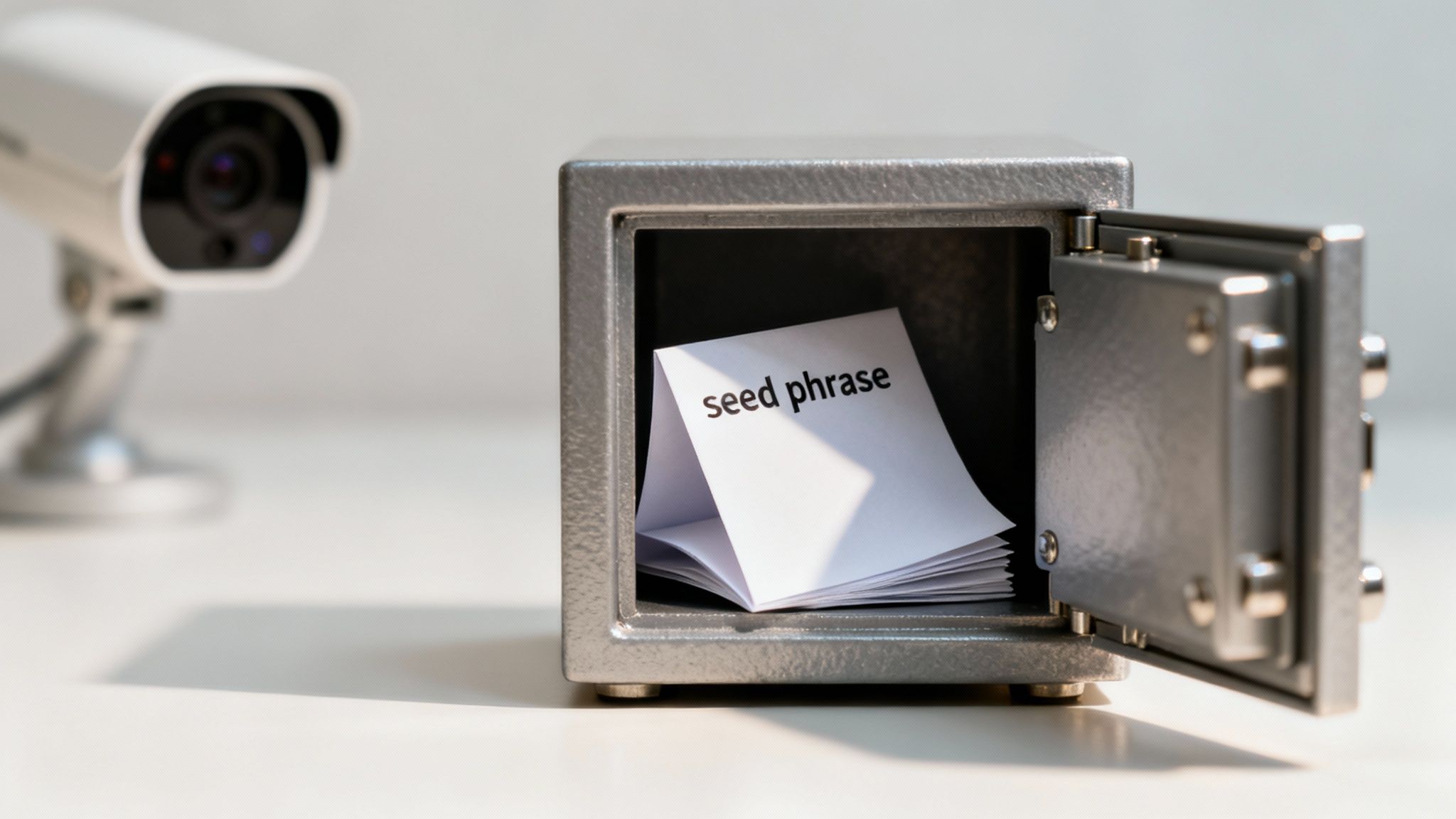
While we obsess over digital security, it's easy to forget about the physical world. A seed phrase scribbled on paper or saved on a USB drive is just as vulnerable to a break-in as it is to a hacker.
And it's not just about theft. If you only have one copy of your backup, a simple house fire or flood could permanently sever access to your Bitcoin. Poof. Gone forever.
Here’s a practical checklist to lock down your physical security:
- Use a Dedicated Hardware Wallet: If you're holding any significant amount of Bitcoin, this is non-negotiable. It keeps your private keys completely isolated from your internet-connected computer, making them immune to online malware.
- Store Backups Securely and Separately: This is crucial. Never keep your hardware wallet and your seed phrase backup in the same location. Use multiple, secure, geographically separate locations—think a safe deposit box at a bank and a fireproof safe at home.
- Be Discreet: Don't brag about your Bitcoin holdings, online or off. Advertising your wealth can make you a direct target for physical theft.
The scale of this risk is enormous. According to Chainalysis, billions of dollars worth of cryptocurrency are stolen each year, with a significant portion of losses coming from attacks on private key infrastructure. You can dive deeper into these trends in their latest crypto crime report.
For businesses looking at more advanced key management, it’s worth exploring concepts from the broader IT world, like Privileged Access Management (PAM) strategies. The takeaway is simple: a robust, multi-faceted security plan isn't optional. It's the only way to operate with confidence.
How to Accept Bitcoin Payments Securely
Alright, let's connect all these security ideas to how you actually run your business. Moving from theory to practice is all about building a payment system that gives you absolute, undeniable control over your money. This is exactly where non-custodial, wallet-to-wallet payments come into play, letting you accept Bitcoin directly into a wallet that only you can access.
This model is the polar opposite of custodial services, where you're essentially trusting another company to hold your funds for you. By taking self-custody, you single-handedly eliminate the risk of an intermediary freezing your account, going bust, or getting hit by a massive hack. You maintain total sovereignty over every single satoshi you earn, from the very moment a customer pays you.
A Step-by-Step Guide for Merchants
Putting a secure, self-custody payment system in place is more straightforward than you might think. It’s all built on the private key management principles we’ve already covered, ensuring your business is both safe and efficient. Here’s how you can get started.
1. Set Up a Secure, Self-Custody Wallet
First thing's first: you need a Bitcoin wallet where you control the private keys. For business, a hybrid setup is often the smartest move. Use a trusted software wallet on a dedicated, secure device for day-to-day transactions, and get a hardware wallet to sweep larger amounts into long-term cold storage.
When you set up your wallet, it will generate a seed phrase. Think of this as the master key to your business's Bitcoin treasury.
2. Back Up Your Seed Phrase Offline
I can't stress this enough. Write your seed phrase down on paper or, even better, etch it into a metal plate. Store this physical backup somewhere secure and offline, like a fireproof safe. For extra peace of mind, make a second backup and keep it in a completely different secure location, such as a bank's safe deposit box.
Never, under any circumstances, store your seed phrase digitally. Don't save it in a text file, an email draft, or a cloud drive. It's just not worth the risk.
3. Connect to a Non-Custodial Payment Processor
A non-custodial payment processor acts as the bridge between your customers and your wallet, but it never touches your funds. You connect your wallet by providing a public key (usually an xpub from your HD wallet), which lets the software generate fresh receiving addresses for every transaction. Your private keys never, ever leave your device.
This setup automates the entire payment flow, guaranteeing that all incoming funds travel directly from your customer's wallet to yours.
Maximizing Privacy with Every Transaction
One of the best features of this architecture is the ability to generate a new, unique Bitcoin address for every single payment you receive. This habit is crucial for your financial privacy. It makes it incredibly difficult for snoops on the public blockchain to link all your transactions together and figure out your total revenue.
This principle of controlling your own financial destiny is at the heart of Bitcoin's design. Still, it's worth noting that even in a decentralized world, concentration happens. A recent outlook pointed out that a small group of around 110 institutional and state-level players control about 8% of all circulating Bitcoin. Every one of these big players depends on the exact same private key security principles your business does.
For any merchant integrating Bitcoin, the foundational steps go beyond just key management. It’s also about creating a secure website environment. A secure online shop protects the entire payment journey, making sure your customers' interactions are safe from start to finish. Follow these steps, and you can accept Bitcoin with confidence, knowing you have complete control over your money.
Your Essential Private Key Security Checklist
With Bitcoin, you’re in the driver's seat. You have complete control of your funds, but that freedom comes with a heavy dose of responsibility. The security of your business’s Bitcoin rests entirely on how well you protect your private keys.
Think of this checklist as the final, boiled-down summary of everything we've covered—a set of non-negotiable rules to build a rock-solid defense against both digital and physical threats from day one.
Core Security Actions
If you take away just one thing, let it be this: sovereign control over your Bitcoin demands obsessive protection of your private key crypto.
Generate Keys Offline
The moment you create your keys is the most vulnerable point in their lifecycle. Always use a trusted, reputable wallet—ideally a hardware device—to generate them in a completely offline environment. Doing this slams the door on any malware that might be lurking online, waiting to snatch them at birth.Never Store Your Seed Phrase Digitally
Your seed phrase is the master key to your entire financial kingdom. It has no business being on a computer, in cloud storage, or saved as an email draft. A digital copy is a neon sign for hackers. Keep it strictly in the physical world.Create Redundant Physical Backups
Don't bet your business on a single piece of paper. A fire, a flood, or simply misplacing it could wipe you out. Create at least two separate physical backups (etched in metal is better than paper) and store them in secure, geographically separate locations. A fireproof safe in the office and a safe deposit box across town is a solid start.
With Bitcoin, you are your own bank. This freedom is powerful, but it means there is no one to call if you lose your key. Your security is your responsibility.
Use a Hardware Wallet for Significant Funds
If losing an amount of Bitcoin would cause your business real pain, it belongs on a hardware wallet. It’s that simple. These little devices keep your private keys totally isolated from your internet-connected computer, making them immune to the most common malware and phishing schemes.Guard Your Keys with Absolute Secrecy
Finally, and this should go without saying: never share your private key or seed phrase with anyone. Ever. For any reason. No legitimate service, developer, or support agent will ever ask for them. Treat any request like the scam it almost certainly is.
Following these steps isn't just about security; it's about giving your business the confidence to operate and thrive in the Bitcoin economy.
Burning Questions
Let's tackle some of the most common and practical questions merchants have when they start handling their own private keys for Bitcoin payments. Getting these answers right reinforces the security mindset we've been talking about and clears up any lingering doubts.
What Happens If I Lose My Private Key?
Losing your private key or seed phrase is the digital equivalent of dropping a bar of gold into the ocean. It’s gone forever.
There's no "forgot password" link, no customer support hotline, and no way to reverse the transaction. The Bitcoin tied to that key is still on the blockchain, but without the key, you've permanently lost the ability to access or spend it. This is precisely why creating secure, offline, and redundant backups of your seed phrase is the single most important job for anyone holding Bitcoin.
Can I Have More Than One Private Key?
Yes, and in fact, modern wallets automatically manage a whole bunch of them for you. These are called Hierarchical Deterministic (HD) wallets, and they use a single master seed phrase to generate a nearly infinite tree of private keys and their matching public addresses.
This is a game-changer for merchants. It lets your payment system generate a fresh, unique address for every single customer order, which massively boosts privacy and keeps your bookkeeping clean. The best part? All those keys are managed under the hood. You only need to back up that one single seed phrase to restore everything.
Is It Safe to Enter My Seed Phrase on a Website?
Absolutely not. Never.
Typing your seed phrase into a website is one of the fastest and most common ways to lose your Bitcoin. Scammers are experts at creating fake websites that look exactly like legitimate wallet services or exchanges, tricking you into voluntarily handing over the master key to all your funds.
Your seed phrase should only ever be entered directly on your trusted hardware wallet's physical screen or into the official, verified software when you're restoring a wallet. Any request to type it into a web form is a phishing attack, guaranteed.
How Do Non-Custodial Payment Processors Handle My Keys?
They don’t, and that’s the whole point. A true non-custodial processor is built to let you accept direct wallet-to-wallet payments without ever seeing, touching, or storing your private keys. Their software simply uses your public information (like an extended public key, or "xpub") to generate new receiving addresses that lead directly to your self-custody wallet.
This setup means customer payments go straight to a wallet that only you control, putting you in the driver's seat of your own finances. You always keep 100% control and custody of your funds, wiping out the risk that comes with trusting a third party. You are your own bank.
Ready to accept Bitcoin securely without ever giving up control of your funds? Flash provides the tools you need to integrate direct, wallet-to-wallet payments in minutes. Get started today.