When it comes to private keys crypto, your private key is the one and only thing that proves you own your Bitcoin. Think of it as the master key to an unbreakable digital vault. Whoever has this key has absolute, irreversible control over what's inside. This idea is the very foundation of Bitcoin's security and the power of self-ownership.
Why Your Private Key Is the True Owner of Your Bitcoin
When you "own" Bitcoin, you're not actually holding digital coins like files on a hard drive. What you really possess is a secret piece of data—your private key. This key is just a very long, complex string of numbers and letters, but it’s what gives you the authority to spend the Bitcoin linked to it.
This authority is guaranteed by cryptography. Every time you send Bitcoin, your wallet software uses your private key to create a unique digital signature for that transaction. This signature is mathematical proof to the entire network that you, and only you, approved the payment. Without that key, the funds are locked away for good.
The Power and Responsibility of Self-Custody
Unlike your bank account, the Bitcoin network doesn't have a central authority. There's no customer service number to call if you get into trouble and no "forgot password" link to click. This is one of Bitcoin's greatest strengths, but it also puts the entire weight of security squarely on your shoulders.
If you lose your private key, your Bitcoin is gone forever. It cannot be recovered, reset, or reclaimed by anyone. This is why you’ll hear the phrase "not your keys, not your coins" repeated like a mantra in the Bitcoin community.
This direct control is what we call self-custody. For any merchant, really getting this concept is the critical first step toward accepting Bitcoin securely. It means you have to be deliberate and proactive in protecting your private keys from every possible threat, both digital and physical.
What This Means for Your Business
Embracing self-custody lets your business operate without needing traditional financial middlemen, which cuts down on fees and settlement delays. But it also demands a serious security mindset. The success of your business with Bitcoin hinges entirely on how well you manage and protect these all-important keys. This guide will walk you through everything you need to know to do it right.
How Private Keys Actually Work with Bitcoin
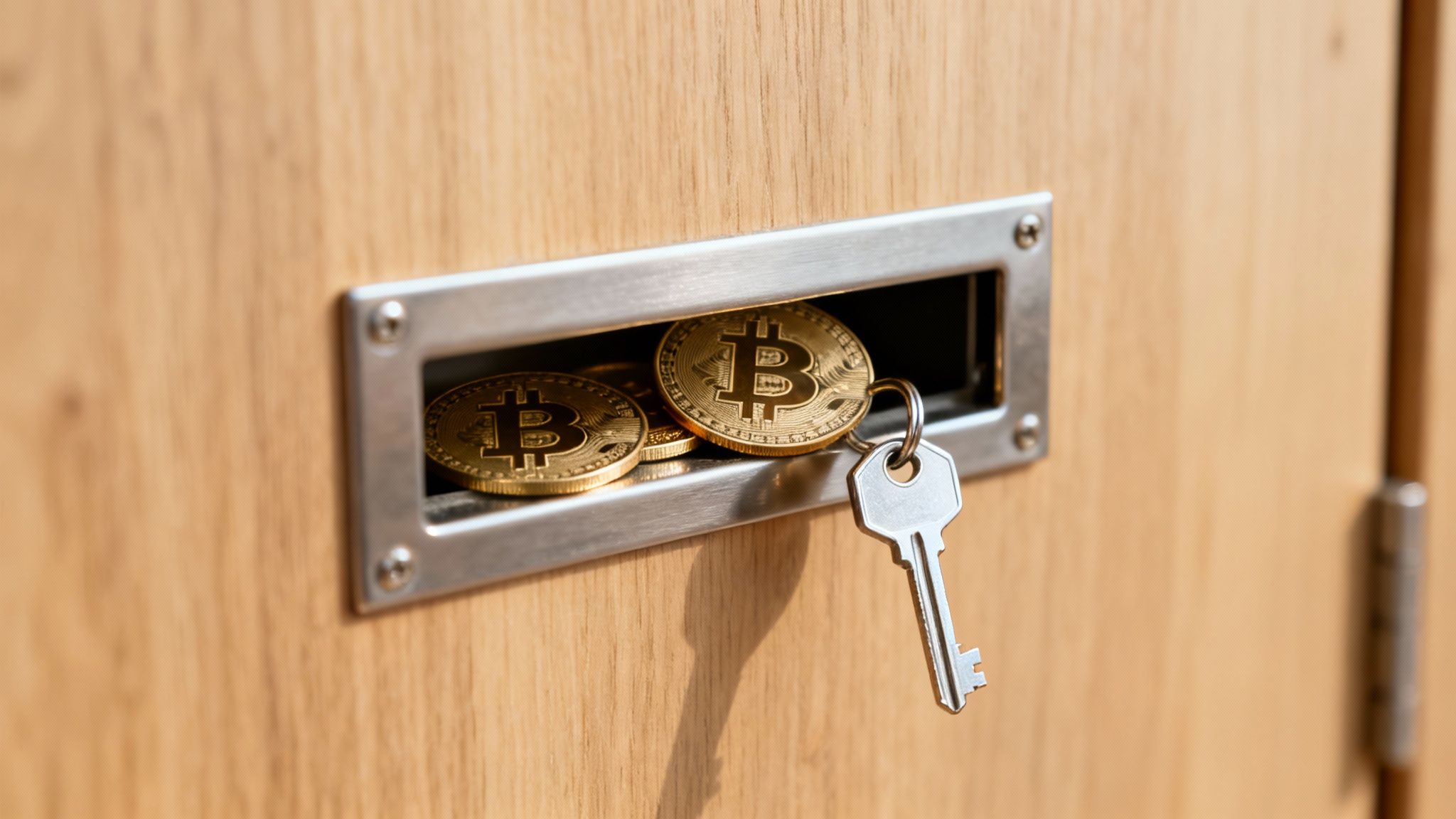
To get a real handle on how a private key keeps your Bitcoin safe, let's ditch the dense math for a moment and use a simple analogy: the classic mailbox. It’s a surprisingly effective way to visualize the relationship between public keys, private keys, and Bitcoin addresses.
Think about setting up a new mailbox. You give out its location—your address—to anyone who wants to send you a letter. In the world of Bitcoin, your public key is used to create a Bitcoin address. This address is just like your mailbox's location; it's public info you can share with anyone, anywhere, without worry.
Anyone on the planet can send Bitcoin to your public address, just like anyone can drop a letter into your mailbox. But here's the key part: just because they can see the mail piling up doesn't mean they can open the box and take it.
Unlocking Your Funds with a Digital Signature
This is where your private key comes into play. It's the only thing that can unlock that mailbox. When you decide to spend the Bitcoin that's been sent to your address, your wallet software uses your private key to create a unique digital signature.
This signature is a bit of cryptographic magic. It acts as mathematical proof that you—and only you—own the funds. It essentially broadcasts a message to the entire Bitcoin network saying, "I am the rightful owner of the Bitcoin at this address, and I authorize this specific transaction." This all happens in the background, but it's the core process that secures every single payment.
Crucially, your private key is never broadcast to the network. Only the signature it creates is shared. This allows you to prove ownership without ever revealing the secret key itself, keeping your funds safe from eavesdroppers.
This one-way street is the foundation of Bitcoin's security. You can easily derive a public key from a private key, but trying to reverse-engineer a private key from a public one is practically impossible.
The Seed Phrase: Your Master Backup Key
So, what happens if you lose your phone or your computer fries, taking your wallet and private keys with it? This is where the seed phrase saves the day. A seed phrase (or recovery phrase) is simply a list of 12 to 24 simple words that serves as the master backup for your entire wallet.
Think of your seed phrase as the master blueprint for all your keys. When you first set up a modern Bitcoin wallet, it gives you this phrase and tells you—in no uncertain terms—to write it down and store it somewhere safe and offline.
Restoration Power: If your device is lost, stolen, or broken, you just install a new wallet on a new device and punch in your seed phrase. The wallet uses this phrase to perfectly regenerate all of your private keys, restoring full access to your Bitcoin.
Ultimate Responsibility: This phrase is even more sensitive than an individual private key. Anyone who gets their hands on your seed phrase can clone your entire wallet and drain every last satoshi. Protecting it is your single most important security task.
Understanding this hierarchy is fundamental for any business handling Bitcoin. The seed phrase restores the private keys, and the private keys control the funds at your Bitcoin addresses. Grasping this lets you build a secure operational workflow and make smart decisions about managing your company's Bitcoin.
To help clarify these concepts, here’s a quick reference table.
Key Bitcoin Security Concepts at a Glance
This table breaks down the core components of Bitcoin security that every merchant should know, using simple analogies to make them stick.
| Concept | Analogy | Primary Function |
|---|---|---|
| Bitcoin Address | Your public mailbox location | The public identifier you share to receive funds. |
| Public Key | The design of your mailbox slot | Used to generate your address and verify your signature. |
| Private Key | The physical key to your mailbox | The secret key used to sign (authorize) outgoing transactions. |
| Digital Signature | The turn of the key in the lock | Cryptographic proof that you own the private key. |
| Seed Phrase | The master blueprint for the key | A master backup used to restore all your private keys. |
Having a clear mental model of how these pieces fit together is the first step toward building a rock-solid security strategy for your business's Bitcoin funds.
The Most Common Threats to Your Private Keys
Knowing how private keys work is one thing, but keeping them safe out in the wild is a completely different ballgame. You have to understand the very real threats you’re up against. These aren't just theoretical risks; they are active, daily dangers for any business holding Bitcoin. In reality, the weakest link isn't a flaw in Bitcoin's code—it's almost always a breakdown in human procedure.
Attackers are constantly cooking up new schemes to get their hands on your private keys crypto. These threats generally fall into two buckets: digital attacks that exploit your online presence and physical attacks that target you or your devices directly. Being aware of both is the first step toward building a truly resilient defense for your business's assets.
And make no mistake, the stakes are incredibly high. Thefts of digital assets have skyrocketed, with over $2.17 billion stolen from various services in just the first half of a single recent year. What’s truly alarming is the shift in focus: personal wallet compromises now make up a staggering 23.35% of all stolen funds this year. This shows that attackers are increasingly pivoting from hardened exchanges to softer targets like individual users and merchants. You can dig into the full mid-year crime report for a deeper dive into these trends.
Sophisticated Digital Attacks
Digital attacks are the most common way private keys get stolen, simply because they can be launched from anywhere in the world and scaled up massively. Scammers use a mix of deception and malicious software to trick you or your team into accidentally exposing your keys.
Here are a few of the most common digital traps to watch out for:
Phishing Scams: These are cleverly disguised emails, texts, or DMs that look like they’re from a trusted source, like your wallet provider or a payment service. They create a sense of urgency, telling you to "update your wallet" or "verify your account." The goal is to get you to click a link to a fake website that looks legit, where they'll ask you to enter your seed phrase.
Malware and Keyloggers: Malicious software can quietly infect your computer or phone. Some malware is specifically designed to hunt through your device’s files, looking for anything that resembles a private key or seed phrase. Keyloggers are even sneakier; they record every single keystroke, hoping to capture your password or seed phrase as you type it in.
Social Engineering: This is the art of psychological manipulation. An attacker might impersonate a support technician, convincing you to share your screen or reveal your seed phrase to "fix" a problem that they invented. They build rapport and create urgency to make you bypass your own security instincts.
Direct Physical Threats
While digital attacks get more headlines, you can't afford to ignore physical threats. If word gets out that your business holds a significant amount of Bitcoin, you or your devices could become a direct target.
The core principle of Bitcoin security is that whoever possesses the private key has absolute control. This truth applies just as much in the physical world as it does in the digital one.
Physical attacks can be anything from simple theft to outright coercion.
Device Theft: The most obvious physical threat is someone stealing a device that holds your private keys—a laptop, phone, or even a hardware wallet. If that device isn't properly encrypted and protected with a strong PIN or passphrase, the thief could potentially extract the keys and drain your funds.
The "$5 Wrench Attack": This is a grim industry term for a scenario where an attacker uses physical violence or threats to force you to give up your keys, passwords, or seed phrase. It sounds extreme, but for individuals and businesses known to hold large amounts of Bitcoin, it’s a genuine risk. This highlights why it's crucial to not only secure your keys but also maintain privacy about your holdings.
Ultimately, defending against this array of threats boils down to having solid, repeatable security procedures in place. The first and most critical step is acknowledging that human error is, and always will be, the weakest link in the chain.
Choosing Your Bitcoin Private Key Storage Strategy
Alright, you understand the threats. Now it's time to build your fortress. The cornerstone of your entire Bitcoin security plan is your storage strategy—how and where you decide to keep the private keys crypto for your business. This isn't just a technical detail; it's a fundamental balancing act between the convenience you need for daily operations and the robust security required to protect your company’s assets.
The world of private key storage really boils down to two main camps: hot wallets and cold wallets. The difference is simple but has massive implications: one is connected to the internet, and the other is not. Getting the mix right is one of the most important decisions any business using Bitcoin will make.
The stakes are incredibly high. Since Bitcoin’s early days, a jaw-dropping 3 million BTC—worth tens of billions of dollars today—have been lost forever. These aren't just exchange hacks; they're lost keys, forgotten passwords, and self-custody mistakes. A conservative estimate suggests at least 1.57 million BTC are gone for good, a huge portion of which comes from individuals and businesses mismanaging their own keys. For a full, sobering breakdown, check out River's comprehensive Bitcoin Custody Report.
Hot Wallets The Digital Cash Register
A hot wallet is any Bitcoin wallet that lives on an internet-connected device, like a desktop program or a mobile app. The best way to think of it is as your business’s digital cash register. It’s perfect for handling smaller amounts of Bitcoin for the frequent, day-to-day transactions you need to process quickly.
Their main selling point is pure convenience. You can send and receive payments in seconds, check balances on the go, and plug them right into your point-of-sale systems. But that constant online connection is also their Achilles' heel. It exposes the private keys inside to every online threat we've talked about—malware, phishing, and remote hacks.
For this reason, a hot wallet should never be used to store the bulk of your company's Bitcoin holdings. Treat it like you would a physical cash register: keep only enough funds in it to cover your immediate operational needs.
Cold Wallets The Fort Knox for Your Bitcoin
In complete contrast, a cold wallet keeps your private keys entirely offline. This approach, often called cold storage, is the undisputed gold standard for securing large amounts of Bitcoin for the long haul. By creating an "air gap"—a physical separation between your keys and the internet—you practically eliminate the risk of someone stealing your funds from across the globe.
The most popular and accessible form of cold storage today is the hardware wallet. It’s a small, specialized physical gadget built for one job and one job only: to protect your private keys.
Here's why a hardware wallet offers such top-tier security:
- Offline Key Generation: Your private keys are born inside a secure chip on the device itself. They never, ever touch an internet-connected computer.
- Isolated Transaction Signing: To spend Bitcoin, the transaction details are sent to the hardware wallet. You physically look at the transaction on the device's screen and press a button to approve it. The signing happens right there, inside the secure device.
- Protected Signature: Only the final, signed transaction is sent back to your computer to be broadcast to the network. Your private key is never exposed.
This clever process lets you safely manage your Bitcoin even if the computer you're using is riddled with malware.
To help merchants decide which path is right for their needs, let's break down the key differences between hot and cold storage.
Hot Wallets vs Cold Wallets A Comparison for Merchants
This table compares the primary storage methods for private keys, helping businesses weigh the pros and cons based on security, convenience, and typical use cases.
| Feature | Hot Wallets (e.g., Mobile/Desktop Apps) | Cold Wallets (e.g., Hardware Wallets) |
|---|---|---|
| Connectivity | Always connected to the internet. | Completely offline; connects only to sign transactions. |
| Primary Use Case | Daily spending, frequent small transactions. | Long-term savings, securing large amounts. |
| Security Level | Lower. Vulnerable to online attacks like malware and phishing. | Highest. Immune to remote digital theft. |
| Convenience | Very high. Fast and easy access to funds. | Lower. Requires physical access to the device for transactions. |
| Key Exposure | Keys are stored on an internet-connected device. | Keys never leave the secure, offline device. |
| Ideal For | A merchant's "cash register" for daily sales. | A business's "vault" for holding profits and reserves. |
Ultimately, the choice isn't just about picking one over the other. The smartest strategy for most businesses involves a hybrid approach, using both types of wallets for what they do best.
Advanced Security with Multisig Wallets
For businesses that need airtight security and robust internal controls, a multi-signature (or multisig) wallet is the ultimate setup. Think of a multisig wallet as a digital bank vault that requires more than one key to unlock.
Instead of one person holding a single private key, a multisig wallet requires signatures from multiple keys before funds can be moved. A common setup is a "2-of-3" wallet, where three partners each hold a key, but any two of them must sign off to authorize a payment.
This structure delivers powerful advantages for corporate governance:
- No Single Point of Failure: If one person's key is compromised, the funds are still safe. An attacker would need to steal multiple keys, likely from different people in different locations.
- Enhanced Internal Controls: It prevents a single rogue employee or executive from running off with the company's funds, creating a mandatory system of checks and balances.
- Built-in Redundancy: If one keyholder loses their key, the other two can still come together to access and recover the funds.
Choosing your storage strategy demands a careful look at how your business operates. Most merchants will find a hybrid model is the sweet spot: a hot wallet for processing daily payments and a secure cold storage solution—like a hardware wallet or a multisig setup—for the vast majority of their funds.
Best Practices for Merchants Accepting Bitcoin Payments
Turning security theory into practice is where the real work of protecting your Bitcoin happens. For merchants, this means creating a secure, repeatable workflow for every single payment you accept. The most critical decision you'll make right from the start is to adopt a non-custodial approach.
This simply means you, and only you, control the private keys for your business's revenue. Getting tangled up in holding customer funds or managing their keys opens a can of worms filled with massive liability and regulatory headaches. A non-custodial model puts you in the driver's seat of your own money—exactly how Bitcoin was meant to be used.
Embrace a Non-Custodial Payment Setup
A non-custodial payment solution is the foundation of this entire security framework. Instead of payments passing through a third-party account where they hold your money, these tools enable direct wallet-to-wallet transactions. When a customer pays you, the Bitcoin goes straight from their wallet into your secure business wallet.
This one simple change has huge security benefits. It completely eliminates third-party custody risk. You're no longer losing sleep over an exchange getting hacked or a payment processor deciding to freeze your funds. The money lands directly in a wallet that you control, like a hardware or multisig wallet.
Going the non-custodial route isn't just about protecting your own assets; it's about shrinking your attack surface and simplifying your operations. Your only job becomes securing the private keys for your own business wallets.
The threat landscape today makes this a no-brainer. To give you some perspective, state-sponsored hackers were responsible for stealing nearly $800 million in just one year, with their heists being almost five times larger than those from other groups. Their main weapon? Compromising private keys and seed phrases, which accounted for nearly 70% of all infrastructure-related attacks that year. You can dig into the details of these sophisticated threats by reading the full crypto crime report from TRM Labs.
Actionable Steps for a Secure Workflow
Building a secure workflow isn't about becoming a cybersecurity wizard. It's about disciplined operational security and having clear, consistent rules for how you handle Bitcoin payments.
Here are the essential steps every merchant should put in place:
Dedicate Wallets for Business Use: Never, ever mix personal and business funds. Set up dedicated hardware or multisig wallets just for your company's revenue. This makes accounting a breeze, improves privacy, and contains any potential security issue to one specific area.
Establish Clear Fund Management Protocols: Decide exactly how and when funds are moved. For instance, you could have a policy to sweep all payments from a daily "hot wallet" into your secure cold storage at the close of every business day. Write this process down and make sure anyone with access understands it.
Perform Regular Security Audits: At least once a quarter, review your entire security setup. Check on your seed phrase backups, make sure your hardware wallets are working properly, and re-evaluate who has access to what. Treat this with the same seriousness as a financial audit—it’s that important.
Integrating Secure Payments into Your Business
Choosing the right tools is what makes your security plan a reality. A solution like Flash lets you accept Bitcoin payments directly into your own wallet without ever taking custody of the funds. It serves as the secure layer that generates invoices and confirms payments, all while you maintain 100% control over your private keys.
Beyond Bitcoin specifically, it's smart to look at the bigger picture of your transaction tools to make sure everything works together smoothly. Exploring the best payment processing solutions can give you great context for building a complete and effective financial toolkit for your business. By pairing a strong non-custodial Bitcoin setup with well-chosen traditional payment systems, you create a resilient and flexible business that's ready for any customer.
Your Questions on Private Keys Answered
Jumping into Bitcoin security always brings up a few practical questions. Let's tackle some of the most common ones that merchants ask about private keys crypto. These answers should clear things up and help you feel more confident about handling your Bitcoin.
What Happens if I Lose My Private Key?
If you lose your private key and don't have a backup of your seed phrase, the Bitcoin controlled by that key is gone. Forever. There's no "forgot password" link or customer support line to call. The coins still exist on the blockchain, but they're effectively frozen in time, completely inaccessible.
For a business, this is the digital equivalent of a vault's contents vanishing into thin air. It’s a catastrophic and irreversible loss. This is exactly why creating and protecting multiple, offline backups of your seed phrase isn't just a suggestion—it's the single most important security task you have. Without a backup, you don't get a second chance.
Is It Safe to Store My Seed Phrase Digitally?
Absolutely not. This is one of the biggest and most common mistakes you can make. Storing your seed phrase anywhere that's connected to the internet—in cloud storage, an email draft, a password manager, or even a notes app—is like leaving the keys to your business in the front door. It exposes your entire treasury to hackers and malware.
The gold standard, and the only practice you should follow, is to store your seed phrase physically and offline. Write it down on paper or, even better, stamp it into metal plates. Then, secure those copies in different, safe locations like a fireproof safe or a bank's safe deposit box. Never, ever take a digital photo of your seed phrase.
This "air gap" between your master backup and the internet is your strongest line of defense. A hacker halfway across the world simply can't steal a piece of paper locked in your office safe.
How Does a Non-Custodial Payment Processor Help?
A non-custodial payment processor is a game-changer for your security. It completely removes the need for you to ever handle or worry about your customers' private keys. Payments go directly from your customer's wallet straight to your business wallet—one that only you control. The processor just acts as a secure messenger, not a bank.
This setup drastically reduces your liability and security headaches. You're never responsible for customer funds, which simplifies your regulatory risk and lets you focus on one thing: securing the private keys for the wallet where you receive payments.
Should My Business Use a Single Bitcoin Address?
No, you should never do this. Reusing the same address over and over is a massive privacy and security blunder. It lets anyone on the public blockchain see every single payment you receive, essentially broadcasting your revenue, customer activity, and total holdings to the world. That makes your business a much bigger and more attractive target for attackers.
Modern Hierarchical Deterministic (HD) wallets fix this problem by automatically generating a new, unique address for every single transaction. This isn't just a neat feature; it's the industry standard for both privacy and security.
Any professional payment solution should integrate with HD wallets to ensure a fresh address is generated for every invoice. This practice is non-negotiable for protecting your financial privacy and that of your customers.
The world of digital security is always moving. For ongoing learning and different takes on managing private keys, you might want to check out additional articles and insights on private key security. Staying informed is a huge part of a solid defense.
Ready to accept Bitcoin payments with a truly non-custodial solution that puts you in complete control of your private keys? Flash provides the tools you need to integrate secure, direct wallet-to-wallet payments into your business in minutes. Eliminate intermediaries and protect your revenue with the gold standard in Bitcoin payment processing. Get started at .