That final click to "Complete Purchase" is the most valuable one your customer can make. It’s also the most expensive one they don't.
When a shopper leaves items in their cart, it’s easy to write it off as a simple change of heart. But this misses the bigger picture: every abandoned cart is a loud, clear message that something in your sales process created friction, doubt, or frustration.
To reduce shopping cart abandonment, you first have to stop seeing it as just a lost sale. It’s a direct signal—a piece of feedback—telling you exactly where the friction is. The key is to reframe these abandoned carts from a failure into your single biggest opportunity for growth. It all comes down to addressing the core issues that cause hesitation, like surprise costs, forced account creation, and a lack of trusted, modern payment options.
The Real Cost of an Abandoned Cart
It's not just an abstract problem; the financial hit is staggering and directly impacts your bottom line.
Globally, the average shopping cart abandonment rate is a breathtaking 70.2%. Think about that. For every ten customers who show clear buying intent by adding items to their cart, seven of them walk away without paying.
This translates into eCommerce businesses losing out on an estimated £2.96 trillion in potential revenue each year. If you want to dive deeper into the numbers, you can explore these shopping cart abandonment statistics and see how you can start reclaiming those lost sales.
Why Customers Really Leave
Understanding the psychology behind why people bail is the first step toward fixing the problem. Shoppers are often driven away by predictable—and totally fixable—pain points that break their journey from browsing to buying. These triggers are your roadmap for improvement.
The usual suspects include:
- Sticker Shock from Hidden Fees: This is the number one killer. Unexpected shipping costs, taxes, or service fees that only show up on the final step feel like a bait-and-switch.
- Forced Account Creation: Requiring a customer to create an account before they can buy adds a huge, unnecessary barrier, especially for first-time shoppers just wanting to get in and out.
- Lack of Trusted Payment Options: Customers expect flexibility and security. If their preferred payment method isn't available, or if they don't trust the options you provide, they're gone.
An abandoned cart should be viewed as direct, actionable feedback. It's a customer telling you, "I wanted to buy this, but you made it too difficult."
A New Opportunity for Growth
Instead of looking at these abandoned carts as lost revenue, see them for what they are: your greatest opportunity. Each one is a clue, pointing you toward how to improve your checkout experience. By tackling these friction points head-on, you can turn hesitation into conversion.
This is where modern payment solutions can completely change the game. Integrating direct, wallet-to-wallet Bitcoin payments offers a powerful way to eliminate many of these common barriers.
For a growing global audience that values privacy, speed, and decentralization, offering Bitcoin isn't just another payment option—it's a signal that you understand their needs. It allows you to sidestep the high fees and slow processing times that plague traditional systems, creating a smoother, more transparent path to purchase.
How to Find Your Checkout Friction Points
You can't fix a problem you don't understand. So, before you start tweaking your checkout process to reduce shopping cart abandonment, you have to play detective and figure out exactly where the leaks are in your sales funnel. Guessing is just a great way to waste time and money. A data-driven approach, on the other hand, ensures you're putting your effort into fixes that will actually move the needle.
This whole journey kicks off in your analytics. Finding the real friction points in your checkout is less about gut feelings and more about methodical investigation. You've got to see the entire process through your customers' eyes to really get why they're bailing.
Uncover Leaks with a Conversion Funnel
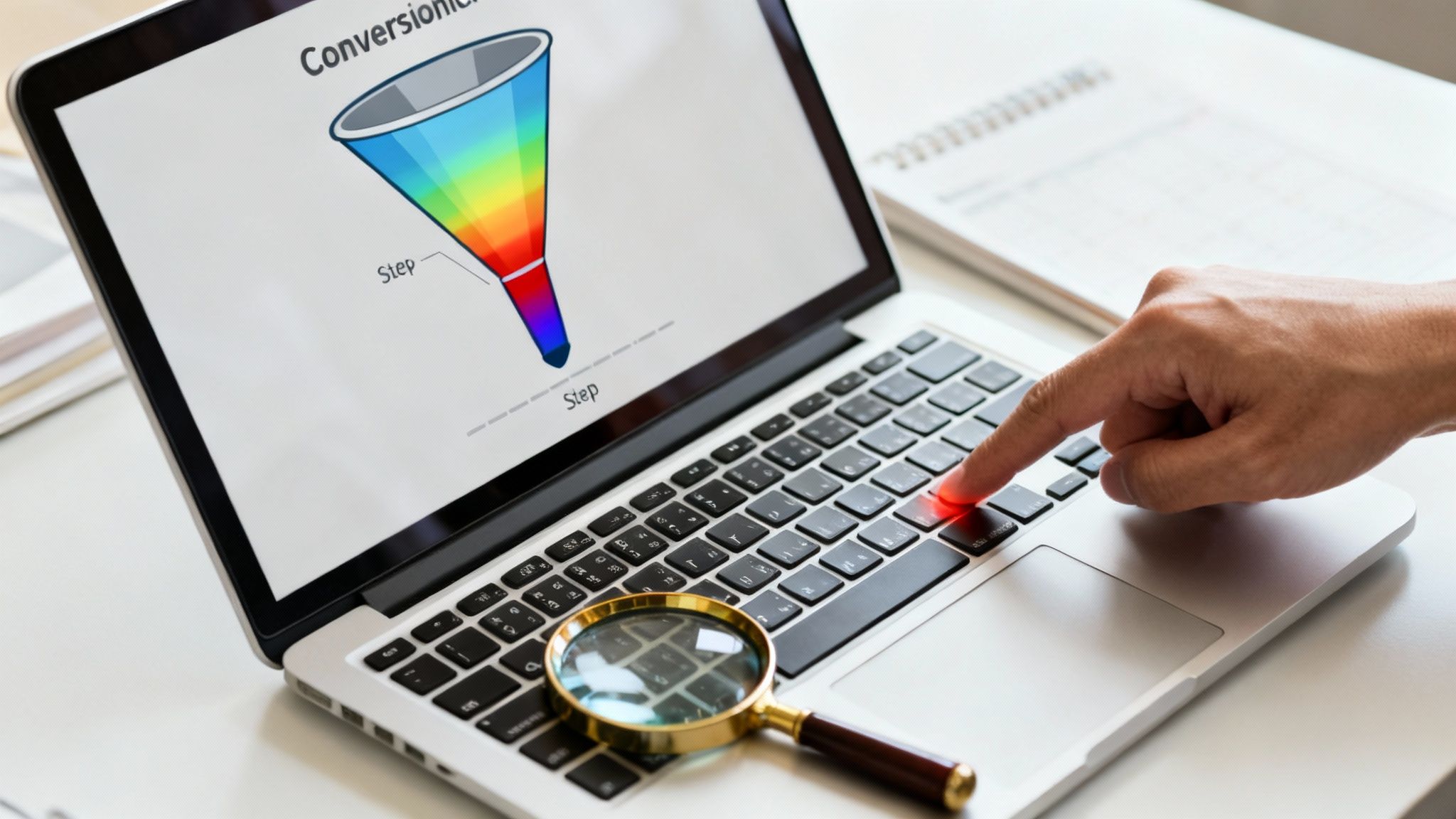
The most powerful tool in your diagnostic kit is the conversion funnel. When you set one up in your analytics platform, you get a clear visual of the customer’s journey from adding a product to their cart all the way through to completing the purchase. More importantly, it shows you the precise drop-off rate at each stage.
A typical e-commerce funnel might look something like this:
- Customer adds an item to their cart
- They begin the checkout process
- They enter their shipping information
- They select a payment method
- They complete the purchase
Now, if you see a massive 40% drop-off between entering shipping info and selecting a payment method, you've just found a huge clue. This strongly suggests that your shipping costs, which are probably revealed at that exact moment, are causing some serious sticker shock. A small drop-off is normal, but a cliff is a red flag telling you exactly where to focus.
Your analytics data doesn't just show you what is happening; it screams where it's happening. A steep drop-off in your conversion funnel is a direct signal of customer friction at that specific step.
Watch How Customers Actually Interact
While funnels show you where people are leaving, they don’t always explain why. This is where qualitative tools like heatmaps and session recordings become absolute game-changers. They give you a window into your customers' real-time behavior, letting you see your checkout process exactly as they do.
Heatmaps create a visual overlay showing where users click, move their mouse, and scroll. You might discover that shoppers are repeatedly clicking on a security badge, expecting more info, or trying to interact with something that isn't even clickable.
Session recordings are even more direct—they're anonymized video replays of actual user sessions. You can literally watch as a customer struggles to find the guest checkout option, gets tripped up by a confusing form field, or hesitates when they see your limited payment choices. Trust me, seeing someone rage-click a broken button is a much more powerful motivator to fix it than just looking at a number on a chart.
Get Direct Feedback from Shoppers
Sometimes, the easiest way to find out what’s wrong is just to ask. An exit-intent survey—that small, unobtrusive pop-up that appears when a user is about to leave the checkout page—can be incredibly effective for gathering direct, actionable feedback.
Keep it simple. A single multiple-choice question can give you structured data that's easy to analyze.
Example Exit-Intent Survey Question:
"Just wondering, what stopped you from completing your purchase today?"
- Shipping costs were too high.
- I was just browsing.
- The checkout process was too long.
- My preferred payment option wasn't available.
- Other (please specify).
This kind of direct feedback is gold. If "My preferred payment option wasn't available" consistently ranks high, it’s a clear signal to diversify your payment methods—maybe by adding a direct Bitcoin payment option for customers who value that choice.
Once you’ve identified these key issues, you can explore proven tactics to improve ecommerce conversion rates for concrete solutions. By combining the hard data from your funnel with the human insights from user behavior tools and surveys, you can build a prioritized list of fixes that are guaranteed to make a difference.
Designing a Frictionless Bitcoin Checkout
Once you've figured out where customers are bailing, it's time to overhaul your checkout. The goal isn't just to tweak a few fields; it's to build an experience that's so fast, secure, and simple that paying becomes an afterthought. To truly reduce shopping cart abandonment, you have to knock down the biggest walls standing between your customer and the "complete purchase" button—things like clunky forms, forced account creation, and a lack of modern payment choices.
This is where direct Bitcoin payments can be a legitimate game-changer. A solution like Flash is built from the ground up to create a faster, more direct checkout that tackles the root causes of abandonment. By enabling direct wallet-to-wallet transactions, you cut out the middlemen and all the friction they bring with them.
Guest Checkout Is Non-Negotiable
Seriously, if you take one thing away from this, it's this: stop forcing people to create an account. It’s a stone-cold conversion killer. You’re asking for personal information and a long-term commitment before they’ve even finished their first purchase. It’s a huge ask that introduces unnecessary steps and privacy worries right at the finish line.
Make guest checkout the obvious, easy path. This lines up perfectly with the expectations of anyone paying with Bitcoin, who already values speed and privacy. A Bitcoin payment doesn't need a name, shipping address, or password—just a wallet. This minimalist approach slashes the time and effort needed to buy.
By making guest checkout the default, you’re telling customers you respect their time and privacy. It’s a simple shift in mindset that can give your conversion rates a serious bump, especially for first-time shoppers.
Real-World Scenarios for Bitcoin Payments
You don't need a massive technical overhaul to start accepting Bitcoin. With the right tools, you can spin up a seamless payment experience on any channel, each designed for a specific situation.
Here are a few practical ways it plays out:
- Turn Any Smartphone into a Point-of-Sale Terminal: A local shop or a vendor at a farmers market can use an app to generate a QR code for each sale. The customer scans it with their Bitcoin wallet, and payment is confirmed on the spot. No clunky card readers, no hardware leases—just a phone.
- Embed a Payment Widget with a Single Line of Code: For your ecommerce store, adding a "Pay with Bitcoin" button can be as simple as pasting a code snippet into your site. The widget takes care of everything else, from creating the invoice to confirming the payment, making it feel like a native part of your store.
- Create Payment Links for Social Media Sales: Selling directly on Instagram or X? You can generate a unique payment link for an item and DM it to a customer. They click it, land on a clean payment page, and complete the purchase with Bitcoin in seconds.
In every case, the customer wins. No invasive KYC (Know Your Customer) forms, instant confirmations, and better privacy. This builds a ton of trust and opens your doors to a global audience that’s tired of old-school payment rails.
Why Mobile Demands a Better Checkout
Nowhere is a smooth checkout more critical than on a smartphone. Mobile shopping carts have the highest abandonment rates in the game, projected to hit 75.5% globally in 2025. Why? Because people get fed up trying to navigate clunky interfaces and slow-loading forms on a small screen.
For merchants, integrating a tool like Flash turns these mobile window-shoppers into actual buyers with instant Bitcoin payments. This is especially true for those impulse buys coming from social media, where a complex checkout can cause an insane 91% of users to abandon their purchase. You can dig deeper into how to reclaim these lost mobile sales to understand the scale of the problem.
And for you, the merchant, the case for a direct Bitcoin payment system is just as strong.
This table breaks down how a Bitcoin-native solution directly counters the most common reasons customers abandon their carts.
Checkout Friction Points vs Bitcoin Payment Solutions
| Common Checkout Friction Point | How Flash's Bitcoin Payments Solve It |
|---|---|
| Long, complicated forms | A simple QR code or payment link replaces the need for extensive personal info, boiling the process down to a single scan or click. |
| Mandatory account creation | Direct wallet-to-wallet payments don't need a user account, offering a true guest checkout experience that respects customer privacy. |
| High transaction fees | Bitcoin network fees are often dramatically lower than the 2-3% skimmed by credit card processors, especially for international sales. |
| Chargeback fraud | Bitcoin transactions are final. This protects you from the cost and headache of fraudulent chargebacks, which is a huge drain on resources. |
Ultimately, by building your checkout around speed, simplicity, and security, you're directly solving the pain points that make people leave. Offering a direct Bitcoin payment option isn't just a novelty; it's a powerful strategy to slash cart abandonment and connect with a modern, tech-savvy customer base.
Build Trust and Eliminate Surprise Costs
Nothing kills a sale faster than a last-second surprise on the checkout page. We’ve all been there—you’re ready to buy, and then boom, a mysterious new fee for shipping or taxes pops up. That moment of sticker shock is the single biggest reason people abandon their carts.
To fix this, you have to build an experience based on complete transparency. It’s not just about being honest; it’s a strategic move to remove the psychological barrier that makes customers hesitate.
When customers feel like you've been upfront from the beginning, their confidence goes up, and their resistance to buying goes way down.
Be Radically Transparent with Pricing
The best way to get rid of surprise costs is to get rid of the surprise itself. Stop hiding shipping fees until the final step. Make them visible as early as possible.
Here are a few practical ways to do this:
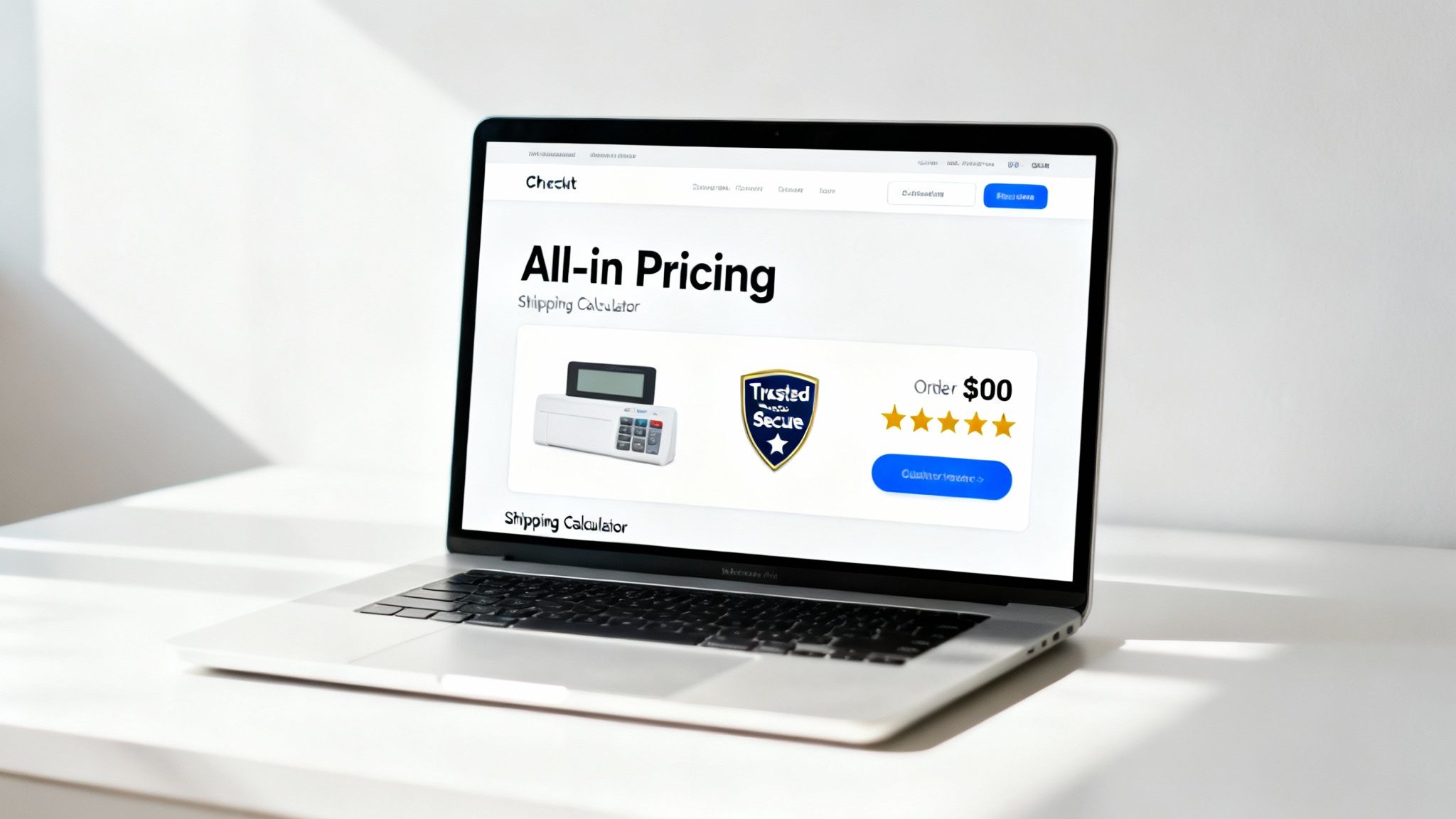
- Add a Shipping Calculator: Put a simple calculator right on the product or cart page. Let customers punch in their zip code to get a real shipping estimate long before they’re asked for their credit card.
- Offer "All-In" Pricing: If your margins allow, bundle taxes and standard shipping directly into the product price. "What you see is what you pay" is an incredibly powerful message that builds instant trust.
- Use a Dynamic Announcement Bar: A banner at the top of every page saying "Free shipping on orders over $50" does two things: it sets clear expectations and encourages bigger orders.
The goal is to make the final price predictable. A customer who knows the full cost upfront is far more likely to click "buy" than one who feels ambushed at the finish line.
Display Trust Signals Where They Count
Price transparency is huge, but it's only one piece of the trust puzzle. Shoppers are always looking for clues—often subconsciously—that your store is legitimate and their data is safe. You need to put these trust signals in the right places.
Don't just bury them in the footer. Place security badges (like SSL certificates) right next to the payment fields where they’re entering sensitive info. Make your return policy obvious and easy to find; a simple link under the "Complete Purchase" button can be enough to calm a nervous buyer. Of course, customer reviews and testimonials are gold, proving that real people have bought from you and had a good experience.
The Inherent Transparency of Bitcoin Payments
This is where accepting direct Bitcoin payments can become a surprisingly powerful trust signal, especially if you sell to a global audience. Traditional international payments are a minefield of hidden fees that neither you nor your customer has any control over.
Think about all the hidden costs baked into a standard international credit card purchase:
- High Cross-Border Fees: Card networks tack on extra charges just for crossing a border, and that cost gets passed on.
- Currency Conversion Markups: The exchange rate a customer gets is almost never the real market rate. Banks and processors skim a bit off the top, inflating the price.
- Bank Wire Transfer Charges: For bigger purchases, international wire fees can be ridiculously high.
These costs are murky and unpredictable—exactly the kind of checkout friction you’re trying to eliminate.
A direct, wallet-to-wallet Bitcoin payment cuts right through all that noise. Because Bitcoin runs on a global, decentralized network, it doesn't have "cross-border fees" or currency conversion markups in the traditional sense. The transaction is a straight shot from your customer's wallet to yours, with only a predictable network fee.
By offering a Bitcoin option through a service like Flash, you’re fundamentally offering a more transparent price to international customers. You’re signaling that you respect their money enough to give them a way around the costly, confusing legacy financial system. For a tech-savvy global audience, that move alone can build massive trust and slash your abandonment rate.
Smart Strategies to Recover Abandoned Carts
An abandoned cart isn't a lost sale—it's an invitation to keep the conversation going. Sure, some people were just browsing, but a surprising number fully intended to buy before life, a distraction, or a sudden doubt got in the way. Smart, timely recovery strategies are your secret weapon to bring them back and finish what they started. This is about more than just a generic "you left something behind" email; it's about giving them a compelling reason to come back.
The trick is to act fast, but not too fast. A well-timed follow-up can recapture a huge slice of otherwise lost revenue. This is your chance to smooth over any last-minute friction, remind them why they wanted the item in the first place, and make the path back to the checkout completely seamless.
Crafting the Perfect Recovery Sequence
One of the most battle-tested methods for clawing back those sales is a targeted sequence of email marketing strategies. While a single email can sometimes do the job, I’ve seen far better results from a strategic two or three-message series. It’s all about the timing and the content—you want to nudge, not annoy.
A solid sequence usually looks something like this:
- First Email (1-3 hours after abandonment): This one is just a gentle, helpful reminder. The customer's intent is still fresh, so the goal is to make it incredibly easy for them to pick up right where they left off. The tone should be pure customer service, not a hard sell.
- Second Email (24 hours later): If the first email didn't get a click, this follow-up can introduce a little urgency or tackle common worries. You might highlight the product’s best features again or mention that popular items can sell out.
- Third Email (48-72 hours later): This is your final shot. It's often where you can introduce a small incentive, like a discount code or a free shipping offer, to give that last little push. For shoppers on the fence about price, this is often the clincher.
Don't think of recovery emails as just a sales pitch. Frame them as a helpful service. You're saving the customer the hassle of finding their items all over again and reminding them of something they were clearly interested in.
Tailoring Your Message for a Bitcoin Audience
When you're dealing with Bitcoin users, your generic recovery tactics will fall flat. These customers operate on a different set of values—they prioritize privacy, speed, low fees, and self-sovereignty. Your recovery messages have to speak their language. Instead of a generic coupon, reinforce the unique advantages of finishing their purchase with Bitcoin.
This isn't just about making a sale; it shows you actually get them and their community. It proves you're not just another merchant who bolted on a Bitcoin option as an afterthought. It builds serious trust.
Bitcoin-Centric Recovery Email Templates
Here are a few ideas you can adapt for your own recovery sequence, designed specifically for a Bitcoin-savvy crowd.
Template 1: The "Simple & Secure Checkout" Reminder (Email 1)
- Subject: Still thinking it over? Your cart is saved.
- Body: We noticed you left a few things in your cart. Ready to finish up? Remember, checking out with Bitcoin is the fastest and most private way to complete your purchase. No forms, no banks, just a simple, direct payment.
- Call to Action: [Return to Your Secure Checkout]
This message gets right to the point, hitting on the core benefits—speed and privacy—that matter most to Bitcoiners. It reframes the checkout not as a chore, but as an efficient and secure experience.
Template 2: The "Global & Fee-Friendly" Nudge (Email 2)
- Subject: Don't let fees get in the way.
- Body: Still on the fence? One of the best parts about paying with Bitcoin is avoiding the usual cross-border fees and currency conversion markups. You get a clear, final price without any surprises from traditional payment processors.
- Call to Action: [View Your All-In Price]
This angle directly attacks the #1 reason for cart abandonment—surprise costs. It positions Bitcoin as the transparent, cost-effective solution they've been looking for.
Beyond Email: Re-Engaging on Their Turf
Don't stop at email. Your recovery efforts should meet your customers where they hang out. A Bitcoin-focused audience spends its time on specific platforms, forums, and news sites. This is prime real estate for a targeted retargeting campaign.
Imagine a clean, simple display ad running on a popular Bitcoin news aggregator or a respected industry blog. It could show the very items they left behind with a straightforward message: "Complete Your Order with Bitcoin for Instant, Private Checkout."
This strategy feels less like an ad and more like a helpful reminder from a brand that's an active, understanding member of their community. By combining a thoughtful email sequence with smart retargeting, you can turn that almost-sale into a loyal customer.
A Few Common Questions About Cart Abandonment
Jumping into new payment tech can bring up a lot of questions. I get it. Here are some of the most common things merchants ask when they’re trying to finally get a handle on abandoned carts.
Will Adding Bitcoin Really Help?
Yes, because it hits the root causes of abandonment head-on. The number one killer of sales is almost always sticker shock from unexpected costs at checkout. Direct Bitcoin payments run on tiny network fees, letting you dodge the usual 2-3% tax from credit card companies. That can be a meaningful difference in the final price a customer sees.
The other big one? A clunky, frustrating checkout. Something like Flash offers a dead-simple payment flow without making people create another account or fill out a mountain of forms. Plus, offering a payment method that a huge global community actively looks for builds instant trust and brings in a whole new type of customer.
How Hard Is It to Start Accepting Bitcoin?
Honestly, with the tools available today, it’s ridiculously easy. Platforms like Flash are built for regular business owners, not developers.
You can genuinely be up and running in less than a minute. For example:
- Got a website? Just copy and paste a small snippet of code for a payment button, just like embedding a YouTube video.
- Running a physical shop or an event? Use a simple point-of-sale app that turns your phone into a Bitcoin terminal on the spot.
The whole point of these tools is to make integration a non-issue. No coding degree or special hardware needed.
The barrier to entry for accepting Bitcoin is basically zero now. If you can add a video to your website, you have all the skills you need to add a Bitcoin payment button.
How Do I Handle Bitcoin Price Volatility?
This is the big one, and it's a completely fair question. While you could hold the Bitcoin you receive, most businesses don't. They opt to take price risk completely off the table.
Modern payment services give you the option for instant, automatic conversion into your local currency. When a customer pays you in Bitcoin, the service converts it to dollars, euros, or whatever you use, right at the moment of the sale. You get the exact amount you charged, every single time.
This way, you get all the good stuff—lower fees, zero chargebacks—without ever touching the volatility.
What If Most of My Customers Don't Use Bitcoin?
That’s perfectly fine. Offering Bitcoin isn't about ripping out what already works. You should absolutely keep your credit card and other payment options that your current customers know and trust.
Think of this as opening a new door, not closing old ones.
By adding Bitcoin, you’re tapping into a massive, global, and often pretty wealthy market that you literally couldn't reach before. For that crowd, seeing a Bitcoin payment option is a huge green flag. It tells them you’re a forward-thinking business that gets it. It’s a powerful way to win over new sales and build loyalty in a very passionate community.
Ready to turn those abandoned carts into sales with a checkout that’s faster and more secure? Flash gives you the tools to accept Bitcoin payments in under a minute, no coding necessary. Start accepting Bitcoin today.