When sending money across borders, businesses often face high fees and slow settlement times. Traditional banking systems rely on multiple intermediaries, adding costs and delays. These fees can range from 4% to 15% per transaction, with additional hidden currency conversion markups of 2% to 7%. Settlement times can take 2 to 7 business days, disrupting cash flow and increasing risks tied to currency fluctuations.
Bitcoin offers a solution by enabling direct, peer-to-peer payments without intermediaries. On-chain Bitcoin transactions cost between $3 and $15, while the Lightning Network allows near-instant transfers for fractions of a cent. Businesses can save significantly, avoid hidden fees, and benefit from faster settlements. Platforms like Flash simplify Bitcoin payments, offering tools for businesses to accept payments efficiently while maintaining control of their funds.
Key Takeaways:
- Fees: Bitcoin (1%-3%) vs. banks (5%-10%).
- Speed: Bitcoin (seconds to minutes) vs. banks (2-7 days).
- Transparency: Bitcoin eliminates hidden fees.
- Tools: Platforms like Flash streamline Bitcoin payment processing.
Bitcoin is reshaping global payments by reducing costs, speeding up transactions, and offering transparency.
How Traditional Cross-Border Payments Generate High Fees
Multiple Intermediaries Drive Up Transaction Costs
Sending money internationally through traditional banking systems isn’t as straightforward as it might seem. Payments don’t go directly from your bank to the recipient’s bank. Instead, they pass through a web of correspondent banks, each taking a slice of the pie along the way. This setup exists because most banks don’t have direct ties with every financial institution worldwide.
The SWIFT network plays the role of coordinator, ensuring these transfers move between multiple banks. But here’s the catch: every intermediary charges a fee. These fees add up fast, resulting in total transaction costs that can range from 2% to 7% of the transaction amount.
On top of this, visible wire transfer fees - usually between $10 and $50 - are just the tip of the iceberg. Banks also tack on exchange rate markups, often 2% to 5% (or more) above the mid-market rate. In 2023 alone, this practice contributed to an estimated $17.9 billion in fees, with $5.8 billion hidden in these markups. And the kicker? These costs are rarely disclosed upfront.
"Large banks and their consultants have concocted new junk fees for fake services that cost almost nothing to deliver. Banks should be competing to provide better products at lower costs, not innovating to impose extra fees for no value." – Rohit Chopra, Director, Consumer Financial Protection Bureau (CFPB)
The situation worsens when errors come into play. Mistakes in formatting or incomplete payment data often require manual intervention, leading to repair fees of $15 to $40 per transaction. Additionally, banks maintain massive reserves in pre-funded foreign currency accounts (known as nostro/vostro accounts) around the globe to facilitate these transfers. This ties up capital that could be put to better use elsewhere.
These mounting fees are only part of the story. The delays in processing add another layer of frustration.
Settlement Delays Disrupt Cash Flow
High fees are just one piece of the puzzle - delays in processing are another major issue. Traditional cross-border transactions, whether through wire transfers, card payments, or SWIFT messages, often take 2 to 7 business days to settle.
For businesses, these delays can wreak havoc on cash flow. Funds remain "in transit", forcing companies to hold larger cash reserves to bridge liquidity gaps. Meanwhile, the longer settlement times open the door to foreign exchange volatility, where currency values can shift significantly between the time a payment is sent and when it’s finally received.
"This lack of transparency causes unnecessary admin and worry for both people and business owners. Rather than focusing on growing their business and doing their job, too many entrepreneurs are spending valuable time trying to stay on top of disparate and vague payment processes." – Rasika Raina, Senior Vice President of Cross-border Payments, Mastercard
Time zone differences and limited banking hours further slow things down. Payments can end up sitting idle until the receiving bank opens for business. Each intermediary in the chain also conducts its own Anti-Money Laundering (AML) and Know Your Customer (KYC) checks, creating redundant processes that drag out the timeline even more. For some regions, the compliance costs have become so steep that many correspondent banks have stopped servicing them altogether.
These inefficiencies highlight the need for a simpler, faster, and more cost-effective solution.
The End of SWIFT? How AI and Stablecoins Will Change Cross-Border Payments
Bitcoin Eliminates Intermediaries Through Direct Transfers
Bitcoin enables direct transfers from one wallet to another on a decentralized ledger, cutting out the need for costly middlemen. This peer-to-peer system removes the reliance on traditional players like correspondent banks and payment processors, which often increase transaction costs.
One of Bitcoin’s standout features is its availability - payments can be made 24/7, completely unaffected by banking hours or holidays. Once a transaction is confirmed on the blockchain, it’s final, ensuring there’s no way to reverse it. This approach highlights how blockchain technology secures transactions and redefines how value is transferred.
Blockchain Technology Enables Peer-to-Peer Payments
At its core, Bitcoin's blockchain functions as a distributed ledger, where a decentralized network verifies transactions instead of a central authority.
"The whitepaper described a peer-to-peer electronic cash system that could enable direct value transfer without traditional financial intermediaries." – Dr. Christian Decker, Research Fellow, Swiss Bitcoin Institute
The blockchain’s base layer emphasizes security and resistance to censorship, making it a reliable system for high-value transfers. On-chain transactions are confirmed roughly every 10 minutes. However, larger transactions may require multiple confirmations, which can take over an hour to ensure they are irreversible. While this delay makes it less suitable for small, everyday purchases, it provides merchants with complete control over their funds, eliminating counterparty risks.
Privacy is another key feature. Through cryptographic methods, intermediate nodes are unable to detect details like the sender, recipient, or transaction amount. This ensures that only the sender and recipient know the payment specifics.
Lightning Network Provides Instant Low-Cost Transactions
Building on Bitcoin's foundation, the Lightning Network offers faster and cheaper transactions. This second-layer protocol operates on top of Bitcoin’s blockchain, using bidirectional payment channels that are anchored to the main blockchain. It allows for near-instant payments without requiring trust in the network participants routing the transaction.
"The Lightning Network is a peer-to-peer payment network. It leverages payment channels anchored on the Bitcoin blockchain to enable near instant and low-cost settlement of bitcoin between participants." – Lightning Engineering
With the Lightning Network, transactions achieve finality in seconds, making it ideal for everyday use. Payments are "all-or-nothing", meaning they either complete fully or fail altogether. This reliability is achieved using Hash Time-lock Contracts (HTLC).
During the 2017 bull market, network congestion made small on-chain payments - those under $10 - too expensive to process economically. The Lightning Network resolved this issue by enabling micropayments at minimal cost, with fees often amounting to fractions of a cent. Between 2020 and late 2025, the network's capacity grew by an impressive 384%.
sbb-itb-f81ab9b
Cost and Speed Comparison: Bitcoin vs. Traditional Payments
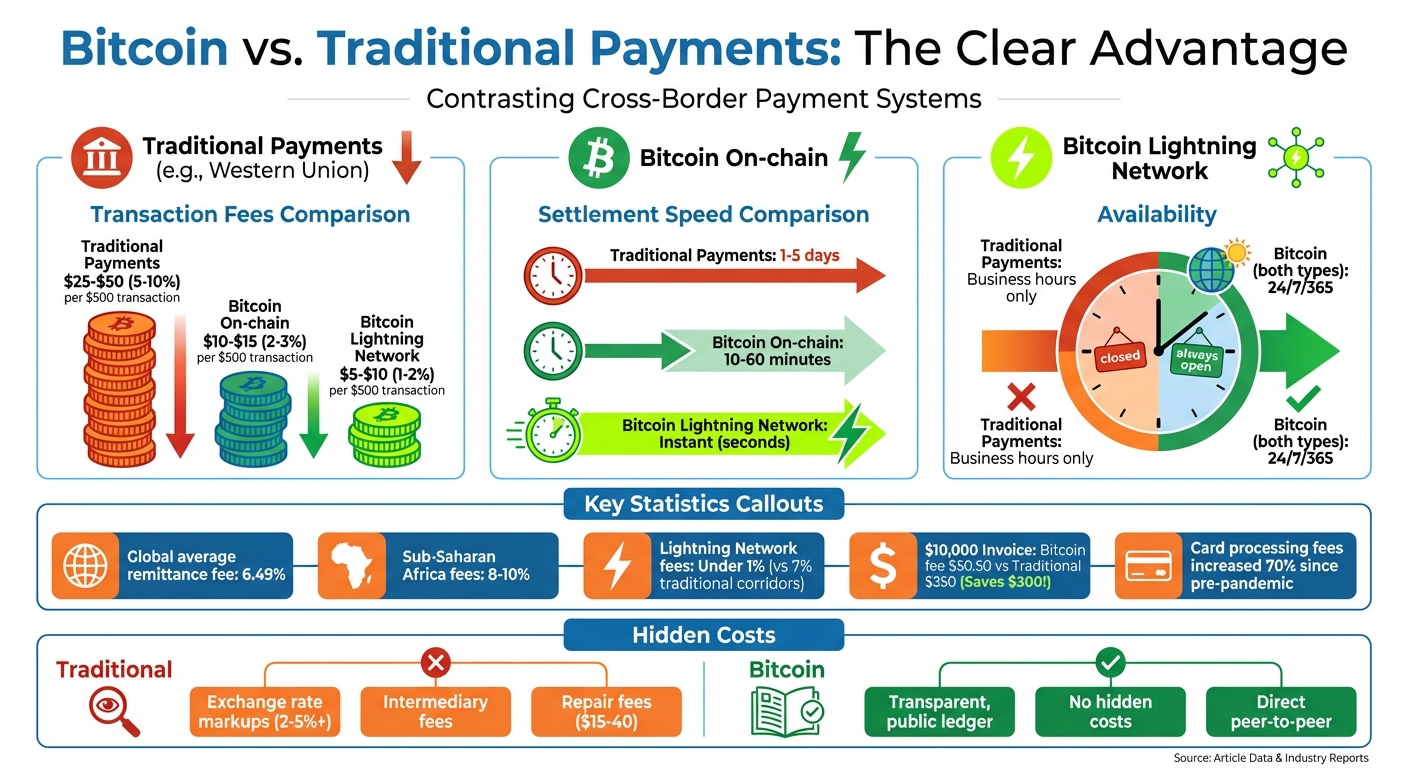
Bitcoin vs Traditional Payment Systems: Cost, Speed & Fee Comparison
Bitcoin offers a stark contrast to traditional cross-border payments when it comes to cost and speed, highlighting its growing appeal.
Bitcoin Transaction Fees: A Fraction of Traditional Costs
Traditional cross-border payments are notorious for their high fees, primarily due to the involvement of multiple intermediaries. For instance, the global average fee for remittances stands at 6.49% of the transaction value as of early 2025. In regions like sub-Saharan Africa, these fees can climb to 8–10%. Sending $500 through traditional services often results in fees ranging from $25 to $50, factoring in both service charges and exchange rate markups.
Bitcoin simplifies this process by removing most intermediaries. On-chain Bitcoin transactions typically cost between $3 and $15, regardless of the amount sent. Using the Lightning Network, fees can drop even further, ranging from $0.01 to $0.10. For example, sending $1,000 via Bitcoin might cost around a third of what banks would charge. Smaller transactions, like $200, also benefit significantly - traditional banks may charge up to 30 times more in fees compared to Bitcoin miners. Businesses utilizing the Lightning Network have reported total fees under 1%, a stark contrast to the 7% average in traditional payment corridors.
Here’s a quick comparison of fees, speed, and availability:
| Feature | Traditional (e.g., Western Union) | Bitcoin (On-chain) | Bitcoin (Lightning) |
|---|---|---|---|
| Fees ($500 send) | $25–$50 (5–10%) | $10–$15 (2–3%) | $5–$10 (1–2%) |
| Settlement Speed | 1–5 days | 10–60 minutes | Instant (seconds) |
| Availability | Business hours only | 24/7/365 | 24/7/365 |
Bitcoin Transactions: Minutes Instead of Days
Speed is a game-changer for businesses managing cash flow. Bitcoin transactions settle within minutes on-chain and in seconds via the Lightning Network. In comparison, traditional methods are significantly slower - ACH transfers take 1–3 business days, while international wire transfers can stretch to 3–5 business days. Once confirmed on the blockchain, Bitcoin transactions are final and cannot be reversed, eliminating chargeback risks that can take weeks to resolve in conventional systems.
This faster settlement process also reduces the uncertainty of hidden fees, reinforcing Bitcoin’s straightforward and transparent model.
Transparent Fees: No Hidden Costs
Traditional payment systems often obscure fees behind layers of intermediary charges, exchange rate markups, and processing costs. For example, card fees for U.S. merchants surged by nearly 70% in 2024 compared to pre-pandemic levels. These fees include 2.35% per transaction for card networks and an additional 1.1–3.15% from issuing banks.
Bitcoin, on the other hand, offers a transparent and predictable fee structure. Every transaction is logged on a public ledger, providing complete visibility. Users can even adjust transaction speeds based on network demand, giving them control over costs.
"Blockchain payments move value directly between parties on a shared digital ledger, instead of relying on traditional intermediaries such as banks or card networks." – BVNK
Platforms like Bitwage showcase these advantages. Processing $400 million for 4,500 companies between 2024 and 2025, Bitwage demonstrated how businesses could save substantially. For instance, a $10,000 invoice funded via crypto incurred a fee of just $50.50, compared to $350 on traditional card networks - saving merchants nearly $300 per transaction. Additionally, Argentine freelancers, who previously lost up to 50% of their income to bank fees and unfavorable exchange rates, benefited from stablecoin payments through blockchain invoicing, keeping more of their earnings intact.
Using Flash to Accept Bitcoin Payments
Flash offers a straightforward way to accept Bitcoin payments by cutting out unnecessary intermediaries. Acting as non-custodial software, Flash directly transfers funds between wallets, skipping banks, processors, and clearinghouses that typically charge transaction fees of 1.5%–3.5%. This direct model not only reduces costs but also simplifies the payment process.
Setting up Flash is quick - often taking just 1–3 minutes - and, in many cases, doesn’t require mandatory KYC, instantly connecting businesses to over 400 million Bitcoin users. A small service fee is deducted automatically in the background, making the process seamless.
Flash Features for Business Payment Processing
Flash’s platform is designed to adapt to a wide range of business needs, offering tools for both simple setups and custom integrations. Businesses can use no-code options for platforms like Shopify, WooCommerce, and Wix, or take advantage of its REST API for more tailored solutions.
Here’s a breakdown of the key tools Flash provides:
| Integration Tool | Description | Best Use Case |
|---|---|---|
| Payment Links | Simple, shareable links for quick transactions. | Ideal for freelancers, wholesalers, or social media sales. |
| Subscriptions | Automates recurring payments with fiat-to-BTC conversion. | Perfect for SaaS, memberships, or premium newsletters. |
| Point of Sale (PoS) | A mobile-friendly interface for in-person payments. | Great for retail stores, fairs, and service-based businesses. |
| Widgets | Embeddable tools for websites or apps. | Suitable for donation buttons or basic web checkouts. |
| Paywalls | Restricts access until a Bitcoin payment is made. | Useful for digital content, exclusive articles, or art galleries. |
Using the Lightning Network, Flash enables near-instant transactions with fees often amounting to just fractions of a cent. This makes it practical for everything from micropayments to large-scale retail operations. To protect against Bitcoin’s price volatility, merchants can set prices in fiat currencies like USD or EUR, with Flash locking in the exchange rate at the time of invoice creation. Additionally, Bitcoin’s irreversible transactions eliminate chargeback fraud, a common issue with credit card payments.
Security and Regulatory Compliance with Flash
Flash’s non-custodial design ensures that merchants retain full control and ownership of their Bitcoin at all times. Since Flash doesn’t hold funds, it significantly reduces security risks. As Pierre Corbin, CEO of Flash, puts it:
"Flash 2.0 is not just about making Bitcoin payments easier - it's about building the infrastructure for a decentralized financial future. Businesses that embrace this shift today will be the pioneers of tomorrow."
Because Flash operates as payment software - not a financial institution - it avoids the regulatory challenges of custodial services. However, merchants must implement their own security measures. For example:
- Use environment variables to store API keys instead of hardcoding them.
- Validate webhook signatures with the
Flash-Signatureheader to ensure notifications genuinely come from Flash. - Verify payment amounts server-side against your database before finalizing transactions.
Flash also provides sandbox keys for testing. These allow businesses to simulate scenarios like successful payments, declined transactions, or network timeouts before moving to live production keys. The platform’s webhook system ensures real-time updates for payment status changes, enabling immediate actions like inventory adjustments or sending confirmation emails.
Conclusion
From the high costs of traditional payment systems to Bitcoin's efficient model, it's clear that Bitcoin is transforming global payments. By removing intermediaries that typically take 1.5%–6.49% per transaction, Bitcoin offers a more streamlined and cost-effective alternative. The Lightning Network further enhances this by enabling direct, peer-to-peer transactions that settle in under a second, often with fees less than a cent.
To put this into perspective, traditional card processing fees can range from $2.00 to $3.00 per $100 transaction. In contrast, Lightning Network fees are typically under $0.01, providing instant settlement and freeing up capital. As Che from Flash explains:
"Lightning's negligible fees (fraction of a cent per transaction) would make at least $138 billion in direct merchant processing fees and hundreds of billions in remittance fees essentially obsolete".
Bitcoin's transparent ledger eliminates hidden fees, offering businesses a clear and predictable cost structure. Platforms like Flash are leveraging these benefits to simplify business payments, providing tools like payment links, custom API integrations, and non-custodial solutions.
With card processing fees rising nearly 70% since pre-pandemic times, integrating Bitcoin payment infrastructure isn't just a forward-thinking move - it's becoming essential for staying competitive.
FAQs
Why are Bitcoin transaction fees lower than traditional bank fees?
Bitcoin helps keep transaction costs low by cutting out intermediaries like banks or payment processors. Unlike traditional payment systems that charge percentage-based fees - ranging anywhere from 2% to 7% of the transaction amount - Bitcoin typically applies a flat fee. This fee usually falls between $1 and $5, no matter how large the payment is. That’s a big advantage, especially for cross-border payments or larger transactions.
What’s more, Bitcoin operates through direct, peer-to-peer transfers. This eliminates hidden fees or extra charges from third parties. The result? A simpler, more transparent process that saves money for both individuals and businesses.
What are the advantages of using the Lightning Network for international payments?
The Lightning Network brings some standout advantages when it comes to international payments. For starters, it drastically cuts transaction costs. Fees usually hover below $0.01 per transaction, a stark contrast to the hefty percentages banks often charge for cross-border transfers. On top of that, payments are processed almost instantly - no more waiting days for funds to clear like with traditional banking systems.
Another perk is its ability to handle high transaction volumes, making it a great fit for frequent or large-scale global transfers. Security is also a strong point. With direct wallet-to-wallet transfers, the risk of fraud or chargebacks is significantly reduced. Plus, its capability to process micropayments unlocks new possibilities for businesses, enabling models and markets that were once unfeasible due to high fees and sluggish processing times.
By leveraging the Lightning Network, both businesses and consumers can benefit from faster transactions, reduced costs, and improved transparency - changing the game for global payments.
How can businesses manage Bitcoin's price volatility when using Flash?
To navigate Bitcoin's price swings effectively with Flash, businesses can adopt several practical strategies to protect their financial stability. One smart move is automating Bitcoin-to-fiat conversions during times of intense market volatility. This helps secure the value of funds and minimizes the risk of sudden price changes. Another important step is setting clear treasury policies and using multi-signature wallets, which add layers of security and diversify reserves.
Flash also offers businesses valuable tools like real-time tracking and analytics. These features provide insights that support smarter decision-making. By implementing these measures, businesses can reduce risks while still taking advantage of Bitcoin's low transaction costs and its ability to facilitate payments across borders.