When it comes to storing Bitcoin securely, the most reliable option is **self custody with a hardware cold wallet**. Keeping your private keys completely offline cuts out the majority of attack vectors.
Of course, there are other paths worth considering. We’ll weigh up custodial services for ease of use, then dig into [Flash]()’s hybrid approach.
## Quick Answer And Summary
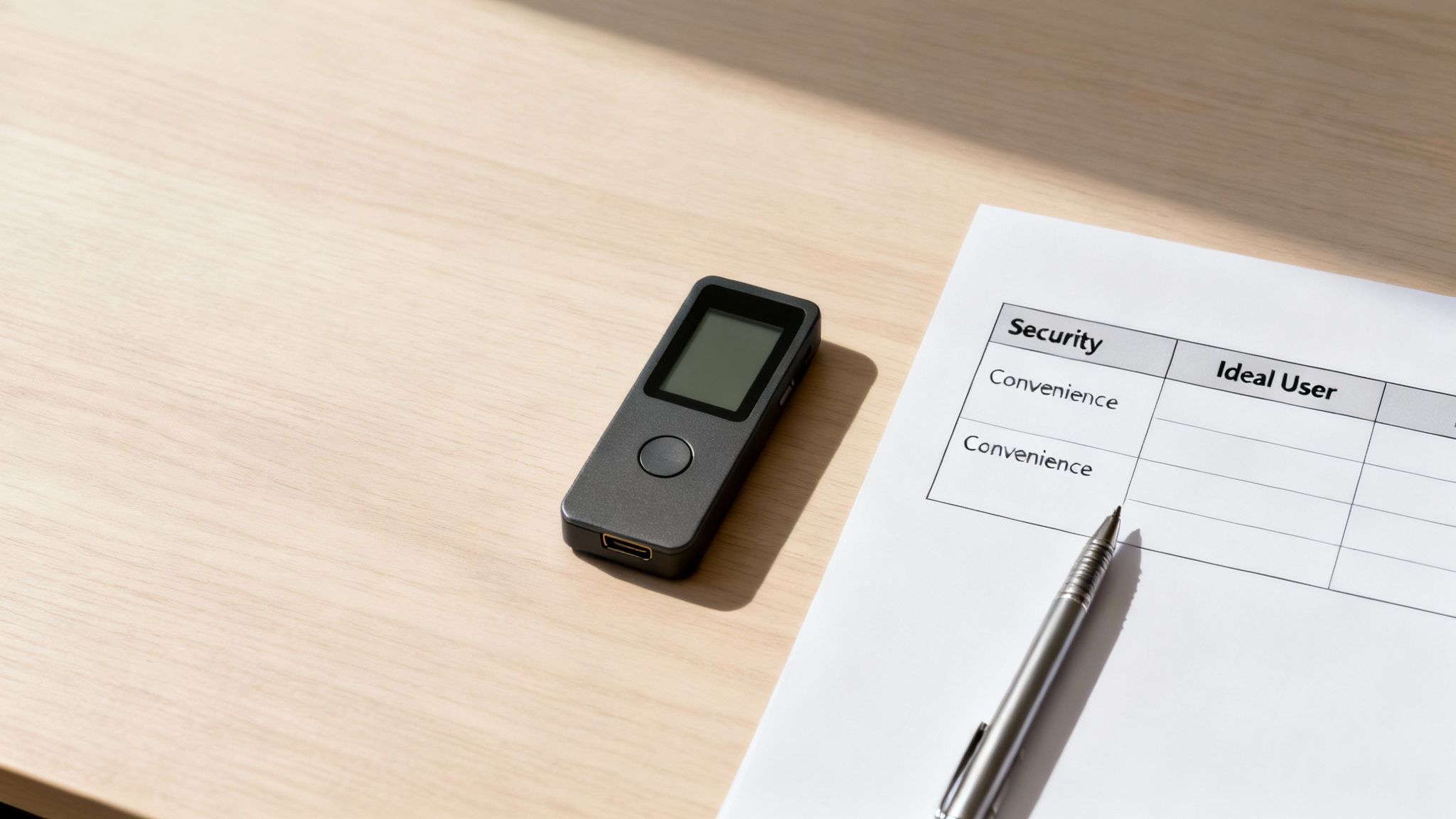
Here’s a rapid overview of the three main Bitcoin storage approaches, compared by security, convenience, and the ideal user.
- Hardware Cold Wallet: Keys stay offline for **maximum protection**.
- Custodial Service: Setup and recovery are simple, but you’re trusting a third party.
- Flash Integration: Signs transactions offline yet offers online access, striking a balance.
## Storage Method Summary
In the table below, you’ll see how each option stacks up on security, convenience, and who stands to benefit most. Use it to match your needs with the right tool for your Bitcoin holdings.
| Storage Method | Security Level | Access Convenience | Recommended For |
|----------------------|----------------|--------------------|---------------------|
| Hardware Cold Wallet | Highest | Low | Long-Term Hodlers |
| Custodial Service | Moderate | High | Frequent Traders |
| Flash Integration | High | Moderate | Tech-Savvy Users |
This snapshot should help you choose a storage strategy that fits your Bitcoin holdings and risk profile.
### Key Trade Offs
No storage solution is one-size-fits-all. Protecting large sums often comes at the expense of quick access.
> High security usually means slower retrieval. Decide based on how often you need to move funds and the level of risk you’re willing to accept.
### Next Steps
- Pinpoint your top priority: absolute security, fast trades, or a balanced mix.
- Follow a hardware wallet walkthrough for setup details.
- Explore Flash’s guide on pairing an air-gapped key with user-friendly apps.
Armed with these pointers, dive into the deeper sections to see real-world scenarios and step-by-step tutorials.
> **Tip** Store your recovery phrase offline and test wallet access regularly to avoid surprises.
Stay vigilant and secure.
## Understanding Bitcoin Storage Fundamentals
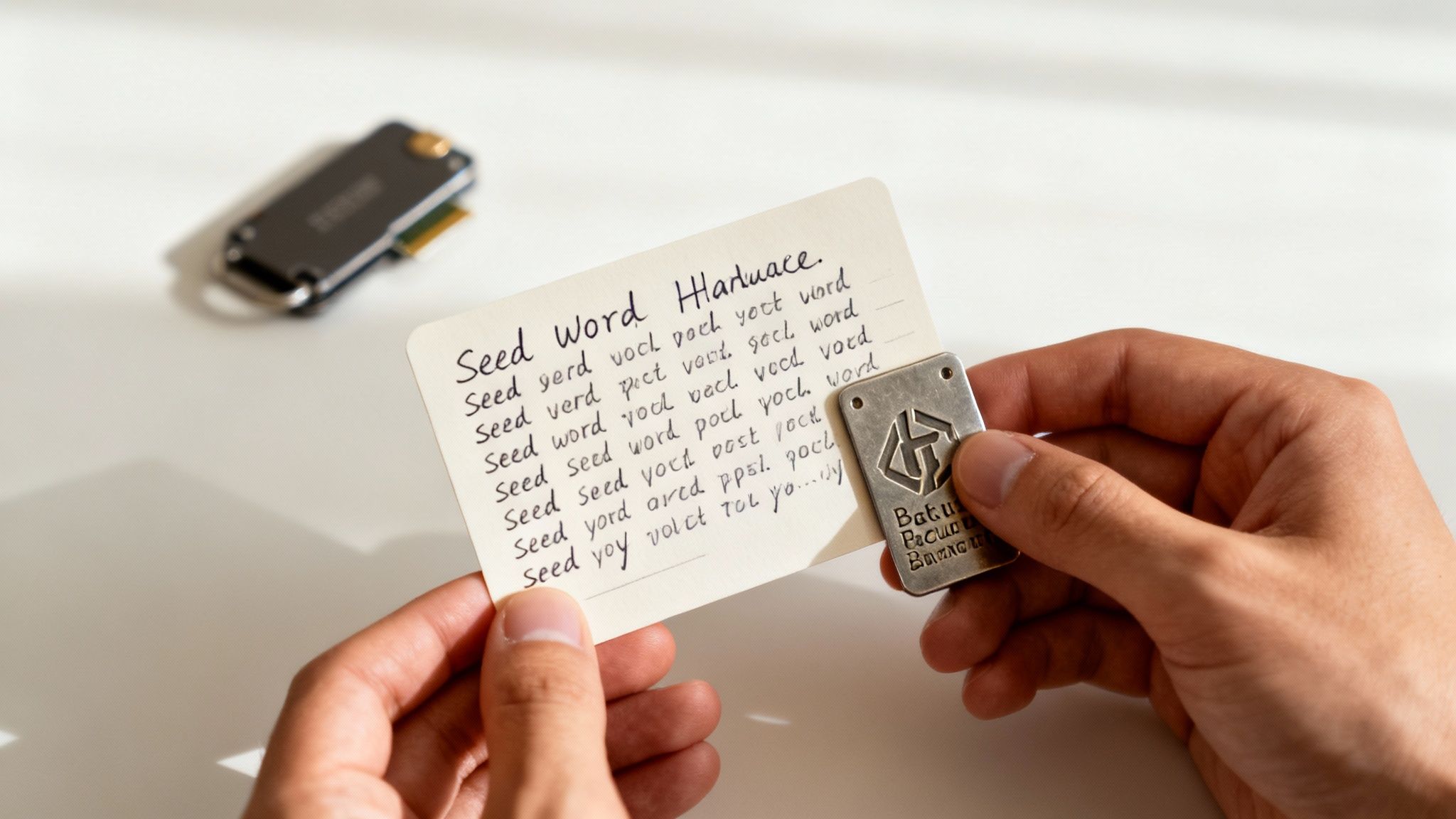
Holding your Bitcoin private keys yourself is what gives you true ownership. When someone else stores those keys, you’re trusting a third party to keep them safe.
Hardware-based self-custody shifts responsibility back to you by locking keys inside a dedicated device that stays offline.
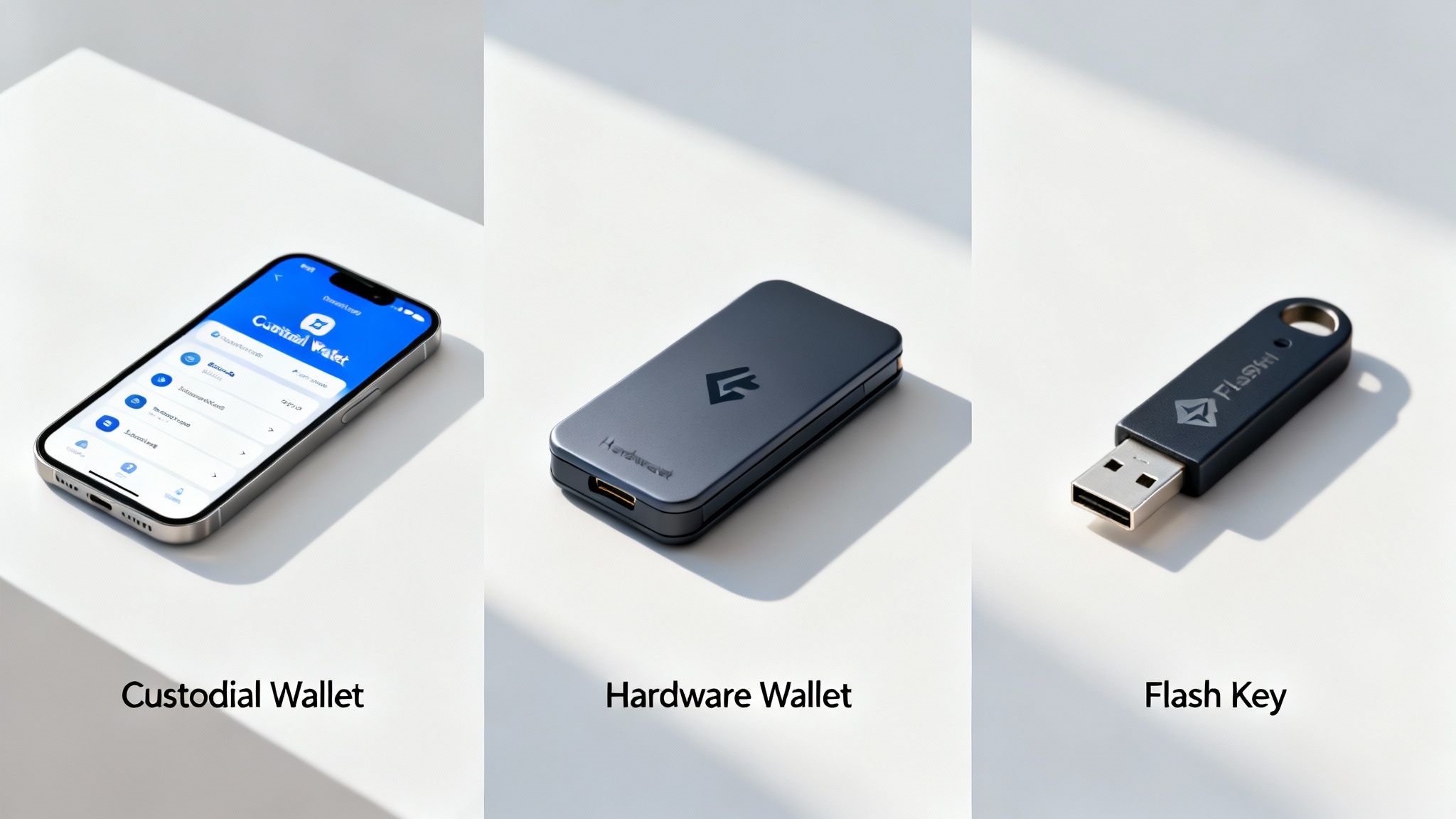
- **Custodial Storage**: Third-party services manage your keys.
- **Self Custody**: You hold keys in a hardware wallet.
- **Flash Integration**: Offline key signing meets an online interface.
Flash-style integrations keep keys air-gapped in a secure enclave yet let you build transactions on a connected device.
A **seed phrase** serves as a human-readable backup, letting you restore your private keys if something goes wrong. With a **multisignature setup**, you split signing power across several keys, so no single point of failure exists.
Offline signing means every transaction gets approved inside a sealed device, shielding keys from any network attack.
> Air-gap isolation thwarts phishing, malware, and remote hacks by removing key exposure to the internet.
Your choice will hinge on how much convenience you need versus how far you’re willing to go for security.
### Key Term Explanations
- **Seed Phrase**: A series of words that regenerates your private key if you ever lose access.
- **Multisignature Setup (Multisig)**: Requires multiple independent keys to sign off on a transaction.
- **Offline Signing**: Transaction approval happens inside a device that never touches the internet.
- **Air-Gap Isolation**: The signing hardware remains completely disconnected from any network.
Around **30% of Bitcoin holders** now use cold wallets as their main storage, while **69% rely on hot wallets** for quick access to Bitcoin. Cold wallet ownership jumped by over **30% year-over-year** among retail users, and institutional use rose by more than **50%**. For more detailed stats, see the cold wallet adoption data on [coinlaw.io](https://coinlaw.io/cryptocurrency-cold-wallet-statistics/).
Flash’s hybrid approach pairs a hardware signing module with a software client, so you get air-gapped security alongside a familiar interface.
### Comparing Isolation Methods
| Feature | Custodial | Hardware Self Custody | Flash Integration |
|---------------------|----------------|-----------------------|-------------------|
| Key Control | Low | High | High |
| Online Exposure | High | None | Minimal |
| Recovery Complexity | Simple | Moderate | Moderate |
| User Autonomy | Limited | Full | Full |
Choosing the right method depends on your tolerance for risk and how often you move funds.
- **Long-Term HODLers**: Prefer hardware wallets with air-gapped signing, eliminating all network exposure.
- **Active Traders**: Lean on custodial platforms for instant access and fewer steps per trade.
- **Hybrid Users**: Opt for Flash integration to balance strict security with day-to-day convenience.
### Offline Isolation Benefits
By cutting network ports, air-gap isolation closes off remote attack routes. No internet means no phishing or malware can touch your private keys. That’s why hardware wallets remain immune to most digital threats.
> Offline isolation is the most effective barrier against remote hacker threats.
With these basics in place, you’re ready to dive into more advanced storage comparisons in the next sections.
### Case Study Example
A tech-minded merchant wanted both security and speed for Bitcoin payments. They chose Flash integration.
1. Paired a hardware signer via NFC with a tablet app in an offline room.
2. Signed each payment inside a locked drawer, then broadcast the transaction online.
3. Kept firmware up to date to maintain compatibility and secure elements.
Next, we’ll break down each storage model side by side. This foundation ensures you can pick the storage approach that fits your needs.
## Evaluating Custodial, Self Custody And Flash Storage
When it comes to storing Bitcoin, the trade-offs aren’t just technical—they’re personal. You balance complete control against ease of use, weigh exposure risks against recovery hurdles, and factor in legal protections versus true independence.
Bitcoin security incidents are climbing. In just the first half of the year, hackers made off with over **$2.17 billion**, a **17% increase** over last year’s tally. Even more staggering is the **$1.5 billion** breach of a single exchange by state-linked actors—the largest hack in crypto history. [Read the full research about record-breaking crypto crime](https://www.chainalysis.com/blog/2025-crypto-crime-mid-year-update/).
Below, we walk through five core criteria to see how custodial platforms, hardware self custody, and Flash’s hybrid approach compare in real-world use.
### Key Evaluation Criteria
- **Key Control**: Who holds and manages your private keys?
- **Online Exposure**: How much is accessible via the internet?
- **Recovery Complexity**: What’s involved in backing up and restoring access?
- **Regulatory Safeguards**: Which legal or insured protections apply?
- **User Autonomy**: How dependent are you on third-party policies?
To connect the dots on security and flexibility, revisit the fundamentals of [custodial vs. non-custodial wallets](https://www.vtrader.io/news/custodial-vs-non-custodial/).
### Self Custody Security Analysis
Hardware wallets keep your private keys offline, inside a secure chip. That means **zero online attack surface** and total ownership of your keys. You do take on the responsibility of safeguarding a seed phrase—no easy task, but it steers clear of any third-party vulnerabilities.
Example Use Case:
1. A Bitcoin investor stores hardware devices in a locked, climate-controlled safe.
2. The 24-word seed phrase is split among three geolocated, fireproof containers.
3. Firmware updates are loaded via USB stick, never connected to a live network.
> By owning the keys outright, you sidestep exchange risks and centralized points of failure.
### Custodial Platform Security Analysis
Custodial services hold your private keys, freeing you from seed-phrase headaches. Many of these platforms carry insurance policies and follow strict audit schedules. On the flip side, you trade direct control for convenience—and face a larger online footprint that hackers can target.
Example Use Case:
- A day trader uses a major exchange to place high-frequency Bitcoin orders.
- Automated KYC and compliance checks speed up withdrawals.
- During market stress, withdrawal caps may temporarily lock up funds.
### Flash Integration Security Analysis
Flash blends offline key signing with a connected interface, giving you the best of both worlds. Transactions are authored on your desktop or mobile app, then signed in an air-gapped device. It mirrors self custody’s recovery steps but feels as quick and intuitive as a custodial wallet.
Example Use Case:
- A small merchant links a Flash hardware signer to their point-of-sale tablet.
- Incoming payments are prepared on screen, then signed with a tap on the offline unit.
- Signed transactions broadcast instantly without exposing private keys.
### Feature Comparison Of Storage Methods
Before you commit, here’s a side-by-side look at how each solution handles key security, exposure, backups, regulation and autonomy.
| Criteria | Self Custody | Custodial | Flash Integration |
|-----------------------|----------------------|-------------------------|-------------------------|
| Key Control | Full Ownership | Third-Party | Full Ownership |
| Online Exposure | None | High | Minimal |
| Recovery Complexity | Moderate | Simple | Moderate |
| Regulatory Safeguards | User-Managed | Insurance & Audits | User-Managed |
| User Autonomy | Complete | Policy-Driven | Complete |
Each model caters to a different set of needs: self custody for absolute control, custodial for seamless convenience, and Flash integration for a middle ground that doesn’t slow you down.
### Practical Takeaways
- Long-term HODLers often favor **hardware self custody** to isolate funds from online threats.
- Active traders and newcomers lean on **custodial platforms** for instant funding and simplified recovery.
- Businesses and power users choose **Flash integration** to sign securely without sacrificing speed.
Regulatory protections can differ based on where you live. Exchanges may offer FDIC-style coverage or third-party insurance, while self custody and Flash users rely entirely on their own safeguards.
### Choosing Based On Profile
- High Security Focus: Go with **Self Custody** if you’re comfortable managing backups and hardware.
- Ease Of Use: **Custodial Platforms** suit those who value quick setups and fewer technical steps.
- Balanced Security And Access: **Flash Integration** fits tech-savvy individuals or merchants who need both safety and speed.
## Real World Storage Scenarios And Use Cases
Finding the right Bitcoin storage solution is all about weighing **security**, **access speed**, and your own **technical comfort**. Below, we explore three everyday scenarios—each one tailored to different risk appetites and transaction habits.
A recent survey shows **59%** of people worry about Bitcoin security, **40%** aren’t confident in their current storage, and nearly **20%** have experienced withdrawal delays on custodial platforms. For more on these insights, check out the Bitcoin security sentiment report at [Deepstrike](https://deepstrike.io/blog/fintech-breach-statistics-2025).
- Risk tolerance defines how much offline isolation you need.
- Transaction frequency dictates whether you favor instant access or airtight signing.
- Technical expertise sets the bar for setup and recovery complexity.
### Long Term Cold Storage
When you’re parking **high-value holdings**, nothing beats a hardware cold wallet kept completely offline. It isolates your private keys in a device with zero network ports.
Store your device in a fireproof safe. Then split and store your seed phrase across secure, geographically dispersed backups. This approach minimizes theft and hardware-failure risks.
Institutions often layer on **multisig** across different locations. Yes, it adds setup complexity—but it also slashes single-point-of-failure risk.
| Criteria | Approach | Benefit |
|-----------------------|-----------------------------|------------------------------|
| Risk Tolerance | Ultra offline cold wallet | Maximum key isolation |
| Transaction Frequency | Rare periodic access | Minimize online exposure |
| Technical Expertise | Moderate setup required | Full ownership and control |
> Think of cold storage as a safety deposit box for your Bitcoin.
### Frequent Trading With Custodial Services
Active traders prize custodial exchanges for their near-instant access to funds. These platforms manage your private keys and often back their service with insurance or third-party audits.
That said, be ready for withdrawal caps or delays when markets get choppy. Always vet platform reliability and maintain a backup plan in case your funds sit locked.
- Near-instant withdrawals keep your strategies nimble.
- Intuitive interfaces let you react faster in volatile markets.
- Built-in compliance and insurance guard against exchange hacks.
> Custodial services suit high-frequency Bitcoin traders—but double-check withdrawal limits to avoid surprises.
### Hybrid Flash Integration For Power Users
Power users and merchants who need both control and speed turn to Flash’s hybrid model. Transactions are constructed online, then signed on an air-gapped module.
This setup blends self-custody’s security with custodial convenience—without surrendering your keys. It’s ideal for those who juggle large volumes and regular settlements.
1. Pair your Flash hardware signer over a secure channel.
2. Build the Bitcoin transaction in the desktop or mobile client.
3. Approve the transaction on the offline device to sign.
4. Broadcast the signed transaction via your network connection.
> Merchants using Flash report **zero reconciliation errors** on daily batch processing and enjoy near-instant settlement confirmation.
When you match your profile with the right storage method, you’re not just storing crypto—you’re managing risk and efficiency on your terms.
**Tip:** Regularly test your backup and recovery process to avoid unexpected workflow hiccups.
## Implementing Setup And Cost Trade Offs
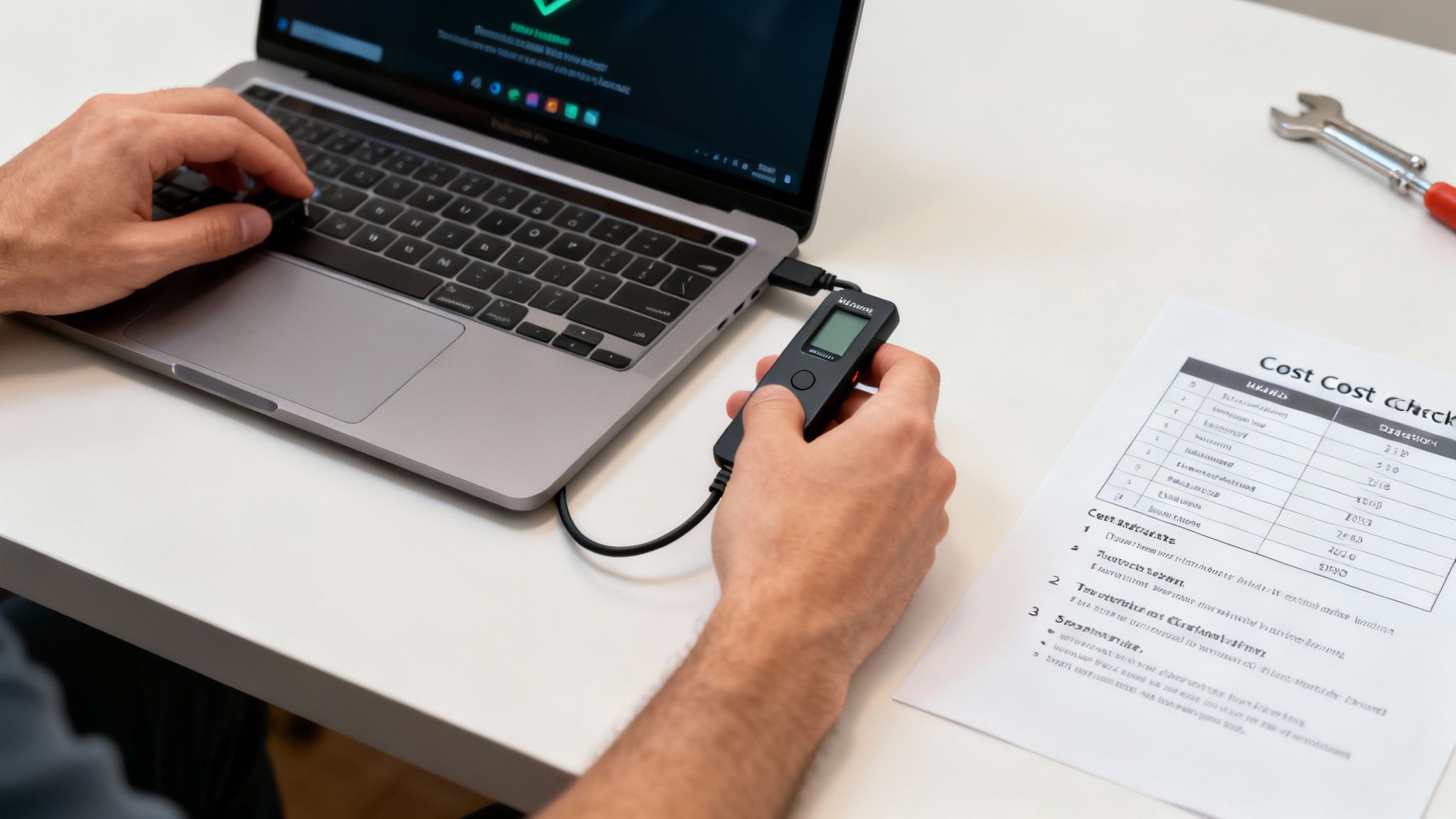
Getting your Bitcoin storage right isn’t as simple as plugging in a device or clicking “create account.” You need a clear plan for every step—hardware, software, backups and ongoing maintenance.
Self-custody, custodial services and Flash’s hybrid approach each come with their own setup paths and price tags. This framework lays out where to invest your time, technical muscle and budget so nothing catches you off guard.
### Hardware Wallet Initialization
A hardware cold wallet locks your Bitcoin keys in a device that never touches the internet. First, unbox and inspect safety seals—counterfeit units can look convincing at a glance.
Next, install the manufacturer’s companion app on a known-clean computer. Generate a **24-word** seed phrase, set a PIN and update to the latest firmware release. These steps dramatically shrink your risk from outdated code or malicious firmware.
After your device is up and running, focus on bulletproof backups. A metal plate or Cryptosteel kit stands up to fire and water far better than paper. Engrave your seed phrase and tuck copies into geographically separated, fire-resistant safes. Always run a recovery test on a secondary device to confirm your process.
Key Initialization Steps:
- Verify hardware authenticity and intact safety seals
- Install and launch the offline setup utility
- Generate and record a **24-word** seed phrase
- Confirm the seed by re-entering it on the device
- Update firmware over USB using a secure, offline machine
- Store metal backups in multiple fireproof locations
This diligent routine represents the **safest way to store crypto** for long-term cold storage.

### Custodial Service Account Setup
Custodial platforms take Bitcoin key management off your hands but introduce ongoing fees. Start by choosing a provider with transparent insurance and a rock-solid compliance record.
Register with your email, complete Know-Your-Customer checks and upload government-issued ID. Enable **two-factor authentication** before you link any payment methods. A small test deposit helps you verify that funding and withdrawals flow as expected.
Account Setup Detailed Steps:
1. Create an account on a vetted custodial platform
2. Complete ID verification with a valid government document
3. Link your bank account or credit card and perform a small deposit
4. Review fee tiers, withdrawal limits and settlement windows
Some services bundle in insurance pools—read the fine print to know exactly what’s covered.
### Flash Integration Walkthrough
Flash marries your hardware key to client software, giving you a hybrid custody model. Install the Flash desktop or mobile app and connect your offline signing module via QR code or USB. This process never exposes private keys to the internet.
Compose transactions within the Flash app, then walk over to your air-gapped device to approve each one. Finally, broadcast the signed transaction through a self-run node or a trusted public API. You’ll never worry about private keys sitting on an exposed system.
- Download and verify the Flash app from the official site
- Pair your hardware signing module in a secure environment
- Build transactions offline in the client interface
- Approve each transaction on the air-gapped device
- Broadcast signed transactions through your chosen endpoint
> “Flash’s hybrid model elevates operational efficiency without sacrificing Bitcoin key security.”
### Cost And Fee Comparison
Understanding upfront and ongoing costs keeps your budget on track. The table below captures the primary expenses you’ll face over the first year:
| Category | Self Custody | Custodial Service | Flash Integration |
|------------------------|-------------------|---------------------|----------------------|
| Hardware Device | **$60–$200** | $0 | **$70–$150** |
| Backup Tools | **$20–$50** | Not required | **$20–$50** |
| Firmware Updates | Free | N/A | Free |
| On-Chain Fees | Pay per TX | **0.5%–1% per TX** | Pay per TX |
| Insurance | User-sourced | Often included | User-sourced |
| Recovery Service | DIY or paid pro | Provider-assisted | DIY or paid pro |
| Multisig Setup | **$50–$150** | Not supported | **$50–$150** |
Bullet Points for Cost Considerations:
- Estimate transaction frequency to project fee accumulation
- Compare insurance limits and the claims process
- Budget for occasional hardware replacement and upgraded storage
- Factor in professional recovery support if you’re safeguarding large balances
### Balancing Security And Budget
If you’re HODLing for years, self-custody often wins with its low ongoing expenses. On the other hand, active traders trade a device’s logistic hassle for the speed and convenience of custodial platforms.
Businesses processing high volumes can see a clear ROI when Flash’s initial hardware costs pay off in fee savings and security. Always map out annual expenses based on your transaction count and asset value.
> “Security planning must always include a cost model,” advises a veteran Bitcoin analyst.
Routine firmware and app updates cost nothing but should go on your calendar. An annual recovery rehearsal will keep emergency expenses from blindsiding you.
### Practical Implementation Tips
A secure storage strategy thrives on clear documentation and regular audits. Maintain a log of firmware versions, backup locations and pairing details.
- Verify device seals before each major firmware upgrade
- Rotate backup storage sites every year
- Store recovery procedures in encrypted digital files
These simple practices ensure your Bitcoin storage remains both resilient and cost-effective. Update your playbook annually to stay ahead of emerging threats.
## Final Recommendations For Different User Profiles
<iframe width="100%" style="aspect-ratio: 16 / 9;" src="https://www.youtube.com/embed/9uodS6FBsdw" frameborder="0" allow="autoplay; encrypted-media" allowfullscreen></iframe>
Choosing the right Bitcoin storage comes down to your tech comfort level and the amount of Bitcoin at stake. Whether you opt for a custodial platform, Flash-powered hybrid, or pure cold storage, your daily habits and long-term goals should guide your decision.
### Beginner User Recommendations
If you’re just starting out, custodial Bitcoin wallets offer a gentle learning curve. You sign up, verify your identity, and the service handles your private keys—no seed phrases to juggle.
Key Highlights:
- Straightforward account setup and identity checks
- Built-in **2FA** and simple recovery options
- Clear fee structures and detailed user guides
> Depositing Bitcoin in a custodial service is the simplest path for new users to learn and transact.
Once you’re comfortable, you can transition to self-custody and take full control of your seed phrases.
### Intermediate User Guidance
After you’ve made your first dozen transactions, you might crave more control without sacrificing ease of use. Flash integration marries an air-gapped signing device with an intuitive app, creating a smooth two-step workflow.
Getting Started:
1. Pair your hardware signing module with the Flash client
2. Draft transactions in the app
3. Approve them offline on your device
4. Broadcast signed transactions through a trusted endpoint
This hybrid approach delivers **High Security** while keeping familiar routines intact.
| Profile | Storage Method | Security Level | Convenience |
|--------------------|-------------------|----------------|-------------|
| Intermediate Users | Flash Integration | High | Moderate |
Ideal for tech-curious traders who value autonomy but still want a straightforward experience.
### Advanced User Strategies
Seasoned Bitcoin holders often turn to full self-custody with multisignature setups. By splitting keys across devices and locations, you protect against loss, theft, or hardware failure.
Best Practices:
- Use a **2-of-3** multisig wallet for redundancy
- Update firmware offline and verify each device’s authenticity
- Store seed backups on metal plates for fire and water resistance
> True ownership means only you control every private key element across your multisig setup.
| Criteria | Multisig Cold Wallet | Flash Integration |
|--------------------|----------------------|-------------------|
| Key Control | Total | Total |
| Online Exposure | None | Minimal |
| Recovery Overhead | Moderate | Moderate |
Choose multisig if you need maximum redundancy, or Flash integration for simpler daily transactions.
### Institutional Considerations
For organizations, traceability and compliance are non-negotiable. Hardware modules integrate with key management systems (KMS) and HSMs, generating signed audit trails at every step.
Core Elements:
- Role-based access control for each signer
- On-chain transaction approvals with embedded audit logs
- Encrypted records to satisfy external reviews
These processes ensure every Bitcoin withdrawal is fully accountable and transparent.
Whether you’re safeguarding a small stash or managing an enterprise treasury, align your storage strategy with your profile. Review your setup as your needs evolve, test recovery procedures regularly, and keep your documentation up to date.
**Quick Best Practice Checklist:**
- Audit your backups every **six months** and confirm seed phrases
- Rotate storage locations to eliminate single points of failure
- Monitor firmware releases and apply updates offline
- Add a passphrase to your seed for an extra layer of defense
Stay vigilant, revisit your security posture often, and adapt as your Bitcoin journey unfolds.
## FAQ
When it comes to holding Bitcoin, there’s no substitute for **self-custody** with a hardware cold wallet. It keeps your private keys offline, cutting off most attack routes. Even if your computer or network is breached, your keys stay untouched.
Custodial wallets trade some control for **convenience**. The platform manages your keys and recovery, making them ideal for frequent traders or anyone testing multiple wallets.
- Streamlined sign-up and account recovery
- Instant access to funds without juggling seed phrases
- Insurance options on select services
[Flash]() wallets merge the best of both worlds. You draft transactions in your everyday app, confirm them offline on a hardware device, then broadcast them once signed. This hybrid approach balances speed with robust protection.
### Key Insight From Experts
> “Hardware wallets are your best defense against remote attacks,” says a Bitcoin security researcher.
If your device goes missing, pull out your securely stored seed phrase and restore it in a trusted wallet. Always verify balances before making new transactions. Storing backups in several locations and rehearsing recovery procedures can save you from a world of stress.
For a lasting legacy, think beyond your own lifetime. Learn how to pass on digital assets responsibly with [Digital Asset Estate Planning](https://texastrustadministration.com/digital-asset-estate-planning/).
### Practical Tips
- Match your storage method to your risk appetite
- Test recovery steps at least once a year
- Use hardware wallets for long-term holdings and custodial services for active trading
Hybrid custody gives you the best of both security and speed. Ready to optimize your Bitcoin workflow? Visit [Flash]().
Uncategorized