Sanctions are strict government-imposed restrictions aimed at protecting national security and foreign policy interests. While Bitcoin itself is decentralized and cannot be frozen, payment gateways facilitating Bitcoin transactions face severe challenges due to these sanctions. Key issues include:
- Financial Penalties: Companies like Binance and Bittrex have faced billions in fines for violations.
- Operational Disruptions: Compliance requires constant monitoring of transactions, user data, and geolocation to avoid sanctioned entities.
- Reputational Damage: Non-compliance can tarnish credibility and lead to loss of partnerships.
To comply, gateways must implement advanced tools like blockchain analytics, real-time IP tracking, and Know Your Customer (KYC) protocols. Platforms like Flash integrate compliance into their systems, using non-custodial payments, analytics, and geolocation tools to mitigate risks. Staying compliant is non-negotiable, as violations bring hefty fines and operational setbacks.
Implementing a Sanctions Compliance Program for Digital Assets
How Sanctions Affect Bitcoin Payment Gateways
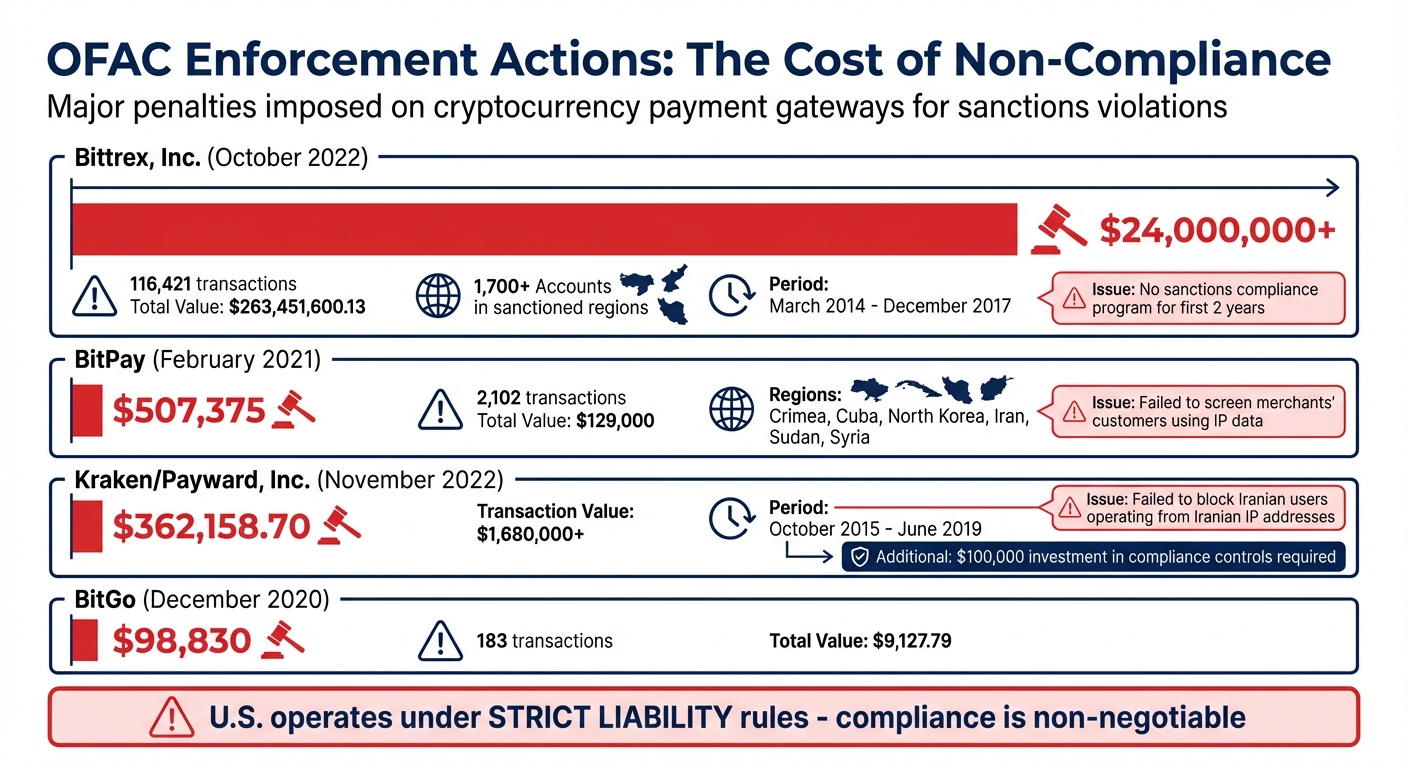
Major OFAC Penalties for Bitcoin Payment Gateway Sanctions Violations
Bitcoin payment gateways encounter three key challenges due to sanctions: financial penalties, operational disruptions, and reputational damage. These consequences shape how gateways operate and strategize. Let’s break down each impact.
Financial Penalties and Asset Freezes
The financial fallout from sanctions violations can be staggering. Take the case of Bittrex, Inc. - in October 2022, the company faced a penalty exceeding $24 million from OFAC. Why? Between March 2014 and December 2017, Bittrex operated over 1,700 accounts and processed 116,421 transactions worth $263,451,600.13 for users in sanctioned regions, all while lacking a sanctions compliance program during its first two years of operation.
Even smaller violations can lead to costly penalties. For example:
- BitGo settled for $98,830 in December 2020 after processing 183 transactions totaling $9,127.79.
- BitPay paid $507,375 in February 2021 for facilitating 2,102 transactions worth $129,000. These transactions involved users from regions like Crimea, Cuba, North Korea, Iran, Sudan, and Syria. While BitPay screened merchants, it failed to screen the merchants' customers using available IP address data.
The U.S. operates under strict liability rules, meaning compliance is non-negotiable. As OFAC emphasizes:
"U.S. persons, wherever located, including firms that process virtual currency transactions, must be vigilant against attempts to circumvent OFAC regulations and must take risk-based steps to ensure they do not engage in prohibited transactions".
Additionally, the 50 Percent Rule requires gateways to block access to any entity owned 50% or more by sanctioned individuals.
Operational Disruptions and Compliance Requirements
Sanctions don’t just hit the wallet - they disrupt how gateways function. Compliance demands constant vigilance through a lifetime-of-the-relationship screening process. This means implementing real-time IP tracking, geolocation monitoring, and blockchain analytics to track fund flows. Gateways must block transactions from sanctioned jurisdictions like Iran, Syria, and Crimea.
For instance, in November 2022, Kraken (operated by Payward, Inc.) settled for $362,158.70 after failing to block Iranian users. Between October 2015 and June 2019, these users transacted over $1.68 million by opening accounts in non-sanctioned regions but later operating from Iranian IP addresses. As part of the settlement, Kraken pledged to invest an additional $100,000 in compliance controls .
As transaction volumes grow, relying on manual reviews becomes increasingly impractical. This underscores the need for automated monitoring systems to ensure compliance.
Reputational Damage from Non-Compliance
Non-compliance doesn’t just hurt financially - it can tarnish a gateway’s reputation. Public enforcement actions serve as warnings to the industry, signaling potential insecurity or non-compliance. OFAC uses settlement announcements to caution other companies. This kind of public scrutiny can harm a platform’s competitive edge and strain business relationships.
Regulators often see non-compliance as giving companies an "unfair competitive advantage" over law-abiding competitors, which can invite harsher penalties and long-term reputational harm. Moreover, gateways that fail to invest in compliance risk being linked to illegal activities, such as darknet marketplaces, ransomware payments, or stolen identification data. Such associations can permanently damage their standing with legitimate partners and customers.
Compliance Requirements for Bitcoin Payment Gateways
Bitcoin payment gateways are subject to the same regulatory expectations as traditional financial institutions. The Office of Foreign Assets Control (OFAC) mandates that digital currency transactions comply with the same standards applied to fiat currency transactions. This means gateways must fully adhere to U.S. sanctions laws.
Meeting these compliance requirements goes well beyond simply verifying new customers. Gateways are obligated to screen every user and transaction against OFAC's Specially Designated Nationals (SDN) List. Since 2013, crypto businesses have submitted 96,000 crypto-related Suspicious Activity Reports (SARs) to the Financial Crimes Enforcement Network (FinCEN), highlighting the extensive monitoring needed to stay compliant.
Sanctions Screening and Geolocation Tools
To meet these stringent regulations, gateways rely heavily on advanced screening tools. Compliance isn’t a one-and-done process - it demands continuous monitoring of users and transactions. This includes ongoing checks for changes, such as customers relocating to sanctioned regions or being added to the SDN List after account creation.
Geolocation tools play a key role in blocking access from heavily sanctioned regions like Iran, Syria, and North Korea. These tools monitor IP addresses in real time to prevent transactions from restricted areas. However, some users attempt to bypass these controls using VPNs or proxy servers. To counter this, gateways need systems that can detect and address IP misattribution.
In addition to geolocation, gateways must enforce robust Know Your Customer (KYC) protocols. These procedures verify personal details and official identification, ensuring compliance with regulations like the 50 Percent Rule.
OFAC offers a Sanctions List Search tool that allows gateways to check specific digital currency addresses by entering the hash value into the "ID #" field. However, relying solely on static lists isn’t sufficient. Best practices include using Multiple Blockchain Analytics Tools (MBAT) to identify unlisted addresses potentially linked to sanctioned individuals or shared wallets.
Transaction Monitoring and Reporting Requirements
Real-time transaction monitoring is another critical aspect of compliance. Blockchain analytics tools are indispensable here, as they trace the movement of funds across multiple "hops", helping identify indirect links to sanctioned actors. When OFAC adds a new address to the SDN List, gateways are required to review previous transactions for any historical connections.
Kenneth Blanco, Director of FinCEN, highlighted the importance of detailed reporting in compliance efforts:
"When people put IP addresses, malware hashes, malicious domains, virtual currency addresses, that really is important. That really helps us".
U.S. persons are required to report any blocked virtual currency to OFAC within 10 business days of the blocking action. These reports must include technical identifiers, such as IP addresses and malware hashes, to assist law enforcement.
The consequences of non-compliance are severe. As Kenneth Blanco cautioned, "Asking for forgiveness is going to be a big problem". Gateways that identify violations are encouraged to voluntarily disclose them to OFAC, which can significantly reduce potential civil penalties. The most effective approach is to integrate compliance measures into the business model and product design from the outset, rather than trying to add them after operations are underway.
sbb-itb-f81ab9b
How Flash Addresses Compliance and Risk Management
Flash weaves compliance into its platform from the ground up, reducing the risk of regulatory penalties. By embedding OFAC's compliance standards right from the start, Flash ensures that users avoid the costly mistakes that have historically challenged the industry. These features integrate effortlessly into broader compliance strategies, creating a strong foundation for managing risk effectively.
Non-Custodial Wallet-to-Wallet Payments
Flash's non-custodial model focuses on direct wallet-to-wallet transactions, bypassing the need to hold customer funds. This approach lowers intermediary liability and reduces the central points of failure that often attract regulatory scrutiny. For instance, breaches in custodial systems have previously led to incidents like the re-designation of Garantex Europe OU in August 2025, after it processed over $100 million in illicit transactions. By enabling direct transfers, Flash minimizes exposure and demonstrates a strong commitment to compliance.
Real-Time Analytics for Compliance Monitoring
In addition to its secure transaction model, Flash includes a real-time analytics system to protect operations continuously. This system supports the "lifetime-of-the-relationship" screening now required by regulators. Real-time monitoring helps businesses catch issues before they escalate, flagging unusual patterns such as rapid fund movements or "peel chains" - tactics often used to conceal illicit activity. With cryptocurrency fraud surging 66% in 2024, resulting in nearly $10 billion in losses, this level of dynamic monitoring is critical for upholding compliance standards.
Customizable Integrations and Low-Code Tools
Flash also offers low-code tools that make it easy for businesses to implement strong compliance measures. Customizable widgets handle tasks like geolocation and IP blocking, automatically restricting access from sanctioned regions and identifying VPN bypass attempts. These tools simplify KYC data collection during onboarding, capturing essential identification details upfront. By proactively screening users from the start, businesses can avoid the complications and costs tied to retrofitting compliance measures later on. This streamlined approach ensures that compliance processes are both thorough and efficient.
Risk Management and Compliance Strategies
Using Blockchain Analytics and Geolocation
Blockchain analytics tools play a critical role in identifying wallet clusters tied to sanctioned entities, even those not explicitly listed on OFAC's SDN list. These tools track funds across multiple transactions and intermediary wallets, revealing connections to mixers and other high-risk entities designed to obscure the origins of funds.
Geolocation tools add another layer of protection by blocking transactions from sanctioned regions in real time. They can also detect attempts to bypass restrictions through VPNs or proxies. OFAC has made it clear that companies must use the information they already collect - such as IP addresses gathered for security purposes - for sanctions screening as well. Together, these tools provide a foundation for building strong internal compliance protocols.
Building Internal Compliance Protocols
Analytics insights are only as effective as the internal compliance measures built around them. As OFAC advises:
"Sanctions compliance requirements need to be incorporated into business plans and product design from day one."
To achieve this, businesses should start with comprehensive KYC procedures during onboarding. This includes collecting critical information such as names, dates of birth, physical and email addresses, nationality, and government-issued identification. Compliance teams must also be trained to recognize warning signs, such as logins from sanctioned regions, interactions with mixers, or rapid transfers across multiple assets.
When OFAC updates the SDN list with new addresses, businesses should conduct historical reviews of past transactions to identify any links to these newly sanctioned entities or associated wallet clusters. A failure to monitor continuously can have serious consequences. For example, in 2015, PayPal faced civil penalties of $7,658,300 for neglecting to screen in-process transactions and ignoring SDN matches. This case highlights the need for ongoing monitoring rather than relying on one-time checks. Strong compliance programs require the full support of senior management and adequate resources to adapt to evolving regulations.
Using Flash for Compliance Implementation
Flash offers a streamlined solution for compliance implementation, integrating monitoring tools directly into broader risk management strategies. Its customizable widgets handle tasks like geolocation, IP blocking, and KYC data collection at the point of sale. These features help restrict access from sanctioned regions and identify potential bypass attempts during every transaction. Flash’s real-time analytics flag unusual activity instantly, supporting the continuous transaction monitoring that regulators now expect.
With its low-code tools, Flash allows businesses to implement these protections without requiring extensive technical expertise. By automating key compliance tasks, Flash ensures businesses can maintain thorough and efficient compliance measures from the very start.
Conclusion
Sanctions regulations apply to Bitcoin payment gateways just as they do to traditional financial institutions. U.S. individuals and companies handling digital asset transactions must adhere to OFAC regulations, regardless of the type of currency involved. The risks of non-compliance are steep, as seen in enforcement actions that have resulted in multi-million-dollar penalties for firms violating these rules. These cases underline the strict liability standards that regulators enforce.
To stay compliant, businesses need robust, automated monitoring systems to uphold regulatory standards. OFAC mandates ongoing screening throughout the business relationship, including real-time geolocation checks and regular updates of the SDN list. Sanctioned entities often use mixers and complex transaction techniques to mask illegal activities, making advanced blockchain analytics a critical tool. Companies with access to customer location data, such as IP addresses collected for security purposes, are expected to leverage this information for sanctions screening.
Flash addresses these challenges by embedding powerful compliance tools directly into its operations. Its non-custodial wallet-to-wallet setup minimizes custodial risks while maintaining necessary regulatory safeguards. Real-time analytics flag suspicious activity immediately, supporting the continuous monitoring required by enforcement standards. Additionally, customizable widgets handle geolocation and IP blocking at the point of sale, effectively restricting access from sanctioned regions without requiring extensive technical resources. This seamless integration reflects the comprehensive strategies discussed earlier.
Beyond advanced monitoring, a strong compliance program demands commitment from leadership and adequate resources to adapt to evolving regulations. Flash’s low-code tools make it easier for businesses to implement these measures, automating critical compliance tasks from the start. By combining secure global Bitcoin payment capabilities with integrated risk management, Flash enables businesses to navigate the complex sanctions landscape while maintaining efficiency and regulatory adherence.
FAQs
How do sanctions affect Bitcoin payment gateways?
Sanctions present considerable hurdles for Bitcoin payment gateways, particularly by heightening compliance demands and increasing the chances of misuse. Bitcoin’s ability to facilitate quick, borderless transactions can be exploited by sanctioned entities seeking to sidestep restrictions. For instance, they might use privacy-enhancing tools or other methods to mask transaction details, making it harder to detect illicit activities.
To counter these threats, businesses need to adopt strong compliance protocols. This includes practices like transaction monitoring, conducting thorough due diligence, and employing geolocation checks. Regulatory authorities stress the necessity of these measures to prevent abuse and ensure compliance with sanctions laws. By staying vigilant and proactive, companies can navigate these challenges effectively while keeping their operations aligned with evolving regulations.
What tools help Bitcoin payment gateways stay compliant with sanctions?
To ensure compliance with sanctions, Bitcoin payment gateways like Flash use a variety of tools and practices. Blockchain analysis plays a crucial role in tracking transactions, spotting illicit activities, and avoiding dealings with sanctioned entities. This helps create a transparent system where potential risks can be identified early.
Another important measure is user screening and due diligence. This involves verifying wallet histories and keeping a close eye on transactions to ensure no users are flagged on sanctions lists. These processes help create a safer and more compliant payment ecosystem.
On top of that, real-time monitoring systems with customizable alerts are essential for detecting suspicious behavior as it happens. Geolocation checks combined with ongoing user activity reviews further strengthen compliance efforts. Adhering to guidance from regulatory bodies like OFAC ensures that Bitcoin payment processors can effectively manage the risks tied to sanctions.
Why is real-time transaction monitoring important for Bitcoin payment gateways?
Real-time transaction monitoring plays a key role in Bitcoin payment gateways. It helps spot and address risks like sanctions violations, cybercrime, and money laundering. By examining transactions on public blockchains, businesses can swiftly identify unusual activity and stay aligned with regulatory standards.
Taking this approach not only shields businesses from legal and financial troubles but also strengthens customer confidence by ensuring payments are both secure and transparent.