You can send bitcoins instantly using the Lightning Network for immediate, near-zero cost transactions, or you can use clever on-chain techniques to speed up confirmations. While standard Bitcoin settlement has a built-in delay, modern payment tools can create a checkout experience that feels just as fast as a traditional card swipe for your customers.
What Instant Bitcoin Payments Really Mean for Business
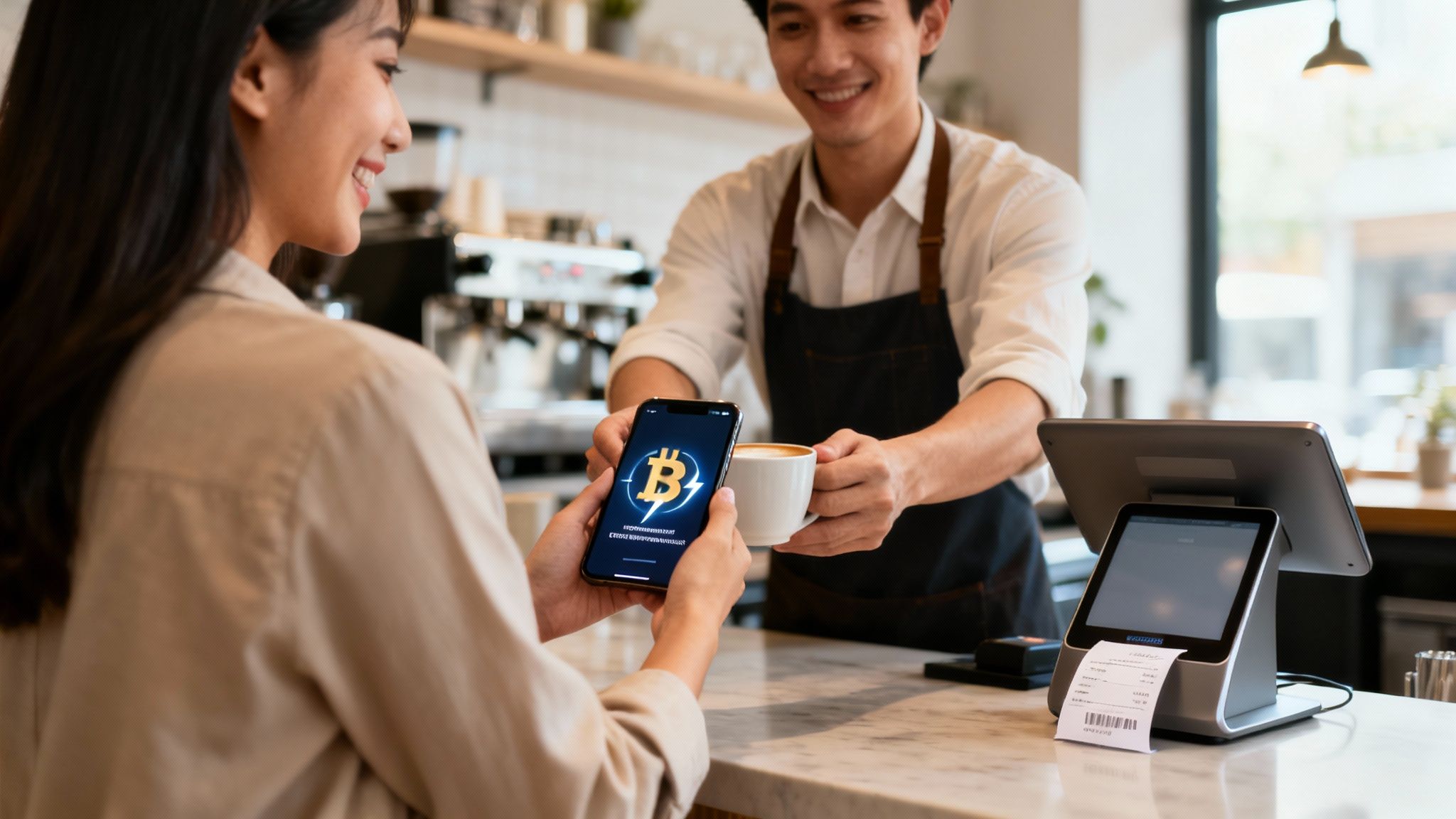
When merchants hear "send bitcoins instantly," it naturally raises a few eyebrows. How can a payment be instant when the Bitcoin network itself takes time to confirm transactions? The answer is all about perspective and the right technology.
The whole idea of "instant" makes more sense when you stop comparing Bitcoin to itself and start comparing it to the traditional financial system it’s designed to replace.
Let's be real: an international wire transfer can take a painful 1–5 business days to land in your account. Even a domestic ACH payment often takes 1–3 days to fully clear. A Bitcoin transaction, on the other hand, is broadcast to the entire world in seconds, and final settlement usually happens in under an hour. While the network aims for a new block every ten minutes, this is still worlds faster than waiting days for a bank to move your money, a trend you can explore in Statista's transaction time analysis.
To put this into context, here’s a quick breakdown of how Bitcoin stacks up against the old guard.
Bitcoin Speed vs Traditional Payments: A Quick Comparison
| Payment Method | Typical User Experience Speed | Final Settlement Time | Best For |
|---|---|---|---|
| Bitcoin (Lightning) | Instant (1-3 seconds) | Instant | Small, frequent payments like coffee, tips, or microtransactions. |
| Bitcoin (On-Chain) | Seconds to appear, 10-60 mins to confirm | 10-60 minutes | Larger purchases where finality is key. |
| Credit/Debit Card | Instant (2-5 seconds) | 2-3 business days | Everyday retail and online shopping. |
| ACH/Bank Transfer | 1-3 business days | 1-3 business days | Payroll, bill payments, large domestic transfers. |
| International Wire | 2-5 business days | 2-5 business days | Large cross-border payments. |
As you can see, the user experience for Bitcoin can be just as fast as a card swipe, but the final settlement for you, the merchant, is dramatically faster.
The Two Paths to Instant Payments
For your business, creating that "instant" feeling for customers really comes down to two main approaches. Each one tackles the speed problem differently, so you can pick what fits your needs.
The Lightning Network: This is a “second layer” built on top of Bitcoin, designed from the ground up for high-speed, low-cost payments. For those small, everyday purchases like a cup of coffee or digital content, Lightning payments are genuinely instant and cost a tiny fraction of a cent.
Optimized On-Chain Transactions: For larger payments that stay on the main Bitcoin blockchain, "instant" is about creating a super smooth checkout flow where the customer doesn't feel any delay. Merchant tools can be set to accept transactions with zero or one confirmation for low-risk sales, treating the payment as complete the moment it's detected on the network.
Bridging the Gap for Merchants
The real magic happens when payment software blends these technologies into a simple, familiar interface for you and your customers. For example, a direct wallet-to-wallet system like Flash lets a customer scan a QR code and send a payment that your point-of-sale device recognizes in seconds.
This gives you the card-like speed customers have come to expect at checkout, but with the superior finality and rock-bottom fees of Bitcoin settlement on the backend. You get paid faster and more efficiently, without the headaches and delays of the old banking world.
Ultimately, the goal is to kill the customer's wait time and your settlement anxiety. Whether it's through the true immediacy of the Lightning Network or the perceived speed of a slick on-chain payment flow, your business can offer a checkout process that’s both modern and incredibly efficient.
Using the Lightning Network for Instant Payments
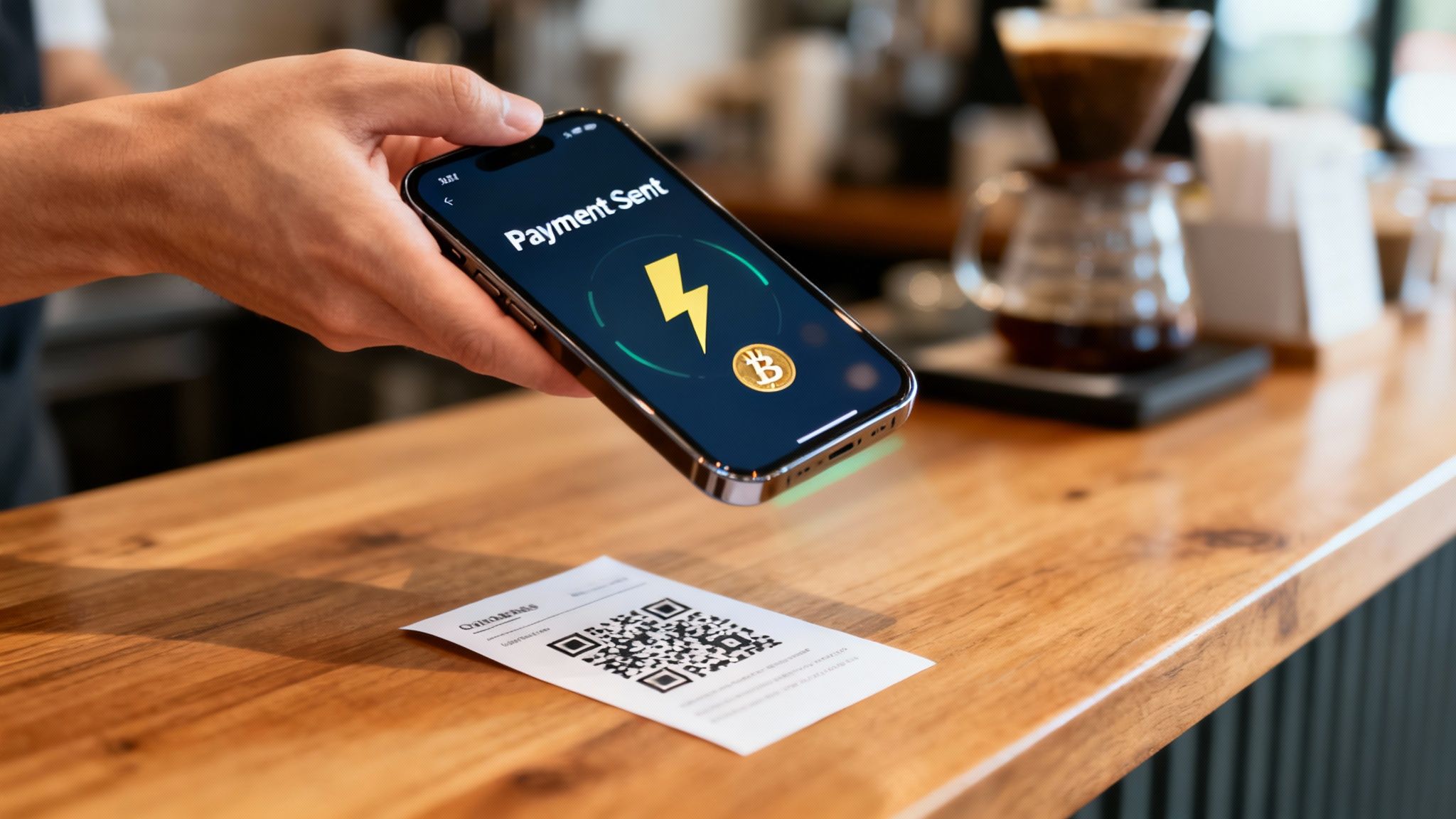
When you need to send bitcoin instantly, the Lightning Network is the only real answer. Think of it as an express lane built right on top of the main Bitcoin blockchain, designed from the ground up to handle a massive volume of small, fast payments without the usual wait for on-chain confirmations.
This isn't just a cool concept; it's a practical tool that completely changes the checkout experience. For businesses that depend on quick turnover—like coffee shops, retail stores, or online services—Lightning is a game-changer. It gets rid of that awkward pause while you both wait for a payment to clear, making the whole process as smooth as any tap-to-pay card.
The magic behind it is actually quite simple. Instead of broadcasting every single transaction to the whole Bitcoin network, Lightning lets users create private payment channels. Funds zip back and forth inside these channels instantly, with only the final balance being recorded on the main blockchain later. This simple change massively boosts speed and slashes costs.
What the Customer Experiences
From your customer’s side, using Lightning couldn't be easier. They don't need to know anything about payment channels or network routing. All they need is a Lightning-enabled Bitcoin wallet on their phone.
The process is intuitive and familiar:
- Generate Invoice: Your point-of-sale system, whether it's a tablet app or an e-commerce page, spits out a QR code for the exact purchase amount. This is a Lightning invoice.
- Scan and Pay: Your customer opens their Lightning wallet (like Wallet of Satoshi or Phoenix), scans the code, and confirms with a single tap.
- Instant Confirmation: The payment is sent and confirmed on your end in 1-3 seconds. No waiting, no wondering. Just a "Payment Successful" message for both of you.
This whole exchange feels just like using Apple Pay or a contactless card. For a busy café during the morning rush, that kind of efficiency is non-negotiable. Customers get their coffee and get on with their day, and you can serve more people without a bottleneck at the register.
The Lightning Network turns a Bitcoin payment into a split-second interaction. It's built for the speed of modern commerce, allowing you to process dozens of sales in the time it would take for a single on-chain transaction to get its first confirmation.
The Power of Microscopic Fees
Beyond the speed, the biggest win for businesses using the Lightning Network is the almost non-existent transaction fees. Because these payments aren't fighting for space in a Bitcoin block, the cost to send them is next to nothing.
Fees on Lightning are usually measured in sats (the smallest unit of a bitcoin) and often add up to fractions of a cent. For a $3 coffee, the fee might be less than a penny. Compare that to the 2-3% you're handing over for every credit card transaction, and the savings become pretty stark.
This opens the door to business models that were just never practical before due to high transaction costs.
- Selling digital content: Charge a few cents for an article or a song download.
- Gaming: Allow tiny in-game purchases without eating up the whole payment in fees.
- Tipping: Let customers easily and directly tip staff without a third party taking a cut.
Lightning makes global, near-free payments a reality for any business willing to embrace it.
How to Speed Up On-Chain Bitcoin Transactions
While the Lightning Network is fantastic for quick, small buys, the reality is that many significant transactions still happen directly on the Bitcoin blockchain. When you need to send bitcoins instantly on-chain, success boils down to one thing: understanding the network’s fee market.
Think of the Bitcoin network as a busy highway. Every transaction is a car trying to get on, and the transaction fee is the toll you're willing to pay. Miners, the ones who confirm transactions, are like tollbooth operators who naturally prioritize the cars paying the highest tolls. Pay too little, and your car gets stuck in a frustrating traffic jam.
Fortunately, you aren't helpless. You have a few powerful techniques to navigate this traffic and get your on-chain payments confirmed quickly and reliably.
Setting the Optimal Transaction Fee
The single most effective way to speed up a transaction is to pay the right fee from the get-go. This doesn't mean you have to overpay; it just means paying enough to secure a spot in the very next block. To pull this off, you need to check the current network congestion, which is all publicly visible in the mempool.
The mempool is essentially the "waiting room" for all unconfirmed Bitcoin transactions. By taking a look, you can see what fees others are paying and what it takes to jump to the front of the line.
A popular explorer like mempool.space gives you a clear, visual breakdown of the current fee rates.
Those colored blocks represent transactions waiting to be confirmed, all neatly organized by their fee rate. It gives you a perfect snapshot of the current fee market. Thankfully, most modern Bitcoin wallets have built-in fee estimators that do this work for you, suggesting low, medium, and high-priority fees. For any important payment, always choose the high-priority option.
Using Replace-by-Fee to Unstick a Transaction
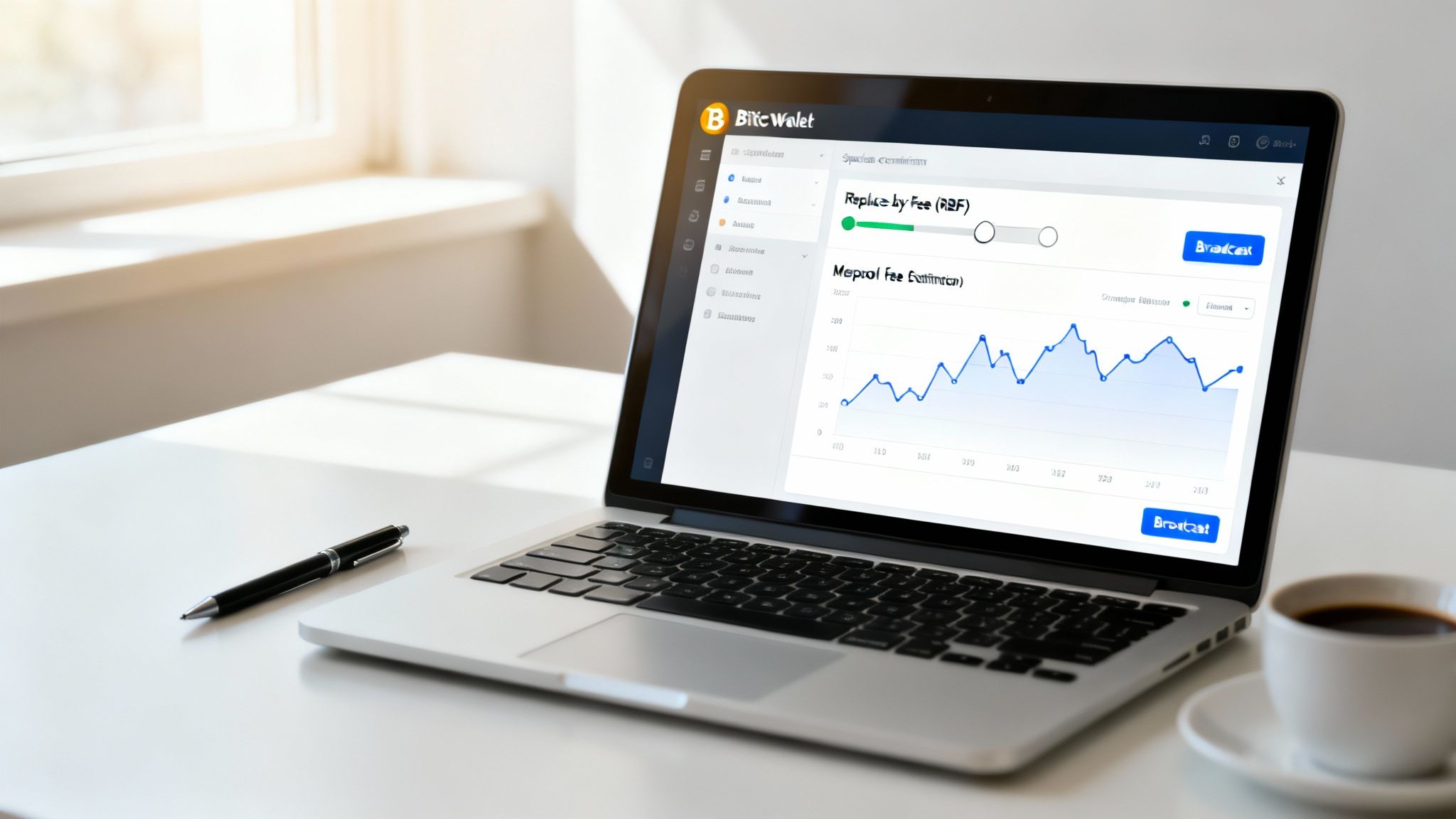
So, what happens if you've already sent a transaction with a fee that was too low? In the past, you'd just have to wait, sometimes for days on end. Today, many wallets support a feature called Replace-by-Fee (RBF), which is your get-out-of-jail-free card for stuck payments.
RBF lets you "replace" your original, unconfirmed transaction with a brand-new one that includes a higher fee. Miners see the new, more profitable transaction and prioritize it, effectively pushing your payment through and discarding the old one.
Here’s the simple breakdown:
- Enable RBF: Before you even send, make sure the RBF option is turned on in your wallet's settings. Most modern wallets support it.
- Find the Stuck Transaction: Locate the unconfirmed transaction in your wallet's history.
- Create the Replacement: Your wallet should have an option like "bump fee" or "increase fee." This action creates a new version of the same transaction but with a more attractive fee.
- Broadcast It: The wallet sends this new transaction to the network. Miners will now see this one and are incentivized to pick it up instead of the old, low-fee version.
This is an incredibly practical tool for anyone sending time-sensitive payments on-chain. It gives you the power to correct a mistake and ensures your transaction doesn't get lost in the mempool abyss.
Speeding Up Payments with Child-Pays-for-Parent
Now, let's flip the script. What if you're a merchant and a customer's payment to you is stuck with a low fee? You can't use RBF on their transaction, but you're not powerless. This is where a more advanced technique called Child-Pays-for-Parent (CPFP) comes into play.
With CPFP, you take the unconfirmed bitcoins the customer sent you and immediately spend them in a new transaction (the "child"). In this new transaction, you include a very high fee—high enough to cover both your new transaction and the original "parent" transaction from your customer.
Miners see this as a package deal. They can't confirm your high-fee child transaction without first confirming the low-fee parent. The combined fee makes the whole package attractive, so they confirm both together in the next block.
Imagine you're running an e-commerce store and a customer places a large order. Their payment is stuck, delaying the shipment. By using a wallet that supports coin control, you can create a CPFP transaction to force their payment through. This allows you to finalize the order and ship the product without waiting around. It's a powerful tool for merchants who depend on reliable on-chain settlement.
Choosing the Right Tools for Instant Settlement
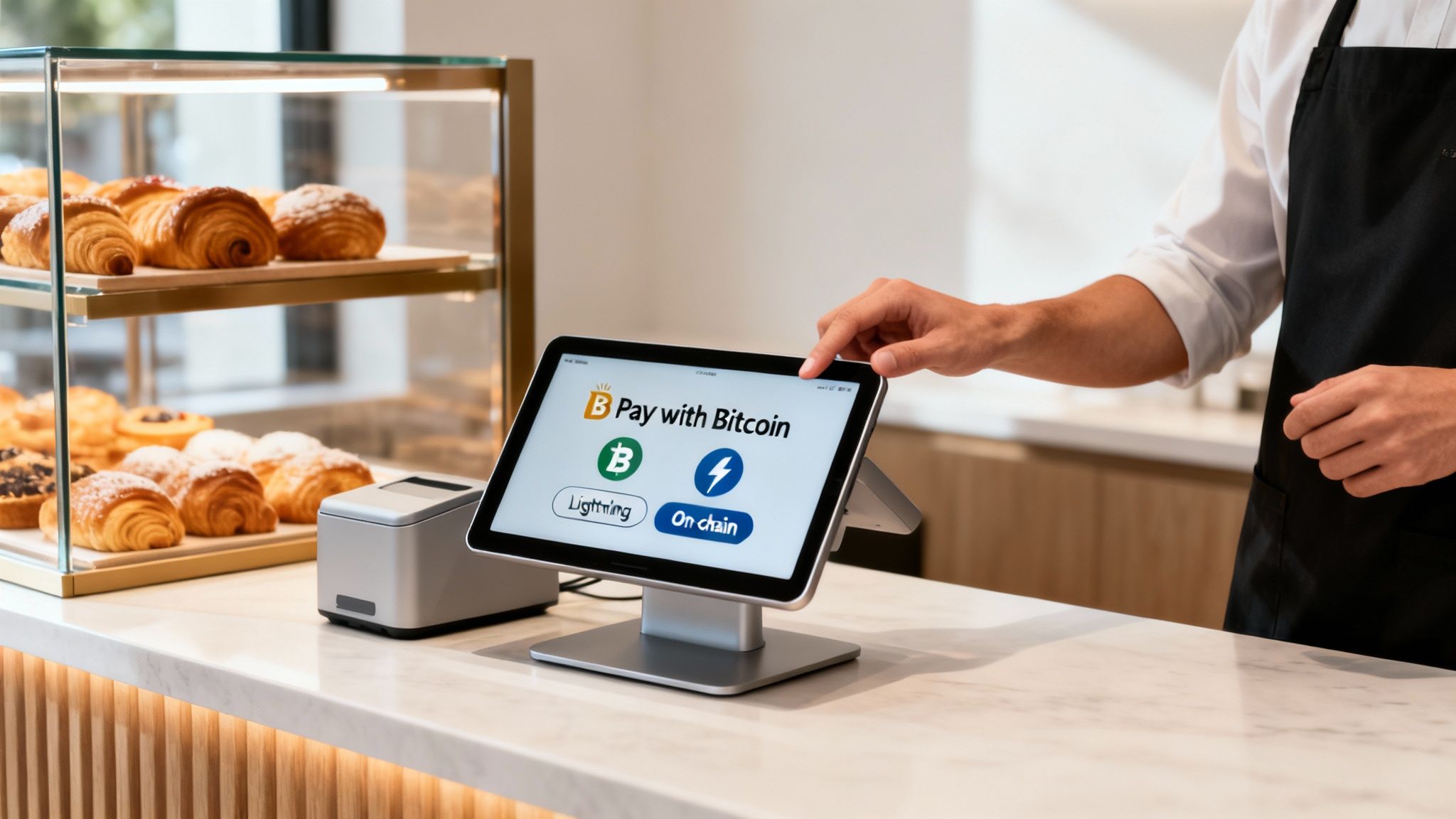
Now that we’ve covered the different ways to get Bitcoin moving faster, let's talk about your side of the counter. Setting up your business to accept instant Bitcoin doesn't mean you have to rip out your existing systems and start from scratch. With the right tools, you can roll out a slick, modern checkout experience that your customers will love and that keeps your cash flow moving.
The secret is using solutions that cut out the middlemen and their built-in delays. This is where direct wallet-to-wallet payment platforms are a game-changer. They make sure that when a customer pays, the Bitcoin goes straight to a wallet you control, completely bypassing the frustrating settlement periods you see with old-school payment processors.
Practical Workflows for Today's Merchant
Getting an instant Bitcoin payment system up and running is easier than you might think. Whether you’re running a busy coffee shop or a global e-commerce store, there are simple, effective workflows you can put in place today.
For brick-and-mortar stores, a point-of-sale (POS) app on a tablet or smartphone is the simplest way in. Software like Flash turns a regular device into a dedicated Bitcoin terminal. When a customer is ready to pay, the app spits out a unique QR code. They scan it, their wallet sends the payment, and your POS confirms it in seconds. It’s a perfect setup for a busy café that needs to clear dozens of small payments during the morning rush.
Online businesses can get that same speed using different tools. Popping simple payment links or buttons onto your website is a low-effort way to start. When you're looking at tools for instant settlement, it's also smart to know how to compare e-commerce platforms, because your choice can really open up—or limit—your payment integration options.
Embracing Zero-Confirmation Transactions Safely
One of the best moves you can make to send bitcoins instantly in a retail environment is to accept "zero-confirmation" (or "0-conf") transactions. This just means you treat a payment as final the moment it hits the network, without waiting for it to be mined into a block. It might sound a bit risky, but it’s a common and safe practice for small-to-medium value sales.
Think of it like accepting a credit card. The terminal says "approved" in seconds, but you know the actual money won't land in your bank account for days. Zero-conf Bitcoin offers that same snappy user experience, but you get the final settlement much, much faster.
The risk of someone trying a double-spend attack on a small, in-person sale is incredibly low. For everyday things like coffee, groceries, or digital downloads, the benefit of a fast, smooth checkout far outweighs the tiny risk.
To do this safely, your POS software or payment gateway just needs to watch the Bitcoin mempool in real-time. The system sees a valid transaction broadcast from the customer's wallet, and—boom—that’s the trigger to complete the sale on your end. This happens almost instantly. Of course, for big-ticket items, it's still best practice to wait for at least one confirmation.
The Power of Direct Wallet-to-Wallet Architecture
The reality of instant Bitcoin payments really comes down to how you manage transaction volume and the customer experience. On-chain data shows Bitcoin handles a massive load, with some days seeing over 540,000 transactions. Even with that volume, most payments get their first confirmation within 10–60 minutes, depending on network fees. You can dive into this data yourself and explore daily Bitcoin transaction counts on YCharts.
But retail can't wait 10 minutes, let alone an hour. This is where platforms like Flash shine, using a wallet-to-wallet architecture to dodge those common delays. By creating a direct line between your customer's wallet and yours, it neatly sidesteps the bottlenecks you find with custodial services.
Here’s why that’s a big deal for your business:
- No Intermediary Custody: Your funds are never held hostage by a third party. Payments go directly into your wallet, giving you full control, instantly.
- Reduced Compliance Delays: With no third party taking custody, many of the compliance hurdles that slow down traditional processors just disappear.
- Elimination of Batch Settlements: So many payment processors batch up transactions and only pay out daily or weekly. Direct wallet payments mean you get your money the moment you make a sale.
If you're running a subscription service or have paywalled content, this direct model is a lifesaver. Recurring Bitcoin payments can be authorized in seconds and settled quickly on-chain. This kills the risk of credit card chargebacks and slashes the overhead that comes with legacy payment systems, creating a much more efficient and reliable revenue stream.
Security and Privacy Practices for Fast Payments
Look, getting paid instantly is a game-changer for your checkout experience. But speed should never, ever come at the cost of security and privacy. If you’re going to embrace fast Bitcoin payments, you need to build some smart habits to protect your business and your customers from very real risks.
It all starts with one simple, non-negotiable rule: you must always control your own funds.
This is precisely why non-custodial solutions are so critical. When you use a platform like Flash that enables direct wallet-to-wallet payments, the Bitcoin lands directly in a wallet where you—and only you—hold the private keys. This completely sidesteps third-party risk. No payment processor can freeze your funds or lose your money. It's yours, period.
Safeguarding Your Business Funds
Your operational security—or "opsec," as it's often called—is all about the habits you develop to protect your assets. For any merchant accepting Bitcoin, this begins and ends with your private keys. Treat them like the master key to your business vault. If they get compromised, your funds are gone. Forever. There’s no bank to call, no one to reverse the transaction.
Here’s what you need to do, starting today:
- Protect Your Private Keys: Never, ever store your wallet’s seed phrase (those 12 or 24 words) digitally. Don't screenshot it. Don't save it in a text file. Don't put it in your password manager. Write it down on paper or, even better, stamp it into metal. Then, store it in multiple secure, offline locations.
- Use New Addresses for Every Payment: Reusing Bitcoin addresses is a rookie mistake and a massive privacy leak. It allows anyone on the internet to connect all your incoming payments, essentially broadcasting your sales volume and cash flow to the world. A good Point of Sale system will automatically generate a fresh address for every single transaction, breaking those links and keeping your financial data private.
By treating your private keys with the same seriousness as the keys to your physical store and using fresh addresses, you're building a strong defense around your revenue. This isn't just good advice; it's a fundamental requirement for operating safely in this space.
Educating and Protecting Your Customers
Your customers are part of this security equation, too. A great payment experience isn't just fast; it’s one where they feel confident and safe.
A simple reminder at checkout can make a world of difference. Encourage customers to always double-check the sending address and the amount in their wallet before hitting "confirm." A simple typo is all it takes to send funds into the void, and there’s no getting them back.
This push to send bitcoins instantly is happening as the entire digital asset economy is scaling to rival traditional finance. Bitcoin is the front door for millions of new users. We're seeing massive capital inflows into the Bitcoin ecosystem. These newcomers expect a smooth, app-like experience but often aren't aware of the security details. You can dive deeper into these trends in Chainalysis's latest crypto adoption report.
Smart Back-Office Reconciliation
Finally, strong security doesn’t stop at the checkout counter; it extends right into your accounting. Unlike credit card payments that spit out neat monthly statements, Bitcoin requires you to be more hands-on with reconciliation. Keeping meticulous records is the only way to avoid a massive headache when tax season rolls around.
Your POS software should give you detailed transaction logs that you can export. Make it a regular habit to match these logs against the transactions recorded in your Bitcoin wallet. This simple check ensures every sale is accounted for and helps you accurately track revenue, calculate any capital gains or losses, and keep your books clean.
Common Questions About Instant Bitcoin Payments
If you're new to accepting Bitcoin, you probably have a few questions. That's completely normal. Let's walk through some of the most common things merchants ask when they're getting started with instant payments.
Is It Really Possible to Send Bitcoin Instantly?
Yes, but the word "instant" can mean a couple of different things here. For small, everyday purchases like a coffee or a digital download, the Lightning Network is king. It provides genuinely instant, final settlement in a matter of seconds.
For larger, on-chain payments, "instant" is more about the customer's experience. Your system can accept the payment the moment it's sent, giving your customer a smooth, immediate checkout. You're not left waiting for days like you would with a bank transfer, and your customer isn't stuck staring at a "pending" screen.
How Is the Lightning Network Different from a Regular Bitcoin Payment?
Think of it like this: the main Bitcoin blockchain is the major highway system, built for large, secure shipments. The Lightning Network is the local road network, designed for zipping around town quickly for small errands.
- On-Chain Payments: These are recorded directly on the main Bitcoin blockchain. They're incredibly secure but need to be confirmed by miners, which takes time and costs a network fee.
- Lightning Payments: These happen "off-chain" through private payment channels. They settle in seconds for almost nothing in fees, which is why they're perfect for the high-volume, low-value transactions common in retail.
The bottom line? The Lightning Network was built from the ground up to send bitcoin instantly for the kinds of transactions that businesses handle every single day.
Are Zero-Confirmation Transactions Safe for My Business?
Accepting a "zero-conf" transaction means you treat the payment as complete the second it hits the network, before miners have officially confirmed it. For most low-to-medium value sales, this is a perfectly reasonable and common practice.
The actual risk of a "double-spend" attack—where someone tries to reverse the payment—is incredibly low for in-person sales or small online checkouts. The goodwill and smooth experience you create for your customer almost always outweighs that tiny risk. That said, for high-ticket items, it’s always smart to wait for at least one confirmation.
Can I Speed Up a Bitcoin Payment That’s Stuck?
Absolutely. It happens. Sometimes a transaction is sent with a fee that's too low for how busy the network is, and it gets stuck in the "mempool" (the network's waiting room). You have two great tools to give it a push.
- Replace-by-Fee (RBF): If the sending wallet supports RBF, you can simply resend the exact same transaction but with a higher fee. Miners are financially motivated to grab the more profitable version, and your payment gets unstuck.
- Child-Pays-for-Parent (CPFP): This is a powerful tool for you as the merchant. If a customer's payment is stuck, you can take those unconfirmed funds and spend them in a new transaction, but you attach a massive fee to it—big enough to cover both transactions. Miners see a lucrative two-for-one deal and will confirm both the original (parent) and your new (child) transaction together.
Do I Need to Be a Tech Expert to Accept Instant Bitcoin?
Not in the slightest. Modern payment tools are designed to make accepting Bitcoin as easy as swiping a credit card. Point-of-sale apps and website integrations are built to be user-friendly, so you don't have to get bogged down in the technical weeds.
A good merchant solution handles all the messy stuff behind the scenes, from generating QR codes to watching the network for you. You get to focus on what you do best—running your business—not becoming a blockchain guru. You can be set up and ready to go in minutes.
Ready to offer your customers the speed and convenience of instant Bitcoin payments? With Flash, you can integrate seamless, secure, and direct wallet-to-wallet payments into your business in under a minute. Get started today and tap into a global economy without middlemen, delays, or high fees. Visit to learn more.