Bitcoin adoption is growing worldwide, and certain cities stand out for making it easier to spend cryptocurrency. These cities are ranked based on factors like the number of businesses accepting Bitcoin, availability of Bitcoin ATMs, regulatory clarity, and digital infrastructure. Here’s a quick look at the top Bitcoin-friendly cities:
- San Francisco, USA: Over 440 businesses accept Bitcoin, supported by 469 ATMs and a strong tech ecosystem.
- Vancouver, Canada: Known as North America's Bitcoin merchant capital, with 85 businesses accepting Bitcoin and 0% transaction fees for merchants using Coinos.
- Amsterdam, Netherlands: A hub for Bitcoin payments in Europe, with strong regulatory support under the EU's MiCAR framework.
- Ljubljana, Slovenia: Ranked the most crypto-friendly city in 2025, with over 1,000 businesses accepting Bitcoin and 150+ ATMs.
- Tel Aviv, Israel: A growing crypto scene with Bitcoin accepted in a variety of businesses, despite regulatory challenges.
- Berlin, Germany: Germany's blockchain capital with a thriving fintech ecosystem and over 180 blockchain startups.
- Miami, USA: A leader in crypto integration, with Bitcoin accepted for real estate, municipal fees, and hospitality services.
- Tokyo, Japan: Early regulatory adopter with major exchanges, though retail Bitcoin adoption remains limited.
- Dubai, UAE: Bitcoin payments accepted for government services, supported by a clear regulatory framework.
- Vienna, Austria: A European leader in merchant adoption, with 120+ Bitcoin-friendly businesses and robust regulatory support.
These cities demonstrate how Bitcoin is becoming a practical payment option for both businesses and travelers. Whether you're paying for coffee, taxes, or real estate, these hubs make it easier to use cryptocurrency in everyday life.
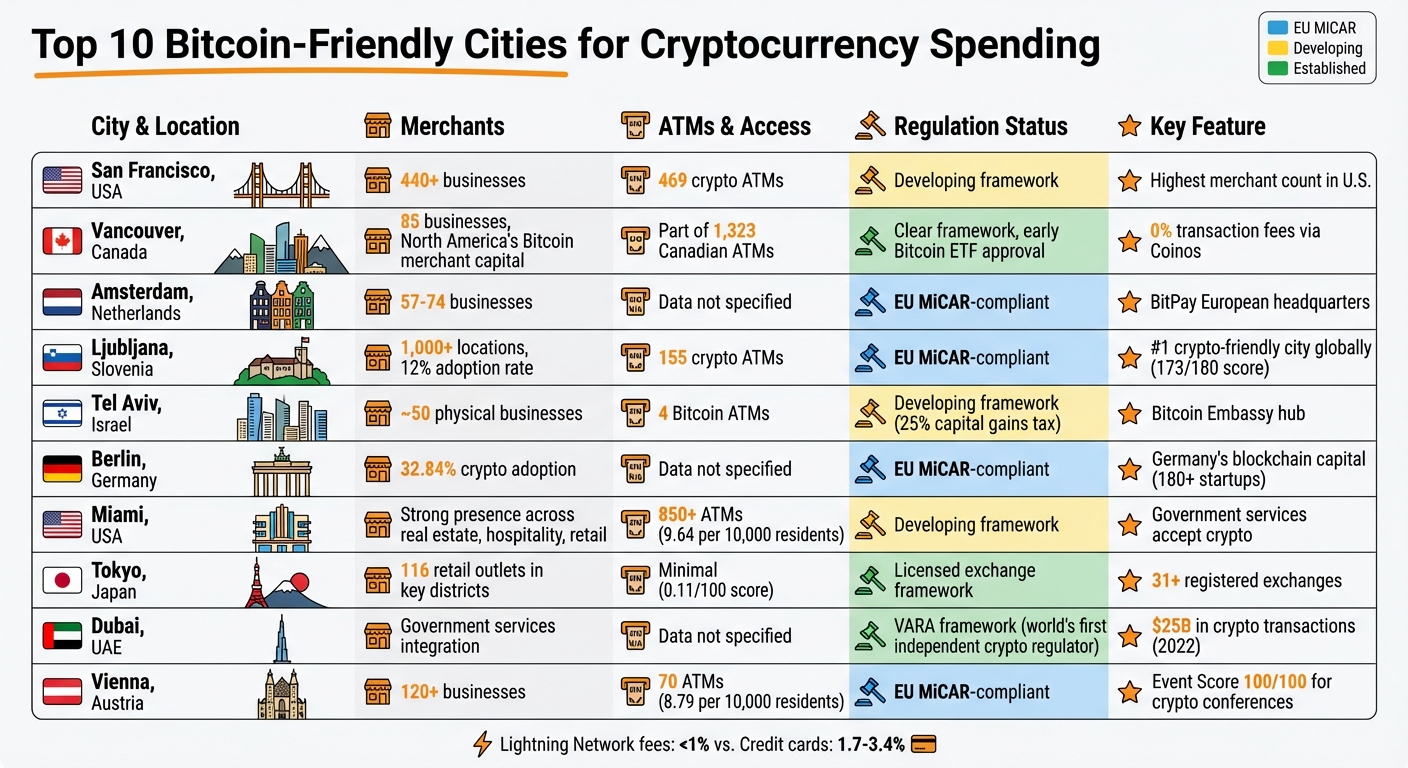
Top 10 Bitcoin-Friendly Cities: Merchant Adoption, ATMs, and Regulations Compared
1. San Francisco, United States
Merchant Adoption & Payment Options
San Francisco stands out as a global hub for Bitcoin usage, boasting over 440 businesses that accept the cryptocurrency - the highest in any U.S. city. Local establishments such as coffee shops, sushi restaurants, bookstores, optometrists, massage studios, and even psychiatric offices are on board with Bitcoin payments. Big-name chains like Starbucks and Whole Foods also make crypto transactions possible through third-party payment processors. The city’s connection to crypto runs deep, tracing back to early 2013 meetups attended by notable figures like Brian Armstrong of Coinbase and Jesse Powell of Kraken. This thriving ecosystem is supported by a growing network of merchants and continuous infrastructure development.
Bitcoin ATM & Infrastructure Availability
The San Francisco Bay Area is equipped with around 469 crypto ATMs, operated by providers like Bitcoin Depot, Coin Cloud, and CoinFlip. The region’s first Bitcoin ATM appeared in March 2014 at Hacker Dojo in Mountain View. For those looking to spend Bitcoin directly, tools like Coinmap highlight over 100 physical businesses in the city that accept cryptocurrency payments.
Regulatory Environment & Government Support
California is paving the way for blockchain innovation. In May 2022, Governor Gavin Newsom signed an executive order aimed at creating a unified framework for blockchain technology, setting the state up as a leader in the field. The California Fair Political Practices Commission now allows candidates for local and state offices to accept cryptocurrency donations, and state legislators have proposed bills to enable crypto payments for select government services.
"CA is the first state in the nation to begin creating a comprehensive & harmonized framework for responsible blockchain technology to thrive. We're aiming to create a pipeline of talent for the emerging industry & utilize the technology for public good."
– Gavin Newsom, Governor of California
San Francisco is also home to major crypto players like Ripple Labs, Block, Chainlink Labs, BitGo, and Anchorage Digital. Universities and research centers in the area contribute to developing a skilled blockchain workforce, further solidifying the city’s position as a key player in the crypto world.
sbb-itb-f81ab9b
2. Vancouver, Canada
Merchant Adoption & Payment Options
Vancouver proudly holds the title of North America's Bitcoin merchant capital, with 85 businesses accepting Bitcoin as of early 2025. These businesses span over 20 categories, from cozy cafes to liquor stores. A key player in this ecosystem is Coinos, a local payment processor that offers merchants a compelling deal: 0% transaction fees and just 0.1% for withdrawals. Compare that to credit card fees, which can climb as high as 4.3% - the difference is striking.
"We're not just at the front of the pack, we're leading the charge with more bitcoin businesses than any other city in North America."
– Cole Goodwin, Director of Business Development, Coinos
Vancouver’s Bitcoin scene thrives thanks to grassroots organizations like Bitcoin Privilege, BTC Vancity, and Bitdevs, which together foster a community of over 700 members. Tools like the Coinos world map make it easy to locate Bitcoin-friendly merchants, while the Lightning Network enhances scalability, handling millions of transactions per second - far outpacing Visa’s 65,000 TPS. This vibrant network lays a solid foundation for future regulatory and governmental advancements.
Regulatory Environment & Government Support
In December 2024, Mayor Ken Sim made waves by proposing the use of Bitcoin for municipal taxes and fees. He backed this initiative with a $10,000 Bitcoin donation and commissioned a feasibility report, expected in the first quarter of 2025.
"It would be irresponsible for the City of Vancouver to not look at the merits of adding bitcoin to the City's strategic assets to preserve the City's financial stability."
– Ken Sim, Mayor of Vancouver
However, provincial law currently stands in the way. The BC Ministry of Housing and Municipal Affairs cites the Vancouver Charter and Community Charter, which exclude cryptocurrency as a valid payment method. This legal hurdle complicates the integration of Bitcoin at a municipal level. Despite these challenges, Vancouver’s history of innovation - home to the world’s first Bitcoin ATM in 2013 - shows its determination to lead in the cryptocurrency space. Legislative change may be the next step in this evolving journey.
3. Amsterdam, Netherlands
Merchant Adoption & Payment Options
Amsterdam holds the 11th spot globally for Bitcoin merchant adoption, with 57–74 businesses - from restaurants and cafes to bike rentals and boat tours - accepting cryptocurrency. Back in 2016, even fast-food chains in the city began embracing Bitcoin, signaling its move toward mainstream acceptance. In September 2014, BitPay set up its European headquarters in Amsterdam's historic "Golden Bend" district, establishing itself as a hub for education and integration of Bitcoin payments. This diverse network of merchants not only supports everyday Bitcoin transactions but also caters to tourists, solidifying Amsterdam's reputation as a practical destination for crypto users.
Regulatory Environment & Government Support
The Netherlands has gained recognition for its pragmatic and forward-thinking approach to Bitcoin regulation. Both the AFM (Dutch Authority for the Financial Markets) and De Nederlandsche Bank see cryptocurrency as a tool to enhance efficiency and transparency. In April 2024, the AFM became one of the first regulators in the EU to launch a digital portal for Crypto-Asset Service Provider license applications, streamlining the transition to the MiCAR (Markets in Crypto-Assets Regulation) framework.
"The Netherlands has established itself as a progressive blockchain hub in Europe."
– Legal500
This principles-driven regulatory framework not only provides clear legal guidelines but also fosters innovation. Traditional banks are joining the mix, too - ING, one of the Netherlands’ largest banks, is part of a consortium of nine European banks developing a Euro-stablecoin, set to launch in 2026. Such clarity and institutional involvement create fertile ground for enterprise-level growth and technological advancements in Amsterdam.
Enterprise & Tourism Readiness
Amsterdam ranks as Europe’s 5th leading tech ecosystem as of 2025, making it a prime location for businesses adopting Bitcoin. The city is home to over 3,500 international companies and nearly 2,000 startups and scale-ups, all supported by a pool of more than 250,000 tech professionals. This strong concentration of talent and innovation makes Amsterdam an ideal setting for businesses looking to integrate Bitcoin payment systems.
Bitcoin is also seamlessly integrated into the city’s thriving tourism industry. Travelers can use cryptocurrency to pay for flights, accommodations, bike rentals, and even boat tours. Local education initiatives help businesses stay informed and encourage broader adoption. With its historical significance as the birthplace of the world’s first stock exchange, Amsterdam continues to stand out as a hub for financial innovation.
4. Ljubljana, Slovenia
Merchant Adoption & Payment Options
In 2025, Ljubljana claimed the top spot as the most crypto-friendly city in the world, earning an impressive 173 out of 180 points - surpassing global financial hubs like Hong Kong and Zurich. What sets Ljubljana apart is its impressive merchant adoption rate of around 12%, far outpacing Hong Kong's modest 3%. Cryptocurrency has become a part of everyday life here, with businesses such as cafes (kavarnas), organic grocery stores, restaurants, hair salons, and even dental offices accepting digital payments. Across Slovenia, over 1,000 locations now accept cryptocurrency, making Ljubljana a standout destination for those looking to use Bitcoin in their daily routines.
Bitcoin ATM & Infrastructure Availability
Ljubljana boasts 155 crypto ATMs conveniently located in places like libraries, bus stops, and grocery stores. This level of integration makes Bitcoin transactions feel natural and accessible. The city also benefits from a strong technical backbone, with 95% fiber optic coverage and average internet speeds reaching 190 Mbit/s. This infrastructure not only supports everyday crypto transactions but also enables high-frequency trading and decentralized operations.
Regulatory Environment & Government Support
Slovenia has been ahead of the curve in crypto regulation, legally recognizing smart contracts since 2020. This provides businesses with a clear legal framework, attracting decentralized platforms to the country. Cryptocurrency transactions currently enjoy a 0% VAT rate, though a 25% tax on personal crypto profits is set to take effect in 2026, potentially generating up to €25 million annually. Notably, crypto-to-crypto trades and wallet transfers within the same ownership remain tax-free. Slovenia's straightforward regulatory approach, combined with officials who understand blockchain technology, creates a welcoming environment for international enterprises.
"In Zurich, definitions are still being negotiated. Here, we code."
– Ana, CEO of a decentralized lending platform
Enterprise & Tourism Readiness
The average Slovenian crypto owner holds an impressive $240,500 in digital assets, a figure that dwarfs averages in places like Hong Kong and the United States. In April 2025, Ljubljana-based blockchain real estate platform Blocksquare collaborated with Vera Capital to tokenize $1 billion worth of U.S. real estate, showcasing the city’s ability to handle large-scale blockchain projects. Additionally, Ljubljana is home to the Blockchain Alliance Europe and is becoming a key player in Real World Asset tokenization. For visitors, the city offers unique experiences like the Crypto Winter Festival, where digital assets can be used in place of cash for transactions.
5. Tel Aviv, Israel
Merchant Adoption & Payment Options
Tel Aviv stands out as a major hub in the Middle East, with around 50 physical businesses welcoming Bitcoin as a form of payment. You’ll find Bitcoin accepted in a variety of places - ranging from kindergartens and tattoo parlors to legal offices and car repair shops. Even the city’s vibrant nightlife has embraced cryptocurrency, with 15 bars and restaurants ready to process Bitcoin transactions. This level of adoption showcases how deeply digital currency has integrated into the city’s daily economic life.
Bitcoin ATM & Infrastructure Availability
The city is home to 4 Bitcoin ATMs, making it easier for locals and visitors to access cryptocurrency. A cornerstone of Tel Aviv’s crypto scene is the Bitcoin Embassy, located near the Tel Aviv Stock Exchange in the financial district. Eli Sklar, a Bitcoin Ambassador, describes it as:
"The Embassy, as we call it, is the home of a large community of people from all walks of life... Many consider the Embassy as the Parthenon of Bitcoin".
The Embassy offers more than just a physical space; it’s a hub for education, hosting lectures and workshops that bring the community together. Similarly, the Israeli Bitcoin Meetup Group, with over 1,800 members, regularly gathers at the Google Campus, typically drawing 30 to 50 attendees per session. Events like the 2015 Bitcoin Hackathon, which attracted 100 participants working overnight on decentralized applications, highlight the city’s active and innovative crypto culture.
Regulatory Environment & Government Support
Israel’s approach to Bitcoin regulation categorizes it as an asset rather than legal tender, meaning individuals face a 25% capital gains tax on Bitcoin transactions. This regulatory stance creates obstacles for businesses, as banks in Israel often hesitate to handle cryptocurrency-related funds due to concerns about money laundering. To address some of these challenges, the Israel Tax Authority implemented a "Temporary Procedure" allowing companies to pay taxes on crypto directly from foreign bank accounts to the Bank of Israel when local banks decline transfers. Despite these barriers, the blockchain sector in Israel has flourished, with over 174 companies employing approximately 3,800 people. A notable milestone came in 2024 when Tectona became the first publicly traded company in Israel to secure a crypto services license from the Israeli Capital Markets Authority.
Enterprise & Tourism Readiness
The Israeli Bitcoin Association (IBA), with 150 registered members, plays a key role in promoting transparency and fostering an inclusive environment for businesses and tourists. Events like "Satoshi Square" provide platforms for peer-to-peer trading and community engagement. As Meni Rosenfeld, Chairman of the IBA, puts it:
"For us, bitcoin isn't just bitcoin – all open trade technologies are within our scope … One of our core values is transparency".
Tel Aviv’s crypto community frequently organizes events, including security workshops for beginners and trading sessions, ensuring the city is welcoming to both tourists and enterprise visitors. In October 2014, the "Inside Bitcoins Tel Aviv" conference attracted 350 attendees and featured prominent speakers like Vitalik Buterin and Peter Todd. More recently, in March 2024, licensed crypto broker Bits of Gold introduced "BILS", a stablecoin tied to the Israeli shekel and built on the Solana blockchain. This initiative operates under the regulatory sandbox of the Capital Market Authority, signaling further growth in the local crypto ecosystem.
Next, we turn to Berlin to explore how its Bitcoin ecosystem is shaping Europe’s crypto landscape.
6. Berlin, Germany
Merchant Adoption & Payment Options
Berlin has established itself as Germany's top fintech hub, with a wide variety of businesses now accepting Bitcoin. From major food delivery services to electronics stores and even higher education institutions, Bitcoin has found a place in Berlin's payment landscape. This trend is supported by the city's impressive fintech ecosystem, which includes four out of Germany's five fintech unicorns and a sector valued at €21.3 billion as of 2024. With over 180 active participants - ranging from blockchain startups to research institutions - Berlin's ecosystem is a driving force behind its broad merchant adoption and enterprise blockchain solutions.
Blockchain Infrastructure & Enterprise Solutions
Known as Germany's "blockchain capital", Berlin is home to more than 100 blockchain startups and serves as a significant hub for enterprise-level blockchain solutions in Europe. The city offers resources like coworking spaces such as "Full Node", which cater specifically to blockchain professionals. Ricardo Garcia, Co-Founder of BerChain, highlights Berlin's growth:
"In the last 2 years, the number of blockchain companies that are incorporated or have a presence in Berlin doubled. It's a city that has perfect conditions to become a global blockchain hotspot."
With approximately 12,300 people employed in fintech companies as of 2024, Berlin boasts a strong talent pool that supports Bitcoin-related ventures.
Regulatory Environment & Government Support
Berlin operates under MiCAR regulations, with BaFin and the Deutsche Bundesbank ensuring compliance with AML standards. The "Financing for the Future Act" simplifies fundraising for fintechs. Government initiatives like the €10 billion "Future Fund" (running until 2030) and the €12 billion "WIN Initiative" in private investments further strengthen the ecosystem. Additionally, a ruling by the Court of Justice of the European Union exempts Bitcoin currency exchanges from VAT, making the regulatory environment even more appealing.
Enterprise & Tourism Readiness
The "House of Finance and Tech Berlin" plays a key role in fostering collaboration among startups, banks, and regulators. Businesses can also seek support from "Berlin Partner for Business and Technology", which offers guidance on investment and innovation funding. Events like "Berlin Blockchain Week" and programs under the Digital Hub Initiative connect startups with investors, making Berlin a prime destination for Bitcoin payment integration.
Next, we’ll explore Miami’s rise as a cryptocurrency-friendly hub in the United States.
7. Miami, United States
Merchant Adoption & Payment Options
By 2025, Miami has firmly established itself as a hub for cryptocurrency integration. Bitcoin is now widely accepted across various sectors, including real estate, finance, retail, and even public services. Luxury properties in the city are now listed with prices in both U.S. dollars and Bitcoin, reflecting this shift. In a landmark achievement, Miami-based fintech company Milo originated over $65 million in crypto-backed mortgage loans in early 2025. This allows buyers to use Bitcoin as collateral without needing to sell off their holdings.
The hospitality industry has also embraced Bitcoin to cater to international tourists, helping them avoid foreign transaction fees. For instance, E11even Miami, a popular downtown nightclub, accepts Bitcoin for everything from table reservations to bottle service and merchandise purchases [48,49]. Similarly, the Thesis Hotel on South Dixie Highway became the first in Miami-Dade County to accept Bitcoin, Ethereum, and Dogecoin for room bookings and dining, thanks to BitPay. Even suburban areas like Miami Lakes are on board, allowing residents to pay for municipal fees - including permits, business licenses, and facility rentals - using cryptocurrency via PayPal [48,49]. These advancements have laid the groundwork for Miami's extensive Bitcoin ATM network and crypto-friendly infrastructure.
Bitcoin ATM & Infrastructure Availability
Miami is home to more than 850 Bitcoin ATMs, placing it sixth in the U.S. for per capita density, with about 9.64 ATMs per 10,000 residents. The city's infrastructure supports large-scale, institutional-grade crypto services, with major players like eToro, Crypto.com, Okcoin, and Binance.US setting up offices in the area [15,48,49]. In a notable move, Blockchain.com relocated its headquarters from New York to a 22,000-square-foot facility in Miami's Wynwood district in February 2022.
Regulatory Environment & Government Support
Miami's pro-crypto stance is championed by Mayor Francis Suarez, who has been instrumental in shaping the city’s crypto-friendly policies. Back in February 2021, the Miami City Commission passed a resolution with a 4-1 vote directing the city manager to explore options for employees to receive part of their salaries in Bitcoin. The resolution also opened the door for residents to pay city fees and property taxes using cryptocurrency. Mayor Suarez expressed his gratitude for the support:
"I want to thank the city of Miami commissioners for supporting my resolution, which directs a city manager after analysis, to procure a vendor to be able to offer our employees to get a percentage of their salary in bitcoin, allows our residents to pay for fees in bitcoin and also would allow the city manager to cooperate with Miami accounting to allow taxes to be paid in bitcoin."
Further bolstering Miami’s crypto ecosystem is the Miami-Dade County Cryptocurrency Task Force, led by Chairman Elijah Bowdre. This group actively researches and drafts legislation aimed at benefiting local businesses [49,54]. Additionally, Florida’s lack of a state income tax makes the city even more appealing for entrepreneurs and investors. As of late 2024, the Miami metro area hosts 614 fintech firms, and in 2023, South Florida startups attracted $577 million across 63 funding deals.
Enterprise & Tourism Readiness
Miami has transitioned from being a speculative player in the crypto space to establishing a solid foundation. By 2022, Miami-Dade County had processed over $25 billion in crypto transactions. The city also hosts the annual North American Bitcoin Conference, drawing over 4,000 participants and providing valuable networking opportunities for businesses. Education and professional development in blockchain technology are also thriving, with the Blockchain Institute of Technology (BIT) in Wynwood offering certified training programs and accepting tuition payments in cryptocurrency. Elijah Bowdre, Chairman of the Miami-Dade County Cryptocurrency Task Force, highlighted the city’s momentum:
"Crypto is on fire. And Miami-Dade County is poised to pierce the veil for municipalities and crypto. And I'm leading that charge."
As Miami continues to lead in Bitcoin integration, other cities, like Tokyo, are also exploring distinct ways to incorporate cryptocurrency into their economies.
8. Tokyo, Japan
Merchant Adoption & Payment Options
In Tokyo, areas like Roppongi, Shibuya, and Akasaka stand out with 116 retail outlets that accept Bitcoin. For instance, Bic Camera allows Bitcoin payments up to 100,000 yen through the bitFlyer app. Some bars and restaurants, such as Two Dogs Taproom, have also embraced Bitcoin as a payment method.
While Japan was an early adopter of cryptocurrency regulations in 2017, high tax rates - reaching up to 55% on crypto profits - have slowed the broader adoption of Bitcoin for everyday transactions. A 2024 study gave Tokyo a "Crypto Acceptance" score of 0.00 out of 100, reflecting limited integration of Bitcoin payments in mainstream businesses when compared to global leaders. This limited adoption is further highlighted by the city's sparse Bitcoin ATM network, which will be discussed next.
Bitcoin ATM & Infrastructure Availability
Tokyo has one of the lowest Bitcoin ATM densities globally, scoring just 0.11 out of 100. Although licensed operators reintroduced ATMs in 2022, their presence remains minimal. In 2024, Tokyo's overall crypto readiness score was 52.84 out of 100, indicating room for improvement.
Despite the lack of ATMs, Tokyo's digital infrastructure is strong. The city hosts over 31 registered cryptocurrency exchanges, including well-known platforms like bitFlyer, Coincheck, and GMO Coin. These exchanges handle the majority of Bitcoin transactions in the city, with bitFlyer enabling payments at major retailers such as Bic Camera.
Regulatory Environment & Government Support
Japan’s regulatory framework for cryptocurrencies is one of the most detailed worldwide. The Financial Services Agency (FSA) requires all crypto exchanges to register, maintain local operations, and comply with strict AML/KYC protocols. By mid-2025, Japan had over 12 million verified crypto users, with digital assets under local custody valued at more than $34 billion.
Big changes are on the horizon. Japan plans to move from its progressive tax system, where crypto profits are taxed up to 55%, to a flat 20% capital gains tax by late 2026. Additionally, the FSA began reclassifying tokens with investment or governance features as securities in mid-2025, paving the way for regulated Bitcoin ETFs in 2026. These shifts reflect a growing focus on institutional crypto adoption rather than consumer-driven use.
The Tokyo Metropolitan Government is also pushing financial innovation through initiatives like the Tokyo Innovation Base (TIB), which opened in November 2023. TIB has already hosted over 1,200 events, attracting 290,000 visitors. SEKIGUCHI Hisashi, Chief Program Officer for Global Financial City Promotion, highlighted Tokyo’s ambitions:
"Tokyo aims to become a leading city for sustainable and resilient finance... establishing its position as a global financial hub where diverse financial players drive innovation through investment."
Enterprise & Tourism Readiness
Tokyo's crypto ecosystem leans heavily on institutional infrastructure rather than retail adoption. The city is home to 26 Fortune Global 500 companies and around 420,000 small and medium-sized enterprises. Major financial players like SBI Holdings and Sumitomo Mitsui Trust Bank are actively involved in launching security tokens and crypto funds, while SMBC is testing stablecoin solutions for settlements. This institutional emphasis aligns with Tokyo's position as a hub for large-scale blockchain integration rather than consumer-facing crypto transactions.
For tourists, Bitcoin acceptance is limited to select venues. On the bright side, Bitcoin transaction fees are typically below 1%, much lower than credit card fees, which range from 1.7% to 3.4%. However, Japan's cash-heavy culture means smaller businesses are less likely to accept cryptocurrency. The 2025 World Expo in Japan, anticipated to be entirely cashless, could accelerate the adoption of digital payments.
9. Dubai, United Arab Emirates
Merchant Adoption & Payment Options
Dubai is reshaping its financial landscape by weaving Bitcoin into everyday transactions. In a groundbreaking move, Dubai became one of the first cities to enable Bitcoin payments for government services. Back in May 2025, the Dubai Department of Finance partnered with Crypto.com through a Memorandum of Understanding, allowing residents to pay for government fees, utilities, and even parking using Bitcoin. The system ensures a smooth process by converting Bitcoin into Emirati dirhams before transferring funds to government accounts. This initiative aligns with the Dubai Cashless Strategy, which aims to make 90% of public and private sector transactions digital by 2026. The projected economic impact? A staggering AED 8 billion (about $2.18 billion) in annual revenue. Dubai’s forward-thinking approach is supported by a solid regulatory framework, ensuring secure and efficient integration of Bitcoin into the local economy.
Regulatory Environment & Government Support
Dubai has positioned itself as a global leader in crypto regulation with a robust framework that encourages innovation. In 2022, the city launched the Virtual Assets Regulatory Authority (VARA), the world’s first independent regulator dedicated solely to virtual assets. VARA oversees most of Dubai’s mainland and free zones, while the Dubai International Financial Centre (DIFC) falls under the jurisdiction of the Dubai Financial Services Authority (DFSA). Law No. 4 of 2022 provides a clear definition of virtual assets and outlines licensing requirements for service providers. On the tax front, Dubai offers a competitive edge with 0% personal income tax and a 9% corporate tax on profits exceeding AED 375,000. Additionally, the Dubai Multi Commodities Centre (DMCC) allows businesses to repatriate their profits fully, enhancing the city’s appeal to crypto firms. By 2022, the UAE had already processed over $25 billion in crypto transactions and hosted more than 1,000 blockchain and crypto companies. This regulatory clarity and support have created fertile ground for enterprise-level integration of Bitcoin and other cryptocurrencies.
Enterprise & Tourism Readiness
Dubai’s strategic location, bridging Eastern and Western markets, makes it a magnet for global crypto enterprises. The city provides multiple regulatory options, including VARA, Abu Dhabi’s Abu Dhabi Global Market (ADGM), and the infrastructure at the Dubai International Financial Centre, giving businesses the flexibility to choose the framework that suits them best. In March 2025, the Abu Dhabi–based investment firm MGX made waves by investing $2 billion into Binance, further cementing the region’s commitment to supporting major crypto platforms. Traditional banks in the UAE are also stepping up, integrating crypto custody and exchange services into their offerings. This evolving infrastructure ensures that enterprises have access to a secure and efficient payment system, making Bitcoin transactions more accessible than ever.
Bitcoin in the City: Mayor Ken Sim's Vision for a Bitcoin-Friendly Vancouver
10. Vienna, Austria
Vienna is carving out a distinct identity as a crypto hub, combining technological progress with clear regulatory frameworks.
Merchant Adoption & Payment Options
Vienna has become a standout destination for cryptocurrency adoption in Europe. As of June 2024, over 120 merchants in the city accept Bitcoin, demonstrating a thriving crypto ecosystem. This growth is supported by the city’s robust ICT sector, which includes more than 6,000 tech companies. These businesses are driving blockchain innovation across industries like retail, hospitality, and services. Adding to its crypto credentials, Vienna is home to Bitpanda's headquarters and serves as the European base for major global exchanges such as Bybit and KuCoin. The Vienna Business Agency also plays a pivotal role by actively monitoring and supporting blockchain advancements, cementing the city’s reputation as a leader in crypto adoption.
Bitcoin ATM & Infrastructure Availability
Vienna boasts an impressive Bitcoin infrastructure, with around 70 Bitcoin ATMs spread across the city as of late 2025. This translates to a density of 5.31 ATMs per $10 billion of city GDP. Austria as a whole ranks among the best globally for crypto accessibility, offering 8.79 Bitcoin ATMs per 10,000 residents. This figure surpasses other major hubs like Hong Kong (6.62) and Switzerland (6.35). Such a dense network ensures easy access to Bitcoin transactions for Vienna’s 1.9 million residents and its international visitors. Combined with the city’s forward-thinking regulatory environment, this infrastructure strengthens Vienna’s position as a crypto-friendly city.
Regulatory Environment & Government Support
Austria’s regulatory framework is aligned with the EU's Markets in Crypto-Assets Regulation (MiCAR), which became fully enforceable at the end of 2024. Domestically, it’s implemented through MiCA-VVG. The Austrian Financial Market Authority (FMA) oversees the crypto space, offering services like accepting regulatory documentation in English to attract international participants. The FMA also runs a "Regulatory Sandbox" program, allowing blockchain startups to test their business models under guided supervision before fully entering the market. In terms of taxation, crypto-assets are subject to a 27.5% capital income tax, while exchanges remain tax-neutral until fiat conversions or invoice settlements. Notably, Bitcoin mining is allowed without a specific license, provided public investments are not involved.
Enterprise & Tourism Readiness
Vienna continues to shine as a hub for crypto events, achieving a perfect Event Score of 100 in 2024, reflecting its popularity for conferences and meetups. The city also earned an impressive Employment Score of 97.87 for blockchain-related jobs, showcasing its active participation in the crypto sector. A global study ranked Vienna #13 among the top 50 crypto-ready cities in 2024, with an index score of 58.12. This ranking highlights Vienna’s edge over many larger cities in event hosting and regulatory transparency. Furthermore, Raiffeisen Bank International (RBI), headquartered in Vienna, is set to launch a MiCAR-compliant Euro Stablecoin in 2026, further bridging the gap between crypto and traditional banking systems.
City Comparison Table
The table below provides a side-by-side comparison of key Bitcoin payment metrics across various cities, summarizing the earlier detailed insights.
| City | Merchant Adoption | Bitcoin ATM Count | Regulation | Primary Use Case |
|---|---|---|---|---|
| San Francisco, USA | High merchant adoption; home to Coinbase and Kraken | Part of 14,762 U.S. ATMs (Mar 2021) | Developing regulation | Business & Tech Innovation |
| Vancouver, Canada | Strong merchant adoption | Part of 1,323 Canadian ATMs | Clear framework; early Bitcoin ETF approval | Tourism & Business |
| Amsterdam, Netherlands | Moderate retail and hospitality adoption | – | EU MiCAR-compliant | Tourism & Business |
| Ljubljana, Slovenia | Over 1,000 crypto-accepting locations; ranked #1 globally in 2025 | 18 ATMs (national total) | EU MiCAR-compliant | Tourism & Retail Commerce |
| Tel Aviv, Israel | Rising merchant adoption | – | Developing regulatory framework | Business & Tech Innovation |
| Berlin, Germany | 32.84% crypto adoption | – | EU MiCAR-compliant | Tourism & Business |
| Miami, USA | Strong crypto business presence | 451 ATMs; 9.64 per 10,000 residents | Developing regulatory framework | Business & Tourism |
| Tokyo, Japan | Solid retail adoption | – | Licensed exchange framework | Tourism & Retail Commerce |
| Dubai, UAE | Expanding merchant network; $25B in crypto transactions in 2022 | – | Government services accept crypto | Business & Tourism |
| Vienna, Austria | Strong merchant adoption | 70 ATMs; 8.79 per 10,000 residents | EU MiCAR-compliant | Business & Events |
This comparison highlights valuable insights for CFOs and financial decision-makers seeking opportunities to integrate Bitcoin into their operations. Ljubljana shines with a dense merchant network relative to its size, while Miami leads in ATM accessibility. Vienna combines strong infrastructure with regulatory clarity, making it a compelling choice for enterprises.
Conclusion
The cities highlighted in this analysis show how Bitcoin payments have transitioned from a niche experiment to a practical tool for businesses and travelers alike. San Francisco stands out with over 440 businesses accepting Bitcoin, while Ljubljana boasts an impressive 12% merchant adoption rate globally. These advancements point to a growing role for Bitcoin in strategic financial planning.
For CFOs, the appeal of Bitcoin often lies in its lower transaction fees. The Bitcoin Lightning Network typically charges less than 1%, compared to the 1.7% to 3.4% fees associated with traditional credit card networks. This cost efficiency becomes particularly compelling for businesses handling large volumes of international payments.
The regulatory and digital infrastructure in Bitcoin-friendly cities also plays a crucial role. Cities like Amsterdam, Berlin, and Vienna, operating under the EU's MiCAR regulations, provide businesses with clear compliance guidelines. Similarly, Dubai’s VARA framework offers a transparent regulatory environment in the Middle East.
Before entering these markets, tools like CoinATMRadar and BTC Map can help pinpoint merchants and infrastructure in your target locations. To optimize payment systems, integrating the Lightning Network is key for keeping transaction fees under 1%. Additionally, offering crypto-based incentives can encourage customer adoption.
These Bitcoin-friendly cities are fostering circular economies where residents can use cryptocurrency to pay for property taxes, tuition, and even parking fines. Such ecosystems not only create new opportunities for businesses but also provide tangible benefits for consumers. The strategic integration of Bitcoin is proving to deliver both financial advantages and expanded market possibilities.
FAQs
What defines a Bitcoin-friendly city?
A city that embraces Bitcoin creates an environment where using cryptocurrency for everyday transactions is not just possible but encouraged. This means you’ll find plenty of businesses - shops, restaurants, and more - accepting Bitcoin as payment. On top of that, these cities often have user-friendly payment systems, like contactless terminals, making transactions seamless. Add to that local regulations that actively support cryptocurrency use, and you’ve got a recipe for widespread adoption.
Take Lugano, Switzerland, for example. In this city, Bitcoin is woven into daily life. Many businesses welcome it, and there are even government-backed programs aimed at boosting its use. With a mix of supportive laws and an engaged community, cities like Lugano are a perfect fit for businesses wanting to incorporate Bitcoin into their operations.
How do local regulations influence Bitcoin adoption in top cities?
Local laws and regulations significantly influence how Bitcoin is embraced across various cities. When rules are clear and supportive, they create a sense of security for both businesses and consumers, encouraging wider use. Take New York, for instance - its introduction of the BitLicense provides a structured framework that balances innovation with regulatory oversight. This kind of system helps businesses navigate the crypto space while ensuring compliance.
On the flip side, regulations that are overly restrictive or unclear can act as roadblocks, deterring businesses and users from adopting Bitcoin. Cities like Lugano in Switzerland show the potential of a different approach. With clear policies and active municipal backing, Lugano has integrated Bitcoin into everyday transactions, setting an example of how thoughtful regulation can help crypto ecosystems thrive. These cases underline the importance of stable and transparent rules in fostering Bitcoin adoption at a larger scale.
Why is Ljubljana considered the most Bitcoin-friendly city in the world?
Ljubljana has earned a reputation as one of the most Bitcoin-friendly cities in the world, thanks to its well-developed crypto infrastructure, straightforward regulations, and widespread acceptance of digital currencies. With over 150 crypto ATMs scattered throughout the city, both residents and visitors can easily access Bitcoin and other cryptocurrencies. On top of that, a significant number of local businesses accept Bitcoin, creating a dynamic environment for crypto transactions.
Organizations like Blockchain Alliance Europe have been instrumental in driving this adoption forward. Rather than relying on flashy incentives, Ljubljana’s regulatory framework prioritizes simplicity and ease of use, making it a standout in the crypto world. The city is also home to innovative platforms like Blocksquare, which specialize in real estate tokenization, further cementing Ljubljana’s position as a leader in the global cryptocurrency landscape.