For any merchant who accepts Bitcoin, figuring out how to transfer Bitcoin to a bank account isn't just a technical task—it's a core part of the business. This is how you turn digital sales into actual cash flow for paying suppliers, making payroll, and reinvesting in your company. The whole process, often called "off-ramping," is the essential bridge between your Bitcoin revenue and the traditional banking world.
From Digital Sales to Bank Deposits: A Merchant's Overview
As a business owner, you know that moving Bitcoin into your bank account is more than just clicking a button. It’s a strategic decision that demands a clear understanding of the tools at your disposal and the trade-offs that come with them. Your main goal here is to manage liquidity, making sure the money you earn from Bitcoin sales is there when you need it.
This means you’ll be navigating a few common pathways, each with its own set of rules, fees, and timelines. The most popular routes all involve using some kind of intermediary service to convert your Bitcoin into fiat currency (like USD, EUR, or GBP) before it lands in your bank.
Core Off-Ramp Strategies
There are three main avenues for cashing out your Bitcoin:
- Centralized Exchanges (CEX): Think of these as your standard digital currency exchange bureau. They're the most common platforms where you can sell Bitcoin for cash.
- Peer-to-Peer (P2P) Marketplaces: These services connect you directly with people who want to buy your Bitcoin. You get more flexibility, but it requires a bit more hands-on effort.
- Over-the-Counter (OTC) Desks: If you're dealing with very large transactions, OTC desks are the way to go. They offer a personalized service to execute big trades without tanking the market price.
Each of these methods has its own headaches, from transaction fees that chip away at your profits to settlement delays that can mess with your cash flow. And you can't forget about compliance hurdles like Know Your Customer (KYC) requirements, which are pretty much standard across the board.
The real challenge for any business is finding an off-ramp that strikes the right balance between speed, cost, and security. A slow or expensive conversion process can wipe out the advantages of accepting Bitcoin in the first place, turning a smooth customer payment into a backend operational nightmare.
The sheer scale of Bitcoin adoption shows just how critical this is. The global user base has exploded, with over 325 million individuals now owning Bitcoin. This massive pool of users is a huge market for merchants, but it all hinges on having efficient ways to convert that crypto back into cash.
For businesses operating on a global scale, banking logistics are another piece of the puzzle. For instance, knowing how to open a non-resident bank account in Dubai could be a game-changer. At the end of the day, a solid off-ramp strategy isn't just nice to have—it's non-negotiable if you want to successfully integrate Bitcoin into your daily operations.
Choosing Your Bitcoin Off-Ramp Method
When you need to transfer Bitcoin to a bank account, you're building a bridge between two very different financial worlds. The path you pick isn't just a minor detail—it directly impacts your business's cash flow, operational costs, and even how much risk you're taking on.
There are a few well-trodden paths for this, but the right one for you really boils down to your transaction volume, how fast you need the cash, and your stomach for regulatory paperwork. Let's break down the main options.
Centralized Exchanges (CEX)
For most businesses, a centralized exchange is the first and most obvious stop. Think of them as a digital currency brokerage. They offer a familiar online platform where you can sell your Bitcoin for dollars or euros and then wire the funds straight to your business bank account.
Their biggest selling point is high liquidity. That just means there are always plenty of buyers, so you can sell your Bitcoin almost instantly at a fair market price. For managing daily finances, this is a huge plus.
The trade-off for this convenience is regulation. To operate legally, exchanges enforce strict Know Your Customer (KYC) and Anti-Money Laundering (AML) rules. For a business, this means handing over a fair bit of documentation to verify your company's identity, which is usually a more involved process than signing up as an individual.
The real kicker with centralized exchanges? You're not in control. Once you deposit your Bitcoin, the exchange holds it. While rare, they can and do freeze accounts for compliance checks or security flags, which could lock up your capital right when you need it most.
Peer-to-Peer (P2P) Marketplaces
If you prefer a more direct route, peer-to-peer (P2P) marketplaces might be a better fit. Instead of selling to a large exchange, you connect directly with individual buyers. It’s a bit like a Craigslist or eBay, but for Bitcoin. You can browse existing offers or post your own to sell.
The main advantage here is flexibility. You can often find better rates and choose from a much wider range of payment methods, from bank transfers and payment apps to, in some cases, even physical cash.
This freedom, of course, comes with more personal responsibility. You're dealing with another person, not a corporation, which opens the door to scams and payment disputes. Good P2P platforms use an escrow service—holding the Bitcoin until the fiat payment is confirmed—but due diligence is non-negotiable. Always vet a buyer's reputation, transaction history, and feedback before you even think about starting a trade.
Over-the-Counter (OTC) Desks
What if your business is moving serious volume? Trying to sell a large amount of Bitcoin on a regular exchange can cause price slippage—your own sell order pushes the market price down as it gets filled, meaning you get less cash than you expected.
This is exactly the problem that over-the-counter (OTC) desks solve. These are specialized services that arrange large, private sales directly between a buyer and seller, away from the public order books. You get a personalized service from a broker who locks in a single price for your entire trade.
- Best for Large Volumes: OTC desks are typically for trades of $100,000 or more.
- Reduced Market Impact: Your sale won't cause a ripple in the public market price.
- Personalized Service: You get a dedicated broker to handle the entire transaction.
The catch is that OTC desks are pretty exclusive. Their high minimums put them out of reach for most small and medium-sized businesses that just need to off-ramp revenue from daily sales.
Comparing Bitcoin Off-Ramp Methods for Merchants
Choosing the right method means weighing these trade-offs against how your business actually operates. This table should help you see how they stack up side-by-side.
| Method | Best For | Typical Fees | Settlement Speed | Key Considerations |
|---|---|---|---|---|
| Centralized Exchange | Regular, small to medium transactions needing high liquidity. | Trading fees (0.1%-0.6%) + withdrawal fees ($0-$50). | 1-5 business days. | Requires extensive KYC/AML verification; risk of frozen funds. |
| P2P Marketplace | Businesses seeking flexibility in payment methods and potentially better rates. | Varies by platform (often 0% to 1%); depends on offer. | Can be very fast (minutes to hours) depending on payment method. | Higher risk of scams; requires careful vetting of buyers. |
| OTC Desk | Infrequent, large-volume transactions (over $100k). | Negotiated as part of the spread; often lower overall cost for large trades. | Typically 1-2 business days. | High minimum transaction amounts; not for small businesses. |
Ultimately, the best strategy might even be a hybrid approach. A local coffee shop might use a centralized exchange to cash out at the end of the week, while a larger tech firm could use an OTC desk for managing its treasury. The goal is always the same: pick the tool that makes the process to transfer Bitcoin to a bank account as smooth and cost-effective as possible for your specific needs.
How to Use a Crypto Exchange to Cash Out
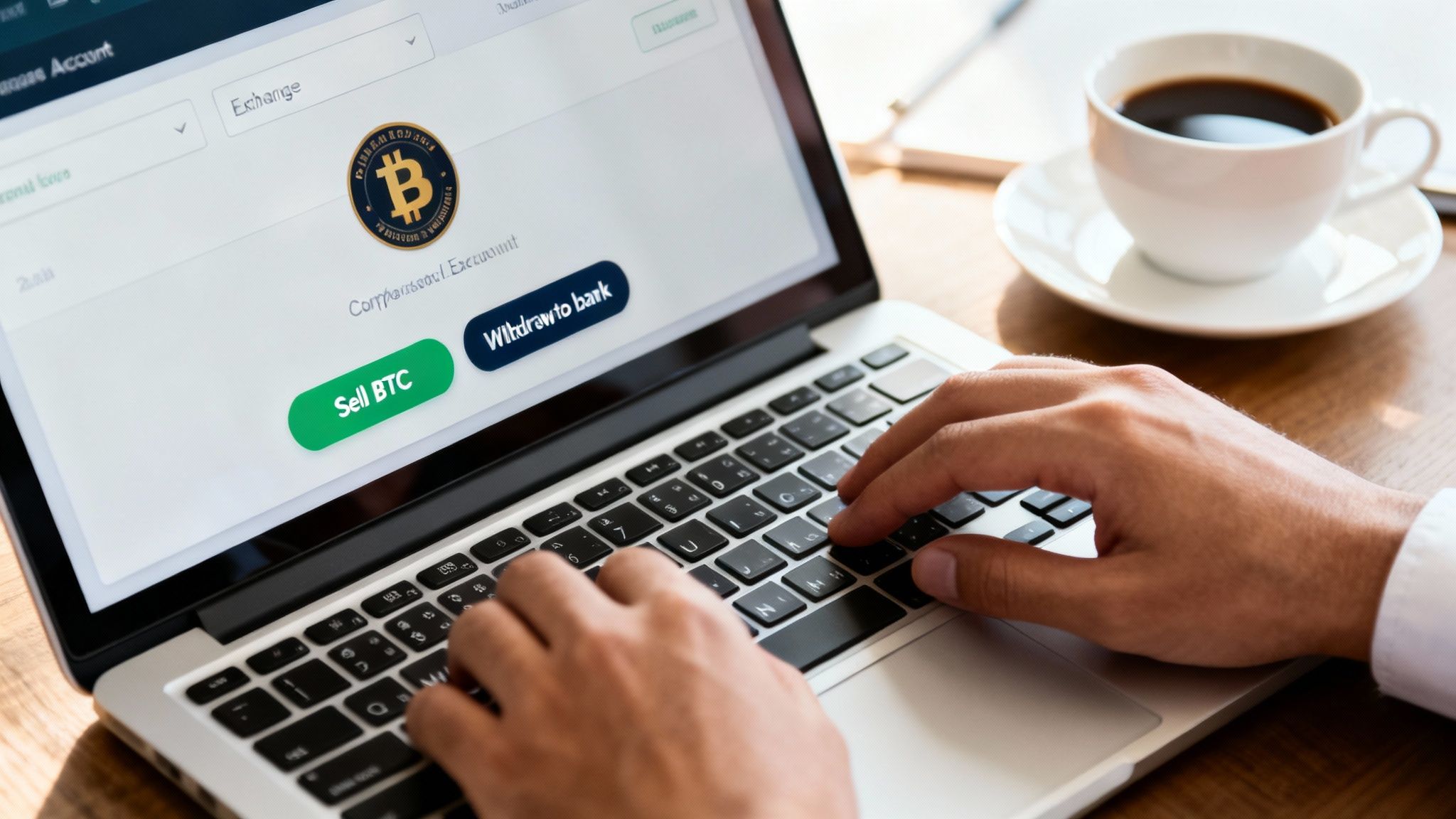
For most businesses, a centralized exchange is the most familiar tool to transfer Bitcoin to a bank account. It’s the established, straightforward path—a regulated bridge connecting your Bitcoin wallet to your company's fiat bank account.
Think of it as a specialized foreign exchange service, but for digital currencies instead of just traditional ones.
The whole process might feel a bit intimidating, especially for a business handling this for the first time. But once you break it down, it's a pretty logical workflow. It’s all about getting your company verified, moving the Bitcoin in, selling it for your local currency, and then pulling that cash out.
Selecting and Verifying Your Business Account
Your first move isn't just grabbing any exchange off the shelf. You need to pick one that is explicitly business-friendly and operates compliantly where you do business. Many exchanges are built for individual retail users and aren't equipped to handle corporate accounts, which come with much stricter verification rules.
When you're setting up the account, get ready for a deep dive into your business's paperwork. This is where Know Your Customer (KYC) and Anti-Money Laundering (AML) regulations really kick in. You'll almost certainly need to provide:
- Articles of Incorporation: The documents proving your business is a legal entity.
- Tax Identification Number (TIN): Your company's official tax ID.
- Proof of Address: A recent utility bill or bank statement in the business's name.
- Ownership Information: A full breakdown of all major shareholders or beneficial owners.
This verification can take anywhere from a few days to a couple of weeks, so it's smart to get it handled well before you actually need to off-ramp. Don't wait until you have an urgent need for cash to start this process.
Pro Tip: Look for exchanges that offer dedicated business support or account managers. Having a real person to call can be a lifesaver if you hit a snag with a large transaction or a compliance check down the road.
Depositing Bitcoin from Your Wallet
Once your business account gets the green light, it’s time to move your Bitcoin from its current home—ideally a secure, non-custodial wallet you control—to the exchange. The exchange will generate a unique Bitcoin deposit address just for your account.
This is a step you have to get right.
Always double-check, or even triple-check, the deposit address before you hit send. A single typo could send your Bitcoin into the digital void, lost forever. A good habit is to copy and paste the address, then visually confirm the first and last few characters match perfectly.
If it's your first time using a new exchange, send a small test amount first. Yes, you'll eat a small network fee, but it's a tiny price for the peace of mind that comes with seeing your funds arrive safely before you transfer a much larger sum.
Executing the Sale from BTC to Fiat
With your Bitcoin now sitting in your exchange account, it's time to sell it for fiat currency (like USD, EUR, or GBP). You'll generally see two basic ways to do this.
- Market Order: This is the "sell it now" button. It tells the exchange to sell your Bitcoin immediately at the best price available on the market. It's fast and simple, but you get whatever the price is at that exact moment.
- Limit Order: This lets you name your price. You set the specific price you're willing to sell at, and your order only goes through if the market hits your target. This gives you more control, but there's no guarantee it will ever get filled if the price doesn't cooperate.
For most businesses just cashing out revenue, a simple market order does the trick. It’s fast and predictable enough for managing cash flow. As soon as the sale executes, the fiat currency will pop up in your exchange account's cash balance.
Withdrawing Funds to Your Business Bank Account
The final piece of the puzzle is pulling the cash from the exchange into your linked business bank account. This is usually done via an ACH transfer or a wire transfer.
Wires are typically faster, often landing in your account within one business day, but they also cost more—usually around $25-$50. ACH transfers are often cheaper (or even free) but can take several business days to show up.
Before you initiate the withdrawal, pay close attention to the exchange's limits. Most platforms have daily or monthly caps on how much fiat you can pull out. If you're a high-volume business, you'll likely need to request an increase to these limits—another reason why having that fully verified corporate account is so important. Plan your withdrawals around your company’s cash flow needs, and always factor in these potential settlement delays.
Navigating Taxes and Compliance for Bitcoin Sales
When you transfer Bitcoin to a bank account, you're doing more than just moving money. You're kicking off a series of compliance and tax obligations that every merchant has to get right. Trying to ignore these rules is a non-starter; it can land you in a world of financial penalties and legal headaches.
The simplest way to think about it is this: treat your Bitcoin sales exactly like any other revenue stream. That means careful, diligent record-keeping from the very first transaction.
In most places, including the United States, regulators view Bitcoin as property for tax purposes. This means every time you sell it for fiat currency (like USD or EUR), you’re creating a taxable event. The outcome is either a capital gain or a capital loss, and it all depends on how Bitcoin's price has moved since you first received it.
Understanding Your Tax Obligations
To figure out what you owe, you first need to understand your cost basis. This is just the original value of the Bitcoin in your local currency at the exact moment you were paid.
Let's say a customer pays you 0.01 BTC for a product when Bitcoin's price is sitting at $50,000. Your cost basis for that specific 0.01 BTC is $500.
If you decide to cash out that 0.01 BTC a month later for $600, you've made a $100 capital gain. That's taxable income. On the flip side, if the price dropped and you only got $450 for it, you've incurred a $50 capital loss, which you can often use to offset other gains. For any business doing even a handful of BTC transactions a day, you can see how this gets complicated fast.
The biggest mistake I see businesses make is forgetting to log the fiat value of Bitcoin at the moment of each sale. Without that number, calculating your cost basis and capital gains becomes a guessing game, leaving you completely exposed in a tax audit.
Your best defense is meticulous record-keeping. You need to be tracking:
- Date and Time of Acquisition: When did you get paid in Bitcoin?
- Cost Basis: What was the fiat market value at that exact moment?
- Date and Time of Sale: When did you convert the Bitcoin to cash?
- Sale Proceeds: How much fiat did you receive for it?
The Role of KYC and AML in Bitcoin Off-Ramping
Beyond taxes, you're going to run into strict regulations designed to stop financial crime. Any time you use a centralized exchange or financial service to cash out your Bitcoin, you'll be subject to Know Your Customer (KYC) and Anti-Money Laundering (AML) rules.
These regulations force platforms to verify your business's identity to prevent anonymous transactions that could be used for illegal activities. This is exactly why opening a corporate account on an exchange feels like a mountain of paperwork—they need to know everything about your company's legal structure and who owns it.
This global push for compliance is a direct result of Bitcoin's explosive growth. As adoption skyrockets, regulators are putting the off-ramps—the points where Bitcoin becomes cash—under a microscope. This makes compliance an absolutely non-negotiable part of your workflow.
Maintaining Compliant Financial Records
Running a business that accepts Bitcoin means you have to be proactive about compliance. Trying to sort through a year's worth of transactions in a panic during tax season is a recipe for disaster.
Here’s some practical advice to stay on top of it:
- Use Specialized Software: Look into crypto tax software. Many of these tools can connect directly to your wallets and exchange accounts to automatically track your cost basis and calculate gains and losses. It saves a massive amount of time and reduces human error.
- Work with a Knowledgeable Accountant: Your regular accountant might be great, but don't assume they understand the specifics of digital assets. Find a professional who has real, hands-on experience with Bitcoin and business taxation.
- Keep Business and Personal Funds Separate: This is non-negotiable. Never, ever mix your personal Bitcoin with your business revenue. Use dedicated wallets and exchange accounts for all business activity. This creates a clean, auditable trail that will save you countless headaches.
Ultimately, staying compliant is all about treating your Bitcoin revenue with the same seriousness as your traditional sales. And remember, the rules don't stop at capital gains. If you're operating internationally, you need to understand the broader landscape, so consulting a guide to navigating UAE business tax and other regional regulations is crucial.
By setting up clear processes for tracking, reporting, and verification from day one, you can confidently turn your digital earnings into real-world, bankable assets.
Security Best Practices for Off-Ramping Bitcoin
When you transfer Bitcoin to a bank account, you're moving valuable company assets across a digital frontier. Security isn't just a nice-to-have; it's the absolute bedrock of a successful off-ramping strategy. One small mistake can expose your business to a major financial loss, making a rock-solid security protocol completely non-negotiable.
The single most important rule is to minimize the time your Bitcoin spends on an exchange. Think of these platforms for what they are: powerful tools for conversion, not long-term storage vaults. Your Bitcoin should only be on an exchange for the brief window it takes to sell for fiat and start the withdrawal. The second that trade is complete, the clock is ticking to get that cash into the safety of your corporate bank account.
Fortifying Your Exchange Account
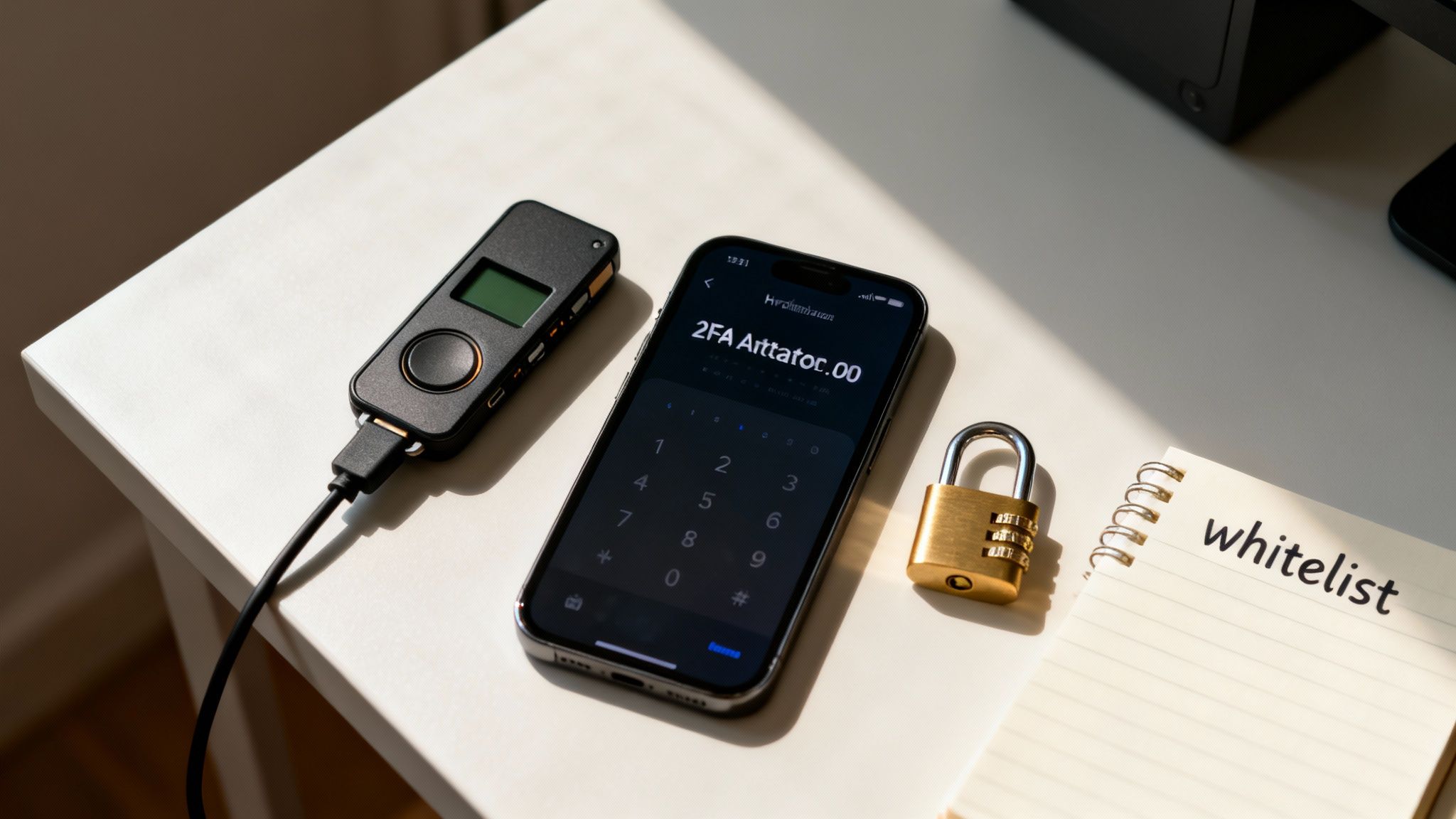
Your exchange account is the main chokepoint for turning Bitcoin into cash, which makes it a glowing target for attackers. Locking it down is your first line of defense. Start by making multi-factor authentication (MFA) mandatory, and always opt for an authenticator app over the less secure SMS-based codes.
Another critical security layer is address whitelisting. This feature lets you create a pre-approved list of bank accounts that can receive funds from your exchange. Once you turn it on, no withdrawals can be sent to an unlisted account. This simple move can single-handedly stop an attacker who gets your login credentials, as they'll have no way to divert your funds to their own accounts.
Think of it this way: your self-custody wallet is your business's secure vault, and the exchange is a temporary, high-traffic loading dock. You move assets to the dock only when a shipment is ready to go out, and you never leave them sitting there overnight.
Safe Transaction Practices
Let's be honest—human error is often the weakest link in any security setup. To get ahead of this, you need a clear, repeatable process for every single off-ramp transaction, especially when dealing with large amounts.
One simple but incredibly effective habit is to always run a small test transaction before moving a significant sum. Sending a tiny amount first and confirming it lands safely in your exchange account and then withdraws to your bank account ensures every address and connection is correct. This tiny step can prevent a catastrophic loss from a simple copy-paste mistake.
- Confirm Addresses Visually: Always, always double-check the first and last few characters of any Bitcoin or bank account address before you hit "send."
- Beware of Phishing: Be paranoid about sophisticated phishing attacks. Scammers are experts at creating fake login pages or emails that look identical to official messages from your exchange. Never click links in unexpected emails; always navigate directly to the exchange’s website by typing the URL yourself.
The Power of Self-Custody
At the end of the day, the best security strategy is built around keeping control of your Bitcoin until the very last second. This is where self-custody, specifically using a hardware wallet, becomes absolutely essential.
By keeping your company’s Bitcoin on a hardware wallet, you're ensuring the private keys—the digital equivalent of the keys to your vault—stay offline and out of reach of online hackers. You only connect the wallet to send the exact amount of Bitcoin needed for a specific conversion. This approach reinforces the principle of treating exchanges as temporary tools and keeps your core assets exactly where they belong: securely under your direct control.
The Direct Payment Model: A Simpler Alternative
So far, we've walked through the classic way to transfer Bitcoin to a bank account: send it to an exchange, sell it, then withdraw the cash. It works, but for a busy merchant, that workflow is often slow, expensive, and just plain clunky.
What if you could sidestep that entire sequence?
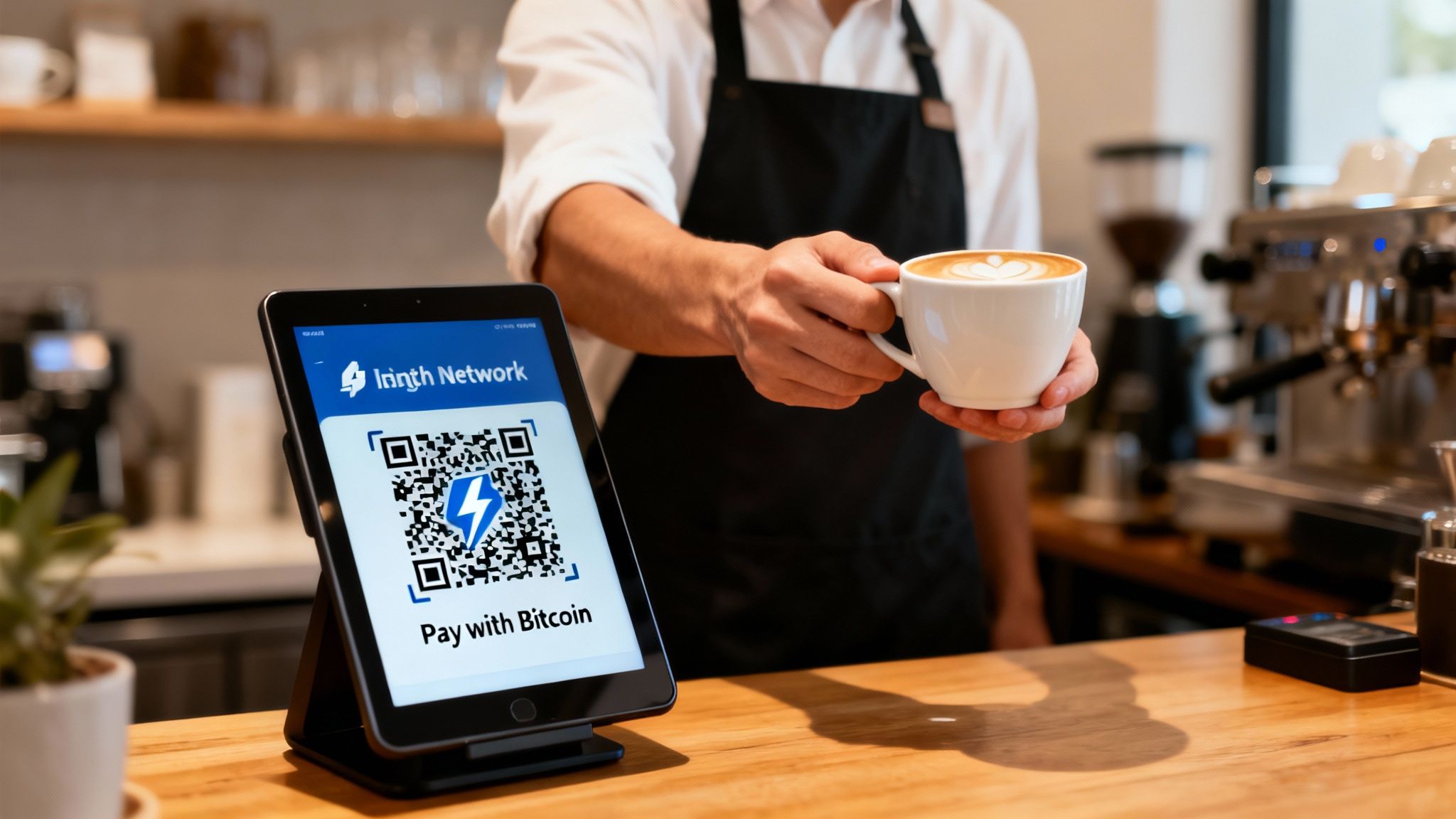
A direct payment model completely changes how you can handle Bitcoin. Instead of accepting BTC and then jumping through hoops to off-ramp it, you get paid directly from a customer's wallet to your own. For lightning-fast, practically free transactions, this is often done using the Bitcoin Lightning Network.
This approach cuts the exchange out of your daily operations entirely. All that friction—the KYC checks, withdrawal limits, and settlement delays—just vanishes from the customer's payment experience.
How Direct Payments Simplify Everything
With a direct model, the transaction is truly peer-to-peer. Your customer scans a QR code or taps a payment link, and the Bitcoin moves from their wallet to yours in seconds. This brings a few immediate, game-changing benefits to any business.
- Instant Settlement: Payments zipping across the Lightning Network settle almost instantly. Forget waiting around for block confirmations or bank processing times.
- Drastically Lower Fees: We’re talking transaction fees that are a tiny fraction of what you’d pay for on-chain transfers or the combined costs of exchange conversion and withdrawal.
- No Customer KYC Friction: Since customers pay straight from their own wallets, they don't have to sign up and get verified with your specific payment processor. That means a much smoother, faster checkout for them.
This direct interaction creates a more efficient and private experience for everyone, making a Bitcoin payment feel as simple as any other modern digital transaction.
Real-World Examples in Action
This isn't just theory; businesses are already using this model to streamline their cash flow today.
Think about a local coffee shop. They can use a point-of-sale app on a tablet to generate a unique Lightning QR code for each latte. The customer pays, the barista sees the confirmation in a flash, and the shop has the funds right away—no waiting for a third party to settle up.
Or consider an online creator selling digital art. They can embed a simple payment link on their site. A buyer clicks, pays with Bitcoin from their wallet, and gets the download link immediately. The creator gets paid without ever needing to manage an exchange account for every small sale.
The core idea is to treat Bitcoin as a true payment rail, not just an asset that needs converting. By shifting the focus from off-ramping to direct acceptance, you remove layers of complexity and cost, making the entire process more efficient for your business.
This model plugs right into the bigger trends in digital finance. Stablecoin transaction volumes have exploded, hitting over $4 trillion in the first half of 2025 alone and now accounting for 30% of all on-chain activity. This signals a massive demand for bridging digital assets and fiat, but the old methods are slow and costly.
A direct Bitcoin payment model, like the one offered by Flash, elegantly solves this. It allows merchants to accept payments directly from any Bitcoin wallet, cutting out the volatility risk and compliance headaches of complicated conversion paths. You can dig deeper into these trends in the findings from the 2025 crypto adoption report.
Frequently Asked Questions
When it comes to cashing out Bitcoin, merchants usually have a few practical questions. Let's tackle some of the most common ones so you can make the right call for your business.
How Long Does It Take to Transfer Bitcoin to a Bank Account?
You're typically looking at a timeframe of one to five business days from start to finish.
The first part is fast—sending your Bitcoin from your wallet to an exchange usually only takes 10 to 60 minutes. The real waiting game begins after that. The exchange needs to process your fiat withdrawal, and then your bank has its own settlement time. This is where things can vary, depending on whether you're using a standard ACH transfer versus a speedier wire transfer.
What Are the Typical Fees for Cashing Out Bitcoin?
There are a few costs to keep in mind. First, you'll pay a small Bitcoin network fee to move the BTC off your wallet and onto the exchange.
Once it's there, the exchange will charge a trading fee to sell your Bitcoin for cash, which usually falls between 0.1% and 0.6% of the transaction amount. Finally, there's a flat withdrawal fee to get the money into your bank account. This can be free for an ACH transfer, but expect to pay $25-$50 for a domestic wire.
Can I Transfer Bitcoin Directly to My Bank Account Without an Exchange?
In a word, no. A direct transfer just isn't possible. Your bank operates on traditional fiat currency systems and simply doesn't have the plumbing to accept or hold Bitcoin directly.
You have to use an intermediary service to convert your Bitcoin into a local currency like USD or EUR first. This conversion is a mandatory step before the funds can be sent to your bank.
These services—whether it's a centralized exchange, a peer-to-peer platform, or a specialized OTC desk—act as the essential bridge between the crypto world and the traditional banking system. They handle the conversion that makes the final bank deposit possible.
Ready to bypass the complex off-ramping process entirely? With Flash, you can accept Bitcoin payments directly from customer wallets, eliminating intermediaries and high fees. Start accepting instant, secure Bitcoin payments in under a minute. Learn more at Flash.