Knowing when to turn your Bitcoin into cash is just as important as knowing how. It's less about timing the market perfectly and more about making a strategic move to fund major life goals, rebalance your investment portfolio, or simply lock in profits after a solid run.
Strategic Reasons to Turn Bitcoin Into Cash

The right time to convert your Bitcoin back into fiat currency is a deeply personal financial decision. It should be driven by your own goals, not market hype or what everyone else is doing. While taking profits is a popular reason, there are several other smart scenarios that lead investors to cash out.
Meeting Real-World Financial Goals
One of the most satisfying reasons to sell is to fund a major life event. Think about putting a down payment on a house, buying a new car, or covering tuition costs. In these moments, converting your Bitcoin provides the cash you need to turn digital gains into something tangible and life-changing.
For instance, an early investor might sell a chunk of their holdings to launch a startup. They're effectively using their Bitcoin profits as seed capital, moving value from a speculative asset into a productive one that they control.
Portfolio Management and Risk Reduction
Another huge driver is just disciplined portfolio management. As Bitcoin’s price climbs, it can easily become a much larger piece of your investment pie than you originally intended, leaving you overexposed to risk.
Selling a portion of your holdings to rebalance is a savvy move to lock in gains and smooth out volatility. This isn't about market timing; it's about keeping your overall financial plan balanced and in line with your personal risk tolerance.
It’s a simple but effective strategy. If your target for Bitcoin was 10% of your portfolio but a bull run pushed it to 25%, selling off that excess brings your allocation back to where you're comfortable. For a broader perspective on the digital asset space, it's worth exploring general cryptocurrency insights.
Capitalizing on Market Conditions
The market has matured significantly, making it easier than ever to cash out. By 2025, cryptocurrency ownership among American adults has jumped to an impressive 28%—that's roughly 65 million people.
With Bitcoin having already crossed the $100,000 mark earlier this year, many long-term holders are looking for a profitable exit. Major exchanges now let you sell BTC directly for dollars, euros, or other currencies, and the money often hits your bank account in just 1-2 business days. You can dig into these consumer trends in the latest cryptocurrency report.
Choosing the Right Method to Cash Out Your Bitcoin
So, you're ready to turn your Bitcoin into cash. First thing to know: there's no single "best" way to do it. The right path for you hinges entirely on what you value most. Are you after speed? The lowest possible fees? Or maybe privacy is your top concern?
Each method has its own quirks and trade-offs. What’s perfect for a quick, small sale might be a terrible choice for cashing out a larger position. Getting a handle on these differences is the first—and most important—step to a smooth conversion.
Let's break down the most popular options, so you can figure out which one fits your specific situation.
Centralized Crypto Exchanges
For most people, a centralized exchange like Coinbase or Kraken is the most familiar on-ramp and off-ramp. Think of them like a traditional online stock brokerage. They offer deep liquidity, meaning you can sell your Bitcoin almost instantly without causing a big dip in the price.
The process is pretty straightforward: you deposit your Bitcoin, place a sell order, and then withdraw the cash directly to your linked bank account. This simplicity and reliability make them a go-to choice. The catch? You’ll have to complete identity verification (KYC), trading some of your privacy for the security and regulatory compliance they offer.
Peer-to-Peer (P2P) Platforms
If you'd rather have more control over the deal and a wider range of payment options, peer-to-peer (P2P) marketplaces are a fantastic alternative. These platforms connect you directly with individual buyers. You can sift through listings, check out a buyer's reputation, and pick one based on the price and payment method you prefer.
This direct approach gives you a ton of flexibility. Buyers can pay you through all sorts of methods:
- Standard bank transfer
- Cash deposit at a bank
- Online payment apps like PayPal or Venmo
While you can often snag better rates and lower fees on P2P sites, you need to be on your guard. Always use the platform's escrow service to make sure the buyer's payment clears before you release your Bitcoin. It's a non-negotiable safety step.
Choosing the right method is all about balancing your needs. An exchange offers speed and simplicity, while a P2P platform provides flexibility and potentially better rates. Always assess what matters most for your specific situation.
Bitcoin ATMs for Quick Cash
Need physical cash, like, right now? Nothing beats a Bitcoin ATM. You simply scan a QR code from your wallet, send the Bitcoin, and the machine spits out cash. It's hands down the fastest way to get your hands on physical money for smaller amounts.
Of course, that speed comes at a steep price. Bitcoin ATM fees are notoriously high, often chomping away 7% to 20% of your transaction. They also have pretty tight daily limits, so they're not built for anything more than small, urgent withdrawals. Think of them as a tool for immediate liquidity, not your main selling strategy.
Over-the-Counter (OTC) Desks
If you’re a serious investor looking to offload a substantial amount of Bitcoin—we're talking $100,000 or more—then an Over-the-Counter (OTC) desk is really your only viable option. Trying to sell a huge amount on a public exchange can trigger "slippage," where the sheer size of your order pushes the market price down, leaving you with less cash than you expected.
OTC desks avoid this mess by setting up private, direct trades at a pre-negotiated price. This gives you price stability, total privacy, and personalized service from a dedicated broker. It’s the professional way to ensure you get a fair market rate for a large holding without sending ripples through the public market.
Comparing Popular Bitcoin Cashing-Out Methods
To make things even clearer, let's put these options side-by-side. This table gives you a quick snapshot of what to expect from each method.
| Method | Best For | Typical Speed | Average Fees | Security Level |
|---|---|---|---|---|
| Centralized Exchange | Simplicity and speed for most users. | 1-5 business days to bank | 0.5% - 2% | High (KYC required) |
| P2P Platform | Flexibility, privacy, and better rates. | Minutes to days | 0% - 1% | Medium (escrow is key) |
| Bitcoin ATM | Immediate physical cash for small amounts. | Instant | 7% - 20% | Low (physical risk) |
| OTC Desk | Large trades ($100k+) without market impact. | 1-3 business days | Varies (negotiated) | Very High (private) |
Ultimately, the best choice depends on how much you're selling and how quickly you need the funds. Each one serves a different purpose, so pick the tool that's right for the job.
How to Cash Out Bitcoin on a Centralized Exchange
For most people, the simplest way to turn Bitcoin into cash is through a centralized exchange. Think of it like the currency exchange counter at an airport—it’s a regulated marketplace built to swap one asset for another. In this case, you're swapping your Bitcoin for good old-fashioned U.S. dollars or another fiat currency.
These platforms are popular for a reason. They have high liquidity, which just means you can sell your Bitcoin fast without tanking the price. The process itself isn't complicated, but nailing the details is what separates a smooth transaction from a frustrating one. Let's get into it.
Getting Your Ducks in a Row Before the Sale
Before you can even think about selling, you’ve got a couple of housekeeping items to take care of. The big one is identity verification, which the industry calls Know Your Customer (KYC). This is a non-negotiable step for almost any centralized exchange. You'll need to upload a government-issued ID and sometimes proof of address.
Don't skip or rush the KYC process. Your verification level directly impacts how much you can withdraw. Basic verification might limit you to a few thousand dollars a day, while full verification can open the floodgates to $100,000 or more, depending on the exchange.
Once you’re verified, it's time to move your Bitcoin from your personal wallet over to the exchange. This is a standard on-chain transaction. Here's a pro tip: always, always double-check the deposit address before you hit send. One wrong character, and your funds are gone forever. No take-backs.
Placing Your Sell Order: Market vs. Limit
Okay, your Bitcoin has landed safely in your exchange account. Now you’re ready to pull the trigger and sell. You’ll generally face two choices, and your decision here directly affects how much cash you'll walk away with.
- Market Order: This is the "sell it now" button. A market order executes your sale instantly at the best available price on the market. It guarantees the sale happens, but it doesn't guarantee the price. In a volatile market, that can make a difference.
- Limit Order: This option gives you the driver's seat. With a limit order, you set the exact price you’re willing to sell at. Your order will only go through if the market hits your target price. It's perfect for maximizing your profit, but you run the risk of the order never filling if the price doesn't cooperate.
So, what's the right move? It boils down to your priority. If you need cash in hand ASAP, a market order is your friend. If you're patient and have a specific price target, a limit order gives you the control you need.
These exchanges give you tools to manage your sale—use them to your advantage. If you're looking for a trustworthy place to get started, our guide on South Africa cryptocurrency exchange platforms can help you find a reliable option.
The Final Step: Withdrawing Your Cash
Once your sell order is filled, you'll see a cash balance in your account. The last step is to get that money into your bank. This is usually done through an ACH or wire transfer.
Expect the funds to land in your bank account within 1-3 business days, though it can vary. Just be sure to check the withdrawal fees—they can be a sneaky cost that nibbles away at your profits if you're not paying attention.
Cashing Out Large Bitcoin Positions With an OTC Desk
When you need to turn a serious amount of Bitcoin into cash—we’re talking $100,000 or more—your typical crypto exchange just won't cut it. It’s a classic rookie mistake.
Trying to dump a massive sell order onto a public exchange is a recipe for disaster. You’ll almost certainly trigger what’s called price slippage. The sheer size of your trade overwhelms the order book, pushing the market price down before your entire order can even be filled. You end up with way less cash than you thought you were getting.
This is exactly where Over-the-Counter (OTC) desks come into play. Think of an OTC desk as a private brokerage for the big players. They connect large buyers and sellers directly, completely bypassing public order books. This keeps the transaction quiet and, more importantly, protects the market from the shock of a massive sell-off.
How Does an OTC Trade Actually Work?
Forget clicking a "sell" button on an app. This is a much more hands-on, personalized service where you'll work directly with a dedicated broker or trading desk.
The whole process is designed for discretion and efficiency:
- Getting Started: First, you’ll go through a proper vetting and onboarding process. Any reputable OTC desk needs to verify your identity and the source of your funds to stay compliant.
- Locking in a Price: Instead of watching the market tick by, you’ll receive a firm price quote for your entire chunk of Bitcoin. This price is locked in for you, completely wiping out the risk of slippage.
- The Swap: Once you agree on the price, you send your Bitcoin to a secure wallet address they provide.
- Getting Paid: The OTC desk then wires the agreed-upon cash amount straight to your bank account. Settlement is usually wrapped up within a single business day.
This white-glove approach is precisely why institutions, crypto whales, and savvy early investors use OTC desks almost exclusively for liquidating large positions. It's the professional’s way to turn Bitcoin into cash at scale.
The real magic of an OTC desk is price certainty. For a major sale, avoiding even a 1-2% price slippage on a public exchange can mean saving tens of thousands of dollars.
Finding a Reputable OTC Desk
Choosing the right OTC service is absolutely critical for a secure and smooth transaction. Many of the big, well-known exchanges have their own private OTC desks for high-net-worth clients, but there are also excellent independent firms that specialize in this.
You’ll want to look for a desk with a long, proven track record, solid regulatory compliance, and a transparent fee structure. No surprises.
As Bitcoin's value has climbed, so has the number of large-scale cash-outs. The world is projected to have 241,700 crypto millionaires by 2025, and this has pumped huge liquidity into the top OTC desks. These firms have already handled tens of billions in institutional BTC-to-fiat trades with barely a ripple in the market. You can dive deeper into this in a Bitcoin capital market analysis.
For any substantial sale, this is by far the most secure and efficient path to take.
Right, so you've sold your Bitcoin and the cash is on its way. Don't pop the champagne just yet. The deal isn't truly done until you've buttoned up two crucial loose ends: security and taxes. Getting either of these wrong can turn a sweet profit into a massive headache.
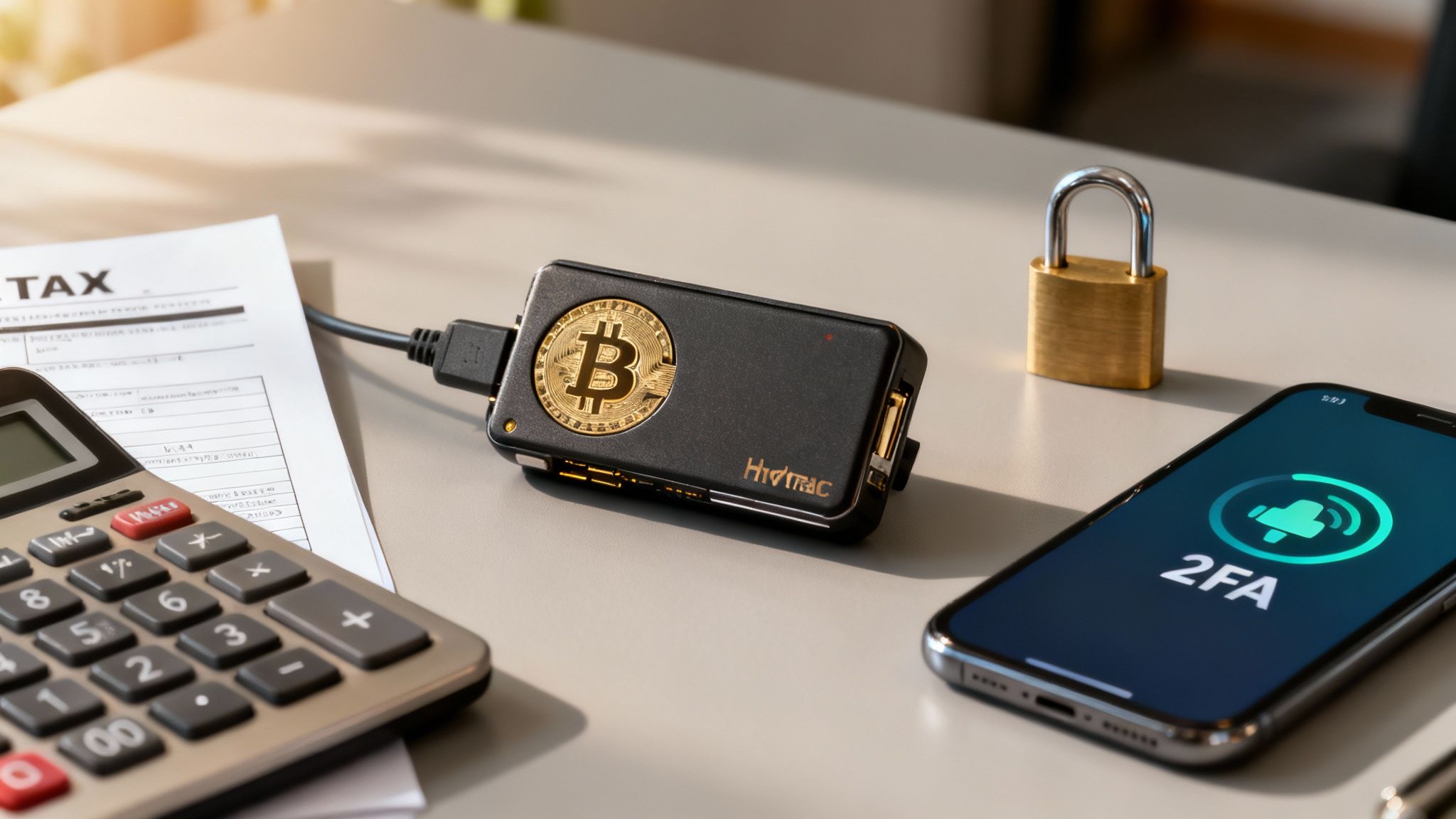
Let's start with the taxman, because ignoring him is never a good idea. In most places, including the U.S., selling Bitcoin for fiat currency is a taxable event. This means any profit you made is likely subject to capital gains tax. The exact amount will depend on how long you held the Bitcoin and what your income bracket looks like.
Think of it this way: if you bought Bitcoin for $10,000 and sold it a year later for $50,000, you’ve got a $40,000 capital gain you need to report. This is why keeping meticulous records—purchase dates, prices, sale details—is non-negotiable. Seriously, just hire a tax professional who knows their way around crypto. It's an investment that pays for itself.
Don't Get Sloppy With Security
Security isn't just about HODLing safely; it's about protecting the entire process when you decide to turn bitcoins to cash. The second you move those funds to an exchange or set up a withdrawal, you paint a giant target on your back for scammers.
Basic digital hygiene goes a long, long way. The absolute bare minimum is enabling two-factor authentication (2FA) on your exchange account. This simple step adds a critical shield, requiring a code from your phone to approve logins and, more importantly, withdrawals.
Always double-check and then triple-check withdrawal addresses. I can't stress this enough. There's a nasty piece of malware that swaps your legitimate bank or wallet address with an attacker's at the last second. That one final check can be the difference between getting paid and losing everything.
Know Thy Enemy: Common Scams to Dodge
Scammers are always cooking up new tricks. Your best defense is simply being aware of their game. Phishing attempts are incredibly common, often disguised as official-looking emails or texts from your exchange urging you to click a link. Don't.
Internalize these security habits until they're second nature:
- Use Strong, Unique Passwords: Never, ever reuse passwords between financial platforms. Get a password manager to create and store ridiculously complex credentials for you.
- Bookmark Your Exchange: Don't click links from emails or search for the exchange on Google. Go directly to your saved bookmark every single time. This sidesteps any convincing-but-fake clone sites.
- Be Wary of "Support": A legitimate support agent will never ask for your password, 2FA codes, or private keys. If someone contacts you first offering help, it's a scam. Full stop.
In the end, a careful and deliberate approach is what separates a successful Bitcoin sale from a cautionary tale. Plan ahead, stay vigilant, and you'll protect those hard-earned gains without any nasty surprises.
Common Questions About Cashing Out Bitcoin
You're almost at the finish line, but navigating those final steps of cashing out can still bring up a few last-minute questions. Getting clear, straightforward answers is the key to making your sale confidently and smoothly.
Let's walk through some of the most common things people ask when they're ready to turn bitcoins to cash. Getting this right helps you sidestep potential headaches, whether you're worried about fees, limits, or the taxman.
What Is the Fastest Way to Turn Bitcoin Into Cash?
When you absolutely need cash now, the best option really depends on how much you're selling.
For smaller amounts, a Bitcoin ATM is often your quickest bet. You can have physical cash in your hands in just a few minutes. But be warned, that speed comes at a price—ATM fees are notoriously high.
For anything more than a small, urgent withdrawal, selling on a verified centralized exchange and sending the funds to your bank is the most reliable and efficient method. The money usually lands in your account within 1-3 business days.
Are There Limits on How Much Bitcoin I Can Sell?
Yes, just about every method for cashing out has its limits. These aren't arbitrary; they're in place for security and to comply with financial regulations.
- Centralized Exchanges: Your daily or monthly withdrawal limits are tied directly to how much of your identity you've verified. A basic account might have a low cap, while a fully verified one will have significantly higher limits.
- Bitcoin ATMs: These are built for convenience, not volume. Expect to be capped at a few thousand dollars per day.
- Peer-to-Peer Platforms: The platform doesn't set the limits here—the individual buyers you trade with do.
- OTC Desks: This is the exception. OTC desks are specifically for high-volume trades, typically starting at $100,000, with virtually no upper limit.
Your verification status is the single biggest factor determining your withdrawal limits on an exchange. If you plan on cashing out a significant sum, completing the full KYC (Know Your Customer) process isn't optional—it's essential.
How Can I Minimize Fees When Selling My Bitcoin?
Fees can take a surprisingly big bite out of your profits if you're not paying attention. A little planning goes a long way.
Start by comparing the fee structures on different exchanges. They can vary dramatically, so look at both the trading fee (what it costs to sell) and the fiat withdrawal fee (what it costs to send the cash to your bank).
When you're ready to sell, consider placing a "maker" order (also called a limit order). This adds liquidity to the exchange's order book and often comes with lower fees than a "taker" order (a market order that executes immediately).
Finally, look at the withdrawal options. Sometimes a simple ACH transfer is cheaper than a wire transfer, so pick the most cost-effective method for your needs.
Do I Have to Pay Taxes When I Turn Bitcoin to Cash?
In most places, including the U.S., selling your Bitcoin for a fiat currency like the dollar is a taxable event. The taxman views it as selling an asset, and you'll generally need to report any profit as a capital gain.
The actual tax rate you pay depends on a few things, like how long you held the Bitcoin (short-term vs. long-term gains are taxed differently) and your total income for the year. This is why keeping meticulous records of when you bought your Bitcoin and for how much is so important.
Tax laws are notoriously complex and can change. To make sure you're doing everything by the book, it’s always a smart move to talk to a qualified tax professional.
For merchants looking to accept Bitcoin directly without the hassle of cashing out, Flash provides a seamless solution. Our software enables instant, wallet-to-wallet payments, connecting you to over 500 million Bitcoin users worldwide without ever touching your funds. Get started in under a minute at .