Choosing a way to store your Bitcoin can feel complicated, but all the different types of crypto wallets boil down to one core function: securing the secret codes, or private keys, that give you access to your funds.
Think of it less like a physical wallet holding cash and more like a specialized digital key ring for your Bitcoin.
What Exactly Is a Bitcoin Wallet
A common misconception is that a Bitcoin wallet actually "stores" your Bitcoin. In reality, your Bitcoin always exists on the blockchain—a global, public ledger that’s shared across thousands of computers worldwide.
The wallet's real job is to safeguard the private keys that prove you own those coins and give you the authority to spend them.
Imagine a secure digital safe deposit box. The box itself (the blockchain) holds your valuables (your Bitcoin), but only your unique key (the private key) can open it. A crypto wallet is the tool that manages this key for you, letting you interact with the Bitcoin network securely.
The Two Main Categories
Every Bitcoin wallet, no matter how fancy, falls into one of two main categories. This distinction comes down to a single, critical factor: its connection to the internet.
Getting this difference is the first step in picking the right tool for the job. And to understand the bigger picture, it helps to be familiar with the concept of cryptocurrency itself.
These two fundamental types are:
- Hot Wallets: These are wallets that are connected to the internet, like an app on your phone or software on your computer. Their online status makes them incredibly convenient for everyday transactions but also leaves them more exposed to online threats.
- Cold Wallets: These are wallets kept completely offline, disconnected from the internet. By isolating your private keys from potential remote attacks, they offer the highest level of security, making them perfect for storing larger amounts long-term.
Key Takeaway: The whole point of any wallet is to manage your private keys. The main difference between them is how they balance the trade-off between easy access and rock-solid security.
This simple distinction—hot versus cold—sets the stage for every other type of wallet we’re about to explore. Let's break it down further.
Hot Wallets vs Cold Wallets At a Glance
Here’s a quick comparison to see how these two wallet types stack up against each other.
| Feature | Hot Wallet | Cold Wallet |
|---|---|---|
| Connectivity | Always online | Completely offline |
| Security | Good, but vulnerable to online threats | Highest level of security |
| Convenience | Excellent for daily use and quick payments | Less convenient for frequent access |
| Best For | Small amounts, frequent transactions, daily spending | Large amounts, long-term savings, "HODLing" |
| Examples | Mobile apps, desktop software, web wallets | Hardware devices, paper wallets |
Ultimately, many people end up using both: a hot wallet for their "spending" money and a cold wallet for their "savings," giving them the best of both worlds.
Understanding Hot Wallets for Everyday Use
When you need fast and fluid access to your Bitcoin, a hot wallet is your go-to tool. Their defining trait is a constant connection to the internet, which is precisely what makes them perfect for frequent transactions and daily spending.
Think of a hot wallet like the cash you keep in your physical wallet. You wouldn't walk around with your life savings in your back pocket, right? But you need enough cash on hand for coffee, lunch, or other everyday buys. A hot wallet serves the same purpose—it holds a smaller amount of Bitcoin you plan to use on a regular basis.
This always-online status is the secret to their incredible convenience. It's what allows you to send and receive Bitcoin in an instant, whether you're paying a merchant, tipping a creator, or just sending some sats to a friend.
Mobile and Desktop Wallets
Within the hot wallet category, you'll mainly find two flavors: mobile apps and desktop software. While they both prioritize quick access, they each serve slightly different use cases.
- Mobile Wallets: These are the apps you download to your smartphone, essentially turning your phone into a pocket-sized Bitcoin terminal. They are fantastic for paying in person, often using QR codes to make sending Bitcoin as easy as snapping a photo. Their sheer convenience is why they've become so popular.
- Desktop Wallets: This is software you install on your laptop or home computer. While not as portable as a mobile app, desktop wallets often pack in more advanced features. You might find more detailed transaction histories or finer control over network fees for power users.
The Bitcoin wallet market has seen a massive shift toward mobile-first experiences. In 2025, the number of people using mobile wallets soared past 35 million monthly active users. This trend is all about the unbeatable convenience and accessibility of having your Bitcoin right on your phone. You can dig into more data on wallet market share statistics.
The Security Trade-Off
So, what's the catch? The biggest drawback of any hot wallet is that it's always online. Because the private keys—the "password" to your funds—are stored on an internet-connected device, they have a larger attack surface. This makes them more vulnerable to online threats like malware or a clever phishing scam.
Important Consideration: Hot wallets are incredibly useful, but they are not the right place to store a large amount of Bitcoin. Their "always-on" nature makes them a target. Stick to using them for your transactional, everyday spending money.
This doesn't mean hot wallets are fundamentally insecure. Good wallet providers implement strong encryption and other security measures to keep your keys safe. But the risk is inherently higher than with an offline solution. It's the classic trade-off between convenience and security that exists with every type of Bitcoin wallet.
Exploring Cold Wallets for Maximum Security
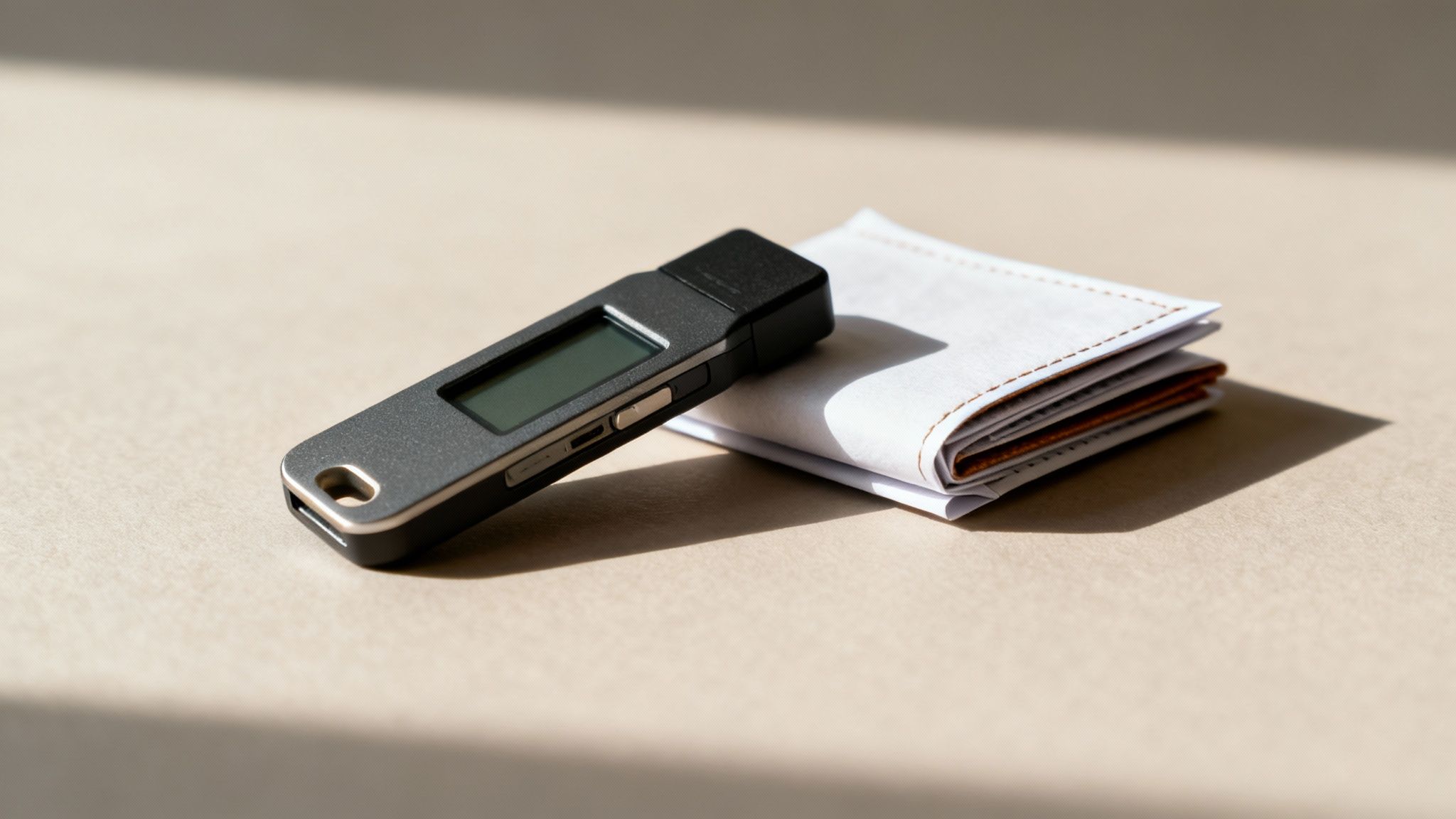
While hot wallets are great for convenience, that internet connection comes with a security trade-off. When it's time to get serious about protecting a significant amount of Bitcoin for the long haul, cold wallets are the undisputed gold standard. Simply put, this type of crypto wallet keeps your private keys completely offline.
This total offline isolation is what makes them so powerful. By creating an "air gap" between your keys and the online world, cold wallets are fundamentally immune to threats like hacking, phishing attacks, and malware that could infect a computer or smartphone.
Think of a cold wallet as your personal bank vault. You wouldn't pop down to the vault for your daily coffee, but it's exactly where you'd store your most valuable assets. This makes it the only sensible solution for anyone truly serious about protecting their Bitcoin holdings.
Hardware Wallets The Modern Fortress
Today, the most popular and practical form of cold storage is the hardware wallet. These are small, purpose-built physical devices, often looking like a fancy USB drive, designed to do just one thing: keep your private keys locked down in a secure, offline chip.
When you need to send a transaction, you connect the device to your computer or phone. The transaction details are sent to the hardware wallet, which uses your private key to sign it internally before sending just the signed transaction back out to the network. Your keys never, ever leave the device.
This design gives you the best of both worlds:
- Maximum Security: Your keys are kept totally isolated from internet-connected devices, cutting off remote attack vectors.
- Usable Convenience: They're not as instant as a mobile app, but they make managing funds securely a relatively straightforward process.
The Golden Rule of Self-Custody: For any amount of Bitcoin you cannot afford to lose, a hardware wallet isn't just a good idea—it's essential. It represents the most robust defense an individual user has against theft.
The market reflects this reality. The global crypto wallet market was valued at around $18.96 billion in 2025, and hardware wallets are claiming a huge and growing slice of that pie. This surge is fueled by a rising demand for bulletproof security, especially from long-term holders and institutions who put asset protection above everything else. You can read the full research on the crypto wallet market.
Paper Wallets The Original Cold Storage
Before hardware wallets hit the scene, the original method for offline storage was the humble paper wallet. This is a very low-tech but surprisingly secure approach where your public and private keys are simply printed onto a piece of paper, often as scannable QR codes.
Since it's just a physical document, a paper wallet is completely off the grid and impervious to digital attacks. The catch? It requires extreme physical care. If that piece of paper is lost, destroyed in a fire or flood, or physically stolen, your Bitcoin is gone for good. This makes them far less practical than hardware wallets for most people today, but they're a great example of the core principle of cold storage in its purest form.
Custodial vs Non-Custodial Wallets Explained
Forget hot vs cold for a moment. The single most important decision you'll make about a Bitcoin wallet is who actually holds the keys. This one choice defines your financial freedom and how much responsibility you have to shoulder. Every wallet on the planet falls into one of two camps: custodial or non-custodial.
Think of it like this: do you want to use a bank account, or do you want to keep your cash in a personal safe at home? One is convenient and relies on a trusted company to manage things, while the other gives you absolute, hands-on control. Getting this concept right is the bedrock of using Bitcoin safely.
What Is a Custodial Wallet?
A custodial wallet is basically an account where someone else—usually a Bitcoin exchange—holds and manages your private keys for you. When you buy Bitcoin on a big exchange and just leave it there, you're using a custodial wallet.
It feels a lot like a normal bank. You trust them to keep your money safe, and in return, you get convenient perks like password resets and a customer support team to call if you get locked out.
The main draw here is simplicity. You don’t have to stress about securing a long string of words (your seed phrase). Forget your password? No problem, the custodian can help you get back in. For anyone just starting out, this feels familiar and way less scary.
But that convenience comes with a heavy price: you're not really in control of your Bitcoin. The custodian has the final say and can freeze your account if they want to. Their security is your security, so if they get hacked, your funds are on the line.
What Is a Non-Custodial Wallet?
A non-custodial wallet flips the script entirely, putting you in complete control of your private keys. Hardware wallets, along with most mobile and desktop software wallets, fit this description. This is where the famous Bitcoin mantra comes from: "not your keys, not your coins."
With a non-custodial wallet, you are your own bank. Period. No third party can touch, freeze, or take your funds without your say-so. You have total financial sovereignty.
Of course, this freedom comes with total responsibility. You are the one and only person in charge of protecting your private keys, which are usually represented by a 12 or 24-word recovery phrase. If you lose that phrase and your device, your Bitcoin is gone forever. There's no 1-800 number to call for help.
The Essential Trade-Off: The choice between custodial and non-custodial wallets is a classic tug-of-war between convenience and control. Custodial wallets are easy but require you to trust a third party. Non-custodial wallets give you complete ownership but demand personal responsibility.
As you get more comfortable in the Bitcoin world, moving your funds from an exchange's custodial wallet to a non-custodial wallet that you control is a rite of passage. It's the step you take to truly own your digital assets without having to rely on anyone.
To make this crystal clear, let's break down the key differences side-by-side.
Custodial vs Non-Custodial Wallet Comparison
| Characteristic | Custodial Wallet | Non-Custodial Wallet |
|---|---|---|
| Key Control | Third party (e.g., exchange) holds your keys. | You hold and control your own keys. |
| Security | You trust the provider's security measures. | You are 100% responsible for your security. |
| Account Recovery | Usually possible via password reset or support. | Impossible if you lose your recovery phrase. |
| Access | Can be frozen or restricted by the provider. | Uncensorable. Only you can access your funds. |
| Ease of Use | Generally simpler, feels like a bank app. | Requires more personal responsibility. |
| Best For | Beginners, traders, small amounts. | Long-term holders, users valuing sovereignty. |
Ultimately, there's a place for both. Custodial wallets are great for getting started or for small amounts you might trade with, but for any serious savings, taking self-custody is the only way to truly embrace the power of Bitcoin.
Advanced Wallets for Enhanced Security
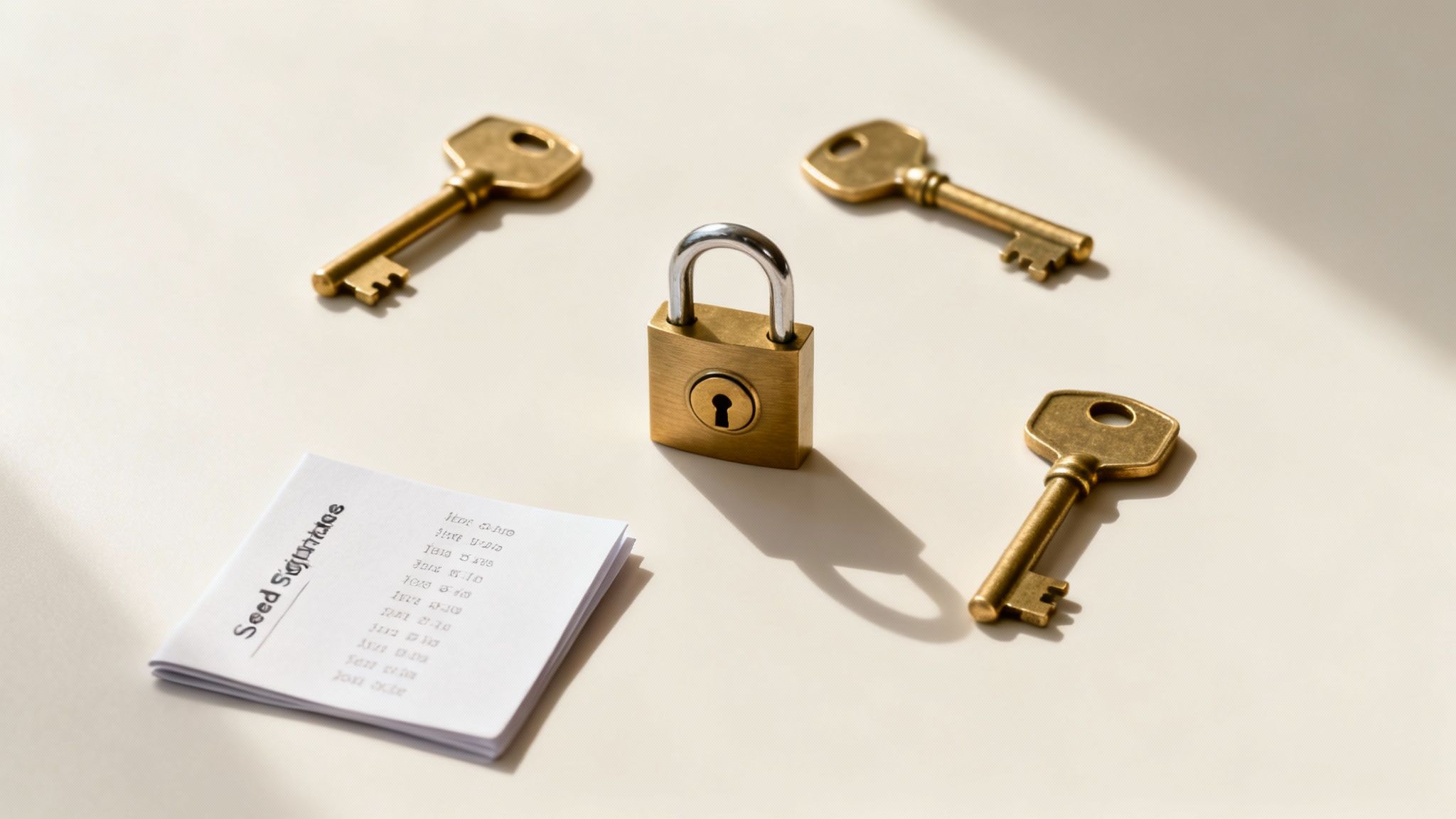
For some users, a standard single-key wallet just doesn't cut it. When you're dealing with company funds, protecting a large personal stash, or managing money as a group, you need specialized layers of security. These advanced setups are all about eliminating single points of failure.
This is where the multisignature (or multisig) wallet comes in. It’s one of the most powerful security tools in the Bitcoin world, requiring more than one private key to approve a transaction. This creates a seriously robust defense against theft or simple human error.
Think of it like a bank vault needing two different keys turned simultaneously to open the door. A thief might steal one key, but it’s useless on its own. That's the core idea behind multisig security.
How Multisig Wallets Work
A very common setup is the "2-of-3" wallet. In this arrangement, three separate private keys are generated, but only two are needed to sign off on a transaction. This design hits a sweet spot between hardcore security and real-world practicality.
This structure is a game-changer for a few key scenarios:
- Business Partnerships: Prevents one rogue partner from draining company funds. Any transaction requires a sign-off from at least one other keyholder.
- Escrow Services: A neutral third party can hold one key, acting as a mediator in a deal between a buyer and seller.
- Next-Level Personal Security: You can store your three keys in completely separate, secure locations. If a fire, flood, or thief takes out one key, your funds are still safe because an attacker still needs a second key to do anything.
By spreading control across multiple keys, a multisig wallet makes it impossible for a single person or a single hacked device to compromise your funds. It's a foundational security practice for any serious Bitcoin user or organization.
Of course, even with a great wallet, you shouldn't neglect basic security hygiene. Adding an extra layer of protection like two-factor authentication is always a smart move to block unauthorized access.
The Concept of a Brain Wallet
Another interesting—though extremely risky—idea is the brain wallet. The concept is to ditch all hardware and paper backups by simply memorizing your seed phrase. In theory, your Bitcoin is accessible anywhere in the world, with nothing but what's in your head.
As you might guess, this is an incredibly dangerous approach and not recommended for pretty much anyone. The human brain is notoriously bad at remembering long, complex strings of words perfectly. Forget one word or mix up the order, and your Bitcoin is gone forever. No recovery, no do-overs.
While it's a fascinating thought experiment on ultimate portability, the massive risk of human error makes it more of a novelty than a practical security strategy. For security you can actually count on, stick with proven technologies like hardware devices and multisig setups.
How to Choose the Right Bitcoin Wallet
Picking the right type of crypto wallet isn’t about finding a single “best” option that works for everyone. It’s more personal than that. You’re really just matching a wallet’s strengths to your own habits and how much risk you’re comfortable with.
Your choice is a direct trade-off between everyday convenience and long-term security. To make it tangible, let's walk through a few common scenarios. Each one shines a light on a different need, pointing you toward the right tool for the job.
The Daily User
Are you planning to use Bitcoin for frequent, smaller payments? Think buying coffee, tipping creators online, or splitting a bill with friends. If so, your top priority is speed and having your funds ready to go at a moment's notice.
For this kind of activity, a non-custodial mobile hot wallet is your best bet. Treat it like the cash in your physical wallet—it's there for your daily spending. Because it’s always online, payments are as easy as scanning a QR code, but you should only keep small, transactional amounts in it.
The Long-Term Holder
Maybe you're more focused on accumulating Bitcoin as a long-term investment. If you're saving for the future, security is the only thing that should be on your mind. This type of user, often called a "HODLer," needs to shield their assets from every possible online threat.
The undisputed champion here is a hardware cold wallet. By keeping your private keys totally disconnected from the internet, a hardware wallet acts like your own personal, digital Fort Knox. It’s the gold standard for protecting any amount of Bitcoin you can't afford to lose.
The Collaborative Group
What about when a team, a business, or a family needs to manage funds together? Using a standard wallet with a single key creates a massive vulnerability—a single point of failure that’s just asking for trouble.
The solution is a multisignature (multisig) wallet. This clever setup demands multiple approvals before any funds can be moved, making it impossible for one person to act alone. It’s security through teamwork.
Key Insight: For most serious users, the smartest play is a hybrid approach. Use a mobile hot wallet for your daily spending money and a hardware cold wallet for your savings. This gives you the best of both worlds: convenient access when you need it and rock-solid security for the long haul.
Frequently Asked Questions About Bitcoin Wallets
Diving into the world of Bitcoin can bring up plenty of questions, especially when you're trying to figure out which crypto wallet is right for you. Let's tackle some of the most common concerns head-on with clear, straightforward answers.
Are Mobile Wallets Safe for Small Amounts?
Yes, for small, everyday amounts of Bitcoin, reputable mobile wallets are perfectly fine. Think of it like the cash you'd keep in your physical wallet—it’s there for convenience and daily spending, not for stashing your life savings. These apps use strong encryption on your phone to keep your keys safe.
The catch is that your phone is always online, which naturally makes it more vulnerable to attack than a device that's completely disconnected from the internet. For that reason, mobile wallets are best for your "spending" Bitcoin, not your long-term HODL stash.
Do I Really Need a Hardware Wallet as a Beginner?
If you're just dipping your toes in the water with a very small amount of Bitcoin, you can definitely start with a mobile wallet. But here's the real test: if you plan to accumulate an amount that would genuinely upset you if it vanished, a hardware wallet stops being a luxury and becomes a necessity. It’s simply the most secure way to shield your funds from online threats.
A hardware wallet takes the single most important part of the process—signing transactions—completely offline. This one feature creates a security barrier that no internet-connected software can ever hope to match, making it essential for anyone serious about long-term storage.
How Do I Recover a Lost Wallet with My Seed Phrase?
If you have your seed phrase (sometimes called a recovery phrase), getting access to a lost non-custodial wallet is surprisingly simple. That list of 12 or 24 words is the master key that unlocks all of your Bitcoin addresses on the blockchain.
Here’s how it generally works:
- Grab a new device and install a new wallet app. It's easiest to use the same software as before, but any compatible wallet will do the trick.
- When you’re setting it up, look for an option that says "Restore" or "Import Wallet" instead of creating a brand new one.
- Carefully type in your seed phrase, making sure every word is in the exact right order.
Once that's done, the wallet software will regenerate your private keys from the phrase and, just like that, you'll have full access to your Bitcoin again.
Ready to accept Bitcoin payments directly from any wallet? Flash empowers your business with instant, wallet-to-wallet transactions that are secure and decentralized. Get started in under a minute.