Accepting Bitcoin in the UK comes with specific tax and regulatory requirements. Here’s what you need to know:
- Bitcoin is classified as an asset by HM Revenue & Customs (HMRC), not as a currency.
- Every transaction - whether for sales, vendor payments, or holding bitcoin - can trigger tax obligations like capital gains or trading income.
- Accurate record-keeping is mandatory, including acquisition dates, cost basis, and market values.
- Businesses must comply with anti-money laundering (AML) laws and Financial Conduct Authority (FCA) regulations.
- Non-compliance can lead to penalties, audits, or legal consequences.
To manage these complexities, UK businesses should establish clear processes for tax reporting, adhere to AML/KYC requirements, and stay updated on regulatory changes.
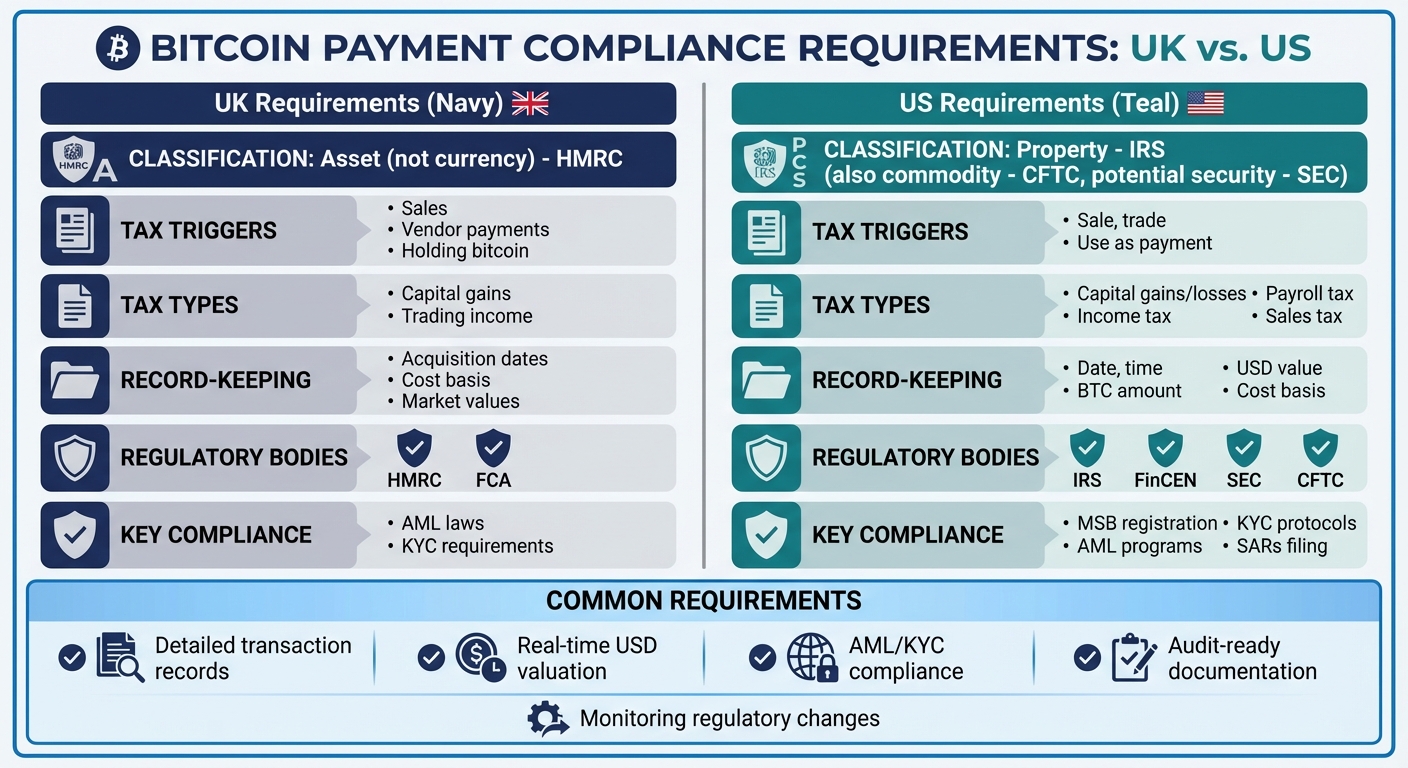
UK vs US Bitcoin Tax and Regulatory Compliance Requirements Comparison
US Tax Treatment of Bitcoin Payments
IRS Classification of Bitcoin and Tax Consequences
The IRS views bitcoin as property, meaning any sale, trade, or use as payment creates a taxable event. This is calculated by comparing the bitcoin's fair market value at the time of the transaction to its original cost basis. To stay on the right side of the IRS, it's crucial to keep detailed records of each transaction, including the fair market value and original cost basis. Working with a tax professional can help ensure you're meeting all compliance requirements. These rules also play a role in how you handle related sales, payroll, and record-keeping responsibilities.
Sales Tax Treatment for Bitcoin Transactions
When you accept bitcoin as a form of payment, sales tax obligations are typically based on the transaction's USD value at the time of payment. Since sales tax laws differ across states and local jurisdictions, it's important to confirm the specific requirements where your business operates. To calculate sales tax, convert the bitcoin's fair market value to USD at the time of the transaction.
Payroll Tax Requirements for Bitcoin Employee Compensation
Paying employees in bitcoin comes with its own set of tax responsibilities. You’ll need to calculate the value of the bitcoin compensation in USD at the time of payment to comply with federal and state payroll tax rules, including income tax, Social Security, and Medicare. Employers must report these wages in dollars, ensure proper tax withholding, and submit payments on time. Given the complexities involved, it's a good idea to use tools that provide real-time valuation and consult with a tax professional to navigate payroll tax requirements effectively.
Record-Keeping Requirements for Tax Compliance
Accurate records are essential for tax compliance. Keep detailed logs that include the date, time, bitcoin amount, and its corresponding USD value for each transaction. These records are vital for calculating gains or losses and for audit preparation. Setting up a reliable accounting system to track these details can make it easier to stay compliant with US tax laws.
US Regulatory Requirements for Bitcoin Payments
US Crypto Regulatory Framework
Once you've tackled tax considerations, the next challenge is navigating the intricate regulatory landscape for bitcoin payments in the US. The country doesn’t have a single federal law governing digital currency operations, making compliance a bit of a maze. How bitcoin is classified depends on its use - it could be considered a commodity, a payment instrument, or property for tax purposes. This means your business might need to juggle multiple regulatory requirements at the same time.
For instance, the Financial Crimes Enforcement Network (FinCEN) designates many crypto businesses as Money Services Businesses (MSBs). This includes custodial exchanges, hosted wallet providers, and even kiosk operators. Meanwhile, the Securities and Exchange Commission (SEC) steps in to assess whether certain crypto transactions fall under securities regulations. And then there’s the Commodity Futures Trading Commission (CFTC), which treats bitcoin as a commodity. This patchwork of rules creates a unique set of operational and compliance demands.
AML and KYC Requirements for Bitcoin Payments
To meet these regulatory demands, businesses must establish strict operational controls. If your business is classified as an MSB by FinCEN, you’re required to implement anti-money laundering (AML) programs and know-your-customer (KYC) protocols. These measures typically involve verifying customer identities, monitoring transactions for suspicious activity, and filing Suspicious Activity Reports (SARs) when necessary. Transaction monitoring is particularly important - it helps detect unusual patterns that might indicate fraud or money laundering. The level of monitoring should match your business’s transaction volume and overall risk exposure.
Data Reporting and Tax Information Requirements
The IRS has made it clear: all federal income tax returns - including Forms 1040, 1041, 1065, 1120, 1120-S, and 709 - must account for digital asset transactions during the tax year. Whether you’re an individual, a partnership, or a corporation, bitcoin transactions need to be reported like any other property transaction. This involves recording the fair market value in US dollars at the time of each payment.
To stay on top of these obligations, keep detailed transaction records and keep an eye on changing reporting standards. Partnering with a tax professional who understands cryptocurrency reporting can make a huge difference, ensuring you remain compliant with current requirements and are ready for any future changes.
Building Compliant Bitcoin Payment Workflows for US Enterprises
How Flash Supports Compliance and Operations

Navigating the complexities of U.S. tax and regulatory requirements is no small feat, especially when incorporating Bitcoin payments into your business. Flash's Bitcoin payment gateway simplifies this process by seamlessly integrating Bitcoin payments into your existing operations. With features like payment links, Bitcoin invoicing, and real-time analytics, Flash enables direct, non-custodial wallet-to-wallet transactions. Even better, it channels transaction data directly into your accounting systems, making audit preparation easier and ensuring compliance stays on track.
sbb-itb-f81ab9b
Governance, Risk Management, and Future US Regulatory Changes
Governance Frameworks for Bitcoin Payment Compliance
When it comes to accepting Bitcoin payments, having a solid governance structure is just as critical as operational workflows. Effective governance assigns clear responsibilities for tax reporting, anti-money laundering (AML) oversight, and regulatory adherence. For instance, your finance team should have dedicated personnel monitoring IRS updates, maintaining transaction records, and ensuring compliance with FinCEN's Know Your Customer (KYC) and AML requirements. It's also crucial to establish auditable trails for every Bitcoin transaction to maintain transparency.
Take the Polkadot Foundation as an example. They ensure that payment recipients meet compliance standards and maintain detailed records to satisfy IRS and SEC requirements. Businesses can adopt similar practices by verifying the compliance of every Bitcoin payment recipient and documenting contractor relationships thoroughly. This approach not only aligns with earlier discussions on creating compliant payment workflows but also ensures that every transaction remains traceable and ready for review.
Preparing for Future US Regulatory Changes
The regulatory landscape for cryptocurrencies in the U.S. is constantly shifting, making it essential for businesses to implement compliance processes that can adapt quickly. Agencies like the SEC, CFTC, and FinCEN frequently release guidance and enforcement actions that may require immediate operational adjustments. Your internal systems should be flexible enough to integrate these changes without delay.
Lilah R. Blackstone, JD, LLM, and Adjunct Professor at UMGC, emphasizes: "Smart crypto compliance is how we make innovation durable and long-lasting."
Staying ahead of these changes is critical. Monitor announcements from federal agencies, engage in industry working groups, and collaborate closely with regulatory counsel to incorporate new guidance efficiently. For example, the Solana Foundation successfully navigated U.S. compliance requirements during its partnership with Visa by coordinating its regulatory obligations effectively.
By building agile processes capable of responding to regulatory shifts, businesses can ensure they are prepared for the evolving crypto landscape. Comprehensive documentation serves as the final piece in achieving audit readiness.
Documentation and Audit Readiness
Clear and thorough documentation is the cornerstone of audit readiness. This includes maintaining well-defined policy documents that outline Bitcoin payment procedures, conducting risk assessments to identify compliance gaps, and keeping detailed transaction logs. Additionally, contractor agreements should specify tax responsibilities to avoid future complications.
Maintaining these records ensures not only compliance but also that your business is prepared for audits. With clear policies, complete risk assessments, and meticulous transaction logs, you create a framework that supports both compliance and operational transparency. This level of preparation can make all the difference when regulatory scrutiny comes into play.
Conclusion: Managing Bitcoin Payments in Business Operations
Integrating Bitcoin payments into your business operations requires a careful balance between embracing new technology and meeting regulatory requirements. Every transaction comes with tax and AML/KYC responsibilities, ensuring your operations remain lawful while leveraging the benefits of cryptocurrency.
As regulations around cryptocurrencies continue to change, staying updated is essential. Non-compliance can lead to serious legal and financial consequences. To safeguard your business, it’s crucial to establish adaptable internal processes. This includes keeping detailed transaction records, setting up clear governance frameworks, and staying informed about regulatory updates. By embedding compliance into your daily operations, you can reduce risks and remain prepared for future changes.
Flash’s Bitcoin payment gateway simplifies this process. It offers non-custodial wallet-to-wallet transactions, real-time analytics, and accounting integration. Whether you need payment links, subscription options, or point-of-sale systems, the platform makes it easier to incorporate Bitcoin payments into your existing workflows.
Ultimately, success with Bitcoin payments depends on having clear and compliant practices. This means understanding tax responsibilities, setting up strong governance, using reliable tools, and maintaining audit-ready documentation. Assigning specific roles within your team and preparing for audits in advance can ensure a smoother process. Businesses that treat compliance as a strategic asset are more likely to succeed in this space.
The potential of Bitcoin payments is undeniable, but it comes with complex regulatory demands. By combining proper tax management, strong AML/KYC protocols, and reliable documentation with a robust payment system, your business can confidently embrace cryptocurrency. Building compliant processes is the key to making Bitcoin payments a sustainable part of modern business operations.
FAQs
What are the tax obligations for businesses in the UK when accepting Bitcoin payments?
When dealing with Bitcoin payments in the UK, businesses must navigate a range of tax considerations. For instance, Capital Gains Tax might apply if you sell, trade, or otherwise dispose of Bitcoin and earn a profit. On top of that, any revenue from Bitcoin transactions could fall under Income Tax or Corporate Tax, depending on how your business is set up.
Another key factor is the VAT treatment for Bitcoin payments. HMRC typically views cryptocurrency transactions as barter arrangements. To stay on the right side of the rules, it’s crucial to keep thorough records of every transaction and seek advice from a tax professional who can provide personalized insights.
What steps can UK businesses take to comply with AML and FCA rules when accepting Bitcoin payments?
To meet Anti-Money Laundering (AML) and Financial Conduct Authority (FCA) regulations, businesses operating in the UK’s cryptoasset sector need to stick to specific guidelines. These include promoting transaction transparency, safeguarding consumers, and ensuring their operations remain resilient.
Key steps include performing detailed customer due diligence, keeping a close watch on transactions for any suspicious behavior, and maintaining comprehensive records to fulfill reporting requirements. Regularly updating compliance policies is also crucial to stay aligned with changing regulatory demands.
What records should I keep for Bitcoin transactions to comply with UK regulations?
To meet UK regulations, it's crucial to keep detailed and precise records of all Bitcoin transactions. This means logging the date, time, and value of each transaction, both in Bitcoin and its equivalent in GBP (£) at the time it occurred. Additionally, you should note the purpose of the transaction and, where possible, the identities of the parties involved.
Make sure to save any supporting documents, like invoices, receipts, and exchange rate calculations, as these are essential for tax reporting and potential audits. Maintaining well-organized records will help your business comply with VAT, corporate tax, and anti-money laundering (AML) requirements, keeping you aligned with legal obligations.