If you've ever seen a string of random-looking letters and numbers like 1A1zP1eP5QGefi2DMPTfTL5SLmv7DivfNa, you've seen a Bitcoin wallet address. This is the unique identifier you share with the world when you want to receive Bitcoin. Think of it as your digital mailing address for money.
What Is a Bitcoin Wallet Address
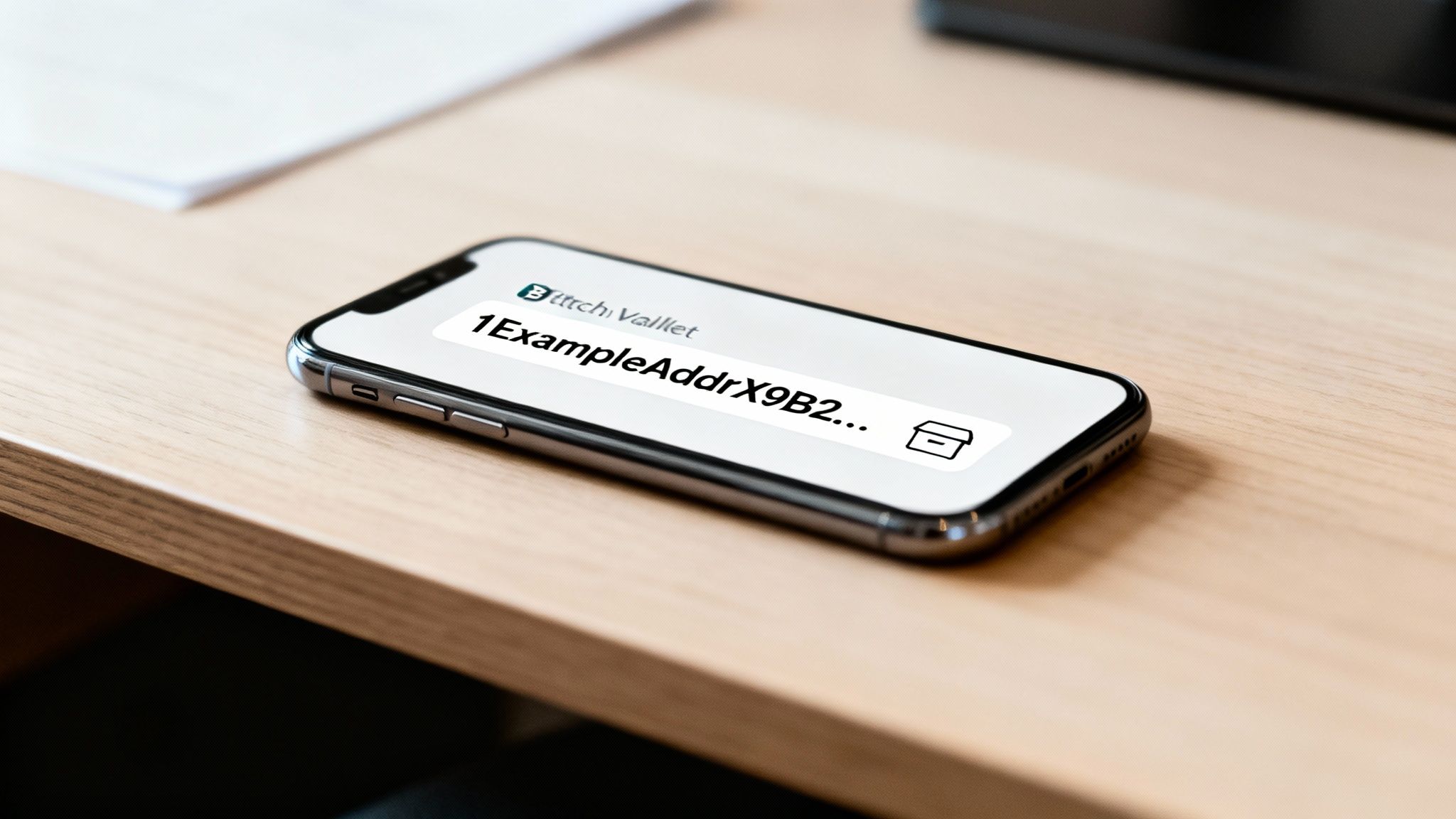
Your Bitcoin wallet address is your personal, public-facing inbox on the Bitcoin network. It's a unique string generated by your wallet that you can safely give to anyone who wants to send you bitcoin. Just like you'd give out your email address to get a message, you give out your Bitcoin address to receive a payment.
This address comes from your wallet's public key, but it's not the same thing. Its only job is to be a destination for incoming funds. No one can ever use this public address to get to your money or spend it. That power belongs entirely to your private key.
The Role of Public vs Private Information
The entire security model of Bitcoin hinges on the separation between public and private information. Getting this right is the first—and most important—step for any merchant looking to accept direct wallet-to-wallet payments.
- Public Address: This is your receiving ID. It’s meant to be shared openly. Every transaction it's part of is recorded forever on the public blockchain.
- Private Key: This is your secret. It's the proof of ownership that lets you spend the bitcoin sent to your public addresses. You should never share your private key with anyone, ever.
A simple way to think about it is this: your public address is like your bank account number—it's safe to share so people can deposit money. Your private key, on the other hand, is like your online banking password and PIN rolled into one. It grants total control.
To give you a quick summary of these core ideas, here's a simple table.
Key Characteristics of a Bitcoin Wallet Address
| Characteristic | Simple Analogy | Core Function |
|---|---|---|
| Unique Identifier | A personal email address | To provide a distinct, one-of-a-kind destination for funds on the network. |
| Publicly Sharable | Your home's mailing address | To safely tell others where to send you Bitcoin without exposing your funds. |
| One-Way Function | A secure drop-box | To receive payments without giving the sender any ability to withdraw funds. |
| Linked to Private Key | The lock on your mailbox | To be controlled exclusively by a secret private key, which acts as the 'key' to unlock and spend the funds. |
This table neatly captures the essence of what a wallet address is and how it functions.
For businesses, mastering this fundamental relationship is key to securely integrating Bitcoin payments. By sharing only your public wallet address with customers, you open a direct and secure channel for them to pay you. This cuts out the middlemen and gives you complete control over your revenue.
Decoding Different Bitcoin Address Formats
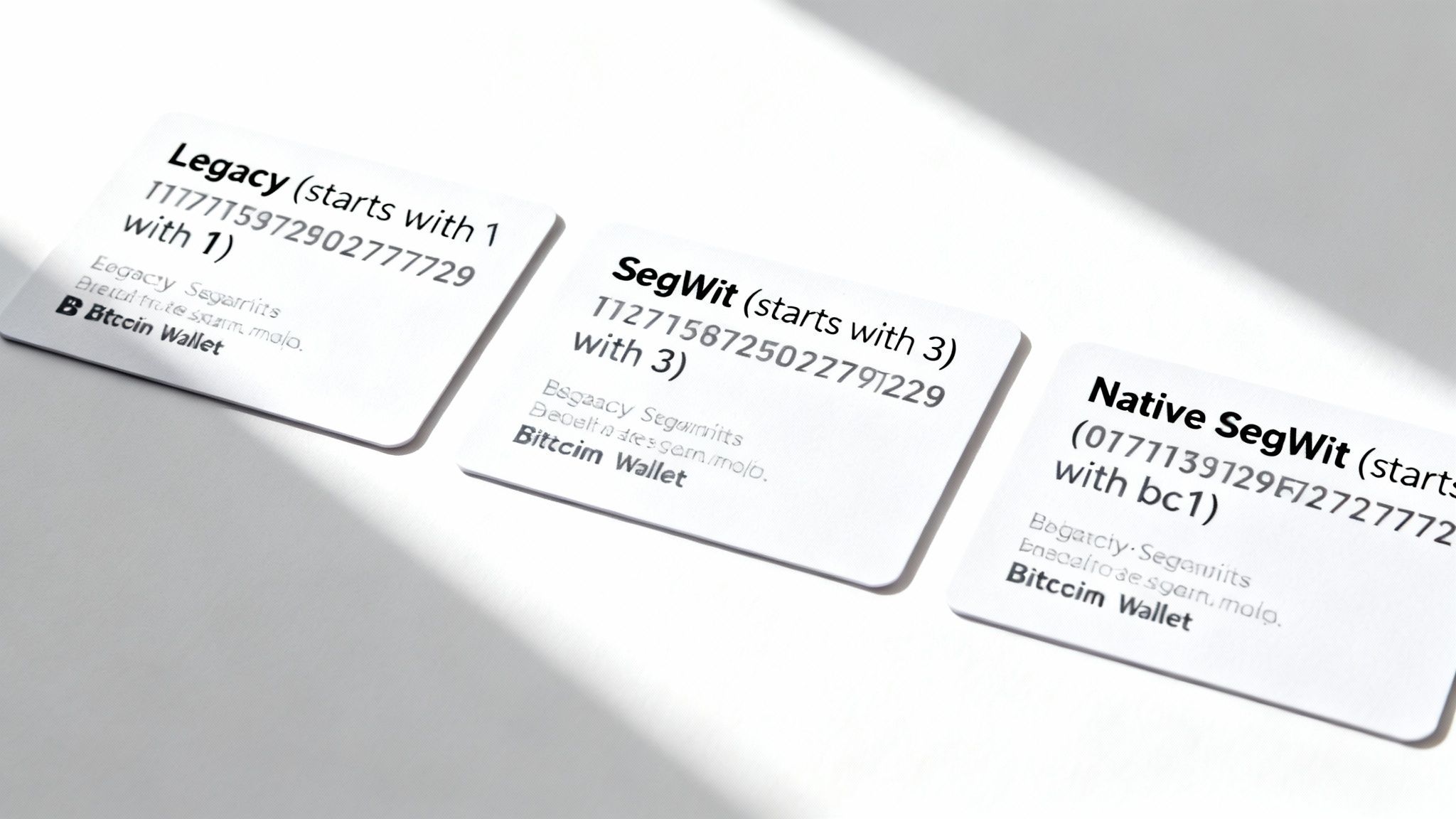
Once you start accepting Bitcoin, you'll quickly realize that not all addresses look the same. Bitcoin isn't static; it has evolved over the years, giving rise to different address formats, each with its own quirks. For merchants, getting a handle on these formats is crucial because they directly affect compatibility and, more importantly, transaction fees.
Think of them like different versions of a shipping label. They all get the package to the right place, but the newer versions are far more efficient and cheaper to process. For a business, choosing the most efficient format can stack up into serious savings on transaction costs over time.
Let’s break down the three main types you'll run into.
Legacy Addresses (P2PKH)
This is the OG, the original Bitcoin address format. Known as Legacy or Pay-to-Public-Key-Hash (P2PKH), it’s been around since the very beginning. You can spot a Legacy address a mile away because it always starts with the number '1'.
Here’s what a Legacy address looks like:1A1zP1eP5QGefi2DMPTfTL5SLmv7DivfNa
Because they're the oldest, Legacy addresses are the most widely compatible. Pretty much every wallet, exchange, and Bitcoin service out there can send and receive payments using this format. But that universal support has a trade-off: transactions using Legacy addresses are bigger in data size, which means you'll pay higher network fees compared to the newer kids on the block.
SegWit Addresses (P2SH)
Next up is the SegWit address, technically called Pay-to-Script-Hash (P2SH). These were rolled out with the Segregated Witness (SegWit) upgrade, a massive improvement to Bitcoin’s protocol aimed at making things more efficient. You can identify these because they always start with the number '3'.
Here’s an example of a SegWit address:3J98t1WpEZ73CNmQviecrnyiWrnqRhWNLy
These addresses hit a sweet spot. They offer lower transaction fees than Legacy addresses but still have great compatibility across most wallets and exchanges. They act as a handy bridge, letting modern features play nice with older systems, making them a popular and solid choice.
For a business, the fee reduction from using SegWit can be huge. A transaction from a SegWit address can be up to 30% cheaper than the same one from a Legacy address. That's a direct boost to your bottom line.
Native SegWit Addresses (Bech32)
Finally, we have the most modern and efficient format of them all: Native SegWit, also known as Bech32. This format is the full realization of the SegWit upgrade and delivers the best performance. It’s easy to recognize because it always starts with 'bc1'.
Here is a Native SegWit address in action:bc1qar0srrr7xfkvy5l643lydnw9re59gtzzwf5mdq
Bech32 addresses are the current gold standard for a reason. They give you the lowest possible transaction fees, have better error detection to catch typos, and are easier to read since they're always lowercase. The only minor drawback is that a few older services might not support them yet, but almost all modern wallets do.
For any merchant focused on maximizing efficiency and cutting costs, generating and giving customers Bech32 addresses is the way to go.
Comparison of Bitcoin Address Formats
To make it even clearer, here's a side-by-side look at the three formats. This table breaks down the key differences to help you decide which one best fits your business needs.
| Address Format | Example Prefix | Key Benefit | Best Use Case |
|---|---|---|---|
| Legacy (P2PKH) | Starts with 1 |
Universal Compatibility | When you need to ensure a payment can be received by any wallet, even very old ones. |
| SegWit (P2SH) | Starts with 3 |
Lower Fees & Good Compatibility | A great default option that balances cost savings with broad support across the ecosystem. |
| Native SegWit (Bech32) | Starts with bc1 |
Lowest Transaction Fees | For cost-conscious businesses using modern wallets to minimize operational expenses. |
Ultimately, understanding these formats allows you to make smarter choices that save you money and ensure smooth transactions for your customers. While Legacy addresses offer a fallback for compatibility, pushing for Native SegWit (Bech32) is the most forward-thinking strategy for any merchant.
The Anatomy of a Bitcoin Address
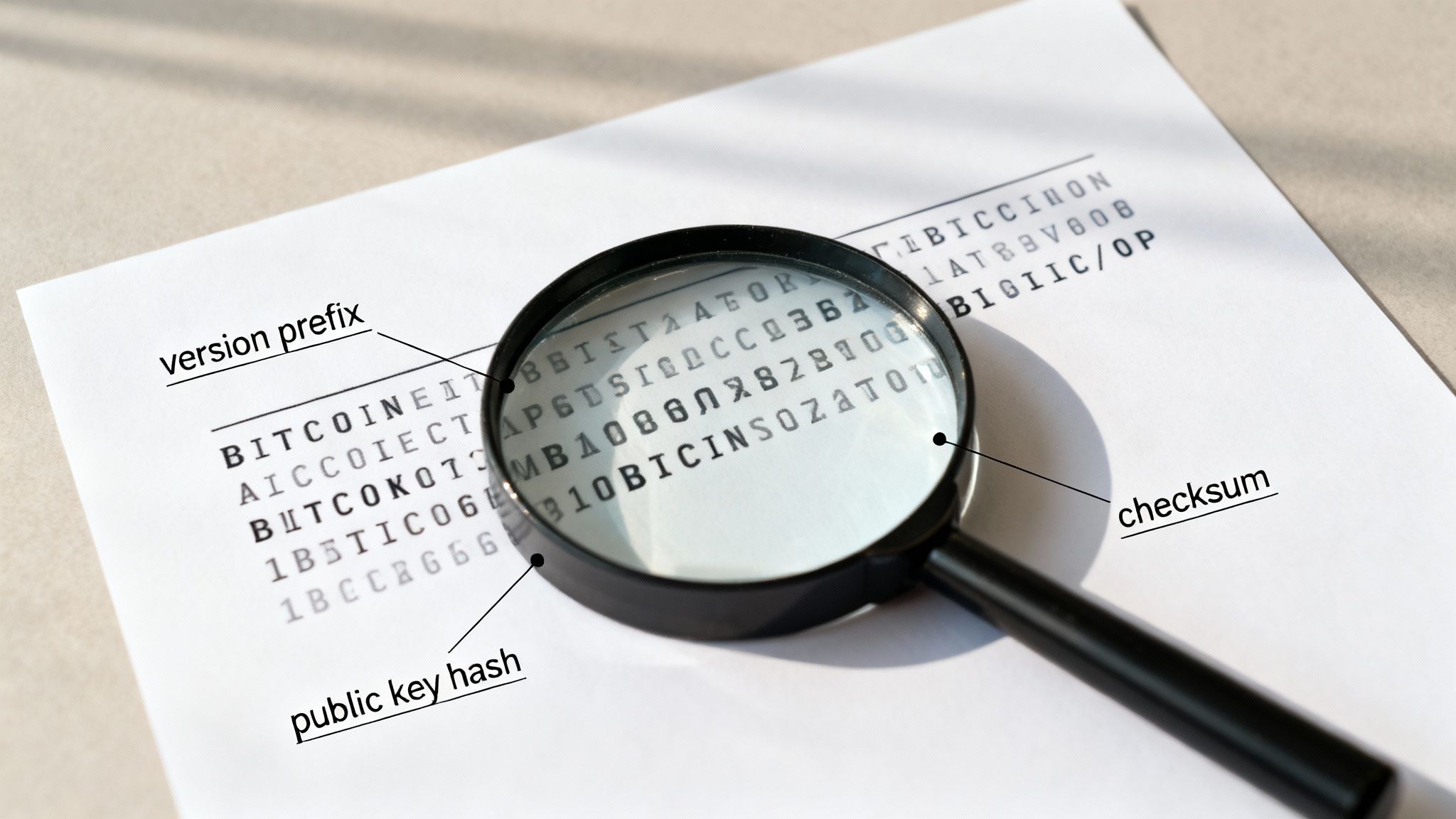
A Bitcoin address might look like a random jumble of characters, but it's actually a precisely engineered string with a very specific job. Each part plays a role in making sure your funds get to the right place, securely. When you break down a wallet address example, you start to see the clever design that protects users from common, costly mistakes.
Think of it like an IBAN for a bank account. You don't need to memorize what every single digit means, but understanding the basic structure gives you confidence in the system. A Bitcoin address is generally built from three key parts that work in concert to create a secure destination for your funds.
The Core Components of an Address
At its heart, a Bitcoin address is derived from your public key, but it’s not the public key itself. Instead, it’s a safer, compressed version with some crucial safeguards built right in.
Version Prefix: This is the first character or set of characters. As we saw earlier, it’s a dead giveaway for the address type—a
1for Legacy, a3for SegWit, orbc1for Native SegWit. This prefix tells the network which set of rules to follow when handling the transaction.Public Key Hash: This is the main body of the address. It’s a scrambled, one-way cryptographic hash of your public key. This hashing process adds a fantastic layer of security, making it practically impossible for anyone to reverse-engineer your public key just from the address.
Checksum: This is arguably the most ingenious part. The last few characters are a checksum, a unique code generated from all the other characters in the address.
The checksum is a built-in typo detector. If you mistype even a single character when entering an address, the checksum won’t match up. Good wallet software will immediately spot the mismatch and warn you that the address is invalid, stopping you from accidentally sending funds into a black hole.
This simple yet powerful feature is a lifesaver. It’s what drastically reduces the risk of losing Bitcoin to a simple slip of the fingers. It’s kind of like the security code on the back of your credit card—an extra little check that confirms everything is correct before the transaction goes through. This built-in safety net is fundamental to the reliability of every Bitcoin payment you process.
Securely Sharing Your Wallet Address with Customers
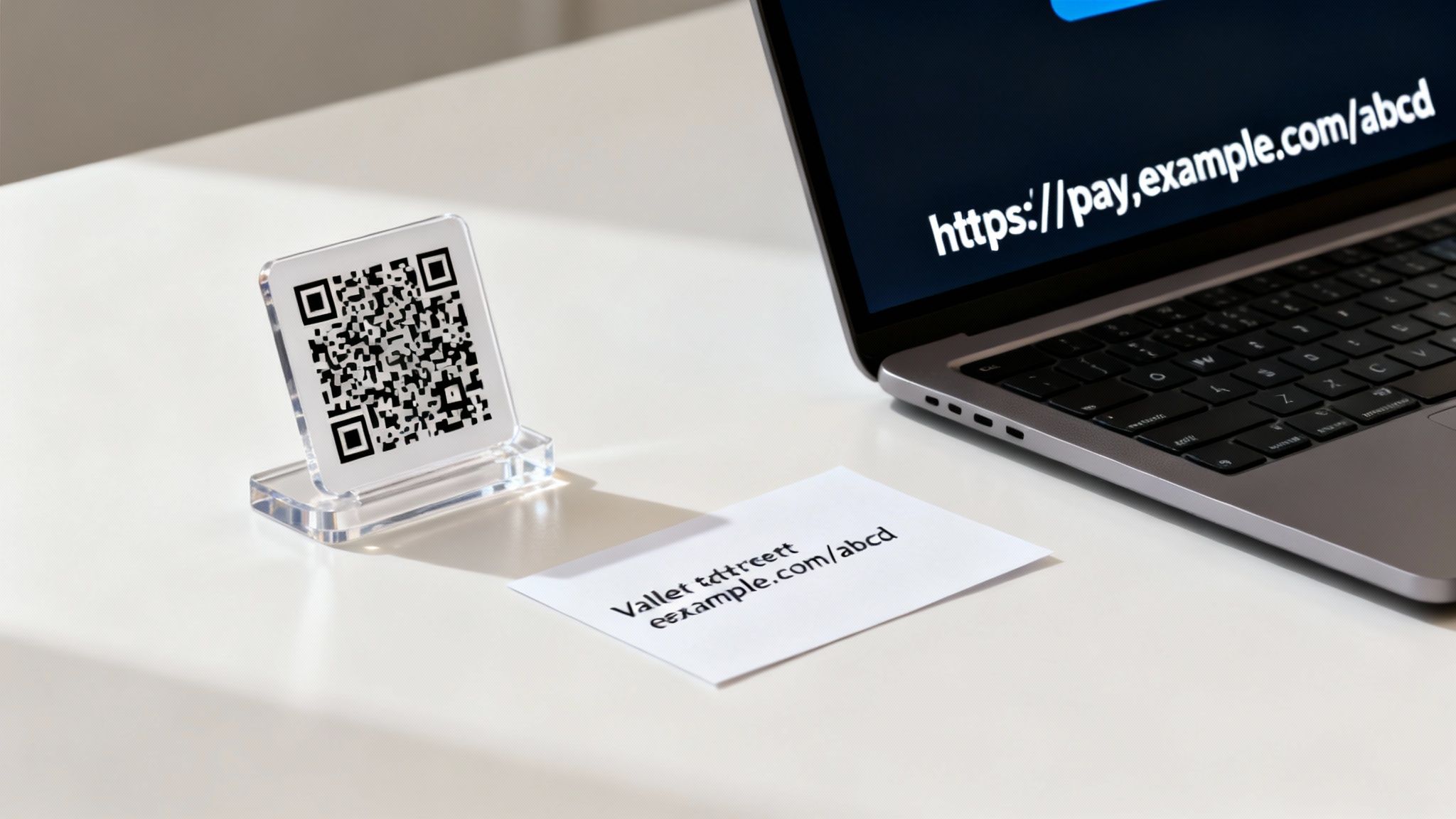
Once you've got a handle on the different address types, the next puzzle piece is presenting them to your customers. You need a process that’s both dead simple and totally secure. After all, making it easy for people to pay you is business 101, and with Bitcoin, you've got a few great ways to do just that.
The name of the game is eliminating friction and preventing those heart-stopping errors. A single mistyped character can launch funds into a digital black hole, so crystal-clear communication is everything. Let's walk through the three main ways to share your Bitcoin wallet address so every transaction is smooth, accurate, and professional.
Method 1: The QR Code
For any face-to-face transaction or payment happening on a screen, the QR code is king. It's a scannable, visual version of your wallet address that customers can zap with their mobile wallet app, completely side-stepping any need for manual typing.
This method is quick, slick, and drastically cuts down the risk of human error. Think of it as the Bitcoin equivalent of a tap-to-pay terminal. Displaying a QR code at your point-of-sale, on a product page, or inside an invoice creates a seamless payment experience that’s just about foolproof.
Method 2: Plain Text Address
The most stripped-down approach is simply providing the address as a string of text. For the customer, it's a straightforward copy-and-paste job. While it sounds simple, this method carries the highest risk of error if you're not careful.
For a customer to pay you, they have to copy that entire string of characters perfectly, without missing a single one. As the merchant, your job is to display the full address clearly and, ideally, add a simple "copy" button right next to it on your site or invoice. This tiny feature makes a world of difference.
Crucial Tip: Always tell your customers to double-check the first and last four characters of the address after they paste it. This quick sanity check can save them from clipboard hijacking malware—a nasty trick where malware secretly swaps the copied address with a scammer’s.
Method 3: The Payment Link
For the most polished and user-friendly online experience, a payment link is the way to go. This is a clickable URL that boots up the customer's wallet and automatically plugs in all the payment details: your address and the exact amount owed.
This method gives you the ease of a QR code with the flexibility of a web link, making it perfect for online stores, email invoices, and selling on social media. It walks the customer through the payment, leaving zero room for mistakes and creating a trustworthy checkout flow.
Many businesses are leaning into this strategy, knowing a smooth payment process builds confidence. It mirrors the long-term holding trend in the Bitcoin world—for a prime wallet address example of this conviction, check out some of the largest Bitcoin holders. You can learn more about top Bitcoin holders and their habits on bitinfocharts.com.
Staying Safe: Common Address Mistakes and Scams to Avoid
When you're dealing with Bitcoin, a security-first mindset isn't just a good idea—it's essential. The Bitcoin network itself is incredibly robust, but the biggest vulnerability has always been and will always be human error. Getting a handle on the most common mistakes and the clever scams out there is your best defense. It's what keeps your funds safe and ensures every payment you receive is secure.
One of the most frequent habits we see, and also one of the riskiest, is address reuse. Yes, it's technically possible to use the same Bitcoin address for every single transaction, but it's a privacy nightmare. The blockchain is a public ledger, remember? Anyone with your address can peek into your entire transaction history, creating a public record of your income. For a business, that’s like posting your bank statements online for the whole world to scrutinize.
Understanding Modern Threats
Beyond simple privacy blunders, you've got bad actors actively trying to trick Bitcoin users with some pretty sophisticated scams. A particularly nasty one that's been making the rounds is clipboard hijacking malware. This type of attack is designed to be completely invisible.
Here's how it works: a customer copies your legitimate wallet address, but malware running silently on their computer instantly swaps it with a scammer's address in their clipboard. If they don't bother to double-check before pasting it into their wallet and hitting send, their payment is gone forever. It goes straight to the attacker, and because it's Bitcoin, there are no take-backs.
Another sneaky tactic is called address poisoning. This is where an attacker sends a tiny, insignificant "dust" amount of Bitcoin to your wallet. The trick is, they send it from an address they created to look almost identical to one you use often—maybe the first and last few characters match perfectly.
The whole point is to "poison" your transaction history. The next time you need to send a payment, you might glance at your history, see what looks like the right address, and copy the attacker's similar-looking one by mistake. It’s a simple but costly slip-up.
Simple Habits for Strong Security
The good news is, protecting yourself doesn't require a bunch of complex tools. It just comes down to building a few consistent, simple habits. Make these practices a core part of your payment workflow, and you'll be able to transact with confidence.
- Always Double-Check: Before you confirm any transaction, always verify the first four and last four characters of the address. This one simple step is enough to defeat most clipboard hijacking and address poisoning attempts. It takes two seconds and can save you a fortune.
- Generate Fresh Addresses: This is the gold standard for both privacy and security. You should generate a new, unique address for every single invoice or payment request. Modern payment systems like Flash can automate this process, so there's no manual effort on your part.
- Use Address Books: Encourage your customers to save your address in their wallet's contact list or address book after the first successful transaction. This stops them from relying on their transaction history, which, as we've seen, could be compromised by a poisoning attack.
Streamlining Bitcoin Payments for Your Business
Knowing the technical details behind a wallet address example is one thing, but actually putting that knowledge to work for your business is where the rubber meets the road. Let's be honest: manually generating, sharing, and tracking a unique Bitcoin address for every single customer payment is a recipe for headaches and risk.
This is exactly why modern payment software exists—to take that entire process off your plate.
Instead of you juggling addresses, these systems automatically generate a fresh, unique address for every single invoice. This isn't just a convenience; it's a cornerstone of financial privacy on the Bitcoin network. It stops prying eyes from connecting all your transactions on the public blockchain, protecting both your business's financial data and your customers' privacy.
Automating for Security and Simplicity
The benefits of automation go way beyond privacy. It drastically simplifies your accounting and shores up your security.
When each payment has its own unique address, reconciliation becomes a breeze. You know exactly which customer paid which invoice, eliminating all the guesswork that comes with reusing a single, static address.
The real power here is enabling secure, direct wallet-to-wallet transactions. You cut out the costly middlemen, giving you full control over your funds the second a customer pays. It’s a direct model that’s both powerful and scalable for any business.
Just how massive can direct wallet-to-wallet transactions be? Take a look at the Binance Cold Wallet at address 34xp4. It holds over 248,597 BTC, which is about 1.25% of Bitcoin's entire supply. Automation lets your business accept payments directly from any user—big or small—with that same level of efficiency.
Making payments simpler and more secure for customers is a common goal for businesses, and it's not unique to Bitcoin. For instance, you can explore how businesses streamline transactions with secure payment links in other contexts. By automating address generation, you're not just improving your operations; you're opening your doors to millions of Bitcoin users around the world and giving them a secure, professional way to pay.
Got Questions About Wallet Addresses?
Diving into the world of Bitcoin payments can feel like learning a new language, and it's natural to have a few questions. Let's clear up some of the most common ones so you can handle transactions with total confidence.
Is a Bitcoin Wallet Address the Same Thing as a Public Key?
Not quite, but they're very closely related. Think of it this way: your public key is generated first, and then your wallet address is created from it through a one-way hashing process.
The address is basically a shorter, more user-friendly, and safer version of your public key that's specifically designed to be shared. It even has a built-in checksum to catch typos, which is a neat little feature.
Can I Just Reuse the Same Bitcoin Address?
You technically can, but for privacy reasons, you really shouldn't. It's a bad habit to get into.
When you reuse an address, every single transaction tied to it is linked together forever on the public blockchain. Anyone who knows that address can easily see your balance and track your entire payment history. It's like using a transparent bank account.
The gold standard for both privacy and security is to generate a fresh, unique address for every single payment you receive. Modern payment tools can handle this for you automatically, so it's a seamless experience for your business.
What Happens if I Send Bitcoin to the Wrong Address?
This is the scary one. Bitcoin transactions are final and irreversible. Once you hit send, that's it.
If you send funds to an incorrect address, there’s no customer support line to call and no one who can reverse the payment. Those funds are almost always lost for good, unless you happen to know the person who owns the wrong address and can convince them to send the Bitcoin back.
This is exactly why you have to be meticulous about double-checking every address before confirming a payment. While the checksum helps catch most simple typos, it won't save you from a copy-paste error or a nasty scam like clipboard hijacking. Always, always verify the first few and last few characters of the address to be safe.
Ready to streamline your Bitcoin payments with automated, secure address generation? With Flash, you can accept direct, wallet-to-wallet payments in under a minute. Learn how Flash makes Bitcoin payments easy.