Think of a Bitcoin wallet address as your personal mailbox on the blockchain. It's a unique string of letters and numbers that you can safely give to anyone who wants to send you Bitcoin. It's the digital equivalent of an IBAN or a physical mailing address, but with a few key differences that make it perfect for the world of Bitcoin.
What a Bitcoin Wallet Address Means for You
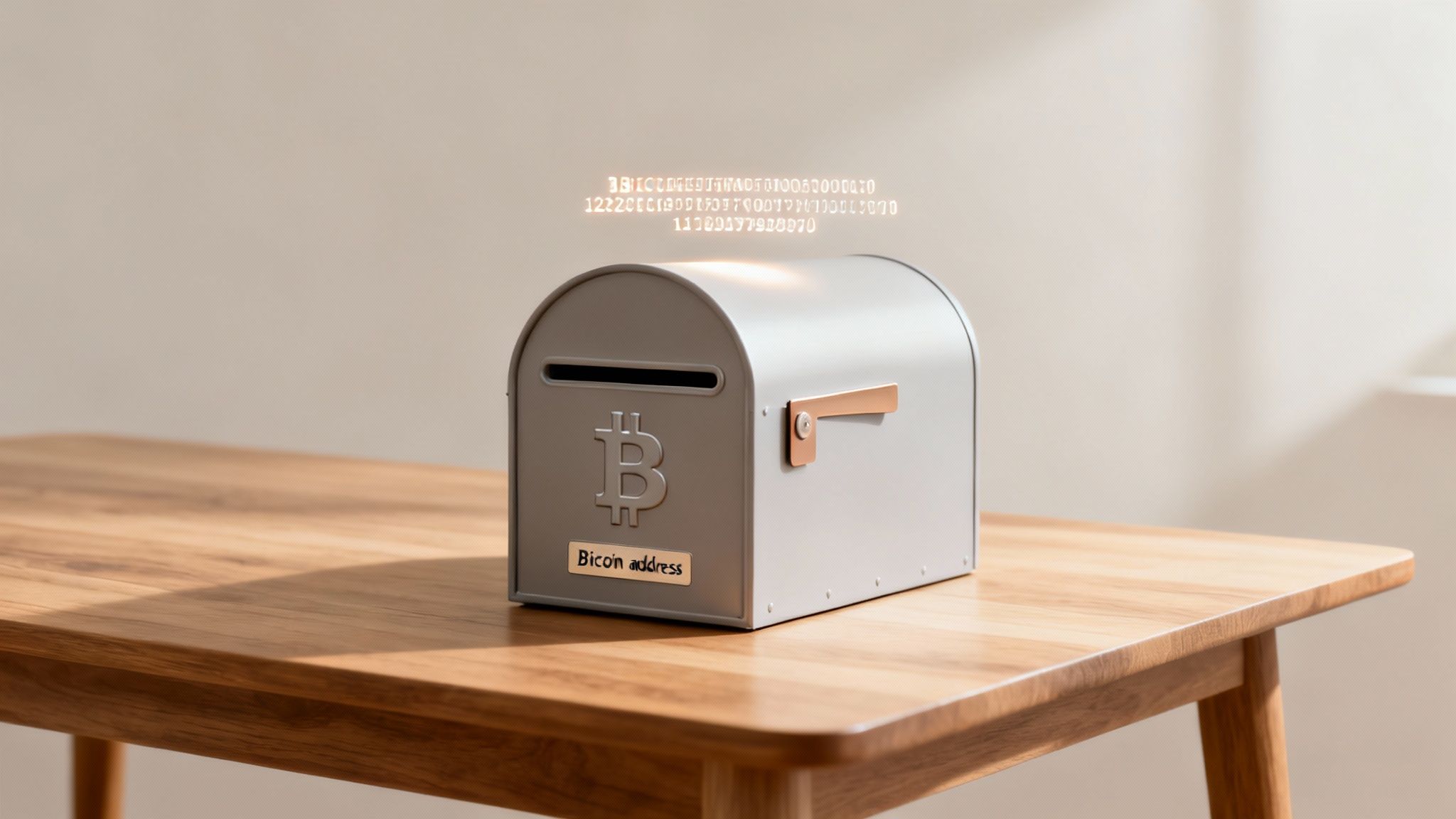
Imagine the Bitcoin network as a massive, transparent ledger that everyone can see. Your wallet address is simply a specific destination on that ledger. It’s where people send funds, and it allows you to interact with the entire network without revealing your real-world identity.
This address is generated through some clever cryptography, and while anyone can look it up and send Bitcoin to it, only the person holding the matching private key can actually access and spend what's inside. This is the cornerstone of Bitcoin's security—a one-way street where funds can come in publicly but can only go out privately.
So, What's It Actually For?
At its core, your wallet address has one primary job: to receive funds. That’s it. It’s intentionally simple and built for a specific purpose. Here's a breakdown of its role:
- A Destination Marker: Just like a street address guides a package to the right doorstep, your Bitcoin address tells the network exactly where to send a payment.
- Completely Sharable: You can slap your address on your website, tweet it out, or show it as a QR code without a hint of risk. It’s public information by design.
- Built for Privacy: Modern wallets are smart. To keep your financial history from being easily pieced together, they generate a fresh, new address for every single transaction you receive.
To get a clearer picture of what a Bitcoin wallet address is all about, let's break down its fundamental characteristics.
Bitcoin Wallet Address Key Characteristics
| Characteristic | Simple Explanation | Analogy |
|---|---|---|
| Public | Anyone can see it and send funds to it without compromising your security. | A public mailbox slot or your business's street address. |
| Unique | Each address is a one-of-a-kind string of characters on the Bitcoin network. | A unique phone number or email address. |
| Pseudonymous | The address isn't directly linked to your real-world identity. | A username or pen name for online interactions. |
| One-Way Function | It's generated from your private key, but the process can't be reversed. | You can make a cake from a recipe, but you can't get the recipe back from the cake. |
| Receive-Only | Its sole purpose is to act as a destination for incoming transactions. | An "inbox only" tray where documents can be dropped off but not removed. |
These characteristics work together to create a system that is both open for payments and secure for holding value.
How Many Addresses Are Out There?
While one person can generate and manage a nearly infinite number of addresses, the on-chain data gives us a fascinating snapshot. Over 460 million Bitcoin addresses have held a balance at some point, but as of today, only about 172 million actually hold any BTC.
A huge chunk of those belongs to exchanges and other large services, which means the number of truly individual, active users is smaller. This is a great reminder that one person or business often uses many addresses to keep their finances organized and private. You can dig into more research on Bitcoin address distribution to see how ownership is spread out.
If you remember one thing, make it this: your wallet address is for receiving, and your private key is for spending. Never, ever share your private key with anyone. It's the only thing that keeps your Bitcoin safe.
The Keys That Control Your Bitcoin Address
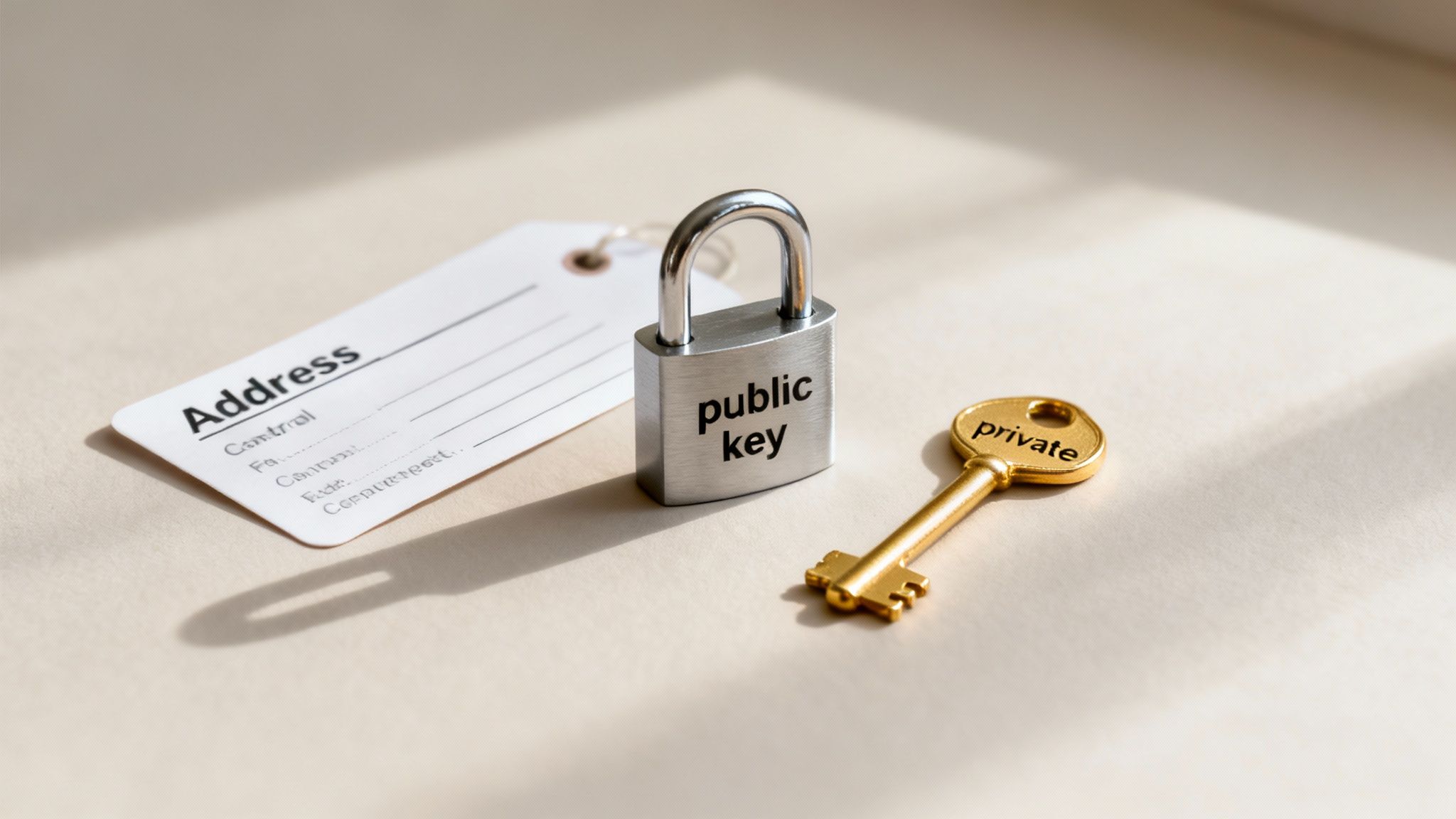
While your Bitcoin address is what you share with the world, it's really just the tip of the iceberg. Behind the scenes, it's part of a powerful cryptographic trio that includes a public key and, most crucially, a private key. Getting a handle on how these three work together is essential to understanding the very core of Bitcoin's security.
Let's go back to our mailbox analogy. The wallet address is the number painted on the front, visible to everyone. Think of the public key as the mailbox's lock mechanism itself—it confirms that mail is meant for this specific box. But the private key? That's the only physical key in existence that can actually unlock the box and get what's inside.
This whole relationship is a one-way street by design, which is what makes it so incredibly secure. You can't start with the address and work your way backward to find the keys.
The Cryptographic Chain of Command
Your address isn't just randomly generated; it’s created through a strict, irreversible sequence built on some serious math. This process guarantees security from the very first step, which begins with the most sensitive piece of data you'll ever own in Bitcoin.
Here’s the simple version of how it all comes together:
- Your Private Key is Born: It all starts here. A private key is essentially a massive, randomly generated secret number. Your wallet software creates this for you, and it is the ultimate proof of ownership for your Bitcoin.
- The Public Key is Derived: Using a mathematical process known as Elliptic Curve Cryptography, your public key is generated directly from your private key. This is easy to do in one direction but is practically impossible to reverse.
- The Address is Created: Your public key then goes through another set of cryptographic hashing functions to produce the final, shareable Bitcoin address. This adds yet another layer of security, as your public key isn't even exposed on the network until you decide to spend your funds.
Your private key is the master key to your Bitcoin fortune. It gives you complete and total control over your funds. Guarding it is the single most important rule in self-custody; if it's lost or stolen, your Bitcoin is gone forever with no way to get it back.
Why This One-Way Process Matters
The genius of this system is that you can freely receive money without ever exposing the key that's needed to spend it. Someone can have your address, and even your public key, but they are completely powerless to access your funds. The true wallet address meaning is rooted in this clever separation of public information from private control.
This cryptographic foundation makes the entire network possible—an open and transparent system where all transactions are public, yet individual funds remain locked down and secure. It’s a delicate balance that works flawlessly because of the unbreakable link between these keys.
The entire security model of Bitcoin hinges on one simple fact: only the holder of the private key can sign and authorize a transaction. This is precisely why you must never share it, screenshot it, or store it on a device connected to the internet.
Decoding Different Bitcoin Address Formats
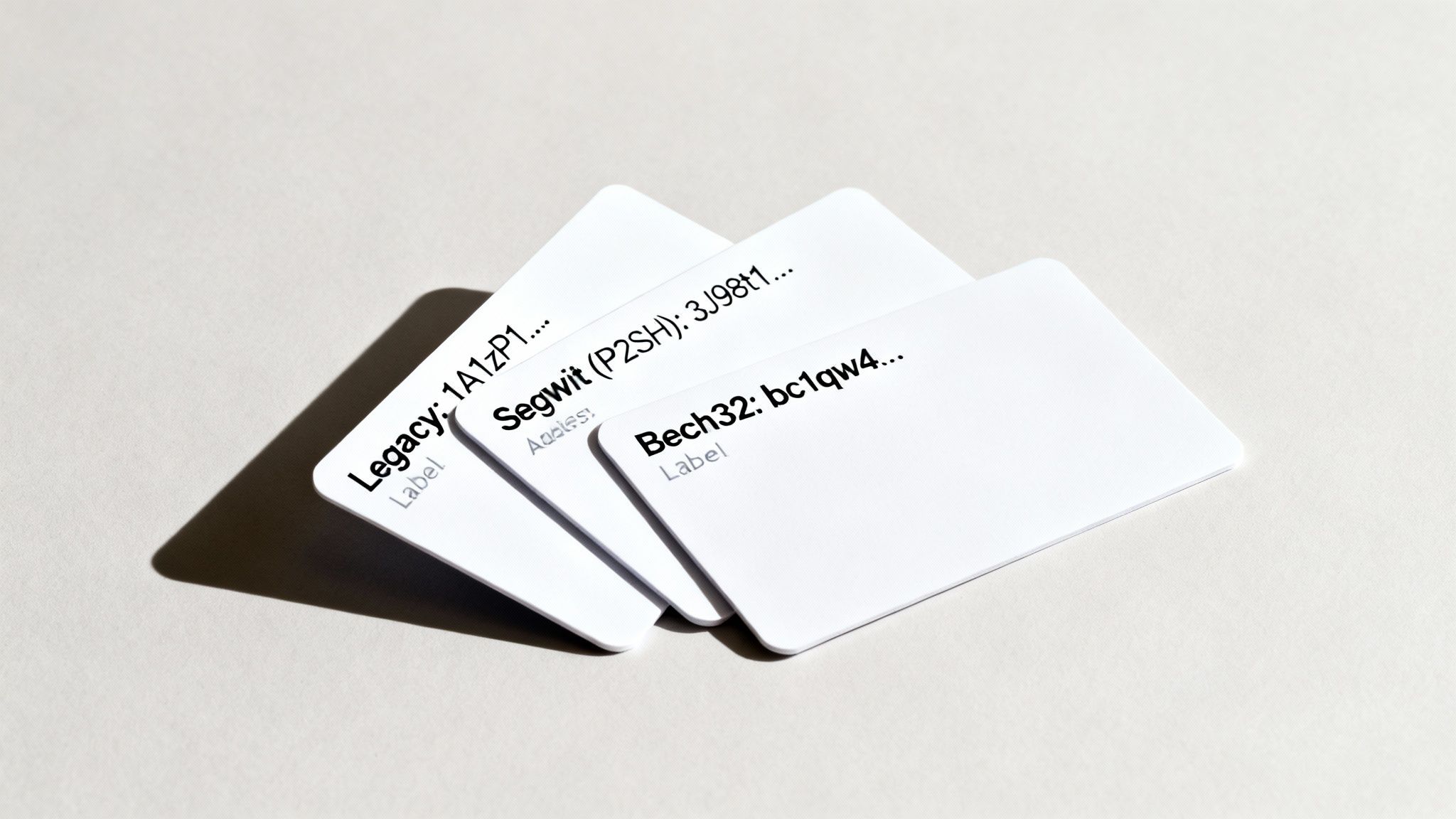
If you've spent any time around Bitcoin, you've probably noticed that not all addresses look the same. Some start with a "1," others a "3," and the newest ones begin with "bc1." This isn't random—it's a sign of the Bitcoin network evolving over time to become more efficient and secure.
Think of it like the evolution of internet connections, from clunky dial-up to broadband and now fiber optics. They all get you online, but the newer versions are faster, cheaper, and more reliable. Let's break down the three main address types you'll run into.
Legacy Addresses: The Original Format
The first-ever Bitcoin address format is known as Legacy, or Pay-to-Public-Key-Hash (P2PKH). These are the classic addresses that start with the number 1. For years, this was the only game in town, and it’s still universally compatible with every Bitcoin wallet and service out there.
But its age is starting to show. Transactions from Legacy addresses are bigger in data size, meaning they take up more space in a block. That translates directly to higher transaction fees compared to modern formats. While they still work just fine, they're the least efficient option available today.
P2SH Addresses: A Step Forward
Next on the scene were Pay-to-Script-Hash (P2SH) addresses, which you can spot because they start with the number 3. Introduced back in 2012, this format was a huge improvement. It opened the door for more complex transaction types, like multi-signature wallets that require multiple private keys to approve a payment.
This format also served as a bridge to newer technology, enabling "wrapped" SegWit transactions that helped shrink transaction data. While not quite as efficient as the latest standard, P2SH offered a great middle-ground, providing lower fees than Legacy addresses while staying compatible with most of the ecosystem.
Bech32 Addresses: The Modern Standard
Today, the gold standard for Bitcoin addresses is Bech32, often called Native SegWit. These are easy to identify as they always start with bc1. They were designed from the ground up for maximum efficiency, resulting in the lowest possible transaction fees—sometimes 30-40% cheaper than sending from a Legacy address.
But Bech32 offers more than just cost savings. These addresses are not case-sensitive (they only use lowercase letters) and have fantastic error detection built in. This makes them much harder to mistype. If you make a typo in a Bech32 address, the system will almost always catch it before you hit send.
For anyone serious about using Bitcoin, switching to Bech32 is a no-brainer. You get the best combination of low fees, strong security, and user-friendly features. As the network matures, this format has rightly become the go-to choice for individuals and businesses alike.
Comparison of Bitcoin Address Formats
To make it even clearer, here's a simple breakdown of how the three main Bitcoin address formats stack up against each other.
| Format Type | Starts With | Key Advantage | Compatibility |
|---|---|---|---|
| Legacy (P2PKH) | "1" | Universal compatibility | Works with all wallets and exchanges |
| P2SH | "3" | Supports complex scripts (e.g., multi-sig) | Widely supported, but some older services may lag |
| Bech32 (Native SegWit) | "bc1" | Lowest transaction fees & error detection | Modern standard, but not yet 100% universal |
Choosing the right format can have a real impact on your transaction costs and user experience. While Legacy addresses offer a fallback, the clear winner for everyday use is Bech32.
How to Use Your Wallet Address Securely
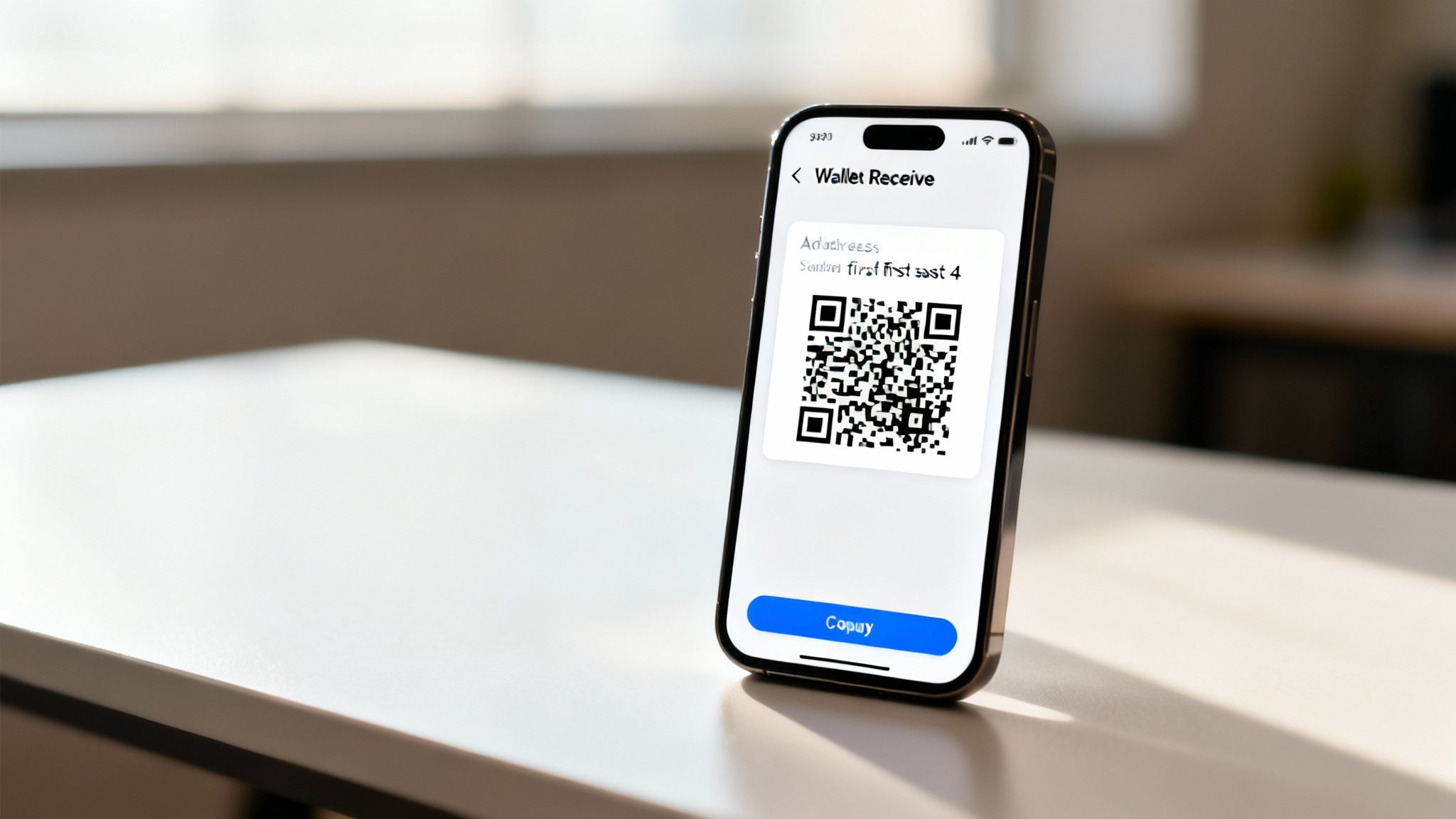
Knowing what a wallet address is is one thing. Using it safely is a whole different ballgame. The good news is, putting this knowledge into practice is pretty simple, as long as you pay attention to the details. Your Bitcoin wallet already has easy, built-in tools to help you get paid without a hitch.
To grab your address, just open your wallet and look for a button labeled "Receive" or "Deposit." Tapping it will pull up your current receiving address, usually in two handy formats:
- A Full Text String: This is the long alphanumeric code. You can copy it directly to your clipboard to paste into a message or email.
- A QR Code: This scannable black-and-white square is perfect for face-to-face payments. The sender just points their phone's camera at it, and the address is instantly imported, slashing the risk of typos.
Best Practices for Sharing and Receiving
Once you've got your address, sharing it is easy, but you'll want to bake a few safety habits into your routine. The Bitcoin network is a busy place—by late 2025, there were about 887,000 daily active addresses buzzing within a global ecosystem of roughly 200 million Bitcoin wallets. With that much activity, being careful isn't optional. (You can dive deeper into the state of crypto at a16zcrypto.com).
Always treat a new transaction with a bit of healthy paranoia. Before you hit "send" on any payment, get into the habit of double-checking the address. Nasty bits of malware known as "clipboard hijackers" can secretly swap out the address you copied with a scammer's address.
The easiest way to beat this is to verify the first few and last few characters of the address you pasted. This simple five-second check can be the difference between a successful payment and losing your funds forever.
Protect Your Privacy with Fresh Addresses
Here's a pro-tip that's crucial for protecting your financial privacy: don't reuse addresses. While you can technically receive multiple payments to the same Bitcoin address, it's a terrible practice from a privacy standpoint. Reusing an address links all of those payments together on the public blockchain, creating a breadcrumb trail of your transaction history for anyone to follow.
To sidestep this, you should always generate a new address for every single payment you receive.
Thankfully, modern Bitcoin wallets, known as Hierarchical Deterministic (HD) wallets, make this incredibly easy. They automatically generate a fresh, unused address from your master seed phrase every time you hit the "Receive" button. This simple act breaks the on-chain link between your transactions, making it way harder for snoops to track your total balance or analyze your spending habits. It's a small step that makes a huge difference in keeping your finances private on an open network.
Why Address Management Matters for Privacy
Your privacy on the Bitcoin network is only as strong as your habits. It's a common misconception that Bitcoin is completely anonymous; it's actually pseudonymous. Every single transaction is recorded on a public ledger for the world to see.
If you keep using the same wallet address over and over, you're essentially leaving a public trail of digital breadcrumbs. Anyone can follow that trail to piece together your entire financial history.
Think of it like using the same clear, glass jar for all your savings. Anyone walking by can see exactly how much you have, where it came from, and where it's going. On the blockchain, specialized firms do exactly this, tracing and clustering activity tied to a single, reused address.
This brings us to the golden rule of Bitcoin privacy: never reuse an address.
The Power of Fresh Addresses
To get around this public snooping, modern Bitcoin wallets are built to automatically generate a fresh, unique address for every single transaction you receive. It's a simple but powerful feature.
By using a new address each time, you break the on-chain link between your payments. This makes it exponentially harder for observers to connect the dots and build a complete profile of your financial life.
This automated process also keeps your total holdings under wraps. Each payment lands in a separate "mailbox," effectively compartmentalizing your funds and shielding your privacy.
Good address hygiene is the cornerstone of Bitcoin privacy. Consistently using new addresses for each transaction is the most effective step you can take to protect your financial history from being publicly scrutinized on the blockchain.
Advanced Security and Threat Awareness
Good habits with addresses are about more than just privacy; they're a key part of your overall security. While software wallets are great for everyday use, holding a significant amount of Bitcoin means you need to step up your game.
- Hardware Wallets: For serious, long-term storage, a hardware wallet is the gold standard. These are physical devices that keep your private keys completely offline, making them immune to online threats like malware or viruses that could infect your computer.
- Phishing Scams: Stay vigilant. Be extremely skeptical of urgent requests or offers that sound too good to be true, especially if they ask you to send Bitcoin or reveal your private keys. Scammers are experts at creating fake websites and emails that mimic legitimate services to trick you.
At the end of the day, understanding the true wallet address meaning goes way beyond just having a place to receive funds. It’s about building the right habits to protect both your privacy and your coins.
Bitcoin Wallet Address FAQs
Once you've got the basics down, a few practical questions almost always pop up. Let's tackle some of the most common ones so you can handle your Bitcoin wallet address with total confidence.
Can I Reuse a Bitcoin Wallet Address?
Technically, yes, you can. But you really, really shouldn't.
Think of the Bitcoin blockchain as a public ledger that anyone can look at. When you reuse an address, you're essentially tying all your transactions—both incoming and outgoing—to that single, public identity. It creates a breadcrumb trail of your financial history for the whole world to see. For this exact reason, your wallet is designed to generate a fresh, new address for every single payment you receive. It's a fundamental feature for protecting your privacy.
Is My Bitcoin Address Case-Sensitive?
That depends on which type of address you're using.
Older formats, like Legacy addresses (the ones that start with a '1') and P2SH addresses (starting with a '3'), are case-sensitive. For these, a capital 'O' is completely different from a lowercase 'o', and mixing them up will send your funds into the void.
However, the more modern Bech32 addresses (they start with 'bc1') are not case-sensitive. In fact, they only use lowercase letters to make them easier to read and harder to mess up.
Bitcoin transactions are final and irreversible. If you send funds to the wrong address, they are permanently lost. There is no central authority to reverse the transaction, which is why double-checking is so critical.
How Many Addresses Can One Wallet Have?
A modern Bitcoin wallet can generate a practically infinite number of addresses. No, that's not an exaggeration.
This is all thanks to a clever bit of tech called Hierarchical Deterministic (HD) wallets. It allows your wallet to create a massive, branching tree of new addresses, all stemming from a single master seed phrase you backed up at the start. It’s a game-changer for maintaining financial privacy, one transaction at a time.
Ready to accept Bitcoin payments directly from your customers' wallets? Flash provides the tools you need to integrate seamless, non-custodial Bitcoin payments in under a minute. Get started today at .