Digital nomad visas let remote workers legally live and work in foreign countries for extended periods, typically 6 to 24 months. Unlike tourist visas, these permits are designed for professionals earning income from abroad. By 2026, over 75 countries offer such programs, each with unique requirements like proof of income, health insurance, and clean criminal records.
Key Facts:
- Purpose: Legal residency for remote workers.
- Duration: 6 months to 5 years, depending on the country.
- Income Requirements: Vary widely (e.g., $1,620/month in Mexico to $7,763/month in Iceland).
- Benefits: Access to housing, banking, healthcare, and sometimes tax perks.
- Popular Destinations: Spain, Thailand, Brazil, Canada, and more.
Digital nomad visas simplify long-term stays, provide legal clarity, and offer access to local resources, making them a practical option for remote professionals.
Eligibility Requirements for Digital Nomad Visas
Common Eligibility Criteria
To apply for a digital nomad visa, you’ll need a passport that’s valid for at least six months beyond your intended stay. You’ll also need to prove that you work remotely for employers or clients based outside the host country. Financial self-sufficiency is another key requirement. This typically involves providing 3–6 months of bank statements, pay stubs, or client contracts to meet income thresholds, which range from around $615 to over $7,700 per month, depending on the country.
Health insurance is non-negotiable and must cover the entire duration of your stay. Some countries even specify minimum coverage amounts - for example, Iceland requires ISK 2,000,000 in coverage, while South Korea demands KRW 100 million.
Most countries also require a clean criminal record. This usually involves submitting a background check certificate from your home country, often with an apostille stamp for official recognition. On top of these general requirements, some nations add their own twists. For instance, South Korea asks for at least one year of professional experience in your current field. While these criteria are fairly standard, each country may tack on additional specifics.
Country-Specific Requirements
The details of application fees and financial criteria can vary significantly depending on where you’re applying. South Korea’s "Workcation" visa, for example, requires applicants to be at least 18 years old and earn approximately $7,000 or more per month. In Spain, the income requirement is set at 200% of the country’s minimum wage, which works out to about $2,762 per month, alongside a 20% tax cap. Iceland, on the other hand, requires a monthly income of ISK 1,000,000 - or ISK 1,300,000 if you’re applying with a spouse - for a six-month period.
Application fees also vary widely. For example, Mexico charges just $48, while Barbados asks for $2,000 per individual or $3,000 for families. Dubai’s one-year visa comes in at $287. Some countries, like Brazil, offer more flexibility. Instead of meeting the $1,500 monthly income requirement, you can show proof of $18,000 in savings.
sbb-itb-f81ab9b
Digital Nomad Visas EXPLAINED: The Best (and Worst) Remote Work and Travel Permits
Countries Offering Digital Nomad Visas
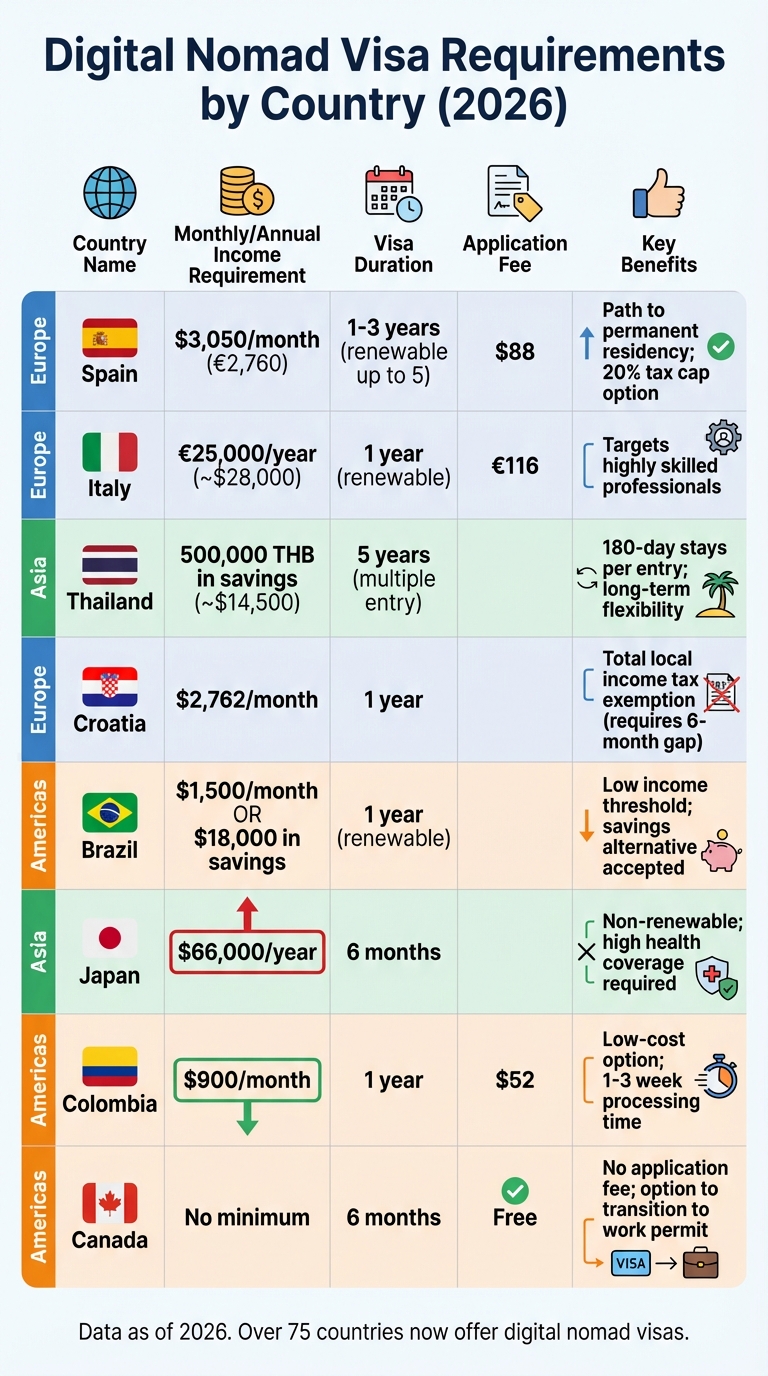
Digital Nomad Visa Requirements by Country: Income, Duration, and Fees Comparison
Digital Nomad Visa Programs by Country
As of early 2026, more than 75 countries have introduced digital nomad visa programs tailored for remote workers. These programs vary significantly, with some aiming to attract high-income professionals for short-term stays, while others offer pathways to long-term residency.
In Spain, professionals need a monthly income of around €2,760 (approximately $3,050) to qualify for an initial one-year visa, which can be renewed. Italy sets a higher bar, requiring skilled professionals to show an annual income of about €25,000 (around $28,000) for a one-year renewable visa.
Thailand introduced a five-year multiple-entry visa called the Destination Thailand Visa (DTV). Applicants must have 500,000 THB in savings (about $14,500) and are permitted 180-day stays per entry. Croatia, on the other hand, offers a one-year visa with full local tax exemptions but requires applicants to wait six months before reapplying after their visa expires. Meanwhile, Brazil keeps its program accessible, offering a one-year renewable visa with either a $1,500 monthly income requirement or proof of $18,000 in savings.
For shorter stays, Japan and Iceland have six-month non-renewable visas aimed at high earners. Japan requires an annual income of roughly $66,000 and comprehensive health insurance, while Iceland’s threshold is around $90,000 per year. The Philippines introduced its digital nomad visa in 2025, requiring a modest annual income of $24,000. Additionally, Canada offers a six-month visitor status program with no minimum income requirement, allowing remote employees of foreign companies to live and work there without needing to pay an application fee.
Here’s a table summarizing the key requirements and benefits of these programs:
Comparison Table of Requirements
| Country | Income Threshold | Visa Duration | Application Fee | Key Benefits |
|---|---|---|---|---|
| Spain | Approximately $3,050/month | 1–3 years (renewable up to 5) | $88 | Path to permanent residency; 20% tax cap option |
| Italy | Approximately €25,000/year | 1 year (renewable) | €116 | Targets highly skilled professionals |
| Thailand | 500,000 THB in savings (≈$14,500) | 5 years (multiple entry) | - | 180-day stays per entry; long-term flexibility |
| Croatia | Approximately $2,762/month | 1 year | - | Total local income tax exemption (requires 6-month gap) |
| Brazil | $1,500/month or $18,000 in savings | 1 year (renewable) | - | Low income threshold; savings alternative accepted |
| Japan | Approximately $66,000/year | 6 months | - | Non-renewable; high health coverage required |
| Colombia | $900/month | 1 year | $52 | Low-cost option; 1–3 week processing time |
| Canada | No minimum | 6 months | Free | No application fee; option to transition to work permit |
How to Apply for a Digital Nomad Visa
Research Visa Requirements
Start by checking the official immigration website of your chosen destination. Look for details like income requirements, eligible professions, and the application process. For example, Spain requires proof of income at 200% of the minimum interprofessional wage (around $2,762 per month), while Italy's requirement is approximately $2,750 per month per person. Make sure you know which consulate oversees your area of residence to avoid any issues with your application. Once you have the details, begin gathering the necessary paperwork.
Prepare Required Documents
Give yourself plenty of time - ideally, start preparing documents 6 to 9 months ahead. Most countries will ask for:
- A valid passport
- Proof of remote work or business ownership
- Bank statements showing you meet the income criteria
- Comprehensive health insurance coverage
Additionally, many countries require a criminal background check. In the U.S., this document often needs Apostille certification, which can take 10 to 12 weeks to process. If your documents aren't in the host country's language, you'll need official translations from certified translators. Be sure to keep photocopies of everything, as you may need them later when applying for a residency permit after you arrive.
Submit Your Application
Once your documents are ready, schedule an appointment at your nearest embassy or consulate, or submit your application online if that option is available. Processing times can range from 15 to 45 days or longer, and fees vary widely - from $80 in Spain to as much as $3,000 for some Caribbean family programs. After your visa is approved, you’ll need to pick it up in person within one month. Upon arriving in your destination country, don’t forget to apply for any local residency permits, like Italy's Permesso di Soggiorno, within the required timeframe (e.g., 8 days).
Benefits and Tax Considerations
Benefits for Remote Workers
Digital nomad visas offer a legal way to work remotely while living abroad. Depending on the program, you can stay in your host country for anywhere between six months and five years. These visas often come with perks like access to long-term housing, local banking services, and healthcare systems. If you're in the Schengen Area, these programs also allow visa-free travel across the zone.
Some countries go a step further. For example, Costa Rica allows you to drive using your home country’s license. In places like Portugal and Italy, extended stays through these visas can even lead to permanent residency or citizenship. Another major draw? The opportunity for geographic arbitrage - living in a country with lower living costs while earning a higher income from abroad.
While these benefits are compelling, understanding tax implications is just as important for making the most of your remote work lifestyle.
Tax Implications and Planning
Enjoying the perks of working abroad comes with the responsibility of navigating tax rules. Many countries, including Croatia, Estonia, Costa Rica, and Mauritius, exempt income earned from foreign sources. Spain offers a flat 24% tax rate on income up to roughly $630,000 per year for the first five years. Similarly, Greece provides a 50% reduction in income tax for up to seven years under Law 4825/2021. Keep in mind, most countries will consider you a tax resident if you spend more than 183 days there in a calendar year.
"Moving to a new country without a tax strategy can be disastrous; conversely, planning correctly can result in significant wealth preservation." – Zara Chechi, Altery
For U.S. citizens, things get a bit more complex. The U.S. taxes its citizens on worldwide income, regardless of where they live. However, there are ways to ease the burden. By spending 330 full days abroad within a 12-month period, you can exclude up to $130,000 in foreign earned income for the 2025 tax year. That said, self-employed individuals still need to pay a 15.3% self-employment tax on their net earnings.
To optimize your tax situation, consider establishing residency in a no-income-tax state like Florida or Texas before you leave. Also, check if your host country has a Totalization Agreement with the U.S., which can help you avoid paying into two social security systems simultaneously.
Conclusion
Digital nomad visas have opened up exciting opportunities for remote workers looking to establish long-term legal residency abroad. With more than 60 countries offering these programs, they provide a structured way to live and work in a foreign country while keeping your income streams intact. Unlike tourist permits, these visas grant access to local services, potential tax perks, and even the possibility of permanent residency after 5–12 years.
However, applying for a digital nomad visa takes careful planning. It’s smart to start the process 6–9 months before your intended move to ensure you meet all requirements and have the necessary paperwork in order. Keep in mind that getting the visa is just the beginning - many countries require additional steps once you arrive. On top of that, staying in one place for more than 183 days often makes you a tax resident, so it’s crucial to understand how local tax laws interact with those of your home country.
For remote workers, these visas offer a practical solution, combining legal security with opportunities for cultural exploration and a sustainable, location-independent lifestyle. With thoughtful preparation and a clear understanding of the requirements, you can make the most of these programs and create a remote work setup that aligns with both your career and personal aspirations.
FAQs
What should I know about taxes when using a digital nomad visa?
The tax implications of digital nomad visas vary depending on the country issuing the visa and your individual circumstances. These visas typically grant remote workers the legal right to live and work in a foreign country for extended periods, often between six months and two years. While some countries aim to attract digital nomads with tax perks or streamlined procedures, others might require proof of income and impose taxes based on your residency status.
Keep in mind that holding a digital nomad visa could result in dual taxation or tax obligations in both your home and host countries. To steer clear of unexpected tax issues, it’s a smart move to consult a tax professional familiar with international tax laws. They can help ensure you meet all necessary reporting and payment requirements.
What are the income requirements for digital nomad visas, and do they differ by country?
Income requirements for digital nomad visas can differ greatly from one country to another. Most countries establish a minimum monthly income to ensure applicants can financially sustain themselves while living there. These amounts typically fall between $2,500 and $7,000 per month, though some places might require more or less. For instance, some destinations are more relaxed, with little to no income requirements, making them an option for a wider range of remote professionals.
Beyond income, other conditions may apply. Applicants are often asked to provide proof of health insurance, evidence of remote work, or a clean criminal record. Since these requirements and policies can shift from year to year, it's essential to check the latest rules for your desired location before starting the application process.
How can I apply for a digital nomad visa?
Applying for a digital nomad visa typically involves a few straightforward steps, but the process can vary depending on the country. Start by reviewing the specific eligibility requirements for your destination. Most places will ask for proof that you're working remotely or are self-employed, along with a valid passport and documentation showing you have enough income to support yourself while you're there.
Next, gather all the required paperwork. This usually includes a completed application form, proof of health insurance, and details about where you'll be staying. Some countries might also request a background check or a letter explaining your plans during your stay.
When you've got everything ready, submit your application either online or at the nearest embassy or consulate. You might need to attend an interview or provide biometric data, so be prepared for that possibility. Keep in mind that processing times can take several weeks, so applying early is a smart move. Once your visa is approved, follow any additional entry requirements, such as registering with local authorities after you arrive.