To really get what non-custodial means for Bitcoin, you just need to remember one simple idea: you are your own bank. It’s all about giving you total, exclusive control over your funds—kind of like keeping cash in your wallet instead of depositing it in a bank.
What Non Custodial Really Means

Let's cut right through the jargon. At its heart, "non-custodial" just means you have absolute command over your Bitcoin. It’s a way of managing your Bitcoin where no third party—like an exchange or some other service—is holding it for you.
Think about it like owning physical gold bars. A custodial service is like stashing them in a bank's vault; the bank holds them for you and gives you access when you ask. But the non-custodial way? That’s like keeping those gold bars in your own safe at home where only you know the combination.
The Power of Private Keys
This level of personal control is all thanks to something called a private key. This isn't a physical key, but a secret piece of code that proves you own your Bitcoin and gives you the power to spend it. In a non-custodial setup, you—and only you—hold these keys.
This concept is so fundamental to Bitcoin that it sparked a core principle you’ll hear all the time in the community:
"Not your keys, not your coins."
This little phrase is a powerful reminder. If you hand your private keys over to someone else, you're also handing them your Bitcoin. You're effectively asking for their permission to use what's already yours.
A non-custodial wallet is built specifically to give you this direct control over your private keys and, by extension, your Bitcoin, without needing to trust anyone else. It puts all the power, and the responsibility, right where it belongs: with you. If you want to dive deeper into wallet types, BitGo offers some great insights.
Non Custodial vs Custodial At a Glance
To make the difference crystal clear, let's put the two models side-by-side. This quick comparison really highlights why this distinction is so crucial for anyone using Bitcoin.
| Feature | Non Custodial | Custodial |
|---|---|---|
| Control Over Funds | You have 100% control | A third party holds your funds |
| Private Keys | You hold your own keys | A third party manages your keys |
| Access to Funds | Direct and immediate | Requires third-party permission |
| Security | You are responsible for security | You trust the third party's security |
| Counterparty Risk | None | High (company failure, hacks, etc.) |
As you can see, it all boils down to a simple trade-off: convenience versus control. While custodial services can feel easier, they introduce risks and dependencies that simply don't exist when you hold your own keys.
The Fundamental Choice: Custodial vs. Non-Custodial
Deciding how to hold your Bitcoin isn't just a technical detail—it’s a philosophical fork in the road. The path you choose completely defines your relationship with your money and has very real consequences for your financial freedom.
On one side, you have custodial services, like the big Bitcoin exchanges. They feel familiar, operating a lot like a traditional bank. You log in, see your balance, and send funds with a few clicks. But this convenience comes with a huge trade-off.
When you use a custodial service, you’re handing over control. You're trusting someone else with your Bitcoin, creating a massive central point of failure. Your funds are suddenly exposed to risks you can't control, like the company going bust, freezing your account, or getting hacked.
Embracing Financial Sovereignty
The other path is the non-custodial one, and it leads to true financial sovereignty. Grasping what "non-custodial" means is about shifting your mindset from asking for permission to having undeniable ownership of your assets.
By holding your own private keys, you completely eliminate counterparty risk. There is no middleman who can deny you access to your Bitcoin or lose it on your behalf.
This approach is the very essence of Bitcoin's core principle: decentralization. It’s about cutting out the need to trust a third party and instead relying on the raw security of the network and your own diligence. For businesses, this is a game-changer.
Using non-custodial payment tools like Flash lets merchants accept Bitcoin directly from a customer's wallet into their own. The funds never touch a third party's balance sheet. This direct, peer-to-peer transaction isn't just more secure; it’s Bitcoin working exactly as it was designed to. You're not just accepting a new currency; you're plugging into a more resilient and independent financial system.
How a Non Custodial Bitcoin Wallet Works

So, how does this all work under the hood? It’s not as complicated as you might think. When you fire up a non-custodial wallet for the first time, it kicks off a crucial process.
The software generates something called a seed phrase, which is usually a list of 12 or 24 simple words in a very specific order. You absolutely must think of this phrase as the master key to your digital vault. It's the most important piece of information you will ever own regarding your Bitcoin.
From this single phrase, your wallet can mathematically create a nearly infinite number of private keys and public addresses. It's the root of your entire Bitcoin wallet.
Keys and Addresses Explained
Let's use an analogy. Imagine your wallet is a massive post office building filled with secure P.O. boxes.
Here’s how the pieces fit together:
- The Seed Phrase: This is the master key to the entire post office. It can open every single P.O. box inside. If you lose it, you're locked out for good.
- Private Keys: Think of these as the individual keys for each P.O. box. Your wallet generates these from the seed phrase, and they are what give you the power to actually spend the Bitcoin sent to that box.
- Public Addresses: These are like the P.O. box numbers you share with people. Anyone can send mail (Bitcoin) to your address, but only the person with the private key can open the box to get what's inside.
The most critical rule of self-custody is to write your seed phrase down and store it securely offline. Never save it on a computer, phone, or any device connected to the internet where it could be stolen.
When you decide to send some Bitcoin, your wallet uses the correct private key to cryptographically "sign" the transaction. This digital signature proves to the entire network that you—and only you—are the rightful owner authorizing the funds to be moved.
The beautiful part is that this whole signing process happens locally on your device. Your private keys never touch the internet or leave your wallet. This is why understanding strategies to enhance fintech app security is so important for wallet developers—it ensures your keys stay safe. It’s how you maintain absolute control without ever having to reveal your secrets to anyone.
Why Choose a Non Custodial Approach
Going non-custodial is more than just a technical decision; it’s a conscious choice to unlock benefits that you simply can't get with custodial services. It's a shift from placing your trust in a third party to trusting yourself.
The most powerful reason? Complete sovereignty. With a non-custodial wallet, no company or government can freeze, censor, or seize your Bitcoin. You have the final, and only, say over your funds.
Taking Control of Security and Privacy
Another huge advantage is enhanced security. Custodial exchanges are notorious targets for hackers because they hold massive pools of user funds in one place. By managing your own keys, you pull your assets out of that central honeypot and become their sole guardian.
The responsibility for security shifts entirely to you, but so does the control. You eliminate the risk of a third party failing to protect your assets.
Finally, the non-custodial route offers improved privacy. Most non-custodial wallets don't force you to hand over sensitive personal information (like Know Your Customer or KYC) just to hold your own money. This gives you a much greater degree of financial privacy.
The explosion in non-custodial wallet adoption shows a clear demand for this kind of decentralized control. These wallets let people worldwide interact with Bitcoin without invasive KYC or AML checks, putting individuals firmly back in charge of their financial data. You can explore a deeper comparison between the two models on BitPay’s blog.
These three pillars—sovereignty, security, and privacy—are exactly why so many in the Bitcoin space see self-custody not as a burden, but as its most powerful feature.
With Great Power Comes Great Responsibility
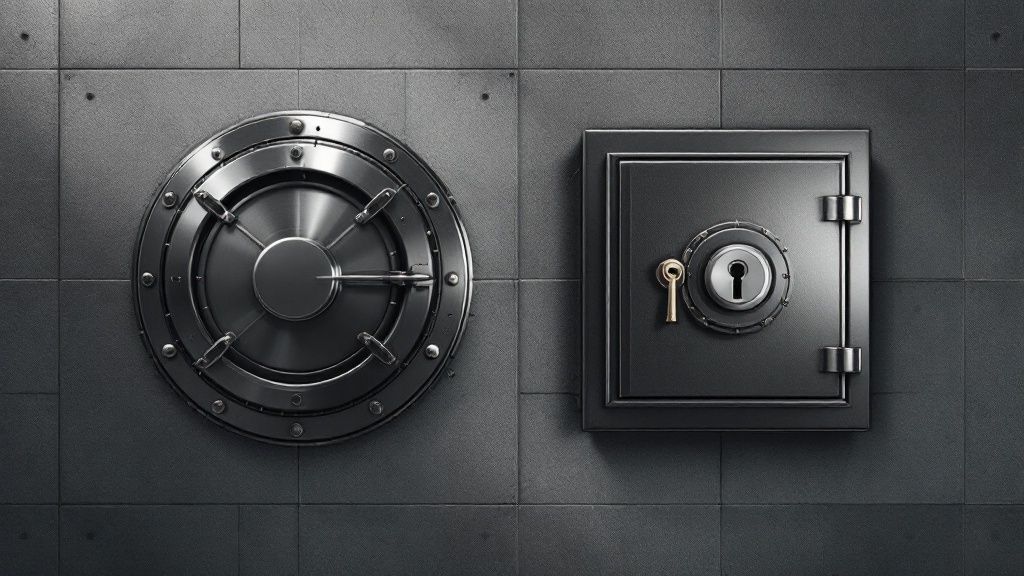
The freedom of a non-custodial wallet is a game-changer, but it’s a double-edged sword. You are 100% responsible for your own security. There's no customer support hotline to ring or a 'forgot password' link to click if you mess up.
This is the most critical takeaway: losing your seed phrase means losing your Bitcoin. Forever. If that master key is gone, so are your funds. No one can help you get them back. This is what it truly means to be your own bank.
From a legal standpoint, the buck also stops with you. Non-custodial wallet providers don't hold your assets, so they typically operate outside traditional financial regulations. This shifts the full legal burden for security onto your shoulders. As the provider can't access your funds, they also can't step in to help with lost keys or fraud. You can discover more insights about these legal distinctions if you want to go deeper.
Common Threats to Your Bitcoin
Being your own bank means you need to think like one. Understanding the threats is the first step toward protecting your assets with confidence.
Here are the primary risks you need to guard against:
- Phishing Scams: These are sneaky attempts, often through fake emails or websites, to trick you into revealing your seed phrase. A legitimate wallet provider will never ask for your seed phrase. Period.
- Malware and Viruses: Malicious software on your computer or phone can be designed to steal your private keys or seed phrase as you type them. Always use trusted devices and keep your security software up to date.
- Physical Security Risks: Just writing your seed phrase down isn't enough. You have to store it somewhere safe from theft, fire, or water damage—a place where no one else can stumble upon it.
The goal isn't to scare you, but to prepare you. By adopting strong, common-sense security habits, you can easily manage these risks and truly enjoy the financial sovereignty that Bitcoin offers.
Frequently Asked Questions
Even after getting the hang of what "non-custodial" really means, a few practical questions always seem to pop up. Let's tackle a few of the most common ones to really cement your understanding and get you comfortable with managing your own Bitcoin.
Once you’ve got these down, you'll feel much more prepared to take the leap into true financial self-sovereignty.
Is a Non-Custodial Wallet Anonymous?
This is a big one. While a non-custodial wallet gives you way more privacy than a custodial exchange, it isn't completely anonymous. Exchanges usually demand a ton of personal info (KYC, or "Know Your Customer") just to open an account, linking your real-world identity directly to every move you make.
Non-custodial wallets skip all that. But, and this is a big "but," every single Bitcoin transaction is carved into the public, unchangeable ledger forever. Your real name isn't on your wallet address, but clever analysis of transaction patterns could potentially trace activity back to you.
A non-custodial wallet gives you privacy by breaking the link between your identity and your funds at rest, but the transactions themselves are still public. A better word for it is pseudonymous, not anonymous.
What Happens If I Lose My Phone or Computer?
This is the number one fear for anyone starting out, but the answer is where the real magic of the seed phrase shines through. If your phone gets lost, stolen, or dropped in a lake, your Bitcoin is perfectly safe—as long as you have that seed phrase backup.
The physical device you use is completely disposable. You can just grab a new phone or laptop, download a non-custodial wallet app, and punch in your 12 or 24-word seed phrase. Boom—you've restored full access to all of your funds. The seed phrase is everything; the device is just a temporary window into your wallet.
Can I Still Use Exchanges with a Non-Custodial Wallet?
Absolutely. In fact, this is a very common and smart way to operate. The best way to think about it is to treat your non-custodial wallet like a secure savings account—it’s where you keep the majority of your Bitcoin for the long haul.
Then, you can treat an exchange like a checking account. Keep only small amounts on it for quick trades or for cashing out into traditional currency when you need to. You can move Bitcoin between your personal wallet and an exchange freely and easily. This hybrid approach gives you the best of both worlds: the iron-clad security of self-custody and the day-to-day convenience of an exchange.
Ready to accept Bitcoin payments directly and securely? Flash provides merchants with the tools to process wallet-to-wallet transactions instantly, without ever taking custody of your funds. Get started with Flash today.