So, what exactly is a Bitcoin wallet? Put simply, it’s the digital tool you use to manage the secret keys needed to access and spend your Bitcoin. It’s a common mistake to think it physically stores your coins like a regular wallet holds cash. Instead, think of it as your personal interface to the Bitcoin network—the software that proves you own your funds.
Your Digital Keychain for Bitcoin
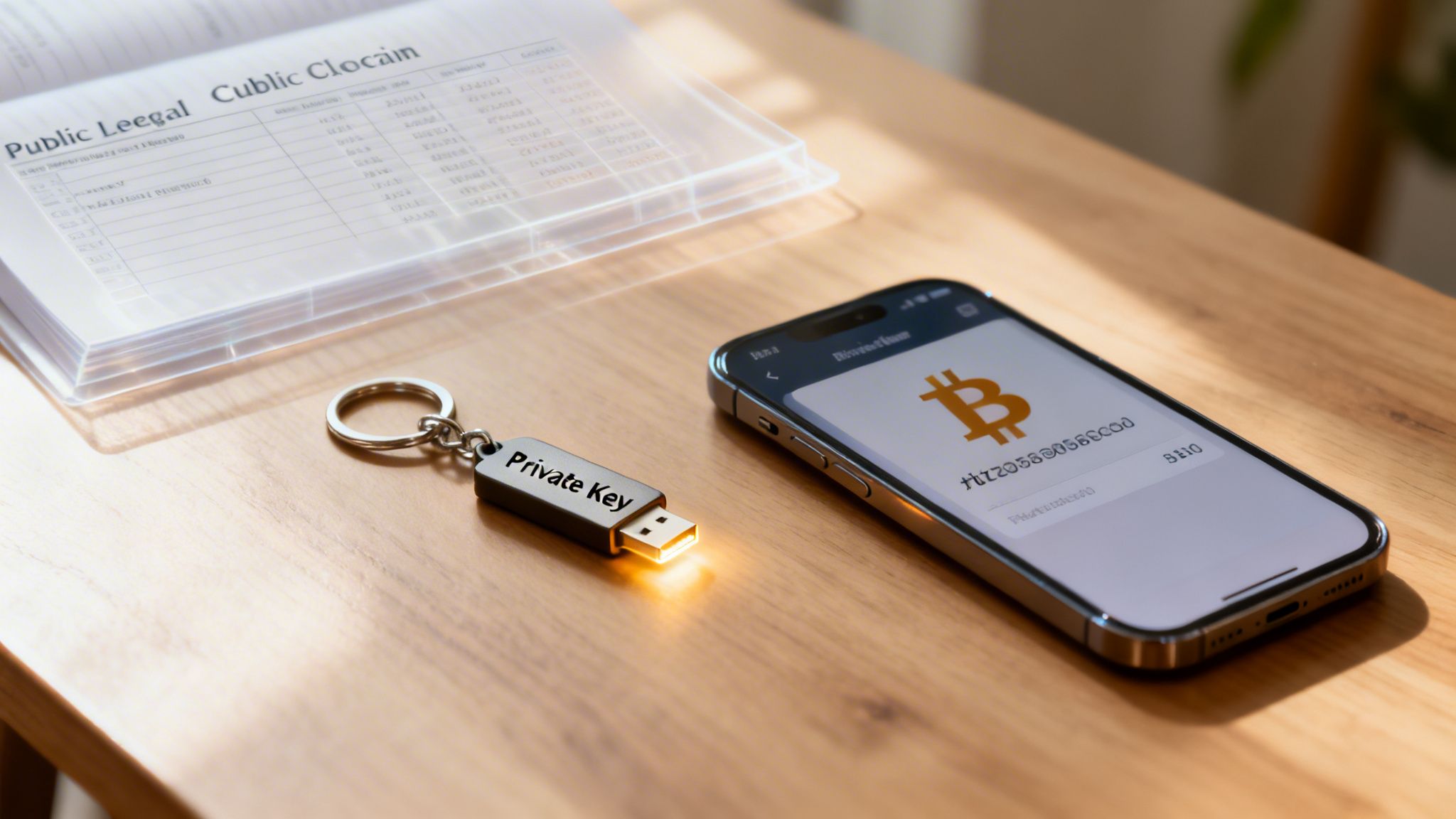
The biggest misconception is that a Bitcoin wallet contains your actual coins. In truth, your Bitcoin never leaves the blockchain, a global, public ledger spread across thousands of computers. Imagine it as a massive, transparent spreadsheet that everyone can see but no one can alter without the right permissions.
So, what does a Bitcoin wallet really do? Its main job is to securely store your private keys. These keys are secret pieces of cryptographic code that serve as the ultimate proof of ownership. They’re what allow you to "sign" or authorize transactions, effectively telling the network that you have the right to spend the Bitcoin associated with your address.
To get the full picture of a Bitcoin wallet, it helps to first understand the bigger idea behind What Is Cryptocurrency. Bitcoin was the first and is still the most famous example, and its wallet system is central to how the whole thing works.
An Email Analogy to Make it Simple
One of the best ways to wrap your head around how a wallet works is to compare it to an email account. This simple analogy breaks down the essential parts into concepts we all use every day.
Let's break down the key components with this analogy in mind.
| Component | Simple Analogy | Primary Function |
|---|---|---|
| Bitcoin Address | Your email address | A public identifier you share to receive funds. |
| Private Key | Your email password | The secret key used to authorize spending your Bitcoin. |
| Wallet Software | Your email app | The user-friendly interface for managing everything. |
This table makes it clear: the wallet software is the easy-to-use application that manages the public and private parts of your Bitcoin identity.
So, What's the Key Takeaway?
Your Bitcoin wallet is the tool that manages your addresses (for receiving funds) and, most importantly, protects your private key (for spending them). It’s your personal keychain for the Bitcoin economy, giving you secure access to your money on the blockchain.
Without a wallet, trying to interact with the Bitcoin network would be an incredibly technical and frustrating experience. The software handles all the complex stuff behind the scenes, letting you send, receive, and check your balance through a simple interface. It generates new addresses for you and uses your private key to sign outgoing payments—all without ever revealing that critical key to anyone.
This mix of public visibility (your address) and private security (your key) is the magic that makes the whole system work so well.
How a Bitcoin Wallet Actually Works
To really get what a Bitcoin wallet is, we have to pop the hood and look at the engine that sends and receives funds. It’s not just a digital container; your wallet is a sophisticated bit of software that manages the cryptographic keys at the very heart of every Bitcoin transaction. Think of it as your personal command center for the entire network.
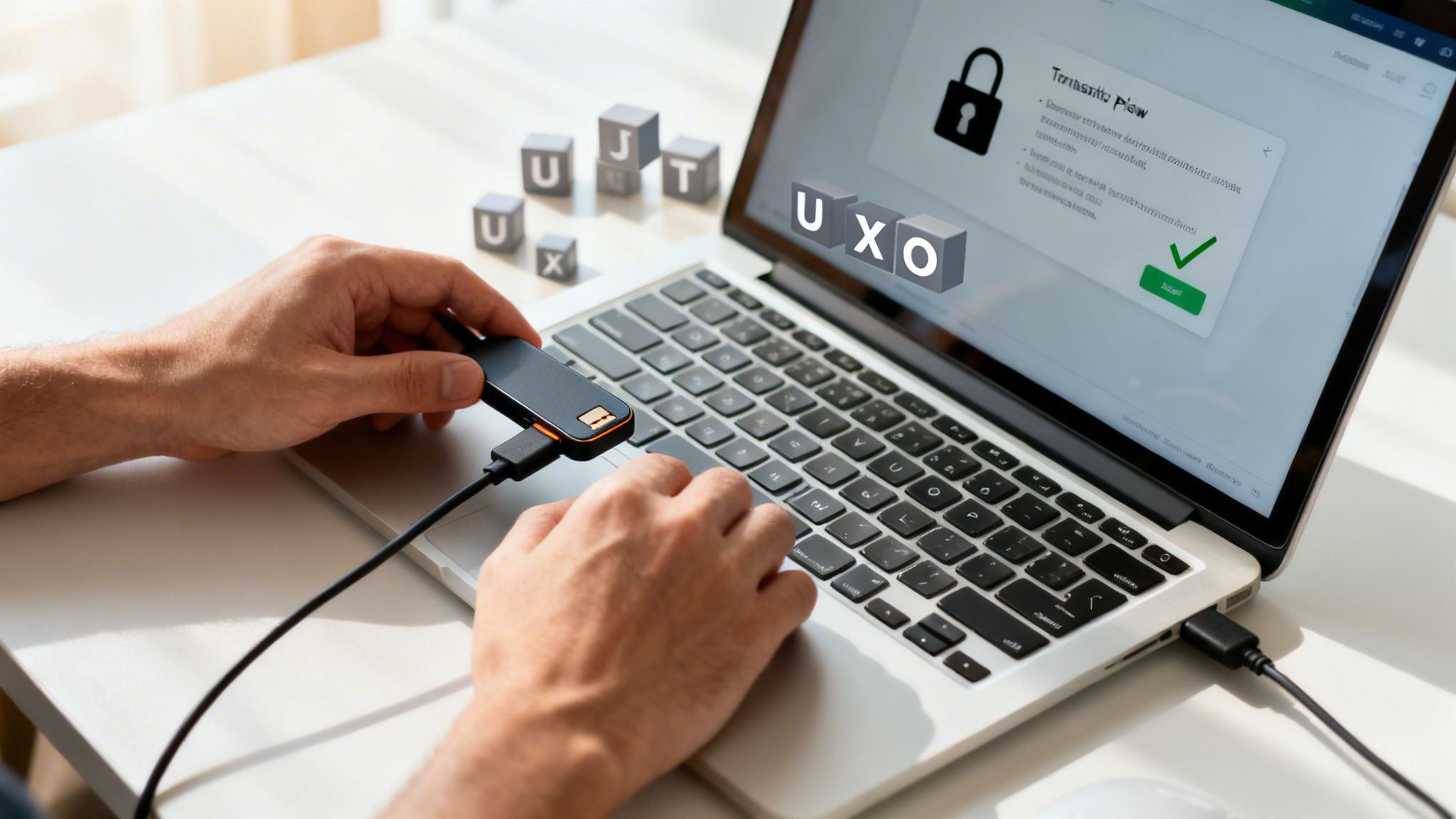
The whole operation hinges on three core parts that work in perfect harmony, a lot like sending an email. Your wallet juggles all this for you, so you never have to sweat the technical details.
The Trio of Keys and Addresses
At the absolute center of everything is your private key. This is, without a doubt, the single most important piece of information you own. Treat it like the master key to a bank vault—if someone else gets it, they can access and spend every last satoshi you have. Your wallet's primary job is to guard this key with its life.
From this private key, your wallet generates a corresponding public key. This key is mathematically tied to your private key, but there's no way to reverse-engineer it to find the original. It acts as a public ID, letting you prove ownership without ever showing your secret.
Finally, your wallet hashes the public key to create a Bitcoin address. This is what you share with people who want to send you bitcoin. It’s like your email address—it's perfectly safe to hand out because it only allows people to send to you, not take from you.
Key Takeaway: Your private key is your secret password for spending. Your public key is a verifiable ID. Your Bitcoin address is the destination for receiving funds. Your wallet manages all three.
Signing and Broadcasting a Transaction
When you decide to send some bitcoin, the process is a bit like sealing a letter with a unique, unbreakable wax seal. You're not actually "sending coins" in the traditional sense. Instead, you're creating a signed message that instructs the entire network to update its public ledger.
Here’s a simple breakdown of what happens:
- You create the transaction: You just need to pop in the recipient's Bitcoin address and the amount you want to send.
- Your wallet signs it: Your wallet software takes the transaction details and uses your private key to create a digital signature. This signature is mathematical proof that you own the funds and have authorized this specific payment.
- The transaction is broadcast: The signed transaction gets sent out to the Bitcoin network, where miners will verify it and include it in the next block on the blockchain.
The crucial part? Your private key never leaves your wallet. The signature it generates is all the proof the network needs. This cryptographic magic is what lets you securely control your funds without ever exposing your most valuable secret.
It's a process used millions of times a day. The Bitcoin wallet ecosystem is exploding, with over 200 million wallets created globally. This growth shows just how much Bitcoin is being adopted for both investment and everyday payments. If you want to dive deeper, you can explore more data on the crypto wallet market's growth and see where things are headed.
Understanding Your Digital Change
Another concept your wallet handles for you is something called Unspent Transaction Outputs, or UTXOs. It sounds complicated, but the idea is actually pretty simple if you think about it like using physical cash.
Imagine you have a $20 bill and want to buy a coffee that costs $5. You hand the cashier the $20, and they give you back $15 in change.
Bitcoin transactions work in a surprisingly similar way. UTXOs are like the individual bills and coins of different denominations in your physical wallet. When you send bitcoin, your wallet might need to use a larger UTXO (like that $20 bill) to cover a smaller payment.
Let’s say you received 1 BTC in a single transaction. You now have one UTXO worth 1 BTC. If you want to send 0.2 BTC to a friend, your wallet uses that entire 1 BTC UTXO and creates two outputs:
- 0.2 BTC goes to your friend's address.
- 0.8 BTC is sent back to a new address in your own wallet as "change."
This 0.8 BTC becomes a new UTXO in your wallet, ready for you to spend later. Your wallet handles this entire process automatically, keeping a running tally of all your digital "bills and coins" so you always see your correct total balance. This UTXO model is fundamental to the security and integrity of the Bitcoin network.
Custodial vs Non-Custodial Wallets: The Critical Difference
When you choose a Bitcoin wallet, you're doing more than just picking a place to store your funds. You’re making a fundamental decision about who actually controls your Bitcoin. This choice always comes down to two paths: custodial and non-custodial.
Getting this right is one of the most important steps for any Bitcoin user.
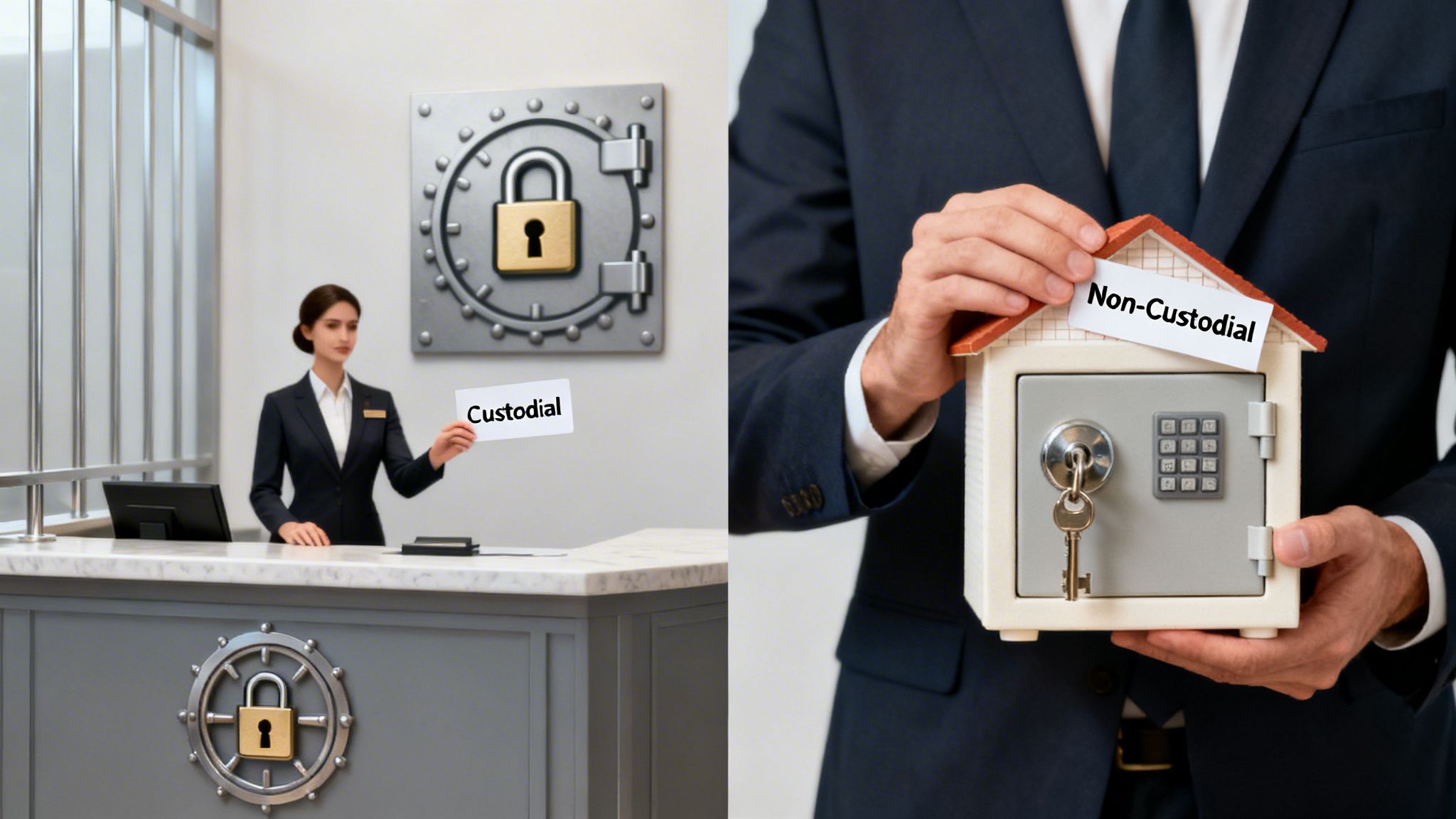
The entire debate is captured perfectly by a popular saying in the Bitcoin community: "Not your keys, not your coins." This isn't just a catchy phrase; it's the golden rule of self-sovereignty in the digital world.
Let's break down exactly what this means for you.
Custodial Wallets: The Bank Model
A custodial wallet is one where a third party—think of a big Bitcoin exchange—holds your private keys for you. It’s the exact same model as a traditional bank. When you deposit cash, the bank holds it, and you're trusting them to keep it safe and give you access when you ask.
This setup is definitely convenient. You can often recover your account with a simple password reset, and the user experience is typically very polished.
But that convenience comes with some serious strings attached:
- You don't have true ownership: Since the company controls the keys, they ultimately control the Bitcoin. They can freeze your account or block transactions if they choose to.
- Risk of company failure: If the custodial service gets hacked or goes bankrupt (and many have), your funds could be lost forever.
- Censorship and restrictions: The custodian can demand extensive personal information (KYC) before you can move your funds or even close your account.
For many, these risks are a deal-breaker. You are placing your complete trust in another company's security, ethics, and ability to stay in business.
Non-Custodial Wallets: Your Personal Digital Safe
A non-custodial wallet flips the script entirely, putting you in complete control. With this type of wallet, you and only you hold the private keys. It's the digital version of having a personal safe in your home where you are the only one who knows the combination.
No bank, government, or company can touch your funds without your permission. This is what we call financial sovereignty.
You have the freedom to send and receive Bitcoin whenever you want, to whomever you want, without asking for approval. For merchants, this is a game-changer. Using a non-custodial solution like Flash means you accept payments directly from customers, wallet-to-wallet, with no middleman. This completely eliminates counterparty risk, protects your customers' privacy, and gives you immediate control over your revenue.
A Bitcoin wallet is a digital tool that allows users to manage private and public keys on the blockchain. Unlike traditional bank accounts, it doesn't hold actual coins but provides access to them. With over 200 million Bitcoin wallets created worldwide, adoption is growing. In the US alone, 22% of Americans own Bitcoin, and 89% have heard of it. For merchants, integrating non-custodial payment solutions means tapping into this vast user base directly, ensuring decentralization and privacy without KYC hassles. Explore more insights on Bitcoin user growth.
This direct, peer-to-peer model is exactly what Bitcoin was designed for. While it means the responsibility for securing your keys rests entirely on your shoulders, the freedom and control it provides are simply unmatched.
Choosing the Right Type of Bitcoin Wallet
Now that you understand the crucial difference between holding your own keys and trusting someone else with them, let's get into the practical side of things. Bitcoin wallets come in a few different flavors, and picking the right one is all about balancing your needs for everyday convenience with long-term security.
Ultimately, the choice comes down to one simple question: will your wallet be connected to the internet?
Hot Wallets For Daily Use
Any Bitcoin wallet that's connected to the internet is called a hot wallet. This includes software you run on your computer or phone, which makes them incredibly convenient for sending and receiving bitcoin frequently. Think of it like the cash you keep in your physical wallet—it’s perfect for buying a coffee, but you wouldn't stuff your life savings in there.
These are the most common types of hot wallets:
- Desktop Wallets: These are applications you install right on your laptop or home computer. They often give you more control over your transaction fees and privacy settings, striking a nice balance between features and security.
- Mobile Wallets: These are simply apps you download to your smartphone. Their biggest advantage is portability, making them perfect for paying a merchant in person or managing your bitcoin while you're out and about. Many use QR codes to make transactions a breeze.
Because they live online, hot wallets are naturally more exposed to digital threats like malware or a sneaky phishing attack. Still, for managing smaller amounts of Bitcoin meant for regular spending, their convenience is unmatched. The global crypto wallet market is growing fast, with software wallets leading the charge in adoption. It's easy to see why—people are looking for faster ways to pay each other than waiting on slow bank wires, and these wallets make peer-to-peer payments simple. You can read the full research on the crypto wallet market to dig deeper into these trends.
Cold Wallets For Maximum Security
On the other end of the spectrum, a cold wallet (or cold storage) is a wallet that is kept completely offline. By creating an "air gap" between your private keys and the internet, you effectively eliminate the risk of being hacked from afar. This is your digital Fort Knox—the ideal place to secure large amounts of Bitcoin for the long term.
The most popular type of cold storage is a hardware wallet.
Hardware Wallets are small, purpose-built physical devices designed to do one job and do it well: protect your private keys. They usually look like a USB stick and only connect to your computer when you need to approve a transaction.
Here’s a quick rundown of how they work:
- You start by creating a transaction on your computer or phone, which is connected to the internet.
- The transaction details are then sent over to the hardware wallet for your approval.
- You physically press a button on the device itself to confirm you want to send the funds.
- The device signs the transaction internally and sends only the signature back to your computer. Your private key never leaves the device.
Key Insight: A hardware wallet ensures your private keys never touch an internet-connected device. Even if your computer is riddled with viruses, your funds stay safe because that final, critical signature happens securely offline.
Multisig Wallets For Shared Control
For businesses or even families that need a higher level of security through shared responsibility, multisignature (multisig) wallets are a fantastic solution. A multisig wallet requires more than one key to authorize a transaction, a bit like a bank's safe deposit box that needs two separate keys to be opened.
For instance, a business could set up a "2-of-3" multisig wallet. This means three different people each hold a private key, but any two of them must sign off on a transaction before the bitcoin can be moved. This setup eliminates any single point of failure, protecting the funds from both theft and the accidental loss of a key. It’s a powerful tool for managing corporate funds or shared savings.
Comparison of Bitcoin Wallet Types
To help you visualize the trade-offs, here's a quick comparison of the most common wallet types. Each has its place, and many people use a combination of hot and cold wallets for different purposes.
| Wallet Type | Security Level | Convenience | Best For... |
|---|---|---|---|
| Mobile Wallet | Good (Hot) | High | Everyday spending, point-of-sale transactions, and managing small amounts on the go. |
| Desktop Wallet | Good (Hot) | Medium | Regular use on a primary computer, offering more features and control than mobile. |
| Hardware Wallet | Excellent (Cold) | Low | Securing large amounts of Bitcoin for long-term savings or "hodling." |
| Multisig Wallet | Superior (Hot or Cold) | Varies | Businesses, organizations, or groups needing shared control over funds. |
Choosing the right wallet setup is a personal decision based on how you plan to use Bitcoin. For daily transactions, a mobile wallet offers unparalleled ease. For your long-term holdings, nothing beats the peace of mind that comes with a hardware wallet. And for businesses, multisig provides a robust framework for managing funds securely.
Essential Bitcoin Wallet Security Practices
When you use a non-custodial Bitcoin wallet, you’re taking back control of your money. It’s a powerful idea, often summed up with the phrase, "your keys, your coins." But this financial freedom comes with a trade-off: you are now solely responsible for keeping those keys safe. This isn't just a friendly suggestion—it's the most critical part of owning Bitcoin.
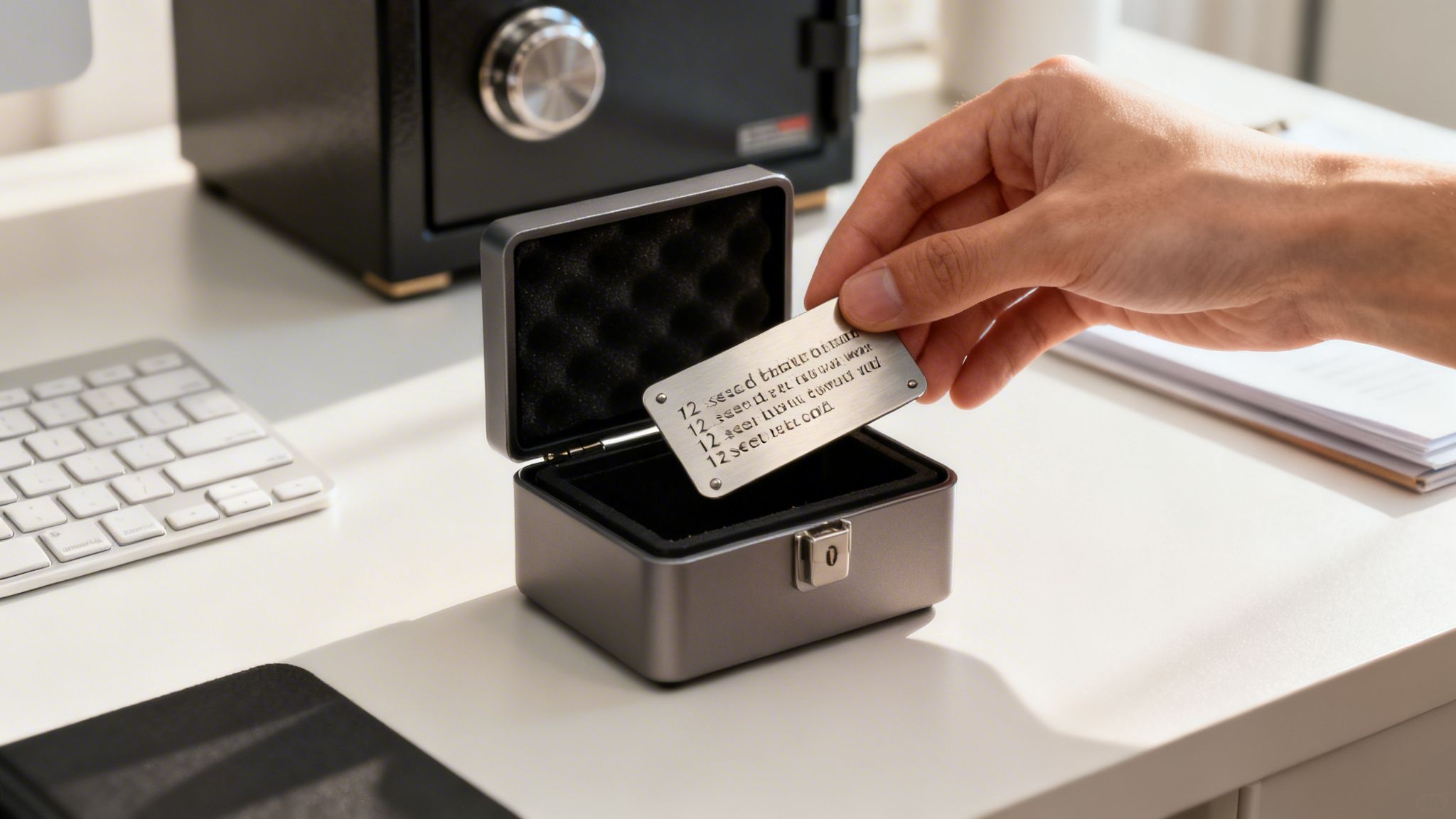
The single most important secret you must protect is your recovery seed phrase. This is the list of 12 or 24 words your wallet gives you when you first set it up. It’s the master key to every single private key your wallet will ever create.
Think of it this way: your wallet app is just the interface you use every day. Your seed phrase is the ultimate emergency override. Anyone who gets their hands on that phrase can recreate your entire wallet on their own device and drain it completely.
Safeguarding Your Master Key
Because your seed phrase is the master key to everything, how you store it is everything. The absolute golden rule is to keep it offline and in a secure, private location. Never, ever store it digitally.
Here are the non-negotiables for protecting your seed phrase:
- Write it down physically: Use the paper card that came with your wallet or a fresh sheet of paper. Even better, etch it into something durable like a steel plate to make it fireproof and waterproof.
- Store it securely: Lock your written phrase in a home safe, a bank’s safe deposit box, or another hidden spot where it’s protected from theft or accidents.
- Never create a digital copy: Don't take a photo of it. Don't type it into a notes app or save it in your password manager. Any device connected to the internet is a potential backdoor for thieves.
Critical Insight: Your seed phrase is your last line of defense. If your phone gets stolen or your hardware wallet is lost, this phrase is the only way to get your Bitcoin back. Treat it with the same seriousness you would a stack of gold bars.
Strengthening Your Digital Defenses
Beyond just protecting the seed phrase, your everyday habits are crucial for keeping your Bitcoin safe from online threats. A non-custodial wallet gives you control, but you still have to be smart about the software you install and the networks you use.
First off, only download wallet software directly from the developer's official website. Scammers are experts at creating fake look-alike apps and websites to trick you into downloading malware that steals your keys or monitors your clipboard for addresses.
And be incredibly careful about the Wi-Fi you use for transactions. Public networks at coffee shops, hotels, or airports are notoriously insecure. Attackers can easily monitor these networks to intercept your data, making them a terrible place to manage your finances.
Common Pitfalls to Avoid
Even people with the best intentions can make simple mistakes that lead to total loss. Knowing what the common traps are is your best defense.
- Phishing Scams: Watch out for unexpected emails, texts, or direct messages telling you there's a problem with your wallet and asking you to click a link to "verify" your details. No legitimate wallet provider will ever ask for your seed phrase. Ever.
- Unverified Software: Never enter your seed phrase into any website or application other than your official wallet software, and only when you are intentionally recovering your wallet.
- Physical Threats: It’s wise to avoid talking publicly about how much Bitcoin you own. This can make you a target for real-world criminals who might use intimidation or force to get you to hand over your devices and keys.
By treating your seed phrase as your most important secret and practicing good digital hygiene, you can confidently manage your wallet and enjoy the true freedom of financial self-sovereignty.
How to Accept Bitcoin Payments as a Merchant
For any business owner, getting a handle on Bitcoin wallets isn't just a tech lesson—it opens up a completely new way to get paid. By embracing a non-custodial setup, you can take Bitcoin payments straight from your customers, cutting out the traditional payment middlemen entirely. This simple shift puts you in the driver's seat, giving you full control over your revenue from the second a sale is made.
Modern Bitcoin payment tools are all about making these direct, wallet-to-wallet transactions happen smoothly. This peer-to-peer model gets rid of the intermediaries, which naturally slashes transaction fees. It also frees you from the tangled web of compliance that comes with third-party payment gateways. You get paid instantly, and your customers get a private, direct way to buy from you.
Streamlining Payments in Your Business
Bringing Bitcoin into your daily operations is surprisingly straightforward these days. It doesn't matter if you run a coffee shop, an online store, or a consulting firm—there’s a non-custodial solution that will slot right into your workflow. These tools are built specifically so you can accept Bitcoin without ever holding customer funds, which massively simplifies your security and compliance overhead.
A few key tools make this possible for merchants:
- Point-of-Sale (POS) Apps: These can turn any old smartphone or tablet into a terminal ready for Bitcoin. The app just pops up a unique QR code for each sale, and the customer pays in seconds by scanning it with their mobile Bitcoin wallet.
- Payment Links: Need to invoice a client or take a donation? Just create a simple link and send it via email, text, or social media. It takes them directly to a secure page to complete the payment.
- Online Checkout Integrations: Easily add a "Pay with Bitcoin" button right next to the credit card options on your website. These plug-ins work with all the big e-commerce platforms, giving your online shoppers a seamless payment experience.
The Benefits of a Wallet-to-Wallet Approach
When you opt for a payment solution like Flash, you're choosing a model where your customer's payment travels directly to your business's non-custodial Bitcoin wallet. This direct line to your money has some serious perks over the old-school and custodial systems. You have total sovereignty over your funds, settlement is almost immediate, and you neatly sidestep the privacy headaches of sharing customer data with yet another third party.
Key Merchant Takeaway: Non-custodial payment tools let you tap into a global market of Bitcoin users without the high fees, chargeback risks, and settlement delays of the legacy financial system. You control the keys, you control the funds.
This approach gives you the freedom to do business on your own terms and connect with a fast-growing crowd of consumers who actually prefer paying with Bitcoin. Getting started is often as simple as downloading an app, meaning you could be accepting Bitcoin payments in just a few minutes.
Common Questions (And Straight Answers) About Bitcoin Wallets
Even with a solid grasp of the basics, a few questions always pop up when you're getting started with Bitcoin wallets. Let's tackle some of the most common ones head-on so you can move forward with confidence.
Are Bitcoin Transactions Anonymous?
Here’s a common misconception: Bitcoin is pseudonymous, not anonymous. There's a big difference. While your name and address aren't stamped on your transactions, every single payment is recorded forever on the public blockchain for anyone to see.
This means if your Bitcoin address is ever linked back to your real-world identity, someone could trace your entire financial history. It's always smart to treat your on-chain activity with the same care you'd give your bank statements.
What Happens If I Lose My Wallet Device?
Losing your phone or hardware wallet is a stomach-dropping moment, but it doesn't mean your Bitcoin is gone for good. As long as you have your recovery seed phrase—those 12 or 24 words you wrote down when you first set up the wallet—you can get full access back.
You just need to import that seed phrase into a new, compatible Bitcoin wallet, and your funds will reappear. This is precisely why guarding that seed phrase is the golden rule of self-custody. Keep it offline, keep it safe, and never share it.
Key Reminder: Your Bitcoin isn't stored on your device; it lives on the blockchain. Your seed phrase is the master key that unlocks your funds from anywhere in the world.
Should I Reuse My Bitcoin Address?
For privacy reasons, it's best to avoid reusing Bitcoin addresses. Think of it like this: if you give the same address to everyone who pays you, they can all look it up and see every payment you've ever received at that address.
Thankfully, most modern wallets handle this for you automatically, generating a fresh, unused address for every incoming transaction. Since all these addresses are controlled by your single seed phrase, your wallet keeps track of everything seamlessly in the background.
How Are Bitcoin Transaction Fees Determined?
Bitcoin transaction fees (often called miner fees) have nothing to do with the dollar amount you're sending. Whether you send $5 or $5 million, the fee is based on two things: the data size of your transaction and how busy the network is at that moment.
When lots of people are trying to make transactions at the same time, the network gets congested, and fees rise as users compete for block space. Most wallets do a good job of suggesting an appropriate fee to make sure your transaction gets confirmed without a long wait.
Ready to accept Bitcoin payments directly, wallet-to-wallet? With Flash, you can get a non-custodial payment solution running for your business in under a minute. Ditch the middlemen, sidestep the KYC, and take full control of your revenue. Start accepting global payments with Flash today!