Think of a crypto address as your personal mailbox on the blockchain. It's a unique string of letters and numbers that tells the world where to send you digital currency. This is the public information you can share with anyone, just like you'd give out your home address for mail or your bank account number for a wire transfer.
Your Digital Mailbox on the Blockchain
It's a simple but powerful idea. When you want someone to send you a letter, you give them your mailing address, not the key to your house. A crypto address works the exact same way. It's the public destination for your crypto, totally separate from the private key that actually unlocks and gives you control over your funds.
This separation between the public address and the private key is a fundamental security feature of crypto. You can post your address on your website, send it in a text, or even print it on a business card without putting your money at risk. To really get why this works, it helps to understand the foundational principles of blockchain technology—the secure, decentralized ledger where all these addresses live.
Core Characteristics of a Crypto Address
At its core, a crypto address is built for one-way traffic: receiving funds. Anyone who has your address can send crypto to it, but only the person holding the matching private key can ever move those funds out. This public-private key relationship is the bedrock of crypto security.
And this isn't some niche concept. On any given day, there are between 700,000 and 1,000,000 Bitcoin addresses actively sending or receiving funds. That’s hundreds of thousands of people relying on these digital mailboxes to transact on the network every single day.
A crypto address is more than just a random string of text. It's your specific, verifiable location on a global, decentralized network—a digital safe that only you have the key to.
To pull it all together, let’s quickly break down the key characteristics of a crypto address.
Crypto Address Key Characteristics
This table offers a quick summary of what makes a crypto address work, using some simple analogies to make the concepts stick.
| Characteristic | Description | Analogy |
|---|---|---|
| Public | The address is meant to be shared openly to receive funds. | Your email address or bank account number. |
| Unique | Each address is a one-of-a-kind identifier on its blockchain. | A specific street address in the world. |
| Secure | Sharing the address does not expose your private key or funds. | The mail slot on your mailbox. |
| Recipient-Only | It serves as a destination for incoming transactions only. | A P.O. Box you can direct mail to. |
Understanding these four points is the first step to confidently using and managing your own crypto. They're simple, but they're the rules that keep the entire system secure and functional.
How a Crypto Address Is Actually Created
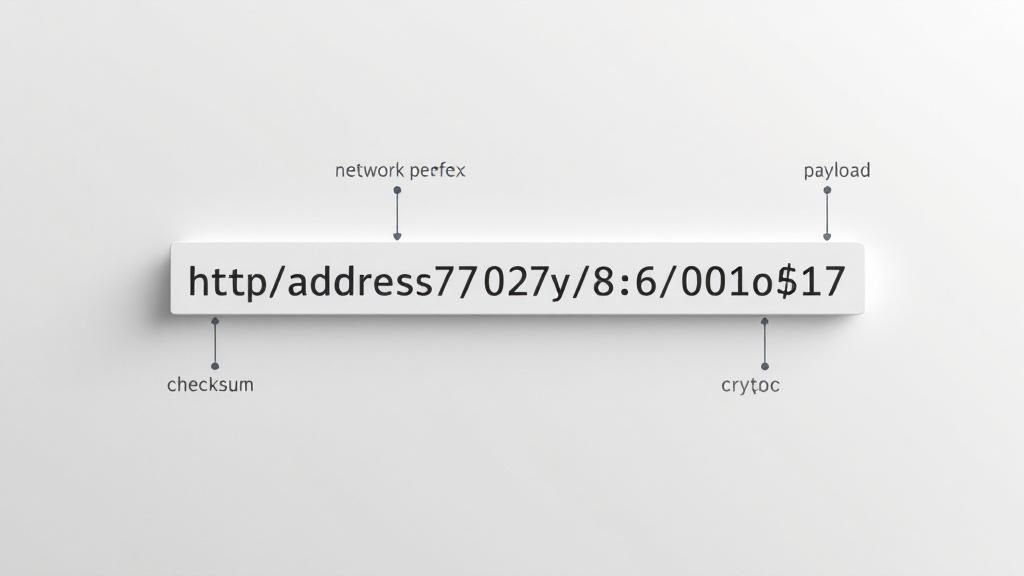
A crypto address might look like a random jumble of letters and numbers, but it’s anything but. It's the final link in a brilliant, one-way cryptographic chain that starts with a single, powerful secret: your private key.
The whole process is designed to let you publicly share your address while keeping the key that actually controls your funds completely locked down and hidden.
Think of it this way: your crypto address is like your bank account number. You can give it to anyone who needs to send you money. Your private key, however, is like the secret PIN and password that gives you—and only you—access to that account. People can deposit funds, but they can't make withdrawals.
This journey from total secrecy to a public identifier is what makes the whole system work. It’s why you can post your address on a website or send it in a message without a second thought.
The Journey from Private Key to Public Address
The magic behind this is something called public-key cryptography. It’s a system built on a pair of mathematically linked keys: one you keep secret (private) and one you can share (public). Don't worry, you don't need to be a math whiz—your crypto wallet handles all the heavy lifting for you.
Here’s a breakdown of how your wallet takes you from a secret key to a shareable address in three key steps.
The Private Key Is Born: This is the big bang moment for your crypto wallet. It generates a very long, totally random number that acts as your master key. This private key is the most critical piece of information you will ever own in crypto. It must never be shared with anyone, for any reason.
The Public Key Is Derived: Using some seriously clever math, your wallet then derives a public key directly from your private key. The crucial part? This is a one-way street. It's virtually impossible to work backward to figure out the private key from the public one. This is a core security feature.
Hashing to Create the Final Address: The public key then goes through one final transformation called "hashing." This process condenses it into the shorter, more user-friendly string of characters you see as your crypto address. It’s this address you’ll share to get paid.
You can often tell which blockchain an address belongs to just by looking at it. For example, older Bitcoin addresses often start with a "1" or "3", while newer ones start with "bc1". An Ethereum address almost always starts with "0x".
The entire process is deliberately designed to be irreversible. You can easily create a public key from a private key and an address from a public key, but you can never go backward. This one-way function is the heart of crypto security.
This multi-step system creates powerful layers of protection. Even if someone somehow got their hands on your public key (which is rarely used directly anyway), they still couldn't reverse-engineer your private key. The final hashing step adds yet another wall of security, keeping your digital assets safe and sound on the blockchain.
Why Not All Crypto Addresses Are the Same
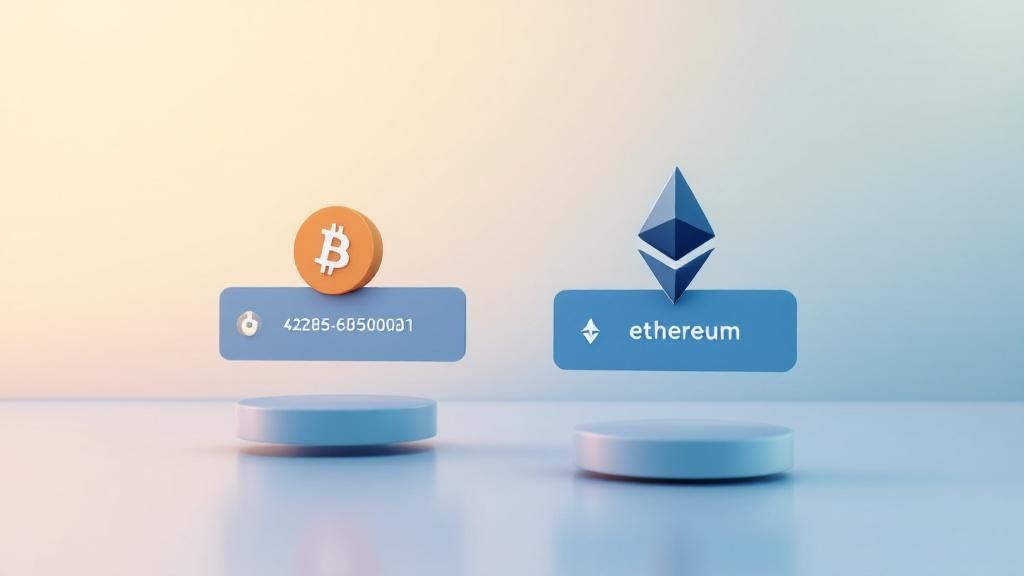
Here’s a costly mistake a lot of newcomers make: assuming any crypto address can receive any type of crypto. Think of it like this: you can't send a letter to a FedEx shipping center using a UPS tracking number. It just won't work. Each blockchain has its own unique "postal system" and address format.
Sending your Bitcoin (BTC) to an Ethereum (ETH) address is a one-way ticket to losing your funds forever. The networks simply don't speak the same language, and there’s no "return to sender" button. Getting a handle on these differences is non-negotiable for navigating the crypto world safely.
Recognizing Different Address Formats
You can often tell which blockchain an address belongs to just by looking at its first few characters. Each network has its own signature, much like how different countries have unique postal codes. This simple check can be your first line of defense against sending crypto into the void.
Here are a few of the most common formats you'll run into:
- Bitcoin (BTC): Addresses on the original blockchain typically start with a
1, a3, orbc1. Thatbc1prefix is a tell-tale sign of a newer, more efficient address type called SegWit. - Ethereum (ETH): Nearly all Ethereum addresses, along with those on compatible networks like Polygon and Avalanche, begin with
0x. This prefix just signals that the address is in hexadecimal format. - TRON (TRX): Addresses on the TRON network are easy to spot. They almost always start with a capital
T.
This visual difference is your first clue that you're working within a specific ecosystem. You always need to confirm you’re using the right address type for the coin you're sending or receiving.
Think of it like this: your Bitcoin address is your BTC-specific bank account number, and your Ethereum address is your ETH-specific account number. They are not interchangeable and are managed by entirely separate banking systems (blockchains).
A Tale of Two Chains: Address Formats Compared
To make this crystal clear, let's break down the key differences between the major players. Each one is built for a specific purpose, and their address formats reflect that.
| Blockchain | Example Address Prefix | Primary Use Case |
|---|---|---|
| Bitcoin | 1, 3, or bc1 |
Secure, decentralized peer-to-peer cash system |
| Ethereum | 0x |
Smart contracts and decentralized applications |
| TRON | T |
High-throughput content sharing and dApps |
As you can see, the prefix is a dead giveaway. Bitcoin's formats have evolved for efficiency and security, while Ethereum's 0x standard is all about its smart contract functionality. TRON's T is designed for its high-volume ecosystem. Knowing these little details can save you a world of trouble.
Why Address Activity Matters
The number of active crypto addresses on any given day offers a fascinating glimpse into a network's real-world usage. For example, Bitcoin averages nearly 887,000 daily active addresses. But that's not the whole story.
Other networks have seen even more on-chain activity. TRON, for instance, reported about 2.9 million active addresses daily—blowing past Bitcoin in that metric. This shows that while Bitcoin is the undisputed king, networks built for high-speed applications like dApps can rack up a huge volume of daily address interactions. You can dig into more insights about crypto user counts and see how the different networks stack up.
The main takeaway here is that each blockchain is its own self-contained universe. The assets, rules, and addresses from one can't just be ported over to another without a special kind of bridge. So, before you ever hit "send," always double-check that the recipient's address matches the exact cryptocurrency you're sending. This simple habit will save you from irreversible mistakes and make sure your funds land where they're supposed to.
Best Practices for Managing Your Addresses
In the world of crypto, you are your own bank. That freedom is powerful, but it comes with the serious responsibility of protecting your own money. It all boils down to how you manage your crypto addresses and, more importantly, the private keys that control them.
Think of your private keys like the keys to your house. You wouldn't just leave them lying around for anyone to find. Simple habits, like always double-checking an address before sending funds, can be the difference between a successful transaction and a devastating, irreversible loss. One wrong character could send your crypto into a digital black hole, gone forever.
Choosing the Right Wallet
Your wallet is your first line of defense. They generally fall into two categories: hot and cold.
- Hot Wallets: These are software-based wallets connected to the internet, like mobile apps or browser extensions. They’re great for everyday spending and small, frequent transactions but are naturally more exposed to online threats.
- Cold Wallets: These are physical hardware devices that keep your private keys completely offline. They offer the best security for holding larger amounts of crypto for the long term, since they're isolated from internet-based attacks.
The crypto community's choices reflect these trade-offs. Hot wallets are incredibly popular, making up a whopping 78% of all wallets simply because they're so easy to use. Cold wallets, the preferred choice for serious investors, account for the other 22%.
Interestingly, a clear majority of users (59%) choose non-custodial wallets, where they hold their own keys. This shows a strong desire for self-sovereignty, yet general confidence in crypto security is still shaky, with only about 7% of informed adults feeling very confident. You can dig into more crypto wallet adoption trends to see how the landscape is shifting.
Essential Security Habits
Beyond your choice of wallet, it's your daily habits that truly keep your assets safe. Consistently applying a few key rules will dramatically lower your risk of falling for a scam or making a costly mistake.
Your security is only as strong as your weakest habit. In crypto, vigilance isn't optional—it's a requirement for protecting your funds from common threats like phishing and user error.
Building these practices into your routine will create a strong security foundation:
- Verify Addresses Meticulously: Always copy and paste addresses. Before you hit send, check the first and last four characters to make sure they match perfectly. Don't get lazy on this step.
- Avoid Address Reuse for Privacy: While you can reuse an address, generating a fresh one for every transaction is a smart move for privacy. It stops people from easily connecting the dots and tracking all your financial activity on the public blockchain.
- Beware of Phishing Scams: Never, ever click on suspicious links or enter your private key or seed phrase on any website. Scammers are experts at creating fake sites or emails that look like legitimate exchanges to trick you into giving them the keys to your crypto.
- Secure Your Seed Phrase Offline: This is non-negotiable. Write down your wallet's seed phrase—your master recovery key—and store it in a secure, physical place. Never save it on a computer or in a cloud service where it could be hacked.
By making these strategies second nature, you can manage your crypto addresses with confidence and protect your digital wealth from the most common and preventable risks.
Putting Crypto Addresses to Work for Your Business
So, what does all this mean for your business? It’s simple: understanding crypto addresses isn’t just for personal use. It's about opening a door to a global market of tech-savvy customers and seriously streamlining how you get paid.
Of course, the idea of manually generating and tracking a unique crypto address for every single order sounds like a nightmare. The good news? You don't have to. Payment platforms like Flash are built to handle all the heavy lifting, making it ridiculously easy to accept Bitcoin without needing a degree in computer science.
These systems work in the background, automatically creating a fresh crypto address for each customer's checkout. This keeps your books clean and easy to track, but it also adds a layer of privacy for both you and your customers.
The Core Benefits for Merchants
Moving to a crypto-friendly payment system isn't just about adding another logo to your checkout page. It's a fundamental upgrade over the old-school financial rails, one that can directly impact your cash flow and cut down on operational headaches.
Here’s where it gets interesting:
- Lower Transaction Fees: You know the drill. Credit card companies skim anywhere from 1.5% to 3.5% off every single sale. Bitcoin network fees are often a fraction of that, especially on larger payments. That’s more money that stays right where it belongs: in your pocket.
- Instant Settlement: Forget waiting days for a bank transfer or card payment to clear. Bitcoin transactions are settled directly on the blockchain, fast. This means you get access to your funds almost immediately, which is a game-changer for any business's cash flow.
- No Chargeback Fraud: This one is huge. Crypto transactions are final. Once a payment is confirmed, it can't be reversed by the sender. This completely wipes out the costly and frustrating problem of chargeback fraud that plagues so many online businesses.
For a business, a crypto address acts as a direct, peer-to-peer payment gateway. It removes intermediaries, reduces costs, and provides a secure and efficient way to transact with customers anywhere in the world.
Integrating a solution like Flash lets you get up and running with Bitcoin payments in less than a minute. Whether you use simple payment links or a point-of-sale app, you can start accepting crypto without touching a single line of code. It's a straightforward way to connect with a growing global user base while keeping full control over your funds through direct wallet-to-wallet transactions.
Common Questions About Crypto Addresses
Even after getting the hang of how crypto addresses work, a few practical questions almost always come up. Let's tackle some of the most common points of confusion so you can manage your digital assets with total confidence.
Can I Reuse a Crypto Address?
Technically, yes, you absolutely can. A single crypto address can receive funds over and over again. But just because you can doesn't mean you should.
From a privacy standpoint, it’s a much better practice not to. Reusing the same address links all of your transactions together on the public blockchain. This creates a breadcrumb trail that makes it surprisingly easy for anyone to analyze your entire financial history, track your balance, and see who you've been transacting with.
Think of it like using one email address for everything versus using different disposable emails for different online services. One is convenient, sure, but the other offers far more privacy and keeps things separate.
To maintain your financial privacy on a transparent ledger, most modern wallets are designed to automatically generate a fresh address for you after each transaction. It's a simple but powerful feature.
What Happens If I Send Crypto to the Wrong Address?
This is probably one of the most critical things to understand in all of crypto: transactions are almost always irreversible. If you send funds to an incorrect or non-existent address, that crypto is likely gone for good. There's no bank or central authority you can call to reverse the charge.
The same goes for sending a specific coin to an address on a different blockchain. For example, sending Bitcoin (BTC) to an Ethereum (ETH) address will cause those funds to vanish into the digital ether. This is why it’s so important to build a few safety habits every single time you send crypto.
- Always Double-Check: Carefully verify the first and last four characters of the recipient's address before hitting "confirm."
- Confirm the Network: Make sure you're sending to an address on the correct blockchain for that specific asset.
- Send a Small Test Amount: For any large or important transaction, send a tiny amount first. Once the other person confirms they got it, you can send the rest without sweating.
These simple steps are your best defense against making a very permanent mistake.
Is My Wallet the Same as My Address?
Nope, they're different but work together closely. Your crypto wallet is the software or hardware that acts like a secure digital keychain, storing all your private keys. It’s the tool you use to manage your funds.
A crypto address, on the other hand, is like a single account number that your wallet generates. One wallet can create and manage thousands of different addresses across various cryptocurrencies. This lets you have separate, unique addresses for receiving payments from different people or for different purposes, all while keeping them organized in one secure place.
Ready to accept Bitcoin payments at your business without the technical headaches? With Flash, you can start accepting secure, wallet-to-wallet payments in under a minute. Learn more and get started today!