When you hear "digital wallet," it's easy to picture a digital version of the leather billfold in your back pocket. But for Bitcoin, that's not quite right. A digital wallet doesn't physically hold your bitcoin. Instead, it securely stores the secret keys you need to access and spend your funds on the blockchain.
Understanding Your First Digital Wallet
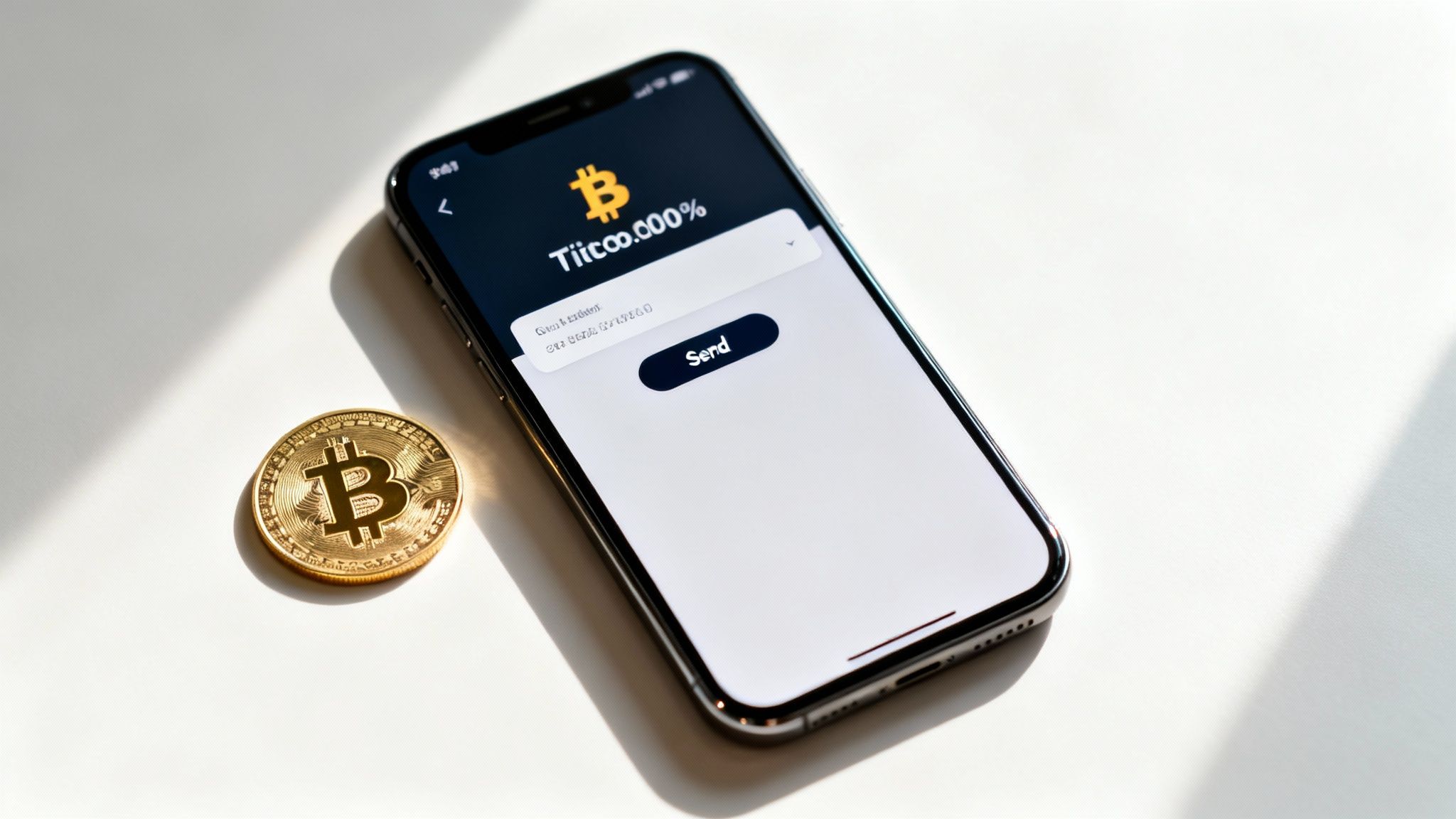
Think of a digital wallet less like a container and more like a special kind of keychain for your digital life. This keychain holds the cryptographic keys—a public key and a private key—that are the engine behind every Bitcoin transaction.
The private key is the single most important piece of the puzzle. It’s a secret code that digitally "signs" any transaction, proving you're the rightful owner of the bitcoin you want to send.
If your public key is like your bank account number (safe to share), then your private key is your password, PIN, and signature all rolled into one. You should never share it with anyone, ever.
A digital wallet for Bitcoin empowers you to be your own bank. It grants you direct control over your assets without needing permission from any third party, embodying the core principle of financial sovereignty.
This model of self-custody is what truly sets Bitcoin wallets apart from the banking apps on your phone. Instead of trusting a financial institution to manage your money for you, you are in complete control.
Why Digital Wallets Are Essential
Simply put, without a wallet, you can't interact with the Bitcoin network. It’s the fundamental tool that lets you perform the three most basic actions:
- Receive Bitcoin from others using your public address.
- Send Bitcoin to anyone, anywhere in the world.
- Check your balance by looking at the public ledger (the blockchain).
The growing importance of these tools is obvious when you look at the numbers. The global value of digital wallet transactions recently soared past an incredible $10 trillion. And that’s not slowing down—projections suggest this figure could climb by 70% to over $17 trillion in the next five years. You can find more details on these digital wallet statistics and their growth.
This massive shift highlights a simple truth: as more and more people seek genuine control over their finances, understanding what a digital wallet is becomes the first real step into a new, decentralized economy.
How a Bitcoin Wallet Actually Works
To really get what a digital wallet is, we need to pop the hood and look at the engine. The heart of any Bitcoin wallet isn't fancy software or a physical device—it's a pair of mathematically linked keys that are designed to work together: a public key and a private key. This dynamic duo is the entire secret to receiving, holding, and sending your bitcoin.
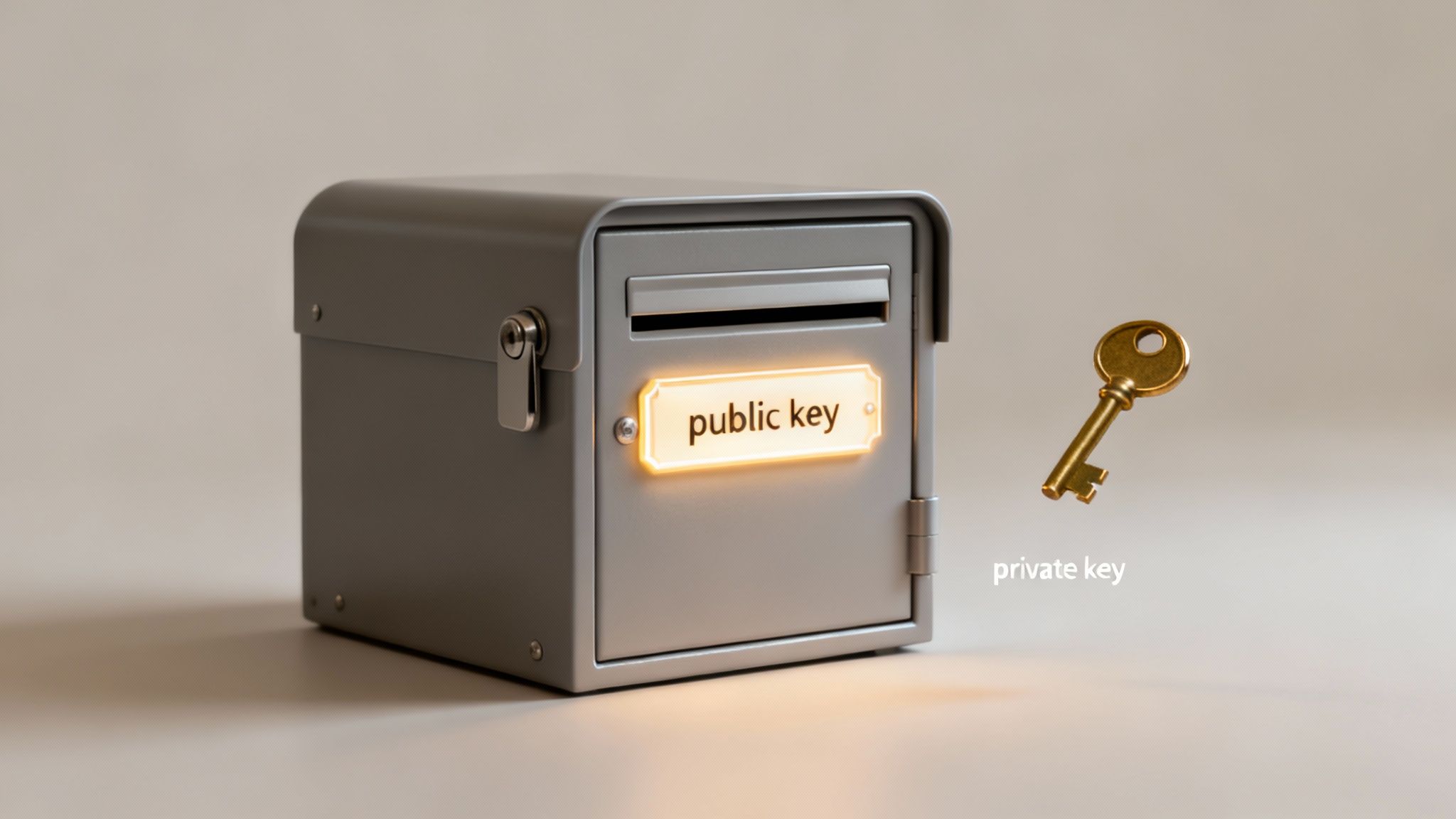
Think of it like a high-tech, transparent mailbox. Your public key is used to generate a receiving address, which is basically the mailing address on your box. You can—and should—share this public address with anyone who wants to send you bitcoin. They don't need your permission; they just need the address to drop the funds in.
But here's the crucial part: your private key is the only thing that can unlock that mailbox. It's a secret bit of data that proves you own the bitcoin associated with your public address. If you lose that key, the mailbox stays locked forever, and whatever is inside is gone for good. This simple but powerful cryptographic relationship is what makes Bitcoin so secure.
The Role of Your Private Key
Let’s be clear: your private key is the single most important piece of information you own in the Bitcoin world. It’s your master key to everything. When you decide to send bitcoin to someone, your wallet software uses your private key to create a unique digital signature for that transaction.
This signature does two critical jobs:
- It proves ownership: It broadcasts to the entire Bitcoin network that you are the rightful owner of the funds and have the authority to spend them.
- It makes the transaction tamper-proof: Once signed, the transaction details—like the amount and the recipient's address—are sealed. Nobody can alter them after the fact.
Because this key is so powerful, protecting it is everything. Seriously. If you lose it, your bitcoin is permanently gone. There’s no customer support line to call or a "forgot my password" link to click.
The core idea behind self-custody in Bitcoin is dead simple: Whoever holds the private key, holds the bitcoin. If you don't control your private key, you are just trusting someone else to hold your money for you.
From Keys to a Usable Wallet
So, how do we go from these complex keys to an app on our phone? Your digital wallet software is the bridge. It handles all the heavy lifting behind the scenes. It generates and securely stores your private key, creates public addresses for you to receive funds, and manages the technical process of signing and broadcasting transactions.
What this means is that even though the cryptography underneath is incredibly complex, the experience for you, the user, is usually pretty simple. Your wallet provides a clean interface that shows your balance and lets you send or receive bitcoin without ever having to see or handle the raw keys themselves. It’s this smart design that makes a powerful system like Bitcoin feel as easy to use as any modern banking app.
Custodial vs Non-Custodial Wallets
Once you decide to get a Bitcoin wallet, you’ll immediately face a crucial choice: custodial or non-custodial? It's the first real fork in the road on your Bitcoin journey, and your decision boils down to one simple, yet profound, question: who holds the keys?
Your answer to this question will define the balance between convenience, control, and personal responsibility you have over your money.
Custodial: The Bank Analogy
Think of a custodial wallet as being like your regular bank account. When you use one, which is common with large Bitcoin exchanges, you're essentially trusting a third party to manage your private keys for you. For many newcomers, this feels familiar and less intimidating, as it removes the burden of securing those keys yourself.
But this convenience comes with a major trade-off. Because that company holds your keys, they have the ultimate say over your funds. This reality is perfectly captured by the most important maxim in Bitcoin: "Not your keys, not your coins."
Non-Custodial: The Personal Safe Analogy
A non-custodial wallet, on the other hand, is like owning a personal safe in your home. With this setup, you—and only you—are in possession of the private keys. This grants you absolute, direct control over your Bitcoin. It's a concept we call self-sovereignty.
When you're in control, no company can freeze your account, block your transactions, or lose your funds in a data breach. You truly become your own bank, with all the freedom and responsibility that comes with it. The flip side? If you lose your keys or your backup phrase, there's no customer support line to call. No one can help you get them back.
Choosing a non-custodial wallet means you take full ownership of your financial security. While it demands more responsibility, it's the only way to truly experience the core promise of Bitcoin—complete control over your own money.
To really hammer home the differences, let's break it down in a table.
Custodial vs Non-Custodial Wallet Comparison
This side-by-side comparison should make the distinction crystal clear. On one side, you have the familiar "bank" model, and on the other, the "personal safe" model that puts you in complete charge.
| Feature | Custodial Wallet (Like a Bank) | Non-Custodial Wallet (Like a Personal Safe) |
|---|---|---|
| Private Keys | Held by a third party (e.g., an exchange). | Held exclusively by you, the user. |
| Control | The custodian has final say over your funds. | You have 100% control over your funds at all times. |
| Security | You trust the company's security measures. | You are solely responsible for securing your keys. |
| Accessibility | Often simpler to set up and recover a password. | Requires careful backup of your seed phrase. |
| Best For | Beginners getting started or traders on an exchange. | Anyone prioritizing security and self-sovereignty. |
Ultimately, grasping this fundamental distinction is central to understanding what a digital wallet really is. For anyone who truly values security, ownership, and financial freedom, a non-custodial wallet is the undisputed choice. It aligns perfectly with the foundational principles of Bitcoin and puts you firmly in the driver's seat of your financial future.
Choosing Between Hot and Cold Wallets
Once you've decided who holds your keys, the next big question is about how your wallet connects to the internet. This is a crucial distinction that splits wallets into two main camps—hot and cold. Getting this right is all about balancing everyday convenience with serious, long-term security. The best choice really just depends on what you plan to do with your Bitcoin.
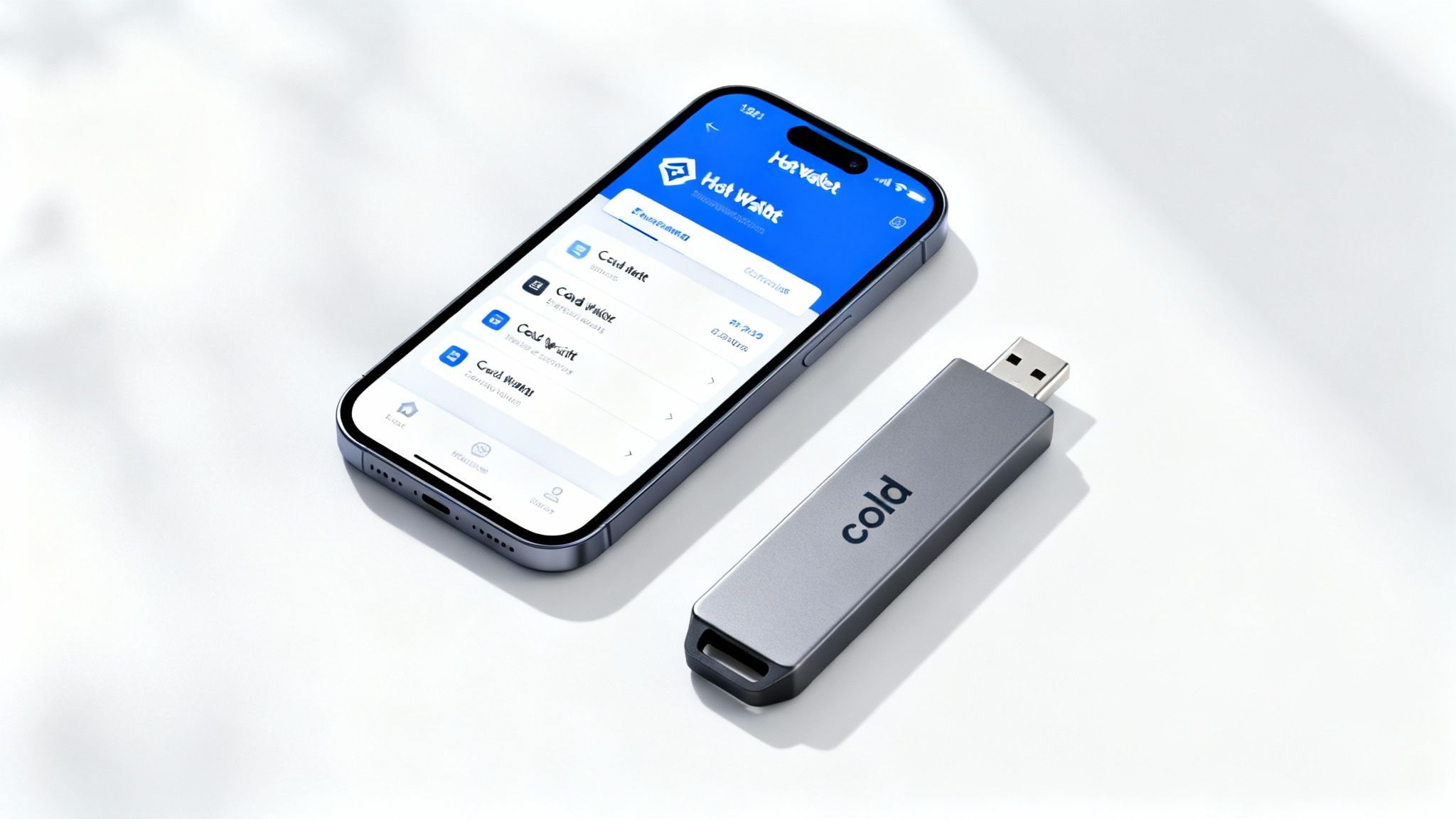
A hot wallet is any wallet that lives on a device connected to the internet, like your phone or computer. The easiest way to think about it is like your checking account. It’s designed for easy access and is perfect for making smaller, more frequent transactions.
Because it’s always online, a hot wallet is incredibly convenient. You can send or receive Bitcoin in seconds, making it the perfect tool for daily life—think buying a coffee or paying for an online subscription. This grab-and-go accessibility is why they're so popular.
The Case for Cold Wallets
At the other end of the spectrum, you have the cold wallet. This is usually a physical piece of hardware, a bit like a specialized USB drive, that keeps your private keys completely offline. Think of this as your personal savings vault, built for one thing: maximum security.
A cold wallet only connects to the internet when you physically plug it in and approve a transaction. This "air gap" creates a powerful shield against online threats like malware, viruses, and hacking attempts. It’s why cold storage is considered the gold standard for locking down larger amounts of Bitcoin you don't plan on touching anytime soon.
A common and highly recommended strategy is to use both types of wallets in tandem. Use a hot wallet for your "spending" money and a cold wallet for your "savings," giving you the perfect blend of accessibility and robust security.
This two-wallet approach lets you enjoy the speed of a hot wallet for daily commerce while your long-term holdings stay safe and sound in deep storage. Digital wallets aren't just for individuals, either; they're fundamentally changing how businesses operate, especially online. In the U.S., digital wallets are already a major force in e-commerce and are on track to handle most online transactions soon. This trend shows just how important it is for everyone, from individuals to merchants, to understand these wallet types. You can dig deeper into the rise of digital wallets in e-commerce.
Comparing Your Options
So, which wallet is right for you? It all comes down to your personal security habits and how you plan to use your Bitcoin. Here’s a quick breakdown to help you decide:
- For Daily Transactions: A hot wallet on your phone offers unmatched speed and convenience for everyday payments.
- For Long-Term Holding: A cold hardware wallet provides the highest level of security for funds you want to protect for the future.
- For a Balanced Approach: Using both gives you the flexibility to spend easily while keeping the bulk of your assets secure.
By understanding the distinct roles of hot and cold wallets, you can build a setup that fits your needs perfectly, protecting both your funds and your peace of mind.
Essential Security Practices for Your Wallet

Getting your head around what a digital wallet is and how it works is only half the battle. The real work begins with securing it—and that responsibility falls squarely on your shoulders.
Everything starts with one critical element: your seed phrase. This is a list of 12 or 24 simple words that acts as the master key to your entire wallet. Think of it as the ultimate backup.
If your phone gets stolen, your laptop dies, or you smash your hardware wallet, this phrase is the only way to get your Bitcoin back on a new device. It has the power to regenerate every single one of your private keys.
Guarding Your Master Key
Because your seed phrase is so powerful, how you store it is everything. The rules are simple but non-negotiable if you're serious about keeping your funds safe.
Here are the absolute must-dos:
- Write It Down on Paper: The old-school way is the best way. Use a pen and paper. Some people even etch their phrase onto metal plates to make it fireproof and waterproof.
- Never Store It Digitally: Don't even think about taking a screenshot, saving it in a note app, emailing it to yourself, or uploading it to cloud storage. Any digital copy is a sitting duck for hackers.
- Keep It Offline: Once generated, that phrase should never, ever touch a device connected to the internet.
Your seed phrase is the single point of failure in your Bitcoin security. Treat it like a treasure map where X marks the spot for all of your funds—because that's exactly what it is.
Once you’ve written it down, find a secure, private place to hide it. A common strategy is to make two or three physical copies and store them in different safe locations, like a home safe and a bank's safety deposit box.
Everyday Security Habits
Beyond protecting your seed phrase, a few simple daily habits can make a huge difference in your wallet's security.
First off, always use a strong, unique password or PIN to lock the wallet app itself. This is your first line of defense if someone gets physical access to your device.
Second, be relentlessly paranoid about phishing scams. Scammers are experts at creating fake websites or sending emails that look like they’re from your wallet provider, all to trick you into giving up your seed phrase. Always double-check URLs and never, ever enter your secret words on a site you don't trust 100%.
Finally, before you send any Bitcoin, triple-check the recipient's address. One tiny typo could send your funds into a black hole. Bitcoin transactions are irreversible, so if it goes to the wrong person, it's gone for good. These simple practices are what turn your digital wallet into a fortress.
Putting Your Bitcoin Wallet to Work
Think of your Bitcoin wallet as more than just a digital safe. It’s not just a place to stash your funds; it’s a dynamic tool you can use for real-world transactions. This is where the theory hits the road, especially for businesses looking to open their doors to a new form of payment. A non-custodial wallet, in particular, can become a powerful engine for your entire commercial operation.
When merchants pair their wallet with a modern payment solution like Flash, they can start accepting Bitcoin directly. The best part? The funds go straight into a wallet they control. This completely cuts out the middleman, meaning no third-party processor ever touches the money.
Instead of twiddling your thumbs waiting days for a bank settlement, payments land almost instantly, from your customer’s wallet to yours. This direct model is a game-changer for merchants. It vaporizes costly processing fees and removes the risk of a third party unexpectedly freezing your account. Just like that, a simple storage tool transforms into a driver for business growth.
Integrating Wallets Into Your Business
The practical power of a digital wallet in a business setting is hard to overstate. It creates a direct, peer-to-peer link between you and your customers, making the entire payment dance incredibly smooth.
For merchants, accepting Bitcoin directly into a non-custodial wallet is more than just adding a new payment option. It's a strategic move toward financial self-sovereignty, cutting dependence on traditional banking systems and all their associated costs.
The momentum behind this technology is massive. Global digital wallet spending is on track to hit tens of trillions of dollars. Right here in the U.S., mobile payment transactions are projected to blow past $1 trillion, a clear sign of just how hungry people are for faster, more secure ways to pay. You can learn more about the strategic implications of the digital wallet revolution to see just how big this shift is.
Of course, as you start using your wallet for more and more Bitcoin transactions, you’ll need to keep an eye on the tax side of things. To make reporting a breeze, you might want to compare various crypto tax software. Staying organized from day one is the key to smoothly integrating this tech into your operations.
Got More Questions About Digital Wallets?
Even after getting the basics down, it's totally normal to have a few more questions rattling around. What if I lose my phone? How many wallets should I even have?
Let's tackle some of the most common queries people have. Getting these answers straight will help you feel much more confident as you navigate the world of Bitcoin.
Can I Have Multiple Bitcoin Wallets?
Not only can you, but you absolutely should. In fact, it's a security practice that pretty much every seasoned Bitcoin user follows.
Think of it this way: you wouldn't walk around with your entire life savings in your pocket, would you? You can apply the same logic to your bitcoin.
Many people use a mobile "hot wallet" on their smartphone for small, everyday transactions—like carrying a bit of cash. For their larger, long-term holdings, they use a hardware "cold wallet" that stays safely offline. This strategy is smart because it limits your risk. If something ever happens to your daily-use wallet, the bulk of your funds remain completely untouched and secure.
What Happens If I Lose My Wallet Device?
This is probably the biggest fear for newcomers, but here's the good news: if you're using a non-custodial wallet and have safely backed up your 12 or 24-word seed phrase, you have absolutely nothing to worry about.
That string of words is the master key that unlocks your funds on the blockchain itself.
Your phone can break, get stolen, or fall into a lake. Your hardware wallet could get lost. It doesn't matter. As long as you have that seed phrase, you can simply restore your entire wallet—and all your funds—on a brand new device.
This is why we say it over and over: protecting that phrase is the single most important thing you can do to secure your Bitcoin. It's the ultimate safety net, giving you true control.
Do I Need a Personal Wallet to Buy Bitcoin?
Not right at the very beginning. When you first buy Bitcoin on an exchange, your new coins are held in a custodial wallet provided and controlled by that platform. This is a simple, common starting point for most people.
However—and this is a big "however"—you should make it a priority to move your Bitcoin from the exchange to your own personal, non-custodial wallet as soon as you can.
Taking this step is what moves you from just owning Bitcoin to truly controlling it. It’s the final, crucial move to ensure your assets are yours and yours alone, with no third party standing in the way.
Ready to put your digital wallet to work? With Flash, you can accept Bitcoin payments directly into the wallet you control, cutting out the middlemen and their hefty fees. Start accepting instant, secure Bitcoin payments in under a minute. Get started with Flash today.