Think of a bank safe that needs two different keys, held by two different people, to open it. A single key is totally useless. That’s the simple, yet incredibly powerful, idea behind a multisig wallet.
Instead of one private key holding the fate of your Bitcoin, a multisig (or multi-signature) wallet requires multiple unique keys to sign off on any transaction. This simple change fundamentally transforms its security.
So, How Does a Multisig Wallet Actually Work?
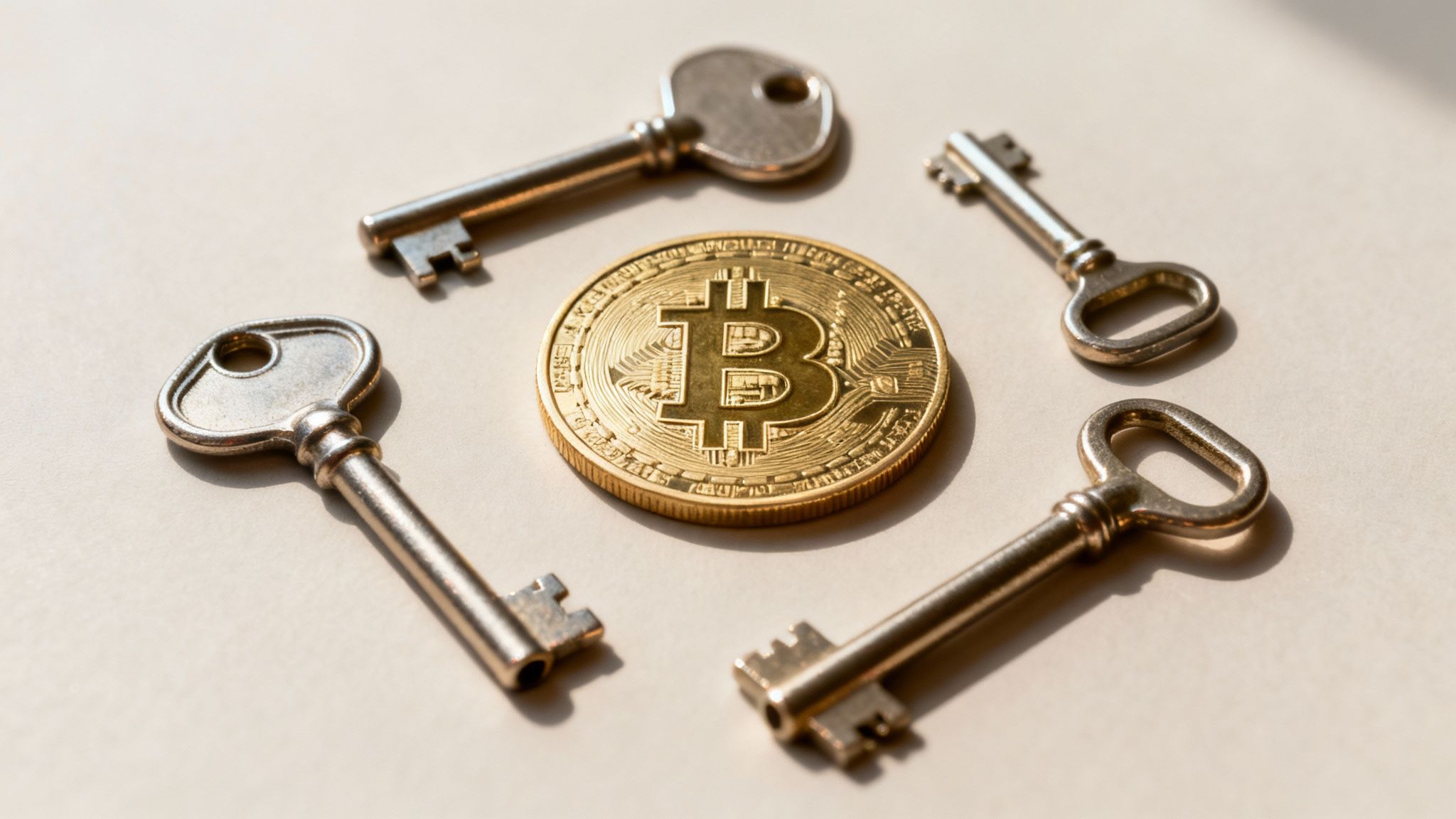
At its heart, a multisig wallet gets rid of the terrifying risk that comes with a single point of failure. With a regular Bitcoin wallet, if your one private key is lost, stolen, or compromised, your funds are just... gone. Forever. There's no customer support line to call for a password reset.
A multisig wallet spreads that power—and risk—around. It’s all based on a concept called "M-of-N," where 'N' is the total number of keys the wallet has, and 'M' is the minimum number of keys needed to approve a transaction.
The Power of M-of-N Setups
The most common arrangement you'll see is a 2-of-3 setup. In this scenario, three separate private keys are generated. To move any Bitcoin, at least two of those three keys must provide their digital signature.
This means that even if a hacker nabs one of your keys, or you accidentally lose one, your funds are still perfectly safe. It’s a huge leap forward in securing digital assets.
In fact, the security boost is massive—multisig setups can slash unauthorized access risks by over 60% compared to their single-key counterparts. With a 2-of-3 wallet, you can give the three keys to different people or store them in separate, secure locations, knowing that only two are ever needed to get a transaction on the blockchain. Industry experts at Ledger have written extensively on these security benefits.
A multisig wallet isn't just another piece of software; it's a structural upgrade to how you control your Bitcoin. It swaps the vulnerability of a single key for a system of shared, verifiable authorization.
This shared control is a powerful defense against all sorts of threats. It's an essential tool for anyone serious about protecting their Bitcoin, whether it's for personal savings or managing a business treasury. You're essentially building multiple layers of security right into your Bitcoin address.
Single-Signature vs. Multisig Wallet at a Glance
To put it all in perspective, here's a quick breakdown of how a standard wallet stacks up against a multisig setup.
| Feature | Single-Signature Wallet | Multisig Wallet |
|---|---|---|
| Security Model | Single point of failure; one key controls everything. | Distributed trust; requires multiple keys (M-of-N) to sign a transaction. |
| Control | One person has absolute control. | Shared control among multiple parties or devices. |
| Recovery | If the single key is lost, funds are likely gone. | Resilient; loss of one key (in a 2-of-3 setup, for example) doesn't mean loss of funds. |
| Complexity | Very simple to set up and use. | More complex to set up and manage transactions. |
| Ideal Use Case | Small, everyday spending; personal hot wallets. | Securing large funds, company treasuries, escrow services, joint accounts. |
| Vulnerability | High risk from theft, loss, or a single compromised device. | Low risk; an attacker would need to compromise multiple keys/devices. |
As you can see, the choice isn't about which is "better" overall, but which is right for your specific needs. For pocket money, a single-sig wallet is fine. For your life savings or a business treasury? That's where multisig truly shines.
How Multisig Technology Actually Works
To really get what a multisig wallet is, you have to pop the hood and see how the engine runs. It's not magic—it’s just a really clever use of Bitcoin’s built-in scripting features. The whole process kicks off not with a single key, but with a collective agreement between several keys.
Instead of creating a standard Bitcoin address from a single public key, a multisig wallet generates a special kind of address from a group of public keys. This address is fundamentally different because it comes with a unique rulebook attached, and the Bitcoin network itself is the enforcer.
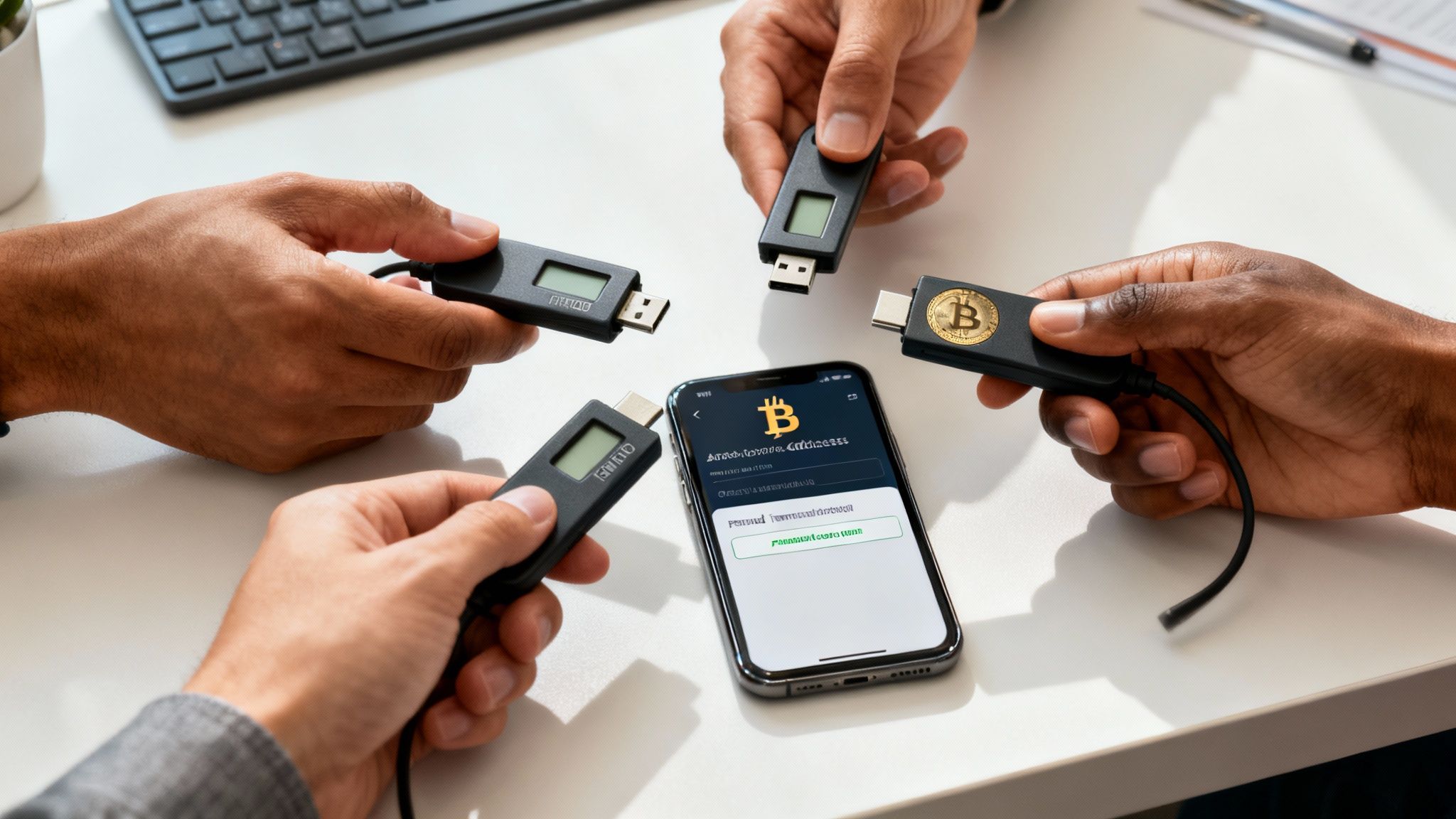
This all works thanks to a feature called Pay-to-Script-Hash (P2SH). Think of P2SH like a digital safe where the key isn't a single item but a set of conditions that must be met. The "script" inside this safe lays down the law—for instance, "two out of these three specific signatures are required to open this."
When you send Bitcoin to a multisig address, you're not sending it to one person's device. You're locking it into this on-chain agreement, and it can only be unlocked when the people with the right keys follow the rules.
The M-of-N Framework Explained
The heart and soul of multisig is the M-of-N framework. This is just a simple way of defining the security rules for the wallet, and it's incredibly flexible. Let's break down the most common setups you'll see in the wild.
2-of-3 Setup (The Partnership Model): This is probably the most popular configuration out there. You have three keys, but you only need any two of them to sign off on a transaction. It’s perfect for a two-person business partnership, or for an individual who keeps one key on their laptop, another on a hardware wallet, and a third backup in a safe deposit box.
3-of-5 Setup (The Corporate Treasury): For bigger organizations, a 3-of-5 setup adds more security and distributes control even further. Picture a board with five executives. A payment might need approval from the CEO, CFO, and COO to go through. This structure ensures no single exec can move funds alone and provides a safety net if a few keyholders are traveling or unavailable.
A multisig wallet is like a corporate bank account that requires multiple signatories on a check. The difference is that the rules are enforced by cryptographic proof on the Bitcoin network, not by a bank teller.
This structure makes your funds resilient. A single lost or stolen key is no longer a catastrophe; it’s just an inconvenience.
The Transaction Signing Process
So, what does it actually look like to spend from a multisig wallet? It’s a bit more involved than the one-click approval you get with a standard wallet, and that’s by design.
Creating the Transaction: First, one of the keyholders has to kick things off. They create a transaction proposal by entering the recipient's address and the amount. At this stage, it’s just a draft—it’s not yet valid and can’t be sent to the network.
Gathering Signatures: Next, this unsigned transaction is shared with the other keyholders. Each required signer uses their private key to add their cryptographic signature. This can be done by passing a file back and forth, scanning a QR code, or using a service that coordinates the whole process.
Broadcasting the Transaction: Once the minimum number of signatures (the 'M' in M-of-N) is on the transaction, it's officially valid. Now, any one of the signers can broadcast the completed transaction to the Bitcoin network for confirmation.
This multi-step dance ensures that every payment is deliberately reviewed and approved by the right people. It introduces a powerful layer of checks and balances, completely changing how digital assets can be managed and secured.
Security vs. Usability: The Multisig Trade-Off
While multisig offers a massive leap in security, it's not a free lunch. There's a fundamental trade-off at play: you gain incredible protection against theft and loss, but you take on more operational complexity. Getting your head around this balance is the first step to figuring out if multisig is right for you.
The security upside is undeniable. Multisig eliminates the catastrophic risk of a single compromised key. With a standard wallet, if a hacker gets your private key or you lose your backup phrase, it's game over. Your funds are gone. Forever. But with a 2-of-3 multisig, losing one key is just an inconvenience, not a complete disaster.
This built-in redundancy protects you from all sorts of threats. Whether it's malware sniffing for keys on your computer or someone physically stealing your laptop, the layered defense of multisig ensures a single breach doesn't mean you lose everything.
The Extra Responsibility of Multiple Keys
On the other side of that coin is usability. The very thing that makes multisig so secure—needing multiple approvals—also makes it more cumbersome. You can't just click "send" anymore.
Setting up the wallet, backing up several keys in different secure locations, and coordinating signatures for every single transaction requires a lot more thought and planning. It’s a deliberate process that adds a bit of friction, making it less ideal for your daily coffee purchase but perfect for safeguarding your life savings.
The core trade-off of a multisig wallet is exchanging speed and simplicity for immense security and resilience. It shifts your mindset from simply using Bitcoin to actively managing a security protocol.
And here's a crucial point: a poorly managed multisig can actually create new risks. The biggest danger is losing enough keys to fall below your threshold. In that same 2-of-3 wallet, if you lose two keys, your funds are just as gone as if you'd lost the only key to a standard wallet. They are permanently locked, and no one can help you recover them.
Finding the Right Balance for Your Situation
So, should you use multisig? It all comes down to what you're protecting versus the effort you're willing to put in.
For a business or institution, the answer is usually a clear yes. When you're managing large amounts of Bitcoin, security isn't just a feature; it's a requirement. Teams will use setups like 3-of-5 multisig to distribute key-holding responsibilities across different roles and geographic locations. This gives them robust, institutional-grade custody without slowing things down too much.
For individuals, it's a more personal calculation. If you're holding a significant amount of your net worth in Bitcoin, the extra steps are a tiny price to pay for the peace of mind that comes with knowing a single mistake won't wipe you out. While multisig protects your keys, remember that's only part of the security puzzle. It's still vital to use smart strategies to prevent Man-in-the-Middle attacks and practice good cyber hygiene across the board.
Real-World Uses for Multisig Wallets
The technical side of multisig is clever, but its real power shines when you see the problems it solves in the wild. Distributing control over funds isn't just a neat security trick; it's a fundamental tool for businesses and individuals who need more than a simple password protecting their Bitcoin.
This is where the theory gets put into practice. Multisig moves from a security feature to an essential governance tool, building trust and accountability in situations where a single point of failure is simply not an option. For any serious business, this means creating robust financial controls from the ground up.

Securing a Corporate Treasury
Easily one of the most powerful applications for multisig is managing a company's Bitcoin treasury. Sticking a significant amount of corporate capital in a standard, single-key wallet is beyond reckless—it means one person, or one hacked device, could drain the entire company's holdings in an instant.
A multisig setup, like a 3-of-5 configuration, completely changes the game. You can hand out keys to key executives—say, the CEO, CFO, and COO—while keeping the other two keys in secure offline storage as backups.
To get a payment out the door, at least three of those keyholders must sign off on the transaction. This simple requirement creates multiple, powerful layers of protection:
- Stops Internal Fraud: No single executive can unilaterally move funds. It forces collaboration.
- Slashes Human Error: It compels a second (and third) set of eyes to review large transactions, catching costly mistakes before they happen.
- Guarantees Business Continuity: If a keyholder leaves the company, loses their key, or is just on vacation, the business isn't locked out of its own money.
This isn't a niche strategy; it's the standard for serious players. Some estimates suggest that over 70% of multi-million dollar Bitcoin transactions rely on multisig wallets, a testament to the need for rock-solid security and internal controls. You can dig into more data on institutional multisig wallet usage to see just how widespread this has become.
Powering Trustless Escrow Services
Multisig wallets are a natural fit for escrow, creating a fair and automated system without having to place blind faith in a traditional third party. Think about a classic online transaction: a buyer and seller want to exchange goods for Bitcoin, but they don't know or trust each other.
A 2-of-3 multisig wallet offers a brilliantly simple solution.
- One key goes to the Buyer.
- One key goes to the Seller.
- The final key is held by a neutral, trusted Mediator.
The buyer sends the Bitcoin into this shared wallet. Once the goods arrive and are confirmed, the buyer and seller can use their two keys to sign and release the funds to the seller. But what if there's a problem? If a dispute arises, the mediator steps in, reviews the situation, and uses their key to side with either the buyer or the seller, creating the two signatures needed to end the stalemate.
With multisig, the Bitcoin network itself becomes an impartial enforcer of agreements. It allows for secure commerce between total strangers.
Managing Joint Funds and Inheritance
The perks of multisig aren't just for big corporations. They're also fantastic tools for personal finance, especially when money is being managed by more than one person.
For families handling joint savings or a shared inheritance, a 2-of-3 or 3-of-4 multisig wallet ensures that the funds are managed transparently and by consensus. No single family member can dip into the funds without getting approval from others, which goes a long way in preventing arguments and making sure the money is used as everyone agreed.
It's also incredibly powerful for estate planning. A family can set up a wallet where keys are distributed among several heirs. This structure ensures the inheritance is handled according to the established rules and stops any one person from taking control of the assets prematurely. It’s a modern, secure method for managing shared wealth with checks and balances baked right in.
How to Set Up Your First Multisig Wallet
Jumping into multisig is a strategic decision, not just a technical one. Setting up your first multisig wallet involves more than clicking a few buttons; it requires a serious plan for your security, key management, and long-term inheritance. The whole point is to build a fortress that protects your Bitcoin from just about anything life can throw at it.
This guide will walk you through the core principles of creating a rock-solid multisig setup. We'll skip the brand-specific tutorials and focus on the foundational steps that apply to any high-quality multisig wallet. This way, you’ll have the knowledge to build a secure vault for your funds, no matter which tools you choose.
Step 1: Choose Your Wallet Software and Hardware
First things first: you need to pick the software that will act as the coordinator for your multisig setup. Look for well-regarded, open-source Bitcoin wallet software with a long history of security and solid multisig support. This software is your command center for creating the wallet, proposing transactions, and broadcasting them once they're signed.
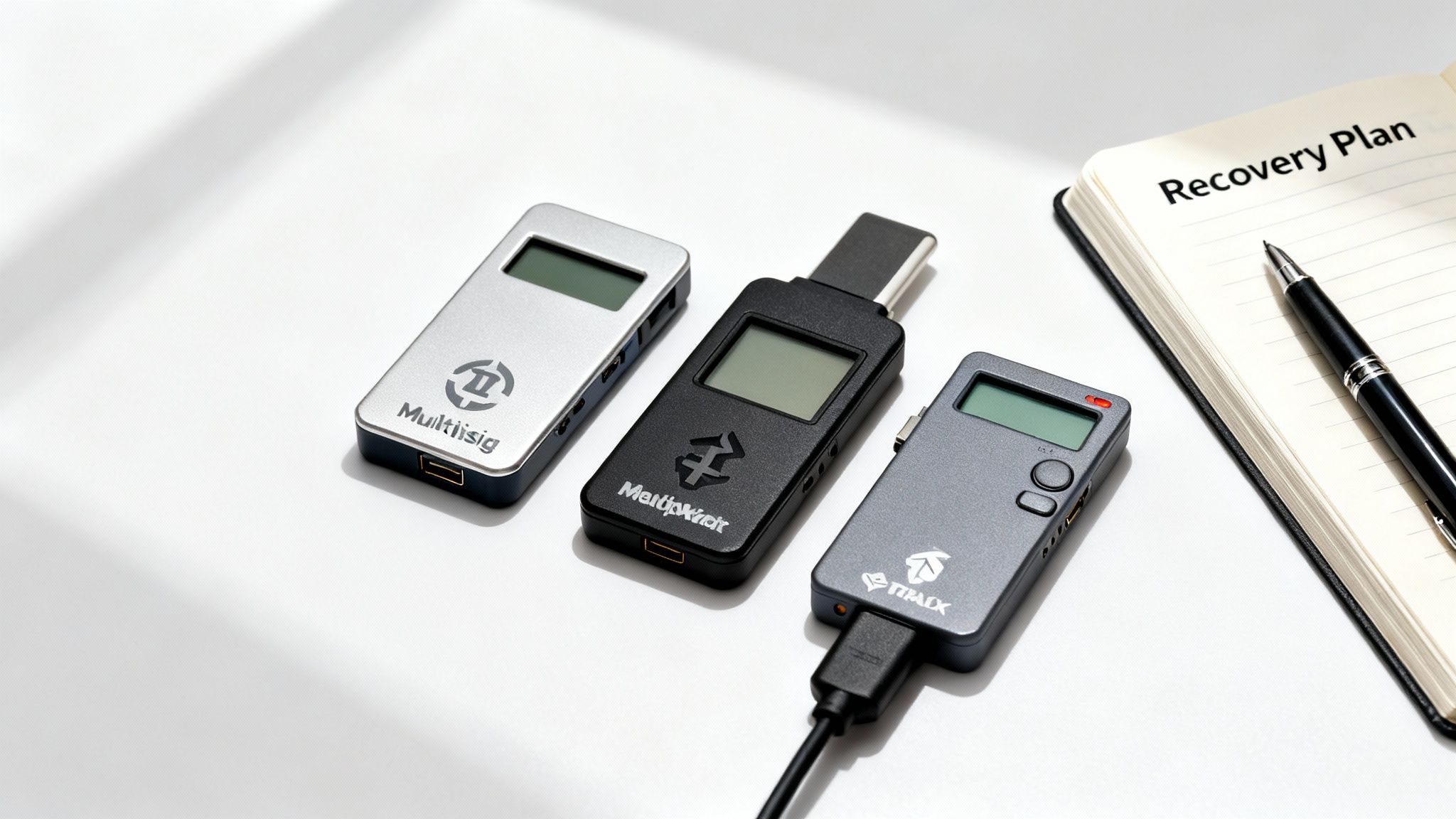
But the software is just the conductor; the real security comes from your hardware. For any serious multisig wallet, using hardware wallets to store your private keys is non-negotiable. A hardware wallet is a small physical device built to keep your private keys completely offline, even while it’s signing a transaction.
A critical best practice is to use hardware wallets from different manufacturers. Putting all your trust in a single brand for all your keys creates a single point of failure—a potential supply-chain attack or a firmware bug could wipe you out.
By mixing and matching devices from at least two different reputable vendors, you create vendor diversity. This simple move dramatically strengthens your defenses, which is the entire philosophy behind using multisig in the first place.
Step 2: Generate and Secure Your Seed Phrases
With your hardware in hand, it's time to generate a unique private key on each device. Each hardware wallet will give you a seed phrase—usually a list of 12 or 24 words—that serves as the master backup for that specific key. This process requires your full attention.
- Generate Offline: Make sure each key is created on its respective hardware device, completely disconnected from any computer or the internet.
- Backup Securely: Write down each seed phrase on paper. Better yet, stamp it into metal plates for durability against fire and water. Never, ever store it digitally on a computer, phone, or in the cloud.
- Separate Locations: Store each backup in a separate, secure, and geographically diverse location. For a 2-of-3 setup, that means three different safe places far away from each other.
Think of each seed phrase as a key to your vault. If an attacker finds enough of them to meet your signing threshold, your funds are gone. Treat them like solid gold bars.
Step 3: Create a Detailed Recovery Plan
This is easily the most important—and most frequently ignored—step. A recovery plan is a physical document that acts as a blueprint for you, your family, or your business partners to recover the funds if a key is lost or a signer is unavailable. Without it, your fortress can quickly become a prison.
Your recovery plan should be a physical document, stored securely with your important papers, containing all the information needed to reconstruct the wallet and access the funds.
What Your Recovery Plan MUST Include:
- The M-of-N Configuration: State the wallet's setup in plain English (e.g., "This is a 2-of-3 multisig wallet").
- Wallet Software Used: Name the exact software used to create the wallet, right down to the version number.
- Key Locations and Holders: Describe where each physical key (hardware wallet) and its seed phrase backup is located. Do not write the actual seed phrases in this document.
- Recovery Procedure: Provide clear, step-by-step instructions on how to use the backups to recover the funds. This should cover importing a seed phrase into a new hardware device and using the wallet software to sweep the funds to a new, secure address.
This document is your lifeline. It ensures your carefully built security system can be navigated by the right people, even in a crisis. A multisig wallet without a clear recovery plan is a disaster waiting to happen. By following these steps, you're not just setting up a wallet; you're building a resilient system for long-term Bitcoin preservation.
Common Questions About Multisig Wallets
Once you start digging into multisig, a few practical questions always pop up. It's one thing to understand the concept, but another to know how these wallets handle real-world problems. Let's tackle the most common ones.
The biggest fear is obvious: losing a key. It’s a totally valid worry, but this is exactly the kind of scenario multisig was built to solve.
What Happens If I Lose One of the Keys?
In a setup like a 2-of-3 multisig wallet, losing a single key isn't the catastrophe it would be with a standard wallet. This is the whole point. You can still use the remaining two keys to sign and access your Bitcoin.
Once you’ve confirmed a key is gone for good, your first move should be to create a brand-new multisig setup and transfer the funds over immediately. This redundancy—the ability to withstand a single point of failure—is what makes multisig such a powerful security tool against loss, theft, or even a simple hardware malfunction.
Are Multisig Wallets Less Private?
This is a great question that gets into the trade-offs. Multisig transactions do leave a different kind of footprint on the Bitcoin blockchain, which can make them stand out from typical, single-key payments. But modern wallets have a clever workaround.
They use a feature called Pay-to-Script-Hash (P2SH). Think of it like putting the complex multisig rules inside a plain-looking envelope. To the outside world, a P2SH address looks just like any other Bitcoin address until you actually spend the funds. Only then is the multisig script revealed to the network.
While multisig is primarily about security, not total anonymity, P2SH provides a very solid layer of privacy for your funds while they're sitting in the wallet.
Is Multisig Good for Daily Payments?
Technically, you could use a multisig wallet for your everyday spending, but it's not what they're designed for. The extra steps of coordinating multiple signers for every single transaction adds a layer of friction that’s just not practical for small, frequent purchases.
Imagine needing to get out two separate hardware wallets just to buy a coffee. It’s overkill.
Multisig wallets shine when used for their intended purpose: securing long-term savings, managing a company treasury, or handling funds for a group. They are strategic tools for protecting serious wealth, not for buying groceries.
For your "cold storage" or corporate funds, that deliberate, multi-step approval process is a critical feature, not a bug. For daily spending, a simple, single-signature wallet on your phone is still the way to go.
Ready to accept Bitcoin payments with the security and efficiency your business deserves? Flash provides the tools you need to integrate seamless, wallet-to-wallet Bitcoin payments directly into your operations, from point-of-sale terminals to subscription billing. Start today and connect with a global network of Bitcoin users.