At its heart, a Bitcoin node is just a computer that's part of the global Bitcoin network. Think of each node as an independent bookkeeper for every single transaction. They all work together to keep the whole system honest and secure, completely removing the need for a central bank or authority.
For merchants, this decentralized network is what makes secure, direct wallet-to-wallet payments possible.
Understanding the Bitcoin Network's Backbone

Let's pull back the curtain on the technology that powers your Bitcoin payments. Picture a massive, worldwide accounting firm where every bookkeeper has an identical copy of the same universal ledger. They all collaborate to verify and record every transaction, creating a system built on mutual trust and verification.
This is what gives Bitcoin its incredible power. There’s no single "boss" or central server that can be shut down, hacked, or manipulated. Instead, thousands of independent computers—the nodes—are constantly talking to each other to maintain the network’s integrity.
What Does a Bitcoin Node Actually Do?
A node is essentially a computer running special software that validates and passes along transactions on the Bitcoin blockchain. They are the backbone of the whole decentralized structure. Without them, the network simply couldn't function securely.
To give you an idea of the scale, as of early 2026, there were over 24,000 reachable Bitcoin nodes operating across the globe. This number is a key sign of the network's health and resilience. You can actually see these stats in real-time on sites like Bitnodes.io.
Each node is busy performing a few critical jobs:
- Transaction Validation: It meticulously checks every incoming transaction against a strict set of rules, making sure it's legitimate and not an attempt at fraud.
- Information Relay: Once a transaction is validated, the node broadcasts it to other nodes it's connected to, helping it spread like wildfire across the entire network.
- Maintaining the Ledger: Nodes store a copy of the entire transaction history (the blockchain). This redundancy is a core part of what makes the network so secure and resilient.
By doing all this work, nodes collectively agree on the current state of the ledger. This decentralized agreement is precisely why Bitcoin transactions are irreversible and trustworthy. It gives you complete confidence in every payment you receive without ever needing to rely on a bank.
To put it simply for business owners, here’s what a node does for you.
Bitcoin Node at a Glance
This quick summary breaks down what a Bitcoin node does and why it's a game-changer for your business.
| Core Function | Primary Role for Merchants |
|---|---|
| Validates & records transactions | Ensures every payment is legitimate and irreversible. |
| Stores the blockchain history | Secures the ledger, protecting your transaction records. |
| Enforces network rules | Maintains a trustworthy, reliable payment network. |
| Relays transaction data | Helps customer payments get confirmed quickly. |
Ultimately, these functions combine to create a payment system you can trust without a middleman.
Why Nodes Matter for Your Business
For you as a merchant, this sprawling network of nodes provides the rock-solid security and reliability you need to accept digital payments directly from customers.
When a customer pays you in Bitcoin, that transaction is verified and secured by this global network, not by a single company or financial institution. This direct, wallet-to-wallet flow cuts out the intermediaries, slashes the risk of censorship, and guarantees that you have 100% control over your own money.
Exploring the Different Types of Bitcoin Nodes
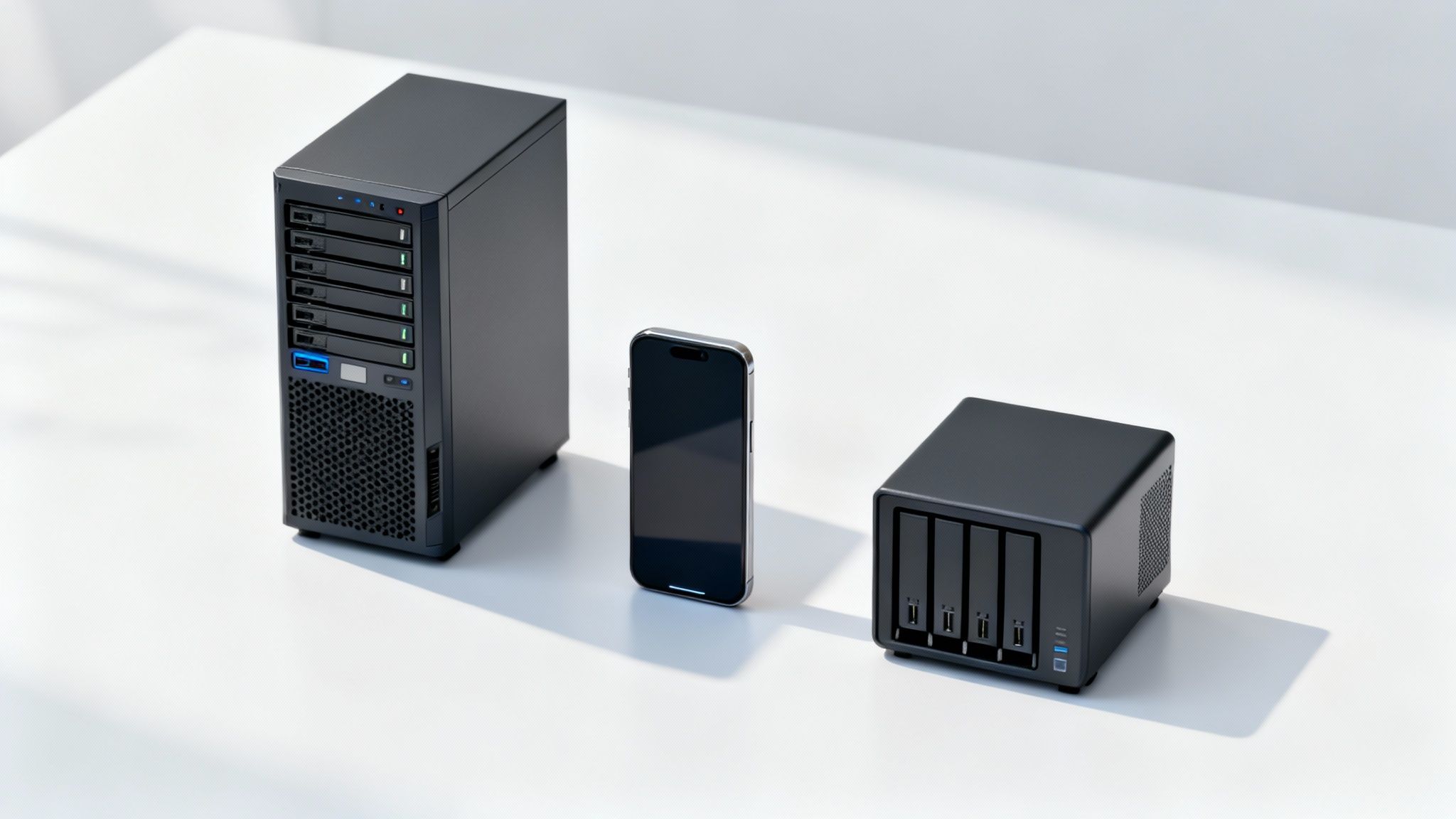
Just like you wouldn’t use a sports car to haul furniture, not all Bitcoin nodes are built for the same job. Each type has a specific role, contributing to the network's overall health and speed. Understanding these differences is key to seeing how the whole Bitcoin ecosystem hangs together.
This variety is what makes the network so resilient and accessible. For a business owner, knowing the different kinds of nodes helps you appreciate the solid infrastructure that payment tools like Flash are built on to deliver trustworthy wallet-to-wallet transactions. Let's break down the most common types.
Full Archival Nodes: The Gold Standard
The full archival node is the absolute bedrock of the Bitcoin network. Think of it as owning the complete, unabridged, and independently verified history book of every single Bitcoin transaction ever made, right back to the very first one in 2009.
Because they download and validate the entire blockchain, full archival nodes are the most secure and trustless way to interact with Bitcoin. They don’t need to ask anyone else for confirmation because they have the complete historical record right on their own machine. The main downside? A hefty storage requirement, which is already over 700 GB and keeps growing.
Pruned Full Nodes: The Practical Middle Ground
A pruned full node offers a brilliant compromise. It does the exact same tough validation work as a full archival node, checking every transaction against the network's rules to make sure it's legit. It downloads the whole blockchain to start but then "prunes" or discards the oldest transaction data after it’s been verified.
This clever approach gives you the highest level of security while slashing long-term storage needs. A pruned node can run with just a few gigabytes of disk space instead of hundreds, which is a massive difference.
For many businesses and serious users, a pruned node hits the sweet spot. It provides the full security benefits of independent transaction verification without requiring a massive, ever-expanding hard drive, making it a much more practical choice.
Lightweight Nodes: Speed and Convenience
Often called Simplified Payment Verification (SPV) nodes, these are all about speed and convenience. They're the reason mobile Bitcoin wallets work so well. Instead of downloading the whole blockchain, they just grab the block headers—think of these as the chapter titles in Bitcoin’s history book.
To check a transaction, a lightweight node simply asks a full node for proof that the transaction is included in a specific block. It’s way faster and uses minimal storage, perfect for devices like smartphones. The trade-off, of course, is a little bit of trust. Lightweight nodes have to rely on the full nodes they connect to, which slightly reduces privacy and adds a small degree of dependency.
Comparing Bitcoin Node Types for Merchants
Making sense of these options can be tricky, so here’s a straightforward comparison focusing on what matters most to a business owner.
| Node Type | Storage Requirement | Security Level | Best Use Case |
|---|---|---|---|
| Full Archival Node | Very High (700+ GB) | Maximum | For developers, researchers, or businesses needing absolute transactional certainty and historical data access. |
| Pruned Full Node | Low (5-10 GB) | Maximum | Ideal for merchants who want the highest security for verifying their own payments without dedicating massive hardware resources. |
| Lightweight (SPV) Node | Very Low (MBs) | High (but relies on trust) | Perfect for everyday use in mobile wallets where quick access and minimal data usage are the top priorities for customers. |
Each of these node types plays a part in keeping the Bitcoin network strong and functional. The main takeaway for merchants is that the ecosystem has flexible options that allow payment providers to build solutions balancing security, user experience, and efficiency. This ensures you can offer customers a smooth payment process backed by a powerful and secure global infrastructure.
How Nodes Work Together to Keep Bitcoin Payments Secure

A leaderless network sounds like a recipe for chaos, but in Bitcoin, it's the very source of its strength. How can a system with no central authority possibly prevent fraud and guarantee every payment is legit? The answer is in the way nodes work together—a collaborative, almost symphonic, process.
Think of it like a global team of thousands of independent auditors. Before any transaction can be finalized, this entire team has to review it and come to a unanimous agreement. This is exactly what a Bitcoin node does. When a customer pays you, every node on the network springs into action, running through a critical sequence of tasks to safeguard your funds.
This decentralized verification is what gives Bitcoin its incredible resilience. It means that when you receive a payment, its security isn't just a promise from a single company; it's guaranteed by a global consensus. This intricate system is built on core principles of communication and validation. If you're curious about the deeper architecture, exploring advanced IT networking principles can offer a much richer understanding.
Step 1: Validation – The First Line of Defense
The moment a transaction is created, its journey begins at a single node. This initial node acts as the first gatekeeper, meticulously inspecting the payment details against a long list of strict rules defined by the Bitcoin protocol.
This isn't a quick glance. The validation is incredibly thorough, and the node verifies several key things:
- Correct Formatting: Is the transaction data structured properly?
- Sufficient Funds: Does the sender actually have enough bitcoin to cover the payment? The node checks their entire blockchain history to confirm.
- No Double Spending: Has this exact same bitcoin already been spent in another unconfirmed transaction?
If a transaction fails even one of these checks, the node immediately rejects it. A potentially fraudulent payment is stopped dead in its tracks.
Step 2: Propagation – Spreading the Word
Once a node validates a transaction, its next job is to tell its peers. It broadcasts the verified transaction data to all the other nodes it’s connected to. This is propagation.
It’s like a ripple effect. Each node that receives the transaction runs its own independent validation check. If it passes, that node then broadcasts it to its peers. In seconds, a legitimate transaction can spread across thousands of nodes worldwide, creating a shared awareness that a payment is pending. This rapid, redundant communication is how the entire network quickly learns about new, valid transactions.
The real magic of Bitcoin’s security is in this decentralized collaboration. A single point of failure is eliminated because the responsibility of verification is shared among thousands of independent participants, all enforcing the same rules.
Step 3: Consensus – Achieving Final Agreement
The final, most crucial step is achieving consensus. This is where transactions are bundled into a "block" and permanently sealed into the blockchain's history through mining. Miners, who run powerful nodes, compete to solve a complex mathematical puzzle.
The first miner to solve the puzzle gets to propose the next block of transactions to the network. Every other node then checks the miner's work and the transactions inside the block one last time. If it all checks out, they add the block to their copy of the blockchain. At this point, the transactions inside are considered confirmed and irreversible.
This is the moment a payment officially becomes yours. The system's stability is reflected in its consistent growth. Node counts exploded after 2017, peaking near 200,000, and have since stabilized. Today, the growth in developer activity—with Bitcoin Core contributors projected to hit 135 in 2025—shows a strong, ongoing commitment to improving node software and keeping the network secure.
Should Your Business Run Its Own Bitcoin Node?
For any merchant who’s serious about accepting Bitcoin, the question eventually comes up: should you run your own node? It’s a big step, but it’s a move toward complete financial sovereignty. Nothing else offers the same level of security and privacy when you're interacting with the Bitcoin network.
When your business runs its own full node, you aren’t trusting anyone. Every single payment you receive gets verified by your hardware, against your copy of the blockchain. This completely cuts out any reliance on third-party services, giving you the final word on whether a transaction is valid.
For a business, that kind of independence is a massive advantage. It also delivers the highest possible degree of privacy. Your transaction data isn't being funneled through an intermediary's servers, which makes it much harder for anyone to connect your business activities to your identity.
The Benefits of Financial Sovereignty
Taking control of your own node puts you firmly in the driver's seat. The real wins here are all about security, privacy, and control—three things that are absolutely critical for any business's financial health.
Here’s what you stand to gain:
- Trustless Verification: You don't have to take a payment processor's word that a transaction is good. Your node confirms it directly against the blockchain's official record. No middlemen, no doubts.
- Enhanced Privacy: By connecting your wallet straight to your own node, you stop broadcasting your financial data to outside servers. This makes it incredibly difficult for snoops to analyze your payment activity.
- Strengthening the Network: Every full node that comes online makes the entire Bitcoin network more decentralized and secure. You’re not just helping yourself; you’re making the whole payment system more resilient for everyone.
For a merchant, running a node means you are your own bank in the truest sense. You hold the ledger, you verify the transactions, and you control your financial destiny without asking for permission.
These nodes aren't just passive observers. Each one stores the entire Bitcoin blockchain—which was over 710 GB as of early 2026 and keeps growing with every block. This massive, distributed ledger is what gives Bitcoin its resilience and censorship resistance. It’s the perfect foundation for merchants using tools like Flash to tap into a market of over 500 million Bitcoin users without any intermediaries. If you want to see the network's health in real-time, check out the node data on Bitnodes.io.
The Practical Realities and Drawbacks
Let's be realistic, though. Running a node isn't a set-it-and-forget-it task. It comes with its own set of challenges that might not make sense for every business.
The main hurdles are resources and know-how. You’ll need dedicated hardware—usually a computer with a decent processor and a massive hard drive that can stay on 24/7. You also need to be comfortable enough with tech to install the software, sync the blockchain, and handle routine maintenance.
It’s a real commitment. The initial blockchain download alone can take several days, and it's a bandwidth-hungry process. For many small to medium-sized businesses, these technical and resource demands can be a major distraction from what you do best: running your company.
Making the Right Choice for Your Business
So, when does it actually make sense to run your own node? The decision really boils down to a trade-off between convenience and absolute control.
| Factor to Consider | When to Run Your Own Node | When to Use a Payment Provider |
|---|---|---|
| Transaction Volume | Your business processes a high volume of Bitcoin transactions daily, making independent verification a strategic asset. | You have sporadic or low-volume Bitcoin sales, and the overhead of a node isn't justified. |
| Technical Resources | You have in-house technical expertise or are comfortable managing the hardware and software requirements. | You prefer a "plug-and-play" solution that requires no technical maintenance on your part. |
| Privacy Needs | Your business model requires the highest possible level of financial privacy and censorship resistance. | Standard privacy offered by a trusted payment provider is sufficient for your operational needs. |
For most merchants, especially those just getting their feet wet with Bitcoin, leaning on a reliable payment provider is the more practical route. Services like Flash are built to give you the power and security of the Bitcoin network without forcing you to manage all the complex infrastructure yourself. This frees you up to focus on your business while still offering customers a secure, decentralized way to pay.
Ultimately, running a node is a powerful strategic move for some, but an unnecessary complication for others.
Getting Started with Setting Up Your Own Node
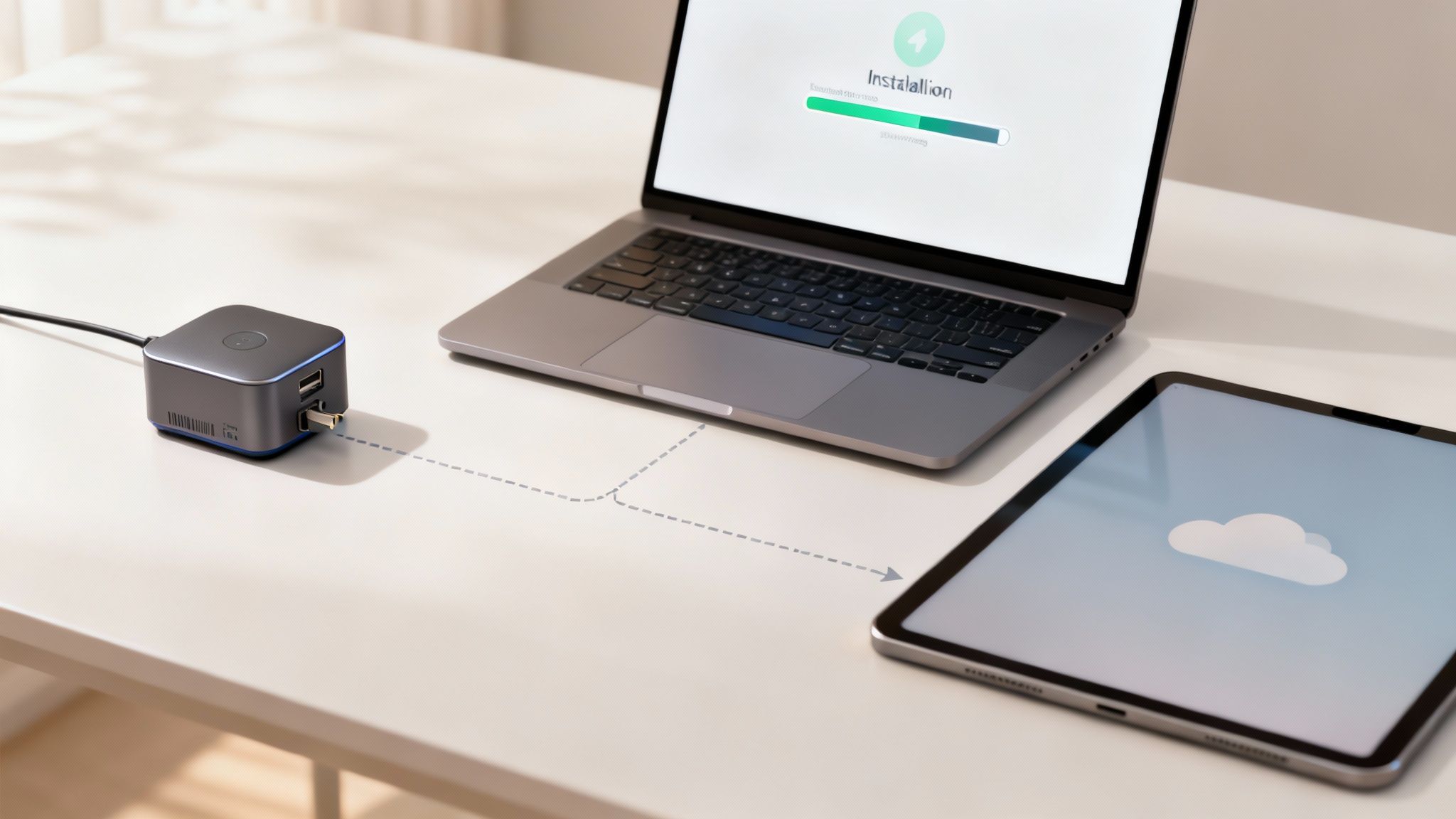
If you've decided to take the leap and gain full financial sovereignty, the next question is simple: where do you begin? The idea of setting up your own Bitcoin node can sound pretty intimidating, but it’s far more achievable than you might think.
This guide breaks down the three main pathways, helping you choose the best fit for your business without getting bogged down in technical jargon. Each option offers a different balance of cost, convenience, and control, so let's dig in.
Option 1: Plug-and-Play Hardware
For anyone who wants a streamlined, no-fuss experience, plug-and-play hardware is the answer. These are dedicated devices, often small, slick-looking boxes, that come with all the Bitcoin node software pre-installed and ready to go.
Think of it like buying a specialized appliance for your business. You just plug it in, connect it to your internet, and run through a simple setup wizard. This path completely removes the headache of sourcing components or installing complex software from scratch, making it the most user-friendly way to get a full node up and running.
- Pros: By far the easiest setup, uses optimized hardware, and usually comes with a slick, user-friendly interface.
- Cons: Higher upfront cost compared to building your own, and you're relying on the hardware manufacturer for support and updates.
Option 2: DIY with Bitcoin Core Software
If you're more of a hands-on type and want total control, you can install the Bitcoin Core software directly onto a dedicated computer. This is the official, open-source software that actually powers the Bitcoin network, giving you complete authority over every single aspect of your node.
You don’t need a supercomputer for this. A simple refurbished desktop or even a small, single-board computer with an external hard drive will do the trick. The most important part is having a large storage drive—at least 1TB—to hold the entire blockchain, plus a stable, unmetered internet connection.
This DIY approach is the purest form of participation in the Bitcoin network. It puts you in direct control of the software and hardware, offering the highest degree of sovereignty and customization possible for your business.
This is the exact path that thousands of node operators across the globe choose. In fact, a huge 64.14% (or 15,703 nodes) hide their location for privacy, likely using Tor. Among the countries we can identify, the US leads with 2,649 nodes, followed by Germany with 1,216. You can see this incredible global network for yourself over at Bitnodes.io.
Option 3: Cloud-Based Services
For businesses that want all the benefits of running a node without having to manage any physical hardware, cloud-based services are a fantastic alternative. This route involves renting server space from a cloud provider and running your Bitcoin node on their infrastructure.
This hands-off method means you don't have to worry about hardware failure, electricity bills, or physical security. The provider handles all the backend infrastructure, letting you manage your node remotely from anywhere in the world. It’s an excellent option if your business already operates in the cloud or you just prefer a service-based model.
- Pros: No physical hardware to manage, high uptime and reliability, and resources that can scale with your needs.
- Cons: You'll have a recurring monthly cost, and you're placing some trust in the cloud provider for infrastructure security.
Choosing Your Path
Each of these options is a perfectly valid way to run a Bitcoin node. A plug-and-play device offers pure simplicity, a DIY setup provides ultimate control, and a cloud service delivers incredible convenience. By understanding these choices, you can confidently select the right path for your business, turning the concept of a Bitcoin node from theory into a powerful, practical tool for your financial independence.
The Role of Nodes in the Future of Bitcoin Commerce
Looking down the road, the entire future of Bitcoin as a global payment system rests on one thing: a robust, growing network of nodes. This decentralized foundation is what will allow Bitcoin to handle more and more transactions and support powerful new tools that directly benefit merchants like you.
A perfect example is the Lightning Network. It’s a second-layer solution built right on top of Bitcoin that makes instant, dirt-cheap payments possible. It's ideal for everything from selling a cup of coffee to a digital download. What this means for merchants is that the Bitcoin payment rail you’re using today is constantly getting stronger, faster, and more efficient.
Powering a Resilient Global Economy
Every single time a new node comes online, the entire financial system gets a little bit stronger. Each one adds to a more resilient, censorship-resistant network where commerce can flow freely, without anyone's permission. This distributed power is what guarantees that no single entity—not a government, not a corporation—can ever shut down or control your ability to do business.
Once you truly grasp what a node is, you can feel confident that you’re tapping into a global network built for the long haul. It secures your ability to trade with customers anywhere in the world, completely on your own terms.
A decentralized network isn't just a fancy technical feature; it's a promise of financial freedom and stability for your business. It’s the guarantee that the rules won't suddenly change on you and that your access to the market will always remain open.
Securing Future Growth and Opportunity
As Bitcoin continues to gain mainstream acceptance, the network of nodes is set to grow right alongside it, providing even more security. To really appreciate how this works, it's worth understanding the long-term incentives for Bitcoin network security that are designed to keep nodes and miners running for decades.
This growth is absolutely critical. Just look at the projections: institutional demand for Bitcoin is exploding, with an expected demand for 775,000 BTC in 2026 against a new supply of only 164,250. More nodes will be essential to secure this coming economic boom. This puts businesses that are already accepting Bitcoin in a prime position to thrive. You can find more insights into the health and growth of the Bitcoin node network at Bitnodes.io.
Ultimately, the collective power of all these nodes is what backs the entire value proposition for merchants. They deliver:
- Unmatched Security: Thousands of independent verifiers secure every single transaction.
- Censorship Resistance: Your ability to receive payments cannot be blocked or frozen.
- Future-Proof Innovation: The network is a solid foundation for new tech like instant payments.
This decentralized node network is precisely what makes Bitcoin a reliable and forward-thinking payment solution, ready to support your business as it scales.
Common Questions About Running a Bitcoin Node
Let's tackle some of the most common questions merchants have about Bitcoin nodes. Think of this as your quick-start guide to clear up the confusion and help you decide what's right for your business.
How Much Does It Cost to Run a Bitcoin Node?
The price tag really depends on the path you choose. If you're a bit of a tinkerer and have an old computer lying around, your main cost might just be a 1TB external drive, which will set you back about $50-$100.
For a more hands-off approach, you can buy a dedicated plug-and-play device. These are built specifically for running a node and typically cost somewhere between $300 and $500. Then there are cloud-based options, which come with a monthly subscription, usually starting in the $20-$50 range, depending on how much power you need.
Do I Need to Be a Tech Guru to Set One Up?
Not anymore, thankfully. Going the DIY route does mean you should be comfortable tinkering with computer hardware and installing software. But the plug-and-play devices are designed for everyone else. They come with simple, guided setups that can get you up and running in less than an hour, no command line wizardry required.
Can My Business Get Paid Without Running a Node?
Absolutely, and this is where most businesses start. Using a trusted Bitcoin payment provider is the easiest entry point. These services handle all the complicated node infrastructure on their end, giving you all the security of the network without any of the technical headaches. You get a simple way to accept payments, and they manage the backend.
The real beauty of a payment provider is convenience. They act as the bridge, letting you focus on what you do best—running your business—while still giving your customers a secure, direct payment option that settles right into your wallet.
Does a Node Need to Be Online All the Time?
To get the full benefits and to really contribute to the network's strength, your node should ideally be running 24/7. If it goes offline, it can't do its job of validating and passing along transactions. When it comes back online, it has to play catch-up and download all the blocks it missed, which can take a while depending on how long it was down.
Ready to accept Bitcoin payments securely without the hassle of running your own node? Flash offers a wallet-to-wallet payment solution that connects you directly to the Bitcoin network, ensuring you have full control over your funds. Get started in under a minute at .