If you’ve ever found yourself searching for "where to buy bitcoins near me," you're not alone. The answer is probably a lot closer than you imagine. For most people, this means turning to one of two main options: a Bitcoin ATM or a peer-to-peer (P2P) marketplace that connects you with local sellers for face-to-face trades.
Your Quick Guide to Buying Bitcoin Locally
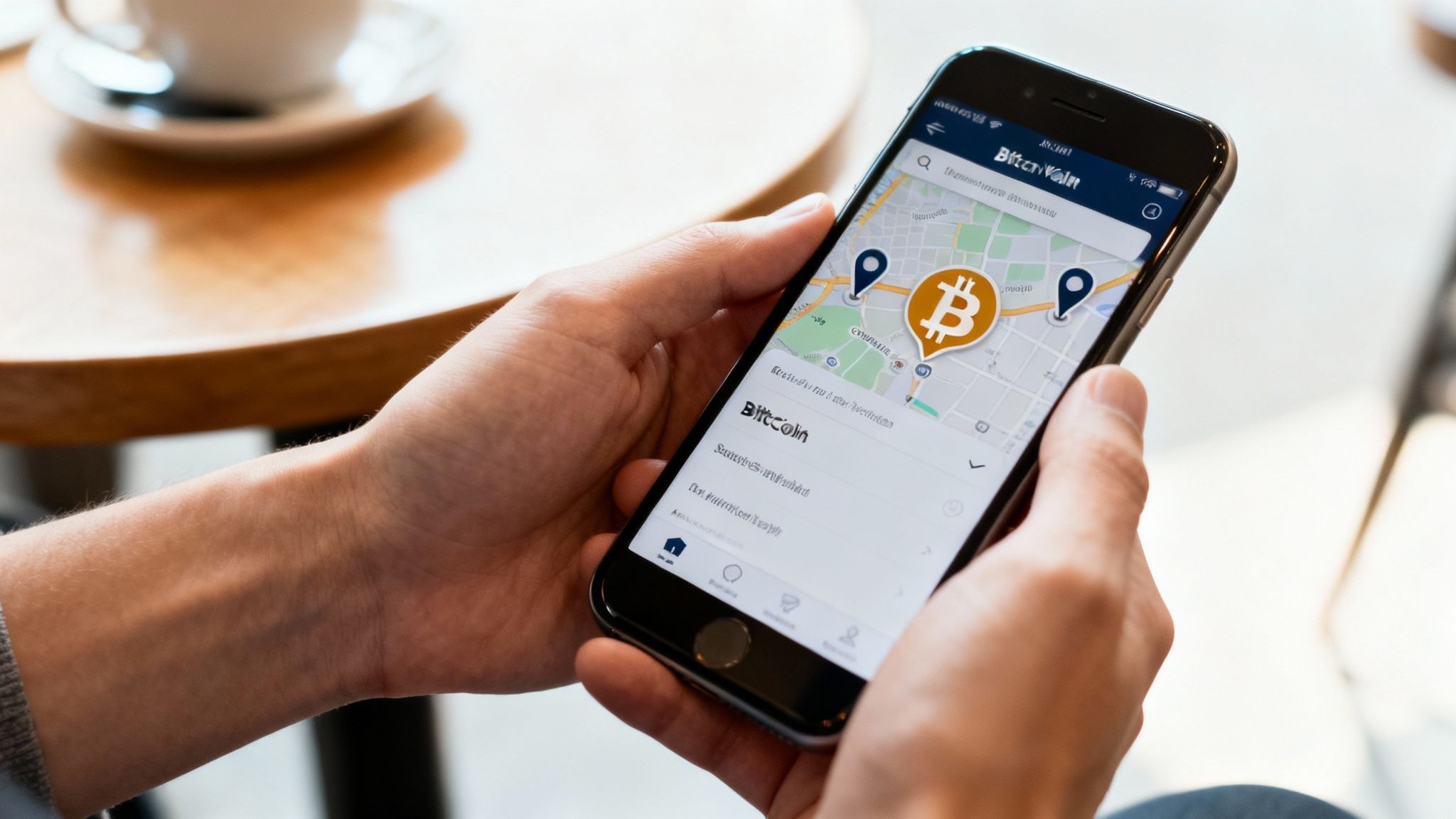
The whole idea of "local Bitcoin" can sound a bit strange at first. Bitcoin is, after all, a global digital currency without borders. Its scale is massive—as of March 2025, the U.S. government alone reportedly held over 207,000 Bitcoin.
Despite its global nature, the demand for simple, in-person ways to buy Bitcoin has exploded. These local options are the bridge between the digital world of Bitcoin and the physical cash in your pocket. For a lot of newcomers, the thought of navigating online exchanges and linking bank accounts feels overwhelming. Buying locally offers a more tangible, familiar starting point.
Why People Search for Local Options
There are a few solid reasons why someone might skip the big online exchanges and look for a local alternative. Knowing these motivations can help you figure out what makes the most sense for you.
- Simplicity and Speed: Talking to a person or using a machine that feels like a regular ATM can seem much more straightforward than signing up for a complex online platform.
- Cash-Based Purchases: It's the most direct route to turn physical cash into Bitcoin. No bank account, no credit card, no problem.
- Increased Privacy: Paying with cash locally can offer a level of privacy you just don't get when you're required to link personal bank accounts and IDs to online services.
The real draw of buying Bitcoin locally is accessibility. It cuts through the red tape—like complicated sign-up forms or the need for a traditional bank account—making it easier for just about anyone to get started.
What This Guide Covers
This guide is designed to walk you through the nitty-gritty of each local buying method. Think of it like researching your options before finding printing services near you—a little homework goes a long way.
We'll dive deep into Bitcoin ATMs and peer-to-peer marketplaces, covering everything from how to find them to what fees you can expect and, most importantly, how to stay safe. By the end, you'll have the practical know-how to buy Bitcoin in your own neighborhood with confidence.
Using a Bitcoin ATM for Instant Purchases
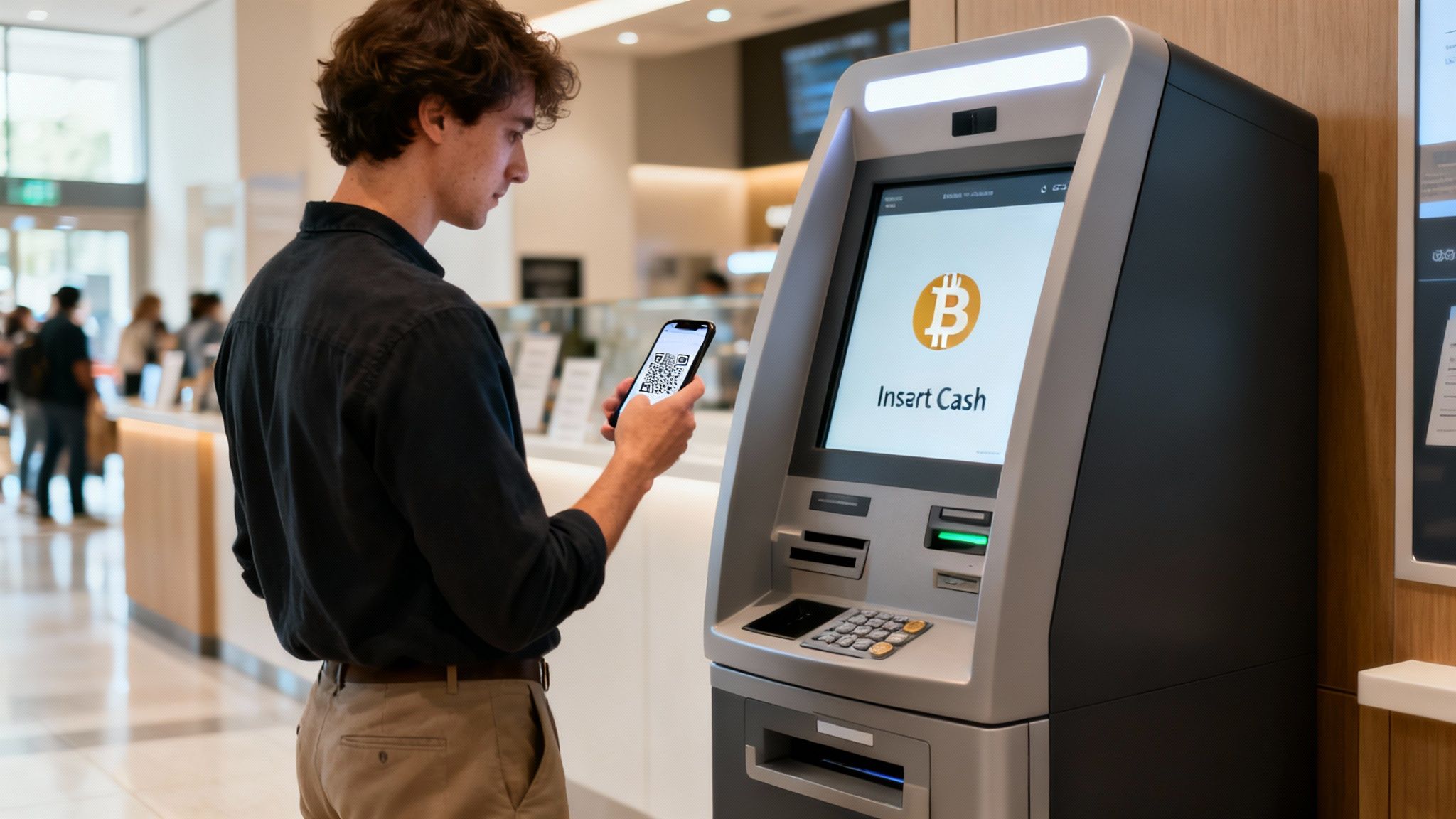
If you're looking for the most direct route from cash in your hand to Bitcoin in your wallet, nothing beats a Bitcoin ATM. You’ve probably seen them popping up in convenience stores, gas stations, or local shops. They work a lot like a regular cash ATM, but in reverse—you feed it cash, and it sends you Bitcoin.
Their biggest draw is the straightforward, physical experience. Instead of fumbling through an online exchange, you're interacting with a physical machine. For a lot of people, especially first-timers, this makes the whole process feel more tangible and way less intimidating.
Bitcoin ATMs have gone from being a niche curiosity to a real piece of financial infrastructure. As of December 31, 2025, there were 39,158 Bitcoin ATMs across the globe, a number that jumped by 3.8% in that year alone. It's a clear sign they’re becoming a go-to option for many. You can learn more about the growth of Bitcoin ATMs globally and see just how fast this sector is expanding.
Finding an ATM Near You
Okay, so before you head out, you need to find a machine. Luckily, there are a few great online tools that map them out in real-time, giving you an instant answer to "where can I buy bitcoins near me?"
My go-to resource is CoinATMRadar. It's a comprehensive global map that makes the search dead simple. Just pop in your address or let it use your location, and it'll show you all the nearby options. More importantly, it gives you the details you actually need for each one:
- Supported Currencies: Most ATMs focus on Bitcoin.
- Transaction Fees: This is a big one. You'll see exactly what percentage the operator is charging.
- Operational Hours: Don't show up to a closed store.
- Verification Limits: This tells you how much you can buy before needing to show an ID.
The On-Site Process Explained
Once you're standing in front of the machine, the process is surprisingly quick. The one thing you must have ready is a Bitcoin wallet on your smartphone. If you don't have one, get that set up first—this is where your new Bitcoin will land.
The on-screen instructions are usually very clear. You'll select "Buy Bitcoin," punch in how much cash you want to convert, and then hold up your phone to scan your wallet's QR code. Insert the cash, confirm the details, and you're done. The Bitcoin is sent straight to your wallet.
Don't panic if the transaction shows up as "pending" in your wallet. The Bitcoin network needs a little time to confirm everything. Typically, you're looking at about 10-30 minutes before your Bitcoin is fully settled and spendable.
Understanding the Trade-Offs
That convenience comes at a price. The biggest trade-off with a Bitcoin ATM is the fees. They are significantly higher than online exchanges, often falling in the 7% to 15% range, and sometimes even higher. You're paying a premium for speed, privacy, and the ability to use physical cash.
Also, be mindful of Know Your Customer (KYC) rules. While many ATMs let you make smaller purchases anonymously (say, under $900), larger amounts will almost always require you to scan a government-issued ID and verify a phone number. It's smart to check the verification limits on a locator map like CoinATMRadar beforehand so you know exactly what to expect.
Navigating Peer-to-Peer Trades for Local Deals
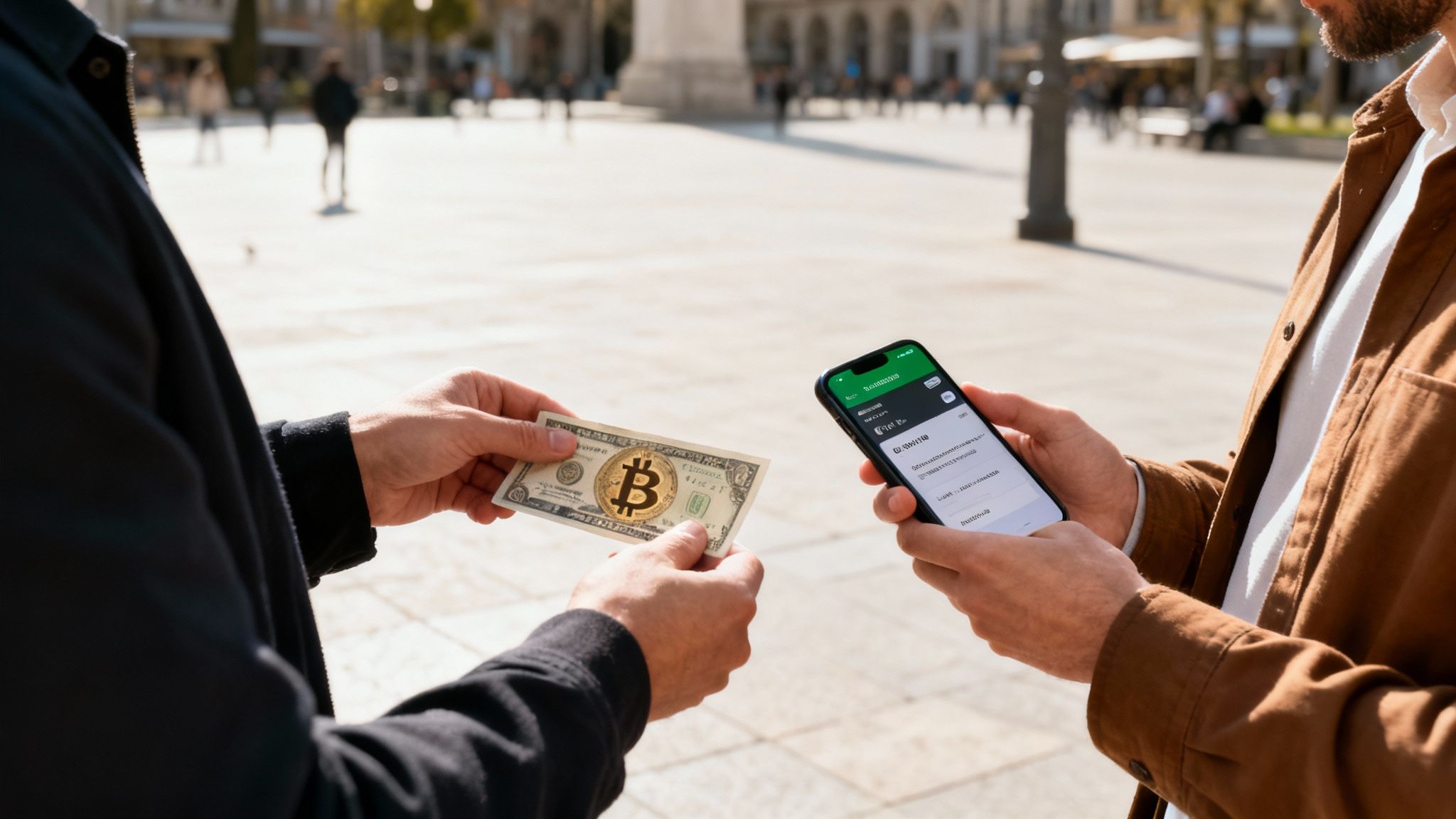
While Bitcoin ATMs are fast and convenient, sometimes you want a more personal touch—and potentially a better deal. That’s where peer-to-peer (P2P) trading comes in. Think of it as a digital bulletin board connecting you with local folks looking to sell their Bitcoin.
This route often unlocks better exchange rates and opens up a whole world of payment options, including the classic cash-in-hand meetup. You're not dealing with a machine; you're coordinating directly with another person.
Platforms like Bisq or Hodl Hodl are built for these local deals, but they come with a critical safety net: an escrow service. When you start a trade, the seller’s Bitcoin gets locked in this digital safe. This ensures they can't just take your money and run. The Bitcoin stays put until you confirm you've paid.
Yes, it takes a bit more coordination than hitting up an ATM. But the trade-offs—like lower fees and more flexible terms—make it a go-to option for anyone serious about finding the best way to buy Bitcoin nearby.
Vetting Sellers and Staying Safe
The absolute key to a smooth P2P deal is doing your homework. You're trading with a stranger, so trust and credibility aren't just nice-to-haves; they're non-negotiable. Slow down and properly vet any seller before you even think about trading.
Most P2P marketplaces have a reputation system built right in. You need to become a detective and look for these clues:
- Trade History: A seller with hundreds of completed trades is a much safer bet than someone with only a handful. Look for experience and volume.
- Positive Feedback: Don’t just look at the star rating. Actually read the comments from other buyers. Consistent praise is what you want to see.
- Account Age: An account that’s been active for several years is generally more trustworthy than one created last week. Longevity matters.
This quick background check is your first line of defense. It helps you weed out the scammers and stick with the established, reputable sellers in your area.
Your In-Person Safety Checklist
Okay, so you've found a seller who looks legit. Now it's time to plan the actual meetup. This is where you need to be extra cautious. Your personal safety is everything.
The rule of thumb for any in-person cash trade is simple: always prioritize your security over convenience. A few extra precautions can prevent a potentially disastrous situation.
Always, always agree on a safe, public location. A bank lobby is perfect—it's well-lit, has security cameras, and is full of staff and other people. Some local police stations even have designated "safe trade zones" in their parking lots for exactly this kind of exchange. Use them.
When you meet, do not hand over a single dollar until you see the Bitcoin transaction hit your wallet. The seller will release the Bitcoin from escrow to your wallet address. You’ll see it pop up as a pending transaction on your phone almost instantly. Once you see that confirmation, and only then, should you complete the cash payment. This final step guarantees the Bitcoin is actually on its way before your cash leaves your hand.
Comparing Costs and Staying Safe In-Person
The biggest draw for buying bitcoin locally is pure convenience. But that convenience comes at a price. Before you jump into an in-person purchase, you have to get a handle on the real costs and, just as importantly, the safety measures you absolutely need to take.
The price you see on an ATM screen or a seller's ad is almost never what you'll actually pay. Local methods nearly always have extra fees baked in that you won't find on a big online exchange. Think of it as a premium for speed, privacy, and the option to use cold, hard cash.
Breaking Down the True Cost
Your final cost really hinges on how you buy. Bitcoin ATMs, for example, are notorious for their hefty service charges. We're talking anywhere from a steep 7% to over 15% of your total purchase. That's the price you pay for the machine's service of instantly turning your cash into Bitcoin.
Peer-to-peer (P2P) trades can be a bit easier on the wallet, but sellers almost always add a premium on top of the going market rate. That's their profit. So, if Bitcoin is trading at $70,000, a P2P seller might list it for $71,500. Knowing this markup exists is the first step to figuring out if you're getting a fair deal.
Always calculate your "all-in" cost before you commit. For an ATM, that's the exchange rate plus the service fee. For a P2P deal, it's simply the seller's final asking price. This is the only number that matters when you're comparing your options.
Your Pre-Purchase Security Checklist
When you're dealing with cash and irreversible Bitcoin transactions, security isn't just a suggestion—it's everything. Your prep work should start long before you meet anyone or even walk up to an ATM. The single most important thing you can do is set up your own secure Bitcoin wallet first.
Get yourself a non-custodial wallet. This just means you, and only you, have control over your private keys—the password that unlocks your funds. Never, ever rely on a wallet provided by an exchange or some other service where you don't actually hold the keys yourself.
Lock down your security with these practices:
- Secure Your Wallet: Write down your wallet's recovery phrase (often called a seed phrase). Store it somewhere safe and offline. Do not take a screenshot of it or save it in a text file on your computer.
- Never Share Your Keys: No legitimate seller or ATM will ever ask for your private keys or recovery phrase. If someone does, it's a scam. Full stop.
- Verify Transactions Yourself: Get comfortable using a public block explorer. After the purchase, you can pop your wallet address in and see the transaction processing on the Bitcoin network for yourself.
How to Verify a Transaction On-Chain
Once the Bitcoin is sent from an ATM or a seller, it doesn't just magically appear in your wallet. It has to be confirmed by the network, and you can watch this happen live.
The sender should give you a transaction ID (TxID). Just copy and paste that string of characters into a block explorer website to track its status. You're looking for the number of "confirmations."
One confirmation means it's officially on the blockchain, but it's good practice to wait for at least 2-3 confirmations before you consider the deal done and dusted. This ensures the transaction is locked in and secure. This simple check gives you the ultimate peace of mind that the funds are well and truly yours.
A Merchant’s Guide to Tapping Into Local Demand
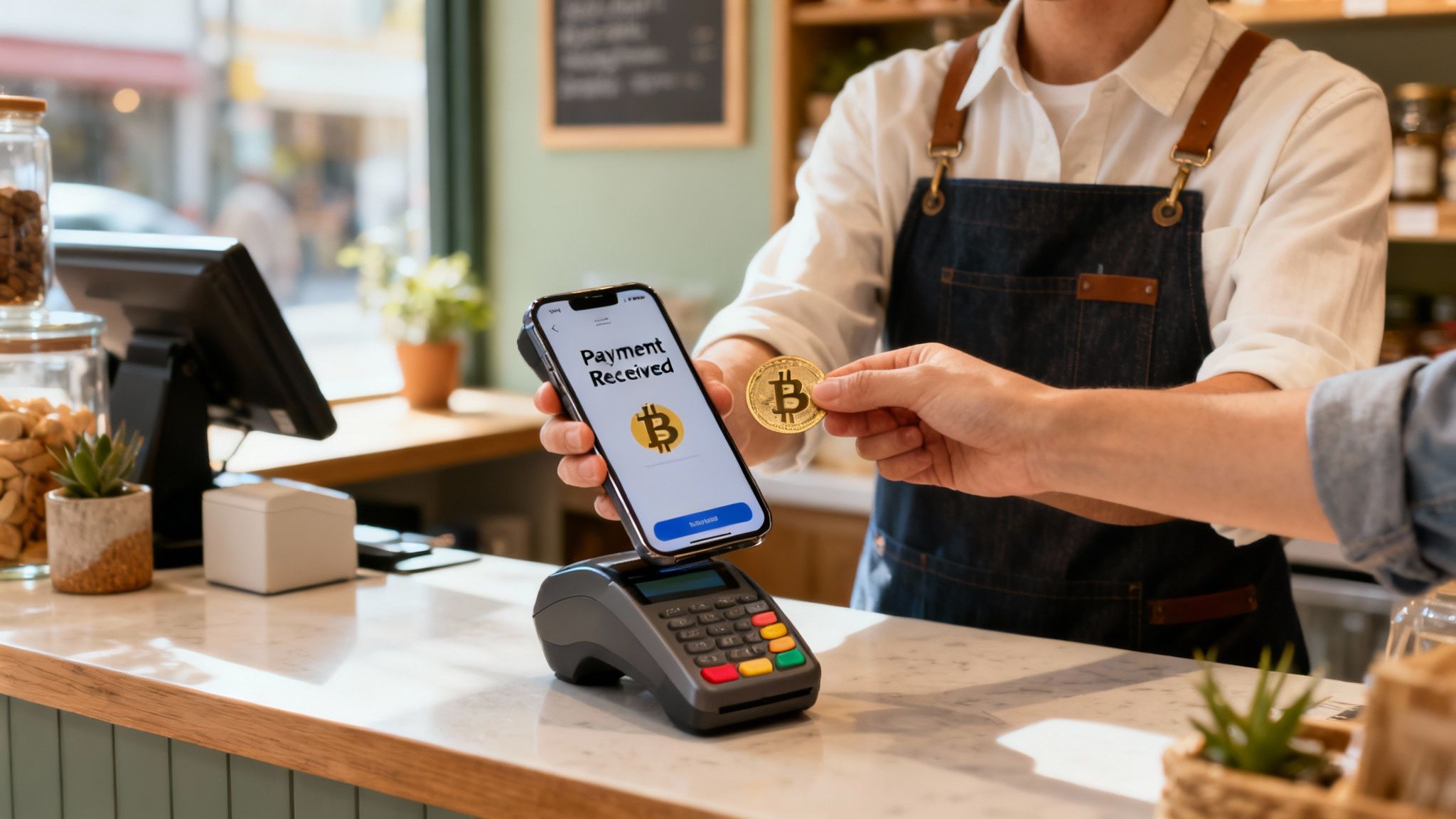
The constant search for "where to buy bitcoins near me" isn't just noise from buyers; it’s a massive, flashing sign for local merchants. Every person looking for a Bitcoin ATM or a local seller is a potential customer who already gets digital currency. By accepting Bitcoin, your business can become the exact answer they’re looking for.
This isn’t about installing expensive hardware or wrestling with complex financial rules. Modern point-of-sale (POS) tools are designed to be dead simple. An app like Flash, for instance, can turn any smartphone or tablet into a Bitcoin payment terminal in under a minute, enabling direct wallet-to-wallet transactions on the spot.
Making this small shift opens your doors to a new, tech-savvy crowd that actively seeks out businesses supporting the Bitcoin economy. It instantly paints your brand as modern and forward-thinking, giving you an edge over local competitors.
Why Your Business Should Accept Bitcoin
The perks go way beyond just looking cool and innovative. Accepting Bitcoin directly solves some major headaches that every small business owner knows all too well.
Here’s where you gain a real competitive advantage:
- Drastically Lower Fees: Credit card processors typically skim 2-4% off every single transaction. Bitcoin network fees can be substantially lower, especially with newer tech built on top of it. That’s more money straight back into your pocket.
- Zero Chargeback Fraud: Bitcoin payments are final. Once a transaction is confirmed, it's irreversible. This completely wipes out the costly and frustrating problem of chargeback fraud that plagues anyone accepting credit cards.
- Instant Settlement: Forget waiting days for credit card payments to land in your bank account. Bitcoin payments hit your wallet in minutes. This is a game-changer for cash flow, giving you immediate access to your earnings.
For a local business, accepting Bitcoin is more than a payment method; it's a marketing tool. You instantly connect with a passionate global community and become a destination for a customer base that is actively looking for places to spend their Bitcoin.
Getting Started with Bitcoin Payments
You’d be surprised at how straightforward the setup is. Because you’re receiving payment directly for goods or services, the complex KYC (Know Your Customer) rules that financial exchanges deal with often don't apply. This means you can get started without jumping through hoops.
Of course, a fundamental first step for any local merchant is just making sure people can find you online in the first place. This means ensuring your business is properly listed on Google so you show up when potential customers are searching nearby. You can learn more about listing your business on Google to get your local visibility dialed in.
By embracing a direct payment system like Bitcoin, you're doing more than just adding another checkout option. You're future-proofing your business and tapping into a dedicated, growing customer base that values privacy, efficiency, and financial freedom.
Got Questions About Buying Bitcoin Locally?
Even with a good game plan, jumping into the local Bitcoin scene can spark a few last-minute questions. It's totally normal. Let's clear up some of the most common things people ask when they're figuring out how to buy bitcoin in person.
Is It Safe to Buy Bitcoin With Cash From a Stranger?
It can be, but you have to be smart about it. Don't just meet some random person from a forum. The single most important rule is to use a peer-to-peer platform that has a built-in escrow service. This is your safety net—it locks the seller's Bitcoin, and they don't get your cash until you confirm you've received the coins.
When it's time to actually meet, your personal safety is everything.
- Pick a smart spot. A bank lobby is great. Some police stations even have designated "safe-trade" zones in their parking lots. These are your best bets.
- Do your homework on the seller. A reputable trader will have a long history of positive feedback on the platform. If they're new or have mixed reviews, just walk away.
- See it before you pay. Never, ever hand over cash until you see the transaction show up as "pending" in your own wallet. This confirms the coins are on their way.
What's the Difference Between a Bitcoin ATM and a Regular ATM?
They might look alike, but they do completely different jobs. A regular ATM at a bank connects to your account and spits out your own money.
A Bitcoin ATM, on the other hand, is more like a vending machine. You feed it cash, and it connects to the internet to sell you a new asset: Bitcoin. It's a purchase, not a withdrawal, which is why the fees are always higher. You're paying for the convenience and the service of converting your cash into Bitcoin on the spot.
Here's the simplest way to think about it: A bank ATM lets you access money you already own. A Bitcoin ATM sells you new money (Bitcoin) in exchange for your cash.
Will I Need an ID to Buy Bitcoin at an ATM?
Good question. The short answer is: maybe. It really depends on the machine's operator and the local laws.
Many Bitcoin ATMs let you make smaller purchases—usually anything under $900—without asking for any identification. This is often called a "no-KYC" (Know Your Customer) option.
But for bigger buys, you can bet they'll ask for ID. You'll likely have to scan your driver's license or another government-issued ID and verify your phone number. If privacy is a big deal for you, use a map like CoinATMRadar to check the machine's specific ID limits before you head out.
How Fast Will I Get My Bitcoin After Buying It in Person?
You'll see it almost instantly, but with one small caveat.
Whether you're at an ATM or a P2P seller releases the Bitcoin from escrow, the transaction gets broadcast to the network right away. Within seconds, it should pop up in your wallet as "pending" or "unconfirmed."
But to be able to actually spend it, the transaction needs to be confirmed by the network's miners. This usually takes around 10 to 30 minutes. Sometimes it's faster, sometimes a bit slower if the network is really busy. Once it has a handful of confirmations, the Bitcoin is 100% yours to control.
Ready to start accepting Bitcoin at your business? Flash provides the simplest, most secure way to integrate wallet-to-wallet payments. Turn any device into a Bitcoin POS terminal in under a minute and connect with a global customer base. Get started today at .