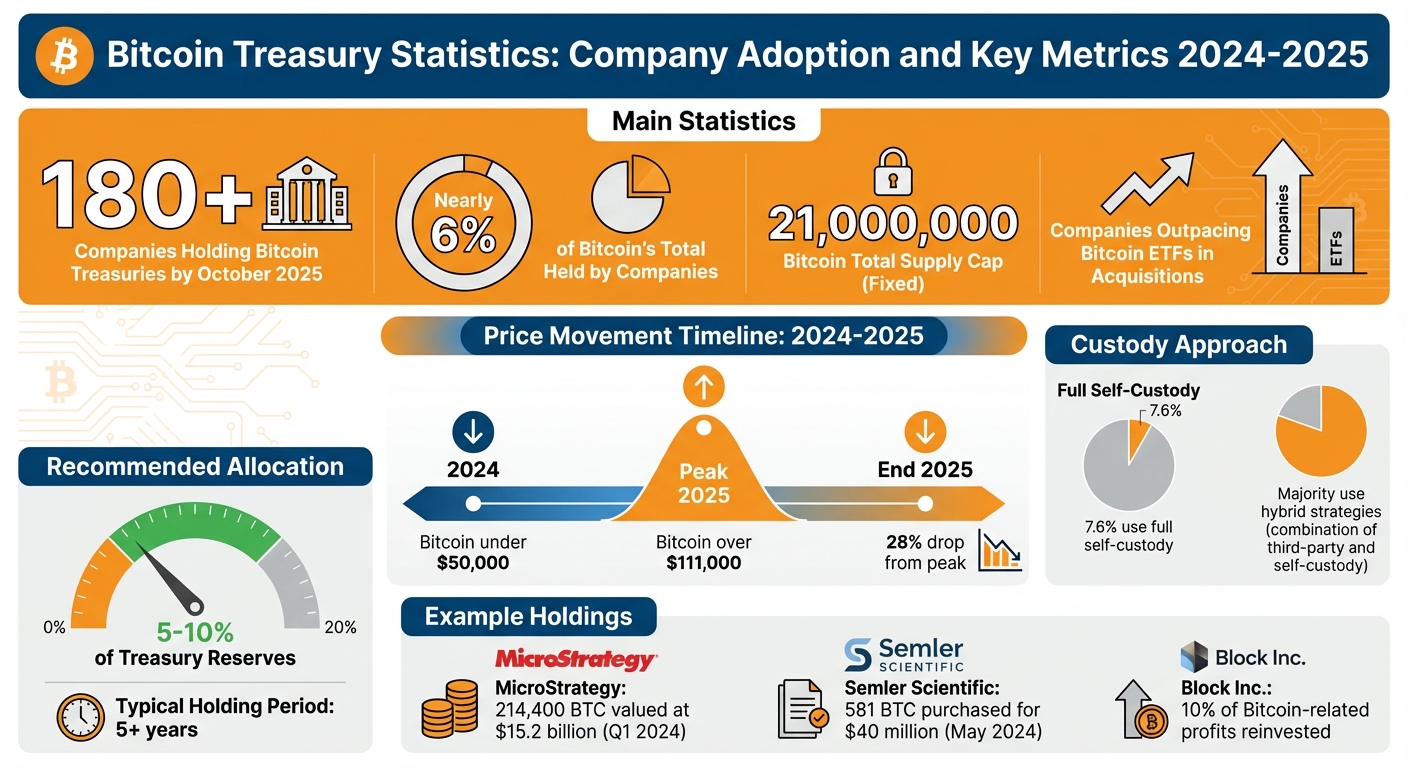
Bitcoin treasuries are becoming a go-to strategy for private companies. Why? They offer a hedge against inflation, diversify reserves, and reduce reliance on traditional banking systems. With Bitcoin's capped supply of 21 million, it’s seen as a safeguard against currency devaluation. By October 2025, over 180 companies held nearly 6% of Bitcoin’s total supply, outpacing Bitcoin ETFs in acquisitions.
Key Reasons Companies Hold Bitcoin:
- Inflation Protection: Fiat currencies lose value as central banks print more money. Bitcoin’s scarcity helps maintain purchasing power.
- Portfolio Diversification: Bitcoin has a low correlation with traditional assets like stocks and bonds, balancing risk.
- Bank Independence: Bitcoin allows transactions without intermediaries, useful during banking disruptions.
- Potential Growth: Historically, Bitcoin has outperformed many assets, making it attractive for long-term value retention.
Risks to Consider:
- Volatility: Bitcoin’s price swings can impact financial statements.
- Accounting Rules: U.S. companies must follow strict reporting standards for crypto assets.
- Security Challenges: Custody solutions need robust safeguards to prevent theft or loss.
- Compliance Needs: Companies must adhere to KYC and AML regulations.
Private companies are starting small, often allocating 5-10% of reserves to Bitcoin. Proper planning, risk management, and secure custody solutions are essential to integrate it into treasury operations effectively.
Bitcoin Treasury Statistics: Company Adoption and Key Metrics 2024-2025
Why Private Companies Add Bitcoin to Their Treasuries
Protection Against Inflation and Currency Devaluation
Bitcoin's fixed supply acts as a safeguard against the erosion of value caused by inflation and currency devaluation. When central banks increase the money supply, the purchasing power of fiat currencies often declines. Bitcoin's scarcity provides a way to counteract this effect, helping companies preserve the value of their reserves. For businesses, it’s a practical move toward a more balanced and resilient asset strategy.
Diversifying Cash Reserves
As a decentralized asset, Bitcoin offers a low correlation to traditional investments like cash, stocks, and bonds. Adding it to a treasury portfolio can improve efficiency and enhance risk-adjusted returns, providing a buffer against the vulnerabilities of fiat reserves. Beyond just diversification, Bitcoin enables companies to operate outside the constraints of traditional banking systems, offering greater flexibility in managing their resources.
Reducing Dependence on Banks and Financial Intermediaries
Bitcoin's decentralized framework allows businesses to hold and transfer value without relying on banks or financial intermediaries. This independence can be especially valuable during times of banking instability. By managing their Bitcoin holdings through self-custody, companies can avoid the risks associated with bank failures. Moreover, the Bitcoin network operates 24/7, enabling transactions to settle at any time without needing third-party involvement.
Potential for Long-term Value Appreciation
Bitcoin’s track record of long-term growth makes it an attractive addition to corporate treasuries. Historically, it has outperformed many traditional asset classes, positioning itself as a strong alternative to cash, which loses value over time due to inflation. With its limited supply and increasing institutional interest, Bitcoin is being used not just as a defensive measure but also as a proactive strategy to grow treasury value over the years.
Operational Efficiency and Market Positioning
Bitcoin simplifies cross-border transactions, offering faster and cheaper settlements compared to traditional banking systems. For companies with global operations, this eliminates currency conversion fees and reduces delays in transferring funds. Additionally, holding Bitcoin signals a forward-thinking approach, portraying companies as leaders in the evolving digital economy. This combination of operational benefits and innovative branding positions businesses to navigate treasury management with greater efficiency and modernity.
Risks and Regulatory Factors to Consider
Managing Price Fluctuations
Between 2024 and 2025, Bitcoin experienced a dramatic surge, climbing from under $50,000 to over $111,000 before dropping by 28% by the end of 2025. These sharp price swings can directly impact financial statements, creating fluctuations in reported asset values and affecting the market valuation of publicly traded companies. To navigate this volatility, companies often set strict allocation limits, conduct regular stress tests on their Bitcoin positions, and maintain transparent communication about Bitcoin's role in their treasury strategy. A common approach is to limit Bitcoin exposure to 5–10% of total reserves, striking a balance between growth opportunities and financial stability. These price movements also influence how Bitcoin is handled on balance sheets and its treatment for tax purposes.
U.S. Accounting and Tax Treatment
In the U.S., Bitcoin is classified as an intangible asset under GAAP guidelines, specifically outlined in FASB Accounting Standards Update (ASU) No. 2023-08, Intangibles - Goodwill and Other - Crypto Assets (Subtopic 350-60). This classification has unique implications: companies must record impairment losses if Bitcoin's value decreases but cannot recognize gains until the asset is sold. This can complicate treasury valuation and reporting. Additionally, any gains from Bitcoin sales are taxable, while losses can offset other income. To navigate these complexities, businesses should collaborate with accounting professionals familiar with crypto-specific reporting standards to ensure accurate financial statements and compliance with tax regulations.
Storage and Security Concerns
Operational risks, especially around custody, are another critical consideration. Custody decisions carry significant risk. Relying on third-party custodians introduces counterparty risks, which run counter to Bitcoin's decentralized design. High-profile failures, such as the collapses of FTX in 2022 and Mt. Gox in 2014 (resulting in the loss of 850,000 BTC), highlight the dangers of depending on external platforms. If a custodian goes bankrupt, companies may be treated as general unsecured creditors, potentially losing access to their Bitcoin holdings entirely.
Self-custody can mitigate these risks but demands stringent security measures. Solutions like multi-signature wallets (commonly using 2-of-3 or 3-of-5 configurations) and regular recovery drills are essential for safeguarding assets. Despite these advantages, only 7.6% of businesses fully self-custody their Bitcoin. Most opt for hybrid strategies, combining third-party qualified custody for larger holdings with self-custody for smaller amounts.
Meeting Compliance and Governance Standards
Compliance with KYC (Know Your Customer) and AML (Anti-Money Laundering) regulations is essential when acquiring Bitcoin or working with custodians. Clear, board-approved policies are crucial for setting allocation thresholds, deployment strategies, and key management protocols. These policies should outline detailed procedures for custody operations, access rotations, key refreshes, incident response plans, and vendor risk assessments.
For companies using third-party custodians, it’s vital to negotiate contracts that ensure their Bitcoin cannot be claimed by the custodian’s creditors. Preference should be given to U.S.-based, institutional-grade custodians that offer insurance coverage. These measures help safeguard assets while meeting governance and compliance standards.
How to Build a Bitcoin Treasury Strategy

Defining Goals and Allocation Amounts
Start by identifying your company's objectives for incorporating Bitcoin into its treasury. These might include hedging against inflation, diversifying cash reserves, reducing dependency on traditional banking systems, or aiming for long-term value growth. Present these goals to your board alongside a comprehensive plan that outlines both the potential advantages and the associated risks.
Many companies begin with a modest allocation - typically 5–10% of their treasury. For example, in May 2024, Semler Scientific purchased 581 Bitcoin for $40 million, emphasizing its fixed supply and verifiable scarcity as key benefits. Your specific allocation should depend on factors like your risk tolerance, liquidity requirements, and the broader economic environment, especially if inflation remains high and yields on traditional safe assets stay low.
Create a detailed treasury policy that defines allocation limits, rebalancing thresholds, and long-term goals. Many organizations aim for holding periods of five years or more to navigate Bitcoin's short-term volatility. Ensure this policy is reviewed and approved internally and by the board before moving forward.
Implementing Risk Management Practices
Effective risk management is essential when incorporating Bitcoin. Regular stress testing can help you assess how fluctuations in Bitcoin's price might impact your balance sheet. For instance, Block Inc. adopted a dollar-cost averaging strategy in 2024, committing to reinvest 10% of its Bitcoin-related profits back into its holdings. This method spreads out purchases over time, reducing the risk of buying at peak prices.
Set up a rebalancing schedule to maintain your target allocation. If Bitcoin's value surges and exceeds your predefined limit, consider selling a portion to lock in profits and rebalance your portfolio. On the other hand, if its value drops below your target range, you might take the opportunity to increase your holdings at lower prices.
It's also critical to maintain sufficient liquidity in traditional assets. Bitcoin should complement - not replace - the cash reserves needed for payroll, vendor payments, and unforeseen expenses. While Bitcoin offers potential long-term growth, it shouldn't jeopardize your ability to meet immediate financial obligations. Incorporate these risk management practices into your overall treasury framework to ensure a well-rounded approach.
Fitting Bitcoin Into Your Treasury Framework
Once risk controls are in place, integrate Bitcoin into a broader, diversified treasury strategy. Bitcoin can enhance diversification and liquidity within your portfolio. Its low correlation with traditional assets like cash, Treasury bills, and bonds makes it a valuable addition for reducing overall risk. Think of Bitcoin as a middle ground between short-term cash reserves and longer-term investments. While it's more liquid than assets like real estate or private equity, it does carry more volatility than money market funds.
Coordinate your Bitcoin holdings with other financial instruments. Some companies maintain traditional credit lines as a backup, allowing them to hold onto Bitcoin during market downturns without being forced to sell. For example, MicroStrategy, which holds 214,400 BTC valued at approximately $15.2 billion as of Q1 2024, has financed its Bitcoin acquisitions through convertible debt offerings while retaining operational flexibility.
Lastly, document the roles and responsibilities related to Bitcoin trading, custody, and reporting within your treasury framework. This ensures alignment with your risk management policies and integrates Bitcoin into your overall governance structure. For midmarket private businesses, the question is no longer whether to include Bitcoin on the balance sheet but how to do so responsibly while maintaining financial stability.
sbb-itb-f81ab9b
Steps to Add Bitcoin to Treasury Operations
Buying Bitcoin Safely
After your treasury policy is approved, the next step is purchasing Bitcoin through secure and reliable channels. Before diving in, ensure the platform you choose complies with regulatory requirements, especially regarding Know Your Customer (KYC) and Anti-Money Laundering (AML) protocols. If you're financing the purchase through private placements or convertible notes, be aware of the securities law implications. Companies employing derivative hedging strategies should also consider the regulations overseen by the CFTC.
It's a good idea to consult a legal expert specializing in digital assets to navigate these complexities. Additionally, consider the tax implications - some transactions may be subject to mark-to-market or ordinary income treatment. To minimize the risk of buying during market peaks and to manage volatility, many companies opt for dollar-cost averaging, spreading their purchases over time.
Setting Up Custody Solutions
When it comes to storing Bitcoin, security should be your top priority. You'll need to decide between self-custody and third-party custody services. Self-custody gives you complete control but requires a high level of expertise. On the other hand, third-party custody offers professional security but comes with counterparty risks.
Most private companies lean toward qualified custodians that provide multi-signature cold storage solutions. Providers like Coinbase Custody, BitGo, and Fireblocks are popular choices, offering advanced security measures, including SOC-1 and SOC-2 certifications. Multi-signature setups add an extra layer of protection by requiring multiple parties to approve transactions. For instance, your company might control two of three signing keys, while the custodian holds the third, ensuring internal majority control.
To protect your holdings further, you might explore triparty agreements, which safeguard your assets in the event of custodian insolvency. When evaluating custodians, look at their track record, client portfolio, integration capabilities with your financial systems, and transparency in fees for storage, transactions, and insurance. Some companies also consider insurance policies for cold wallets, although the premiums can be substantial.
Once you've secured your custody solution, you'll be ready to use Bitcoin for operational transactions.
Processing Payments and Settlements with Bitcoin
With your Bitcoin safely stored, you can integrate it into your operational processes. Bitcoin offers faster settlement times compared to traditional wire transfers, cutting out intermediary fees and streamlining international payments. The Lightning Network takes this a step further, enabling near-instant transactions with minimal fees.
Platforms like Flash provide tools to make Bitcoin transactions seamless for businesses. Flash’s Bitcoin payment gateway allows enterprises to process global transactions efficiently, with features like Bitcoin invoicing, real-time analytics, and Lightning Network support. Their non-custodial wallet-to-wallet system ensures you maintain control of your funds while managing customer payments. Flash also supports payment links, subscriptions, widgets, and point-of-sale systems, all designed to integrate easily into your existing treasury workflows with minimal technical hurdles.
Tracking and Reporting Bitcoin Holdings
Once Bitcoin becomes part of your payment ecosystem, accurate tracking and transparent reporting are essential. Clear reporting not only builds trust with stakeholders but also satisfies audit requirements. Choose an audit firm experienced in digital asset attestations, and set up continuous monitoring for your wallet addresses. Thanks to updated guidelines from the U.S. Financial Accounting Standards Board (FASB), companies can now report crypto holdings at fair market value, simplifying balance sheet representation.
Keep a close eye on your cost basis to calculate unrealized gains or losses on your Bitcoin holdings. Tools like bitcointreasuries.net can help you track your portfolio, while platforms such as Bitbo.io offer dashboards for live price tracking and on-chain data analysis.
For year-end audits, maintain immutable on-chain proofs. Many companies with Bitcoin treasuries now include regular reporting of digital asset values and Bitcoin-related gains in their earnings reports. To avoid confusion, clearly separate Bitcoin held as part of your core treasury from any Bitcoin held as trading inventory in your financial statements.
Bitcoin on the Balance Sheet: Why Companies Are Turning to Crypto as a Treasury Strategy
Conclusion: Why Bitcoin Treasuries Make Sense for Private Companies
Bitcoin treasuries offer private companies a way to protect against inflation and diversify their cash reserves. With Bitcoin's fixed supply of 21 million and its round-the-clock global liquidity, it has become an appealing option for financial strategies. Companies like Strategy (formerly MicroStrategy) have shown how disciplined Bitcoin investments can lead to substantial long-term growth.
To make the most of these advantages, companies need to focus on careful risk management and clear governance. This involves working closely with your board, legal, and compliance teams to set clear allocation goals and establish strong risk management policies. A conservative starting point - usually allocating 5–10% of cash reserves to Bitcoin - paired with governance measures to handle volatility and liquidity planning, is a smart way to begin.
"We believe that bitcoin has the potential to be a more ubiquitous currency in the future. As it grows in adoption, we intend to learn and participate in a disciplined way."
- Amrita Ahuja, CFO, Block
Security is a top priority. Partner with trusted custodians who offer multi-signature cold storage, strong security protocols, and comprehensive insurance coverage. Platforms like Flash simplify Bitcoin payments by supporting the Lightning Network, providing real-time analytics, and enabling non-custodial wallet-to-wallet transactions, ensuring full control of funds.
The adoption process is becoming smoother with new FASB rules that support fair-value reporting and evolving regulatory frameworks that make Bitcoin treasury strategies more accessible. Companies that act now can take advantage of Bitcoin's potential as both an inflation hedge and a tool for operational efficiency. A well-executed Bitcoin treasury strategy not only strengthens financial resilience but also positions businesses for growth in the increasingly digital economy.
FAQs
How can private companies manage the risk of Bitcoin's price volatility?
Private companies can tackle Bitcoin's price swings by using well-thought-out treasury strategies. For instance, they might dedicate only a small, controlled portion of their reserves to Bitcoin, keeping the rest of their portfolio balanced and stable. Another option is employing hedging tools, like futures contracts, to protect against potential losses.
On top of that, businesses can find ways to make their Bitcoin holdings work for them. One example is leveraging the Lightning Network to earn transaction fees, turning a volatile asset into a productive one. By smartly managing their exposure and tapping into Bitcoin's unique capabilities, companies can reduce the impact of volatility on their financial health while potentially adding long-term value.
What compliance requirements do companies need to follow when holding Bitcoin?
Companies in the U.S. that hold Bitcoin need to navigate several important compliance rules. This includes reporting their Bitcoin holdings based on fair market value accounting standards. Additionally, they must comply with Anti-Money Laundering (AML) and Know Your Customer (KYC) regulations, especially when dealing with custodians or exchanges.
Recent regulatory developments, such as the CLARITY Act and updated guidelines from the Financial Accounting Standards Board (FASB), aim to simplify how companies disclose and maintain transparency around their Bitcoin assets. Keeping up with these evolving rules is essential for staying compliant and effectively managing potential risks.
Why do companies use Bitcoin to protect against inflation?
Bitcoin has gained a reputation as a hedge against inflation, thanks to its fixed supply of 21 million coins. This cap ensures that Bitcoin remains unaffected by monetary expansion, unlike traditional currencies that can lose value when governments increase the money supply. Its built-in scarcity helps maintain its purchasing power over time.
For businesses, holding Bitcoin in their treasury offers a unique way to diversify reserves and shield assets from inflation's impact. With its decentralized framework and potential for long-term value appreciation, Bitcoin presents an appealing option for companies aiming to protect their financial health in an uncertain economic landscape.