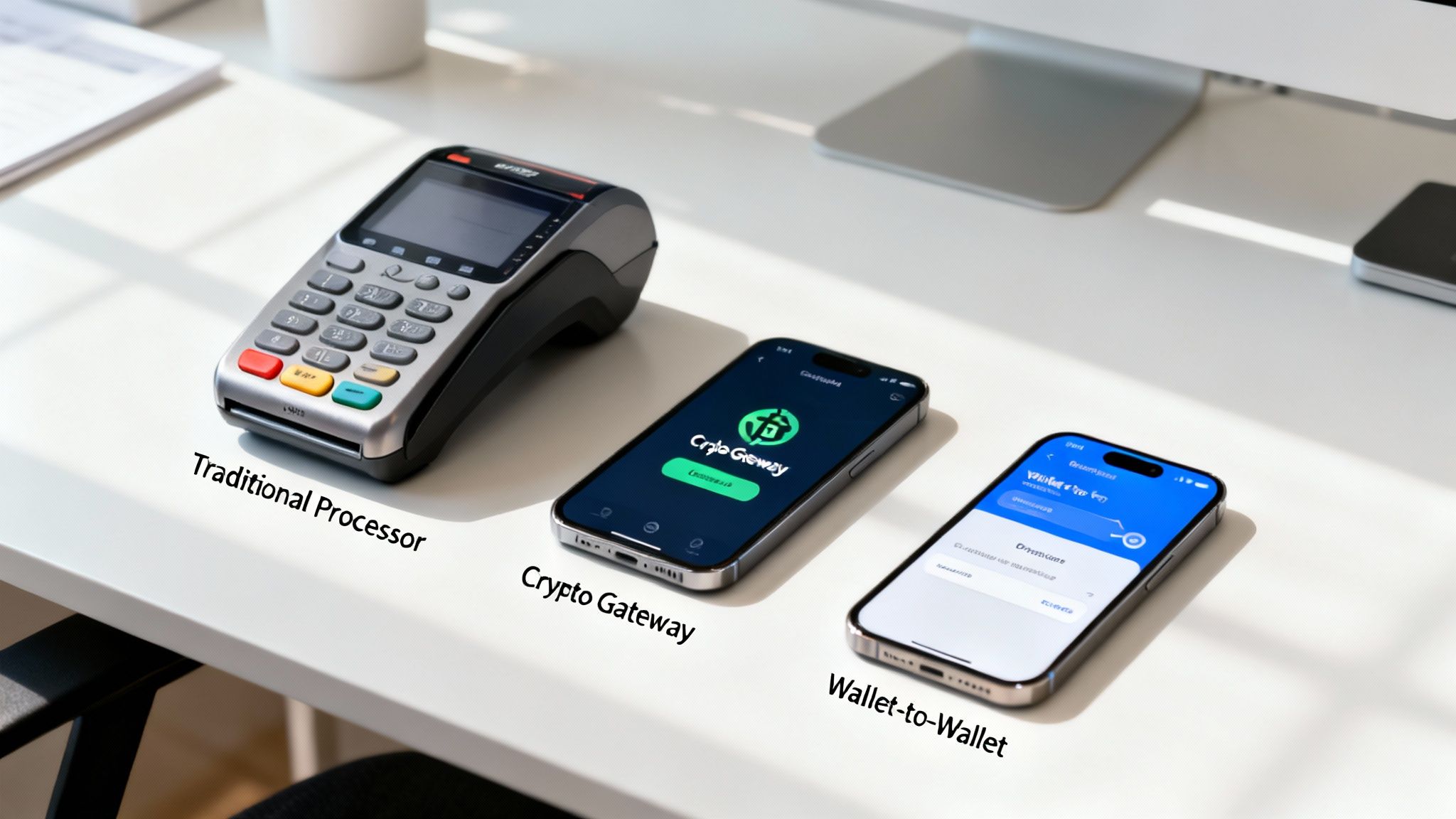
When you're looking to accept Bitcoin, you'll find yourself at a crossroads with three main paths to choose from: traditional processors like Stripe, crypto-native services like BitPay, and direct wallet-to-wallet solutions like Flash.
The right choice really boils down to what you value most. Are you looking for a simple add-on to your existing legacy system? Do you prefer a third party to handle the crypto side of things? Or is complete, non-custodial control over your money the top priority?
Choosing Your Bitcoin Payment Gateway
Picking the right payment gateway is a huge decision for any business today. As the market for these services continues to explode—projected to grow from USD 66.71 billion in 2025 to a staggering USD 201.41 billion by 2032—understanding the nuances between your options is more critical than ever. That's a compound annual growth rate of 17.1%, a clear signal of just how fast this space is moving.
This guide will break down the three fundamental models available, highlighting the real-world trade-offs you'll need to consider.
Understanding the Core Models
The payment processing world is split into a few key categories, each built for different business needs. Making the right call means carefully weighing things like fees, who's in control of the funds, and what it means for your customers' privacy.
- Traditional Processors: Think Stripe and PayPal. These are the giants of the fiat world. They have robust, time-tested infrastructures, but they treat Bitcoin as more of an afterthought. This usually means your BTC gets converted to fiat immediately, often with higher fees attached.
- Crypto-Native Processors: Companies like BitPay sit in the middle. They take Bitcoin from your customer and then settle with you in dollars or another fiat currency. It can simplify your accounting, but it also means you're trusting a third party and dealing with their KYC requirements.
- Direct Wallet-to-Wallet Solutions: This is where platforms like Flash come in. They enable direct, peer-to-peer Bitcoin payments from your customer’s wallet straight to yours. It's a non-custodial approach that cuts out the middleman, slashes fees, and keeps customer data private.
For merchants who truly value financial sovereignty and want to hold their own keys, the direct wallet-to-wallet model is the only way to go. It guarantees you have instant, undisputed control over your revenue without ever needing a third party's permission to access it.
Key Differences at a Glance
Even a quick merchant services comparison reveals some stark differences. This table gets right to the point, summarizing the core distinctions you need to know before we dive deeper.
| Feature | Traditional Processors | Crypto-Native Processors | Direct Bitcoin Solutions (Flash) |
|---|---|---|---|
| Centralization | High | Medium | Low (Decentralized) |
| Transaction Fees | High (2.9% + 30¢) | Medium (≈1%) | Low (Network Fee Only) |
| Settlement Speed | Slow (2-3 days) | Next Day (Fiat) | Instant (Bitcoin) |
| Privacy (KYC) | Required | Required | Not Required |
While this guide is focused on Bitcoin, it's worth noting that businesses can also explore the broader cryptocurrency landscape to see what other options are out there.
In the next sections, we'll get into a detailed, side-by-side analysis to help you figure out which of these models actually makes sense for your business goals.
A Detailed Comparison of Payment Processing Solutions

Picking a payment processor isn't just a technical task; it’s a strategic move that shapes your revenue, security, and the experience you offer customers. A proper merchant services comparison shows that each model—traditional, crypto-native, and direct Bitcoin—runs on entirely different philosophies. Getting to grips with these differences is the key to choosing a solution that actually fits your business's financial goals and operational style.
The digital payments market is an absolute behemoth. Projections show it’s on track to hit a mind-boggling USD 157 trillion in transaction value by 2025, with the processors themselves pulling in around USD 64 billion. That kind of scale tells you there are a ton of options out there, each with its own quirks and trade-offs. You can dig into more market growth projections to see the bigger picture.
This section cuts through the noise to dissect what really matters to merchants. We'll break down pricing models, settlement speeds, security headaches, and the real effort involved in getting set up, giving you the context you need to choose wisely.
Deconstructing Pricing Models and True Costs
At first glance, payment processing fees look simple. The reality? Not so much. The true cost of getting paid is often buried in different fee structures, all designed to benefit the processor one way or another.
Traditional processors like Stripe are famous for their flat-rate pricing, usually somewhere around 2.9% + 30¢ for every transaction. It's predictable, sure, but it can get expensive fast, especially if you have a high volume of sales or a low average order value. That fixed 30-cent fee really stings on smaller purchases.
Crypto-native processors like BitPay often simplify things with a flat percentage, typically around 1%. That's a huge step up from the old guard, but it's still a percentage skimmed right off your top line. You're paying them to handle the Bitcoin-to-fiat conversion and manage the whole process for you.
The biggest shift in cost comes from direct Bitcoin solutions. Platforms like Flash enable wallet-to-wallet payments, completely sidestepping processor-levied percentage fees. The only cost is the Bitcoin network fee, which the customer pays and has nothing to do with your sale amount. For the merchant, this means accepting payment is effectively free.
Settlement Speed and Access to Funds
How fast you get your hands on your money is everything for cash flow. The lag between a customer paying and the funds actually landing in your bank account can vary wildly between services, directly hitting your ability to manage inventory, make payroll, and cover other bills.
Legacy payment systems are notoriously slow. Money from credit card sales usually takes 2-3 business days to settle. This delay is a hangover from ancient banking infrastructure and creates a frustrating gap between making a sale and having the capital to use.
Crypto-native services are a bit better. While the Bitcoin transaction is quick, the processor still has to do its job of converting it to fiat and sending it to your bank. This usually means you get your money the next business day—an improvement, but a delay nonetheless.
The gold standard for speed is found in direct, non-custodial Bitcoin solutions.
- Instant Finality: When a customer pays with a solution like Flash, the Bitcoin hits your wallet and is confirmed on the blockchain within minutes.
- Immediate Access: The funds are yours, right away. No middleman is holding your money or running batch processes on their own schedule.
- Global Consistency: This instant settlement works the same whether your customer is down the street or on the other side of the planet, wiping out cross-border transfer delays.
This immediacy turns cash flow from a waiting game into a real-time advantage, giving merchants a level of financial agility they've never had before.
Security and Chargeback Risk Comparison
When we talk about security in payments, it's not just about protecting data. It's about the fundamental risk tied to each transaction. This is where the gap between traditional finance and Bitcoin becomes a chasm.
The old-school credit card system is built on a "pull" payment model, where you, the merchant, request funds from a customer's account. This model is the reason chargebacks exist—disputed transactions that can be yanked back weeks or even months after you've shipped the product. Chargebacks are a massive headache, leading to lost sales, extra fees, and endless paperwork. A cardholder often has up to 120 days to dispute a charge.
Crypto-native processors reduce this risk because Bitcoin transactions can't be reversed. But since they act as a custodian of the funds during the conversion process, you're still trusting their security to keep your money and data safe.
Direct Bitcoin payments are a "push" model, just like handing someone cash.
- Transaction Finality: Once a Bitcoin payment is confirmed on the network, it’s done. It cannot be reversed by anyone. This completely eliminates the threat of fraudulent chargebacks.
- Self-Custody: With a non-custodial solution, you hold your own private keys. That means you are the only one in control of your funds, removing the risk of a third-party processor getting hacked, freezing your account, or going out of business.
- Reduced Data Liability: Direct wallet-to-wallet payments exchange very little data, which dramatically reduces your PCI compliance burden and the responsibility to store sensitive customer financial info.
This fundamental change in security puts the control right back where it belongs: in the merchant's hands.
Integration Effort and Developer Experience
The last piece of the merchant services comparison puzzle is how much work it takes to get everything running. A great solution is useless if it's a nightmare to integrate into your existing setup.
Traditional processors have had years to build out massive libraries of developer tools, APIs, and plugins for every eCommerce platform under the sun. Their documentation is usually solid, making integration pretty straightforward for any developer who's been around the block.
Crypto-native services also provide APIs and plugins, but their ecosystem is still playing catch-up. While they have tools for the big platforms, a custom job might require more specialized expertise.
Direct Bitcoin solutions like Flash are built from the ground up for simplicity and flexibility. They're designed to work for everyone, from the least technical shop owner to a seasoned development team.
Integration Options:
- No-Code Tools: You can generate a simple payment link or QR code in seconds. Send it in an email, a text message, or drop it on a website without writing a single line of code.
- Low-Code Widgets: Need a "Pay with Bitcoin" button? Just copy and paste a small snippet of HTML to add a customizable button to any site.
- Full API Access: For businesses that need a deep, custom integration, comprehensive developer documentation and powerful APIs offer all the tools needed to build tailor-made payment flows.
This layered approach means that no matter your size or technical skill, the path to accepting Bitcoin is clear and simple.
Merchant Services Comparison Matrix
To make sense of it all, here's a side-by-side breakdown of how these three models stack up across the key areas that impact your business day-to-day.
| Feature | Traditional Processors (e.g., Stripe) | Crypto-Native Processors (e.g., BitPay) | Direct Bitcoin Solutions (e.g., Flash) |
|---|---|---|---|
| Pricing | 2.9% + 30¢ per transaction, plus potential monthly and hidden fees | ~1% flat fee on every transaction | 0% merchant fee. Customer pays a small, variable Bitcoin network fee. |
| Settlement Speed | 2-3 business days | Next business day (after conversion to fiat) | Instant (minutes to confirm on-chain) |
| Security & Privacy | High risk of chargebacks. Merchant stores sensitive customer data (PCI). | No chargebacks, but relies on third-party custody and security. | No chargebacks. Self-custody gives merchant full control. Minimal data exchange. |
| Integration Effort | Mature APIs and extensive plugins for all major platforms. | Good API/plugin support, but a less mature developer ecosystem. | Flexible options from no-code links and widgets to a full developer API. |
| Recurring Billing | Robust, mature subscription and billing tools. | Supported, but often requires specific wallet features from the customer. | Possible via API, but requires a more hands-on implementation. |
| POS Support | Widely available through dedicated hardware and software integrations. | Limited, often requires specialized third-party hardware or software. | Easily done with any tablet or phone displaying a QR code. No special hardware. |
| KYC/Compliance | Extensive KYC required to open and maintain an account. | Full KYC is standard for merchant accounts. | No KYC required for merchants to start accepting payments. |
| Developer Docs | Excellent, comprehensive, and well-supported. | Generally good, but can vary in quality and depth. | Clear, well-structured documentation for all integration levels. |
This table highlights the fundamental trade-offs. While traditional processors offer familiarity, direct Bitcoin solutions deliver unparalleled cost savings, speed, and control for merchants ready to step into a new way of getting paid.
Exploring Advanced Features and Merchant Tools
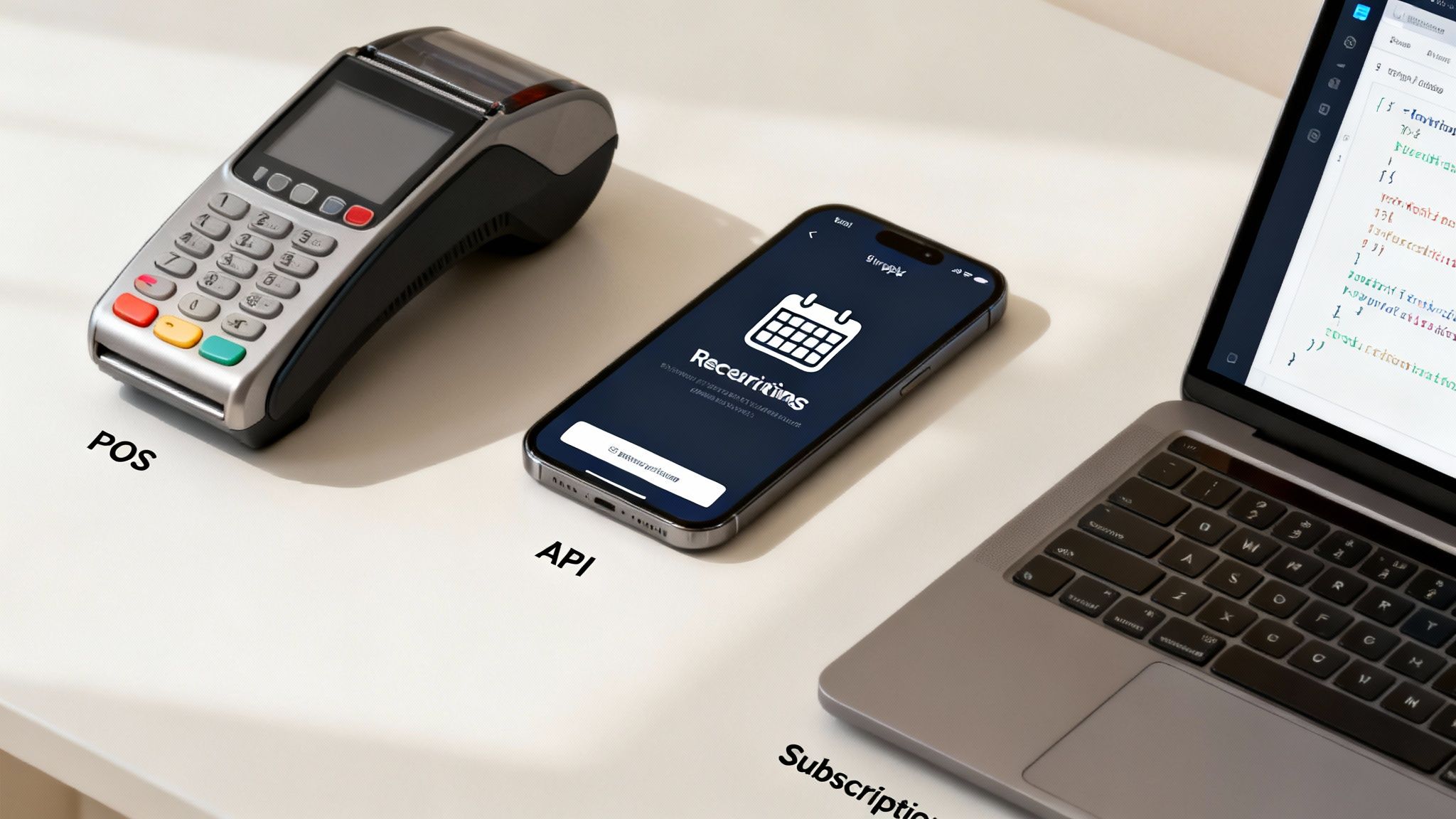
Simply processing a one-time sale isn't enough anymore. The right merchant service gives you a whole suite of tools to actually manage and grow your business. Any serious merchant services comparison has to dig into these advanced features, because they’re what really separates the good from the great. We're talking about recurring billing, point-of-sale (POS) systems, and developer tools—the stuff that dictates how smoothly your operations run.
These tools are becoming mission-critical. The merchant banking services market is expected to balloon from USD 68.9 billion in 2025 to a massive USD 325.7 billion by 2035. That explosive growth tells you everything you need to know about the increasing demand for sophisticated financial tools for businesses. You can explore the full forecast to see where things are headed.
Handling Recurring Billing and Subscriptions
If you run a subscription business—whether it's a SaaS platform or a monthly membership—you live and die by recurring billing. It has to be bulletproof. Traditional processors have been refining this for years, offering robust, automated systems for scheduled payments, customer management, and dunning (the often-painful process of chasing overdue payments).
Crypto-native processors have subscription tools, too, but they can add a layer of complexity. Often, they require customers to use a specific wallet or pre-authorize transactions, which can feel clunky and add friction right when you want things to be smoothest. It works, but it's not always as seamless as the old-school options.
Direct Bitcoin solutions like Flash take a different tack. They give merchants the power to build their own automated payment flows using APIs. This is definitely a more hands-on approach, but it creates a powerful, non-custodial system. You can set up workflows that automatically generate and send payment requests without ever touching customer funds, keeping you in full control.
Point of Sale Integration for Physical Retail
For any brick-and-mortar shop, the checkout experience is everything. Traditional providers have this down to a science, with a huge range of dedicated hardware terminals and software built for the chaos of high-volume retail. Their systems are mature, reliable, and instantly familiar to your staff and customers.
But accepting Bitcoin in person doesn't require a truckload of expensive, specialized hardware.
The beauty of direct Bitcoin payments is that any smartphone or tablet can become a fully functional POS terminal. A solution like Flash allows a merchant to simply generate a QR code on a screen. The customer scans it, pays from their wallet, and the transaction is confirmed in minutes—no clunky card readers or proprietary hardware needed.
This lightweight, mobile-first approach completely changes the game for physical retailers who want to accept Bitcoin. It slashes hardware costs to zero and offers incredible flexibility, whether you're at a fixed counter, a market stall, or a pop-up event.
Developer APIs and Custom Integration
For businesses that need unique payment flows or deep integration with their existing software, the quality of the developer docs and API is make-or-break. A great API lets you build the exact experience you want, freeing you from a one-size-fits-all box.
Both traditional and crypto-native processors typically offer extensive developer resources. They’ve been at it for a while and have well-documented APIs with libraries for multiple programming languages. They're a solid choice if you have a dev team ready to tackle a complex integration.
Direct Bitcoin solutions, on the other hand, tend to prioritize flexibility and simplicity. For example, platforms like Flash provide clear pathways for every skill level:
- No-Code: Generate simple payment links or QR codes in seconds.
- Low-Code: Embed a customizable "Pay with Bitcoin" button with a quick copy-paste snippet.
- Full API: Access a comprehensive API to build totally unique, tailored payment experiences from scratch.
This tiered approach means any merchant, no matter their technical chops, can integrate Bitcoin payments in a way that fits their business perfectly. Custom solutions just became a lot more accessible.
Real-World Scenarios: Which Solution Is Right For You?
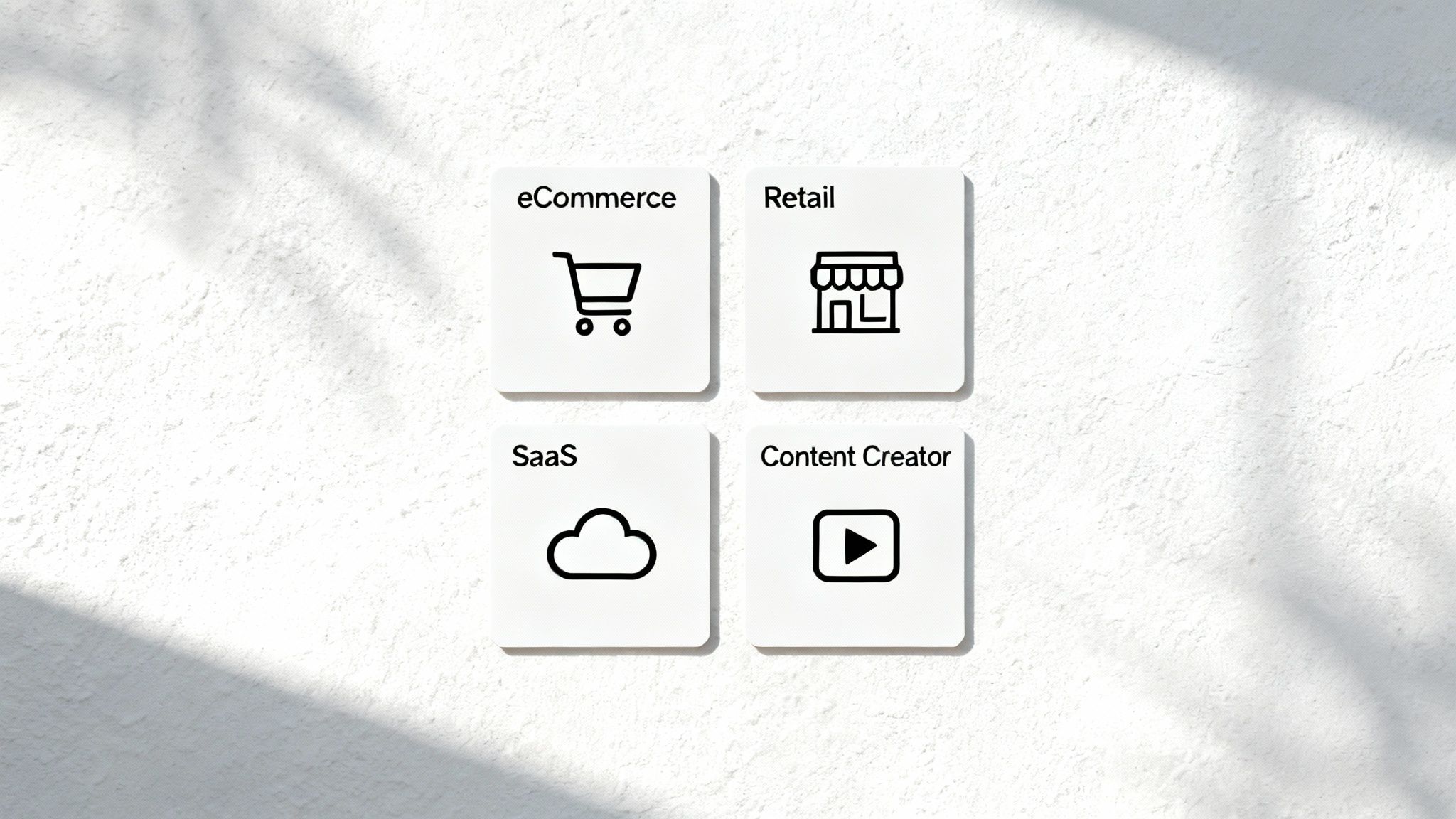
Theoretical comparisons are a good starting point, but the real test is seeing how these payment solutions hold up in the wild. A proper merchant services comparison has to go beyond feature lists and dig into real-world applications. After all, what works for an online store might be a total disaster for a coffee shop.
By looking at specific business models, we can see exactly how the pros and cons of each service affect day-to-day operations, the customer experience, and—most importantly—the bottom line. Let's walk through four common scenarios to help you figure out which path makes sense for your business.
The Online eCommerce Store
An eCommerce business lives and dies by its ability to serve a global customer base smoothly and securely. The biggest headaches are almost always high transaction fees, the constant threat of chargebacks, and the friction that comes with cross-border payments.
Traditional processors are familiar and plug into major platforms easily. But their fees—usually around 2.9% + 30¢—take a bite out of every single sale. International orders pile on currency conversion costs and settlement delays, and just one fraudulent chargeback can wipe out the profit from several genuine orders.
A direct Bitcoin solution like Flash flips this on its head.
- Zero Merchant Fees: When you accept wallet-to-wallet Bitcoin payments, you eliminate percentage-based processing fees. This isn't just a small saving; it's a massive boost to your profitability.
- Chargeback Elimination: Bitcoin transactions are final. This completely removes the financial risk and administrative nightmare of fraudulent chargebacks, a huge pain point for any online retailer.
- Global Reach: Payments settle in minutes, no matter where your customer is. You can say goodbye to the delays and extra fees that come with traditional international banking.
For those deep in the eCommerce trenches, understanding how these solutions plug into your platform is crucial. For example, a detailed guide on WooCommerce website development can show how different payment processors actually integrate into your store's backend.
The Physical Retail Shop
For a brick-and-mortar spot like a café or boutique, the checkout has to be fast, simple, and dead reliable. The main worries are transaction speed, ease of use for staff and customers, and the cost of point-of-sale (POS) hardware.
Traditional card terminals are what everyone is used to, but they come with monthly rental fees, steep transaction costs, and slow settlement times. Crypto-native processors rarely have a clean in-person solution, often needing clunky, expensive third-party hardware that's a pain to get and maintain.
A direct Bitcoin solution redefines the in-person checkout. You can turn any tablet or smartphone into a POS terminal for free. A merchant just generates a QR code on the screen, the customer scans it with their wallet, and the payment is done.
This approach is incredibly lightweight. It completely removes the need for dedicated hardware, making it perfect for pop-up shops, market stalls, or any retailer trying to cut overhead while tapping into the growing Bitcoin economy.
The Subscription-Based SaaS Company
Subscription businesses, like Software-as-a-Service (SaaS) companies, rely on smooth, automated recurring billing. Customer retention is everything, and any hiccup in the payment process can lead directly to churn.
Traditional processors are actually pretty good here, with mature, automated billing systems that handle scheduled payments and follow-ups. Still, they suffer from the usual high fees and the risk of credit card declines, which interrupt service and force you to chase down customers.
Crypto-native services have started offering subscription tools, but they can add friction by making customers use specific wallets or pre-authorize transactions. It adds a layer of complexity to what should be a seamless experience.
A direct Bitcoin solution opens the door to non-custodial recurring payments. Using a flexible API, a SaaS company can build a system that automatically sends payment requests directly to customers. While it takes a bit more setup, it gives the business total control over billing logic without ever holding customer funds, reinforcing a model built on privacy and user control.
The Digital Content Creator
For creators selling courses, ebooks, or digital art, squeezing every bit of revenue from each sale is key. They're often dealing with a global audience and smaller transaction sizes, which makes traditional processing fees especially painful. That fixed 30-cent fee from a processor can eat up a huge chunk of a $5 ebook sale.
A direct Bitcoin solution is a near-perfect fit for this model.
- Profit Maximization: With zero merchant fees, creators keep nearly 100% of their revenue. For a business built on high volume and low prices, that’s a game-changer.
- Instant Payouts: Funds arrive directly and immediately. You get instant access to your money without waiting on a processor's payout schedule.
- Privacy and Simplicity: Creators can start accepting payments without the long KYC and approval process required by traditional systems. It lets them focus on creating instead of jumping through administrative hoops.
Picking the Right Tool for the Job
Choosing a payment solution isn't about finding a single "best" option. It's about matching the right technology to what your business actually needs. When you line them all up, you start to see where each one shines. The best choice comes down to what you value most: airtight privacy, rock-bottom costs, or an easy fit with your current setup.
To make the right call, you have to understand the trade-offs. Once you see the give-and-take between each approach, you can pick a path that genuinely helps your business and your customers.
For Merchants Who Prioritize Privacy and Low Costs
If your main goals are maximum privacy, complete control over your money, and getting rid of processing fees, then a direct wallet-to-wallet Bitcoin solution is a no-brainer. This model is perfect for businesses that want to cut out the middlemen and own their revenue the second a customer pays.
This approach is a game-changer for a few types of businesses:
- Digital Content Creators selling small-ticket items, where a 3% fee would just wipe out their profit margin.
- Online Shops in so-called "high-risk" industries that are tired of getting their accounts frozen by traditional processors.
- Merchants who are true believers in Bitcoin's principles and want a payment rail that's free from censorship and corporate oversight.
The real magic here is that it's non-custodial and requires no KYC. By never holding your funds, solutions like Flash guarantee that you're the only one who can access your money. That offers a level of security and freedom that custodial services just can't touch.
For Businesses That Need to Stick with Fiat
Let's be realistic—some businesses aren't ready to hold Bitcoin on their books. Whether it's due to complex accounting systems or strict regulations, they need a bridge between the Bitcoin world and good old-fashioned fiat currency. For these merchants, a crypto-native processor is a solid middle ground.
These services take the Bitcoin payment and handle the conversion, dropping US dollars directly into your bank account. Of course, this comes with trade-offs: you're back to dealing with custody risk, KYC paperwork, and a processing fee of around 1%. But it lets you tap into the Bitcoin economy without having to completely rework your company's finances.
For Global Businesses Tired of Cross-Border Headaches
For any company with customers around the world, dealing with international payments is a huge drag. Traditional cross-border payments are painfully slow, ridiculously expensive, and tangled up in a web of intermediary banks and currency conversion fees.
This is where direct Bitcoin payments absolutely crush the old system. A platform like Flash makes global transactions instant and borderless, with zero extra fees for international sales.
This clean interface shows just how simple it is for a merchant to create a payment request. The whole process is intuitive for both the business and the customer, no matter where they are.
A customer in Japan can pay a merchant in Argentina as easily as if they were standing next to each other. The payment clears in minutes, not days, and the merchant gets the full amount—no cuts for currency exchange or wire transfer fees. This isn't just an improvement; it fundamentally changes how a business can operate on a global scale.
Common Questions About Accepting Bitcoin
If you're digging into a merchant services comparison, you've probably got some questions, especially around the idea of accepting Bitcoin. Moving away from traditional finance can feel like a huge leap, but it’s usually much simpler than you'd think. Let's tackle some of the most common questions merchants have.
Is It Hard To Start Accepting Bitcoin Payments?
Not at all. Getting started is surprisingly fast, and you don't need to be a tech wizard anymore. That's a common misconception.
With a direct, wallet-to-wallet solution like Flash, you can be up and running in less than a minute. Forget about long applications, underwriting, or setting up new hardware. You just create a payment link or QR code from a mobile app and can immediately start taking payments directly into your own Bitcoin wallet.
How Do I Deal With Bitcoin's Price Volatility?
Volatility is a real concern for any business, and it's something you need a plan for. The good news is, you're in the driver's seat. It all comes down to your financial goals and how much risk you're comfortable with.
Here are the three most common strategies merchants use:
- Hold Bitcoin: If you're optimistic about Bitcoin's future, you can simply hold the payments you receive. Think of it as an asset on your balance sheet.
- Convert to Fiat Periodically: Many businesses set a regular schedule—say, daily or weekly—to convert a portion of their Bitcoin into dollars or their local currency. This helps you lock in your earnings and keep cash flow steady for business expenses.
- Convert Instantly: If you want to eliminate short-term price risk entirely, you can use an exchange service to convert each payment into fiat the moment it comes in.
What's The Big Deal With A "Non-Custodial" Solution?
In simple terms, a non-custodial payment solution means your money is your money. You, and only you, have the keys. This is the biggest difference between direct wallet-to-wallet payments and using a traditional third-party processor.
The core advantage is financial sovereignty. With a non-custodial service, your revenue can't be frozen, held, or seized by a middleman. Payments go straight from your customer's wallet to yours, giving you instant, total control over your funds.
Are There KYC Requirements For Accepting Bitcoin?
This completely depends on the service you pick. Any custodial processor that touches fiat currency (like converting your Bitcoin to dollars) is considered a money services business. They are legally required to perform Know Your Customer (KYC) checks on merchants.
But with a non-custodial, direct Bitcoin tool like Flash, there is no KYC required. The service is just software that facilitates the payment; it never actually holds your funds. This lets you start accepting payments from anyone, anywhere in the world, without compromising your financial privacy.
Ready to eliminate fees and take full control of your revenue? Get started with Flash and begin accepting instant, wallet-to-wallet Bitcoin payments in under a minute. Learn more at the official Flash website.